
Saudi Arabia Vision Care Market Size and Forecast 2025–2033
Saudi Arabia’s Vision Care Sector Enters a New Era of Growth Driven by Technology, Aging Demographics, and Preventive Healthcare Awareness

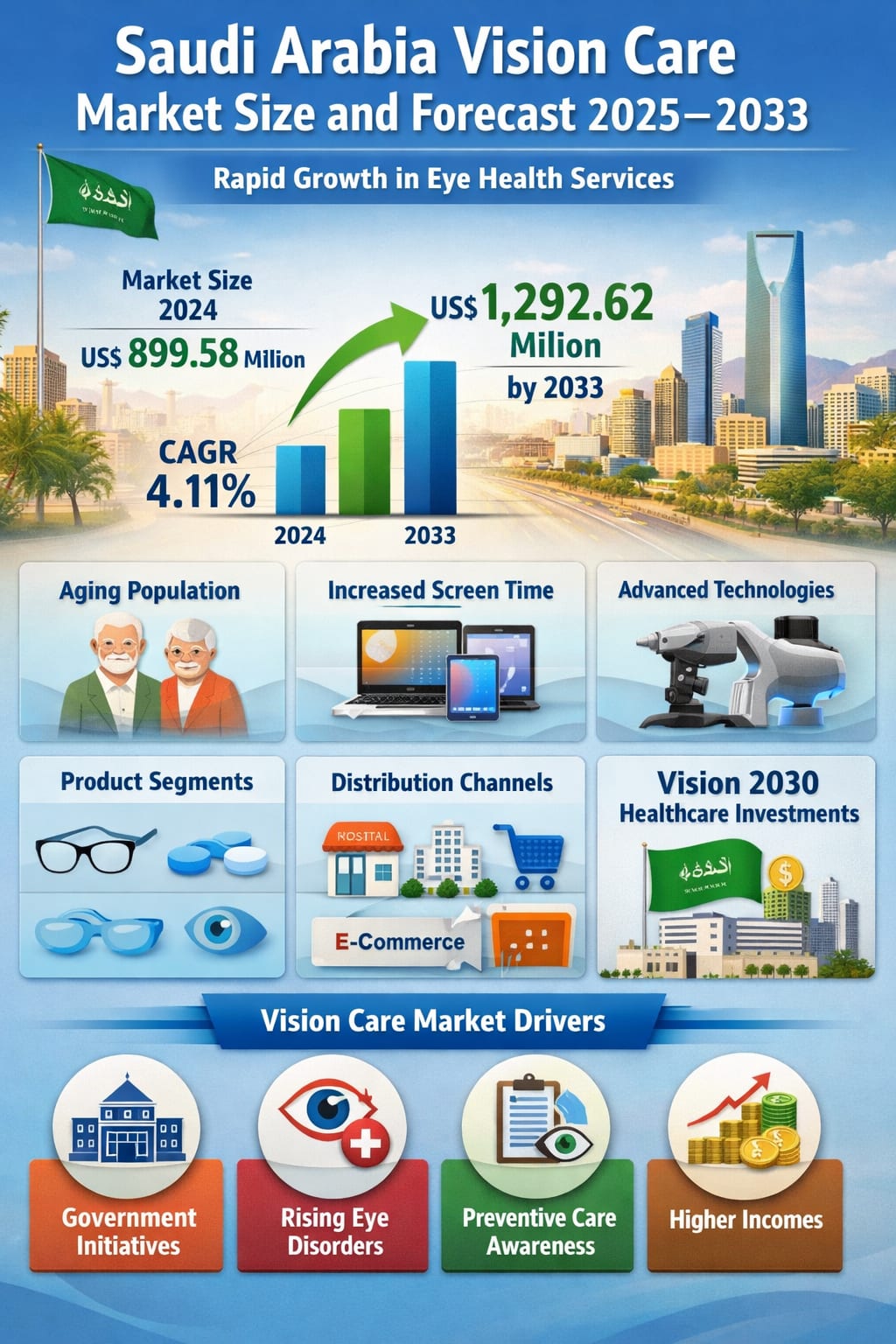
Saudi Arabia Vision Care Market Overview
Vision care plays a vital role in maintaining both quality of life and long-term productivity. It encompasses the prevention, diagnosis, and treatment of eye disorders, including routine eye examinations, prescription of glasses or contact lenses, and management of conditions such as cataracts, glaucoma, macular degeneration, and refractive errors. In modern healthcare systems, vision care also extends to advanced surgical procedures such as LASIK and cataract removal, as well as lifestyle and preventive interventions designed to reduce eye strain and slow the progression of visual impairment.
In Saudi Arabia, the vision care sector is becoming an increasingly important part of the broader healthcare ecosystem. Rapid urbanization, changing lifestyles, and rising screen exposure have contributed to a noticeable increase in vision-related problems among both young and older populations. At the same time, the Kingdom’s ambitious healthcare transformation under Vision 2030 is improving access to specialized medical services, including ophthalmology, across public and private healthcare facilities.
According to Renub Research, the Saudi Arabia Vision Care Market is expected to reach US$ 1,292.62 million by 2033, up from US$ 899.58 million in 2024, growing at a CAGR of 4.11% from 2025 to 2033. This steady growth reflects a combination of demographic shifts, technological progress, higher health awareness, and expanding healthcare infrastructure.
Vision care in the Kingdom is no longer limited to basic corrective eyewear. The market today includes a wide range of products and services, from glass lenses and contact lenses to intraocular lenses, LASIK equipment, contact solutions, and artificial tears. On the treatment side, laser therapy, surgery, and medication are all playing increasingly important roles. Distribution channels have also diversified, with retail stores, e-commerce platforms, clinics, and hospitals all contributing to market expansion.
Market Size and Growth Outlook
The Saudi Arabian vision care market is on a stable and sustainable growth path. The rise from US$ 899.58 million in 2024 to US$ 1,292.62 million by 2033 highlights how eye health is becoming a priority for both consumers and policymakers. A CAGR of 4.11% over the forecast period indicates consistent demand rather than short-term spikes, suggesting that vision care is becoming a core component of routine healthcare spending in the Kingdom.
Several structural factors support this outlook. First, Saudi Arabia’s population is aging, which naturally increases the prevalence of age-related eye diseases such as cataracts, glaucoma, and macular degeneration. Second, younger demographics are experiencing higher rates of refractive errors, largely due to prolonged screen time, digital lifestyles, and reduced outdoor activity. Third, rising disposable incomes and expanding private healthcare services are making advanced eye care treatments more accessible to a broader segment of the population.
At the same time, technological innovation is improving both diagnosis and treatment outcomes. Tools such as optical coherence tomography (OCT), advanced imaging systems, and laser-assisted surgical equipment are enabling earlier detection and more precise interventions. These advancements not only improve patient outcomes but also increase overall spending in the vision care ecosystem, further supporting market growth.
Key Growth Drivers for the Saudi Arabia Vision Care Market
Government Initiatives and Healthcare Infrastructure Expansion
One of the most powerful drivers of the Saudi Arabia vision care market is the government’s long-term commitment to healthcare development under Vision 2030. The Kingdom is actively working to modernize its healthcare system, expand private sector participation, and improve access to specialized medical services across all regions.
Significant investments are being directed toward building and upgrading hospitals, clinics, and specialized medical centers, including ophthalmology departments. Public-private partnerships are being encouraged to accelerate the deployment of advanced medical technologies and to improve service coverage, particularly in underserved and rural areas. These initiatives directly support the vision care market by promoting early diagnosis, preventive care, and timely treatment of eye diseases.
As regulatory frameworks evolve and funding for medical innovation increases, the environment becomes more attractive for both local and international companies to introduce new products and services. This not only enhances the quality of care available to patients but also stimulates competition and innovation within the market.
Rising Prevalence of Vision Disorders
The growing burden of vision-related disorders is another major factor fueling market expansion. Refractive errors such as myopia, hyperopia, astigmatism, and presbyopia are becoming increasingly common, especially among younger populations who spend long hours using smartphones, computers, and other digital devices. Reduced outdoor activity and lifestyle changes have further contributed to the early onset and progression of these conditions.
At the same time, Saudi Arabia is undergoing a significant demographic transition. The proportion of older adults in the population is increasing, leading to a higher incidence of age-related eye diseases such as cataracts, glaucoma, and macular degeneration. These conditions often require long-term management, regular monitoring, and in many cases, surgical intervention, all of which drive demand for vision care products and services.
This dual pressure—from younger, digitally active populations and from an aging society—creates a broad and sustained demand base for the vision care market, spanning everything from basic corrective lenses to advanced surgical procedures.
Growing Awareness and Adoption of Preventive Eye Care
Another important trend shaping the market is the shift from reactive to proactive eye care. Health education campaigns, improved access to optometrists and ophthalmologists, and greater media coverage of eye health issues are all contributing to increased awareness of the importance of regular eye check-ups and early intervention.
Consumers in Saudi Arabia are becoming more conscious of the long-term impact of eye strain, poor vision correction, and untreated eye conditions. This is particularly evident among students and young professionals, who are more exposed to digital screens and are increasingly seeking solutions such as blue light-blocking glasses, anti-fatigue lenses, and personalized prescription eyewear.
Retail optical chains and e-commerce platforms are also making vision care more accessible by offering convenient eye testing services, online consultations, and home delivery of eyewear and contact lenses. Together, these developments are expanding the customer base and increasing the frequency of vision care consumption.
In addition, global and regional players are investing in education and training initiatives for eye care professionals, further strengthening the overall ecosystem. The establishment of advanced training and experience centers in the region reflects a broader commitment to improving clinical skills and adopting cutting-edge technologies in ophthalmology.
Challenges in the Saudi Arabia Vision Care Market
Regulatory Challenges
Despite the positive outlook, the Saudi Arabia vision care market faces several regulatory hurdles. The approval process for new medical devices, pharmaceuticals, and advanced treatment technologies can be complex and time-consuming. Lengthy regulatory procedures may delay the introduction of innovative products and slow down market penetration for international companies.
In some cases, differences between local regulations and international standards can create additional compliance burdens for global manufacturers. These challenges may discourage smaller players from entering the market and can limit the speed at which new technologies become available to patients.
Licensing requirements for clinics and healthcare professionals can also restrict the expansion of services, particularly in remote or underserved regions. Addressing these regulatory bottlenecks through streamlined processes and clearer guidelines would help accelerate innovation and improve access to advanced vision care across the Kingdom.
High Cost of Advanced Eye Care Treatments
Another significant barrier is the high cost associated with advanced diagnostic tools and surgical procedures. Technologies such as optical coherence tomography, LASIK surgery, and complex cataract procedures often involve substantial expenses, which are not always fully covered by insurance.
For middle- and low-income populations, these costs can be prohibitive, leading to delayed diagnosis and treatment. This not only affects individual health outcomes but can also increase the long-term burden on the healthcare system due to the progression of untreated eye conditions.
From the provider’s perspective, the high cost of acquiring and maintaining advanced equipment can make it difficult for smaller clinics to offer a full range of services. Improving affordability, expanding insurance coverage, and encouraging cost-effective technology adoption will be essential to ensure more equitable access to high-quality vision care.
Saudi Arabia Vision Care Market Segmentation
By Product Type
The market covers a diverse range of products designed to address different vision care needs. These include glass lenses, which remain a core component of corrective eyewear, and contact lenses, which continue to gain popularity due to convenience and cosmetic preferences. Intraocular lenses play a critical role in cataract and refractive surgeries, while contact solutions support the growing contact lens user base.
Advanced segments such as LASIK equipment reflect the increasing demand for surgical vision correction, and artificial tears cater to the rising prevalence of dry eye syndrome, particularly among individuals with high screen exposure.
By Treatment
From a treatment perspective, the market is divided into laser therapy, surgery, and medication. Laser therapy, including LASIK and other refractive procedures, is gaining traction due to improving safety profiles and better outcomes. Surgical interventions remain essential for conditions such as cataracts and glaucoma, while medications continue to play a key role in managing infections, inflammation, and chronic eye diseases.
By Distribution Channel
Vision care products and services are distributed through retail stores, e-commerce platforms, clinics, hospitals, and other specialized outlets. Retail optical chains and online platforms are becoming increasingly important, offering convenience and broader product selection. Meanwhile, clinics and hospitals remain central to diagnosis, treatment, and surgical care, especially for complex eye conditions.
Competitive Landscape and Key Players
The Saudi Arabia vision care market features a mix of global leaders and regional players, all competing across product innovation, distribution reach, and clinical partnerships. Companies are typically analyzed across four key dimensions: company overview, key persons, recent developments and strategies, and sales analysis.
Some of the prominent players operating in this space include Essilor International, Johnson & Johnson Services, Inc., Bausch Health Companies, Inc., Novartis International AG, Grand Vision, Carl Zeiss, Valeant Pharmaceuticals, Paragon Vision Science, and Menicon. These companies are actively investing in research and development, expanding their product portfolios, and strengthening their presence in the Saudi market through partnerships, acquisitions, and localized strategies.
Competition is increasingly centered on technology, quality of care, and customer experience. Companies that can combine advanced products with strong professional education and efficient distribution networks are likely to gain a competitive edge in the coming years.
Future Outlook
Looking ahead, the Saudi Arabia vision care market is well-positioned for sustained growth through 2033 and beyond. The combination of demographic trends, lifestyle changes, technological innovation, and supportive government policies creates a strong foundation for long-term expansion.
As awareness of eye health continues to rise and access to services improves, vision care is expected to become an even more integral part of routine healthcare in the Kingdom. At the same time, efforts to address regulatory challenges and cost barriers will be crucial to ensuring that the benefits of modern eye care reach a broader segment of the population.
Final Thoughts
The Saudi Arabia vision care market is entering a phase of steady and meaningful growth, driven by rising demand, technological progress, and a healthcare system in transformation. With the market projected to grow from US$ 899.58 million in 2024 to US$ 1,292.62 million by 2033 at a CAGR of 4.11%, the sector offers strong opportunities for manufacturers, healthcare providers, and investors alike.
More importantly, this growth reflects a deeper shift in how eye health is perceived in Saudi society—from a reactive concern to a proactive priority. As Vision 2030 continues to reshape the healthcare landscape, vision care is set to play a crucial role in improving quality of life, productivity, and long-term public health outcomes across the Kingdom.
About the Creator
United States Jewelry Market Size, Share, Trends, Latest Insights and Forecast 2026-2034
How the United States Jewelry Market Reflects Identity, Celebration, and Modern Luxury Jewelry has always carried meaning beyond decoration. It marks milestones, symbolizes relationships, and reflects personal identity. The United States jewelry market reveals how culture, fashion, and emotional storytelling intersect in everyday consumer behavior. From engagement rings to everyday accessories, jewelry continues to evolve alongside changing values and lifestyles.
By Jackson Watson4 days ago in Trader
The Silent Beam: Pakistan’s Strategic Pivot to Chinese Laser Defense
The Silent Beam: Pakistan’s Strategic Pivot to Chinese Laser Defense The landscape of South Asian warfare is undergoing a quiet but blindingly fast transformation. In early 2026, the Pakistan Navy issued a formal tender for the procurement of two 10 kW Laser Weapon Systems (LWS), marking the country’s first concrete step toward integrating directed-energy weapons (DEWs) into its frontline arsenal. This move, driven by the vulnerabilities exposed during the regional "Operation Sindoor" conflict in May 2025, signals a decisive shift away from traditional kinetic defenses and toward a future where "shots" cost as little as $10 each.
By Wings of Time 5 days ago in Trader




Comments
There are no comments for this story
Be the first to respond and start the conversation.