
Sodium-ion Battery Market Trends & Summary (2025–2033)
Why Sodium-ion Batteries Are Emerging as the Next Big Alternative to Lithium-ion in Global Energy Storage

Global Sodium-ion Battery Market: Big Growth Ahead
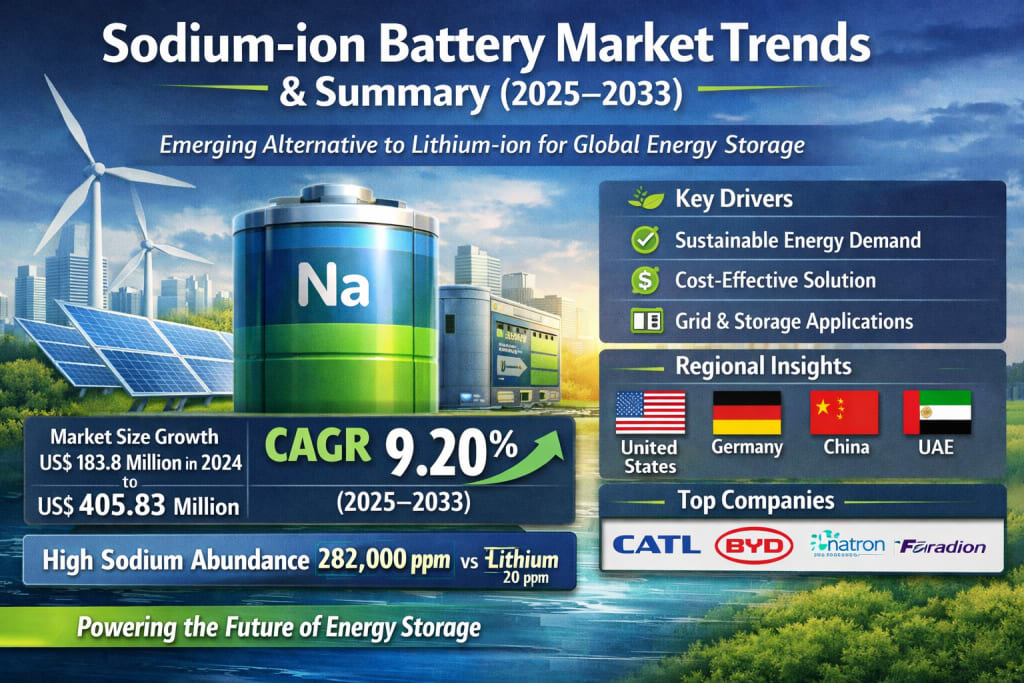
The global Sodium-ion Battery Market is gaining strong momentum as the world searches for safer, cheaper, and more sustainable alternatives to lithium-ion technology. According to Renub Research, the market is expected to grow from US$ 183.8 million in 2024 to US$ 405.83 million by 2033, registering a CAGR of 9.20% during 2025–2033.
This impressive growth reflects a wider shift in the global energy ecosystem. With lithium prices remaining volatile, supply chains under pressure, and demand for large-scale energy storage rising rapidly, sodium-ion batteries are stepping into the spotlight as a practical and scalable solution. Their appeal lies in the abundance of sodium resources, lower material costs, and improving performance characteristics, especially for stationary storage and cost-sensitive mobility applications.
The market report, Sodium-ion Battery Global Market & Forecast 2025–2033, covers segmentation by Product Type (Sodium-Sulphur Battery, Sodium-Salt Battery, Sodium-Air Battery), Application (Stationary Energy Storage, Transportation), and End User (Consumer Electronics, Automotive, Industrial, Energy Storage, Others), along with detailed country-level and company analysis.
As governments, utilities, and manufacturers accelerate investments in clean energy infrastructure, sodium-ion batteries are increasingly seen not just as a backup option—but as a strategic pillar in the future of energy storage.
Global Sodium-ion Battery Industry Overview
In light of growing concerns about lithium resource constraints and rising costs, the global sodium-ion battery industry is rapidly gaining traction as a viable alternative to lithium-ion batteries. Sodium is far more widely available across the world, making it a cost-effective and environmentally friendly option for energy storage.
Technically, sodium-ion batteries operate in a similar way to lithium-ion systems, but they use sodium ions as charge carriers instead of lithium ions. This small change brings significant strategic advantages. These batteries are particularly attractive for grid-scale energy storage, renewable integration, and applications in regions with limited access to lithium resources.
The industry is currently witnessing a surge in research and development spending aimed at improving energy density, cycle life, safety, and overall efficiency. Historically, sodium-ion batteries lagged behind lithium-ion in performance, but recent breakthroughs in materials science and cell design are rapidly closing this gap.
Commercial activity is also picking up speed. Companies and research institutions across North America, Europe, and Asia are building pilot plants, forming strategic partnerships, and moving toward early-stage mass production. These developments are especially visible in stationary storage systems and low-speed electric mobility, where cost, safety, and durability matter more than ultra-high energy density.
A major milestone came in April 2024, when Natron Energy, Inc. announced the start of commercial-scale operations at its sodium-ion battery manufacturing facility in Holland, Michigan. This marked the first commercial-scale production of sodium-ion batteries in U.S. history. The company highlighted advantages such as a domestic supply chain, longer cycle life, higher power density, and enhanced safety features. Notably, these were also the only sodium-ion batteries listed by UL at the time, significantly boosting industry credibility and market confidence.
With continued technological progress and growing economies of scale, sodium-ion batteries are expected to play an increasingly important role in the global transition toward sustainable, resilient, and decentralized energy systems.
Key Growth Drivers of the Sodium-ion Battery Market
1. Abundant Sodium Resources
One of the strongest drivers behind sodium-ion battery adoption is the sheer abundance of sodium compared to lithium. Sodium is estimated to be present in the Earth’s crust at around 282,000 ppm, while lithium is found at only about 20 ppm.
Lithium supply chains are increasingly under strain due to geopolitical risks, mining constraints, and rising global demand from electric vehicles and energy storage systems. Sodium, on the other hand, is widely available across the globe, reducing concerns about resource scarcity and supply concentration.
This abundance helps stabilize supply chains, lowers raw material risks, and significantly reduces production costs, making sodium-ion batteries a more accessible option for large-scale deployment.
2. Cost Efficiency and Advantages over Lithium-ion
Cost is a critical factor in energy storage, especially for grid-scale and industrial applications. Sodium-ion batteries offer a compelling advantage because sodium is cheaper and easier to source than lithium. This translates into lower manufacturing costs and improved affordability for end users.
In addition, sodium-ion batteries perform well across a wider temperature range, making them suitable for diverse climates and operating environments. Their safety profile is also gaining attention, as many sodium-ion chemistries are less prone to thermal runaway compared to conventional lithium-ion cells.
A notable example is BYD’s launch in 2024 of the world’s first high-efficiency sodium-ion BESS, the “MC Cube-SIB ESS.” Powered by BYD’s Long Blade Battery, the system offers 2.3 MWh of storage capacity, improved safety, and faster charge-discharge performance. With benefits such as lower costs, higher safety, and strong power performance, sodium-ion batteries are increasingly viewed as a real alternative rather than just an experimental technology.
3. Rising Demand for Environmentally Friendly Energy Storage
The global push toward renewable energy is another major force driving the sodium-ion battery market. As solar and wind power generation expands, so does the need for reliable, large-scale energy storage to manage intermittency and ensure grid stability.
According to the European Environmental Agency, 24.1% of the EU’s total energy consumption in 2023 came from renewable sources—a share that continues to rise. Energy storage systems are essential to make this transition reliable and resilient.
Sodium-ion batteries are increasingly being adopted for storing electricity generated from solar and wind due to their cost-effectiveness, scalability, and improving performance. Their ability to store large amounts of energy over long periods makes them especially suitable for grid integration, peak load management, and backup power systems.
Challenges Facing the Sodium-ion Battery Market
Material and Electrolyte Stability
Despite strong progress, material and electrolyte stability remains a key technical challenge. Sodium ions are larger and more reactive than lithium ions, which can lead to faster electrode degradation and structural stress during repeated charge-discharge cycles.
Finding electrolytes that offer long-term chemical stability and safety is still an active area of research. These issues can limit cycle life, efficiency, and reliability, particularly in demanding applications. Overcoming these challenges through advanced material engineering and improved electrolyte formulations is critical for long-term commercial success.
Performance in Extreme Temperatures
Another limitation is performance under extreme temperature conditions. In cold environments, ionic conductivity drops, reducing capacity and efficiency. In high-temperature conditions, electrolyte degradation and material stress increase the risk of performance loss and safety issues.
This sensitivity currently restricts the use of sodium-ion batteries in harsh climates and high-stress sectors such as aerospace or certain automotive applications. Improving thermal stability and temperature tolerance will be essential for wider adoption.
Regional Market Highlights
United States
The U.S. sodium-ion battery market is growing rapidly, driven by the need for affordable, domestically sourced energy storage solutions. Companies like Natron Energy are leading the way, with commercial production helping to strengthen national energy security and reduce dependence on imported technologies.
Federal initiatives supporting domestic battery manufacturing and energy independence, such as the Energy Storage Grand Challenge, are further accelerating market growth. Sodium-ion batteries are gaining traction in data centers, grid-scale storage, and lower-range electric vehicles, where cost, safety, and durability are key priorities.
Germany
Germany is actively supporting sodium-ion battery development as part of its broader energy transition strategy. Collaborative programs such as SIB:DE FORSCHUNG and ENTISE bring together industry leaders and academic institutions to develop high-performance, cost-effective, and environmentally friendly sodium-ion technologies.
Backed by the Federal Ministry of Education and Research, these initiatives highlight the strategic importance of energy storage innovation in Germany’s clean energy roadmap, especially for stationary storage systems and electric mobility.
China
China is quickly emerging as a global leader in sodium-ion battery development. Major players such as BYD and CATL have launched large-scale production plans. CATL’s Naxtra sodium-ion battery line aims to replace up to 50% of the lithium iron phosphate (LFP) market, while BYD is building a 30 GWh sodium-ion battery plant in Xuzhou focused on two-wheelers and small electric vehicles.
Government-backed projects, including a 100 MWh sodium-ion energy storage plant in Nanning, further underline China’s commitment. By the end of 2025, the country is expected to reach 275.8 GWh of sodium-ion battery production capacity, signaling massive scale-up and strong global influence.
United Arab Emirates
In the Middle East & Africa region, the UAE is emerging as an important market for sodium-ion batteries, aligned with its goals of energy diversification and sustainability. The country’s focus on grid modernization, renewable energy, and off-grid electrification makes sodium-ion technology particularly attractive.
Although still in an early stage, supportive government policies and international partnerships are expected to accelerate adoption, positioning sodium-ion batteries as a key part of the UAE’s future energy infrastructure.
Market Segmentation Snapshot
By Type:
Sodium-Sulphur Battery
Sodium-Salt Battery
Sodium-Air Battery
By Application:
Stationary Energy Storage
Transportation
By End User:
Consumer Electronics
Automotive
Industrial
Energy Storage
Others
By Country (25 Markets):
North America (U.S., Canada)
Europe (France, Germany, Italy, Spain, UK, Belgium, Netherlands, Turkey)
Asia Pacific (China, Japan, India, Australia, South Korea, Thailand, Malaysia, Indonesia, New Zealand)
Latin America (Brazil, Mexico, Argentina)
Middle East & Africa (South Africa, Saudi Arabia, UAE)
Key Companies Profiled
Altris AB
Faradion Limited
AMTE Power plc.
Natron Energy Inc.
Aquion Energy
NGK Insulators Ltd.
HiNa Battery Technology Co. Ltd.
Tiamat Energy
NEI Corporation
Each company is analyzed across Overview, Key Persons, Recent Developments, and Financial Insights.
Final Thoughts
The Sodium-ion Battery Market is no longer a niche or experimental segment—it is rapidly becoming a strategic pillar of the global energy storage ecosystem. With the market projected to grow from US$ 183.8 million in 2024 to US$ 405.83 million by 2033 at a CAGR of 9.20%, momentum is clearly building.
Driven by resource abundance, cost advantages, sustainability goals, and accelerating innovation, sodium-ion batteries are well positioned to complement—and in some cases challenge—lithium-ion technology. While technical hurdles remain, especially around materials stability and temperature performance, ongoing R&D and industrial investment suggest these barriers are steadily being overcome.
About the Creator
Sakshi Sharma
Content Writer with 7+ years of experience crafting SEO-driven blogs, web copy & research reports. Skilled in creating engaging, audience-focused content across diverse industries.
Keep reading
More stories from Sakshi Sharma and writers in Trader and other communities.
North America Gluten-Free Food Market Trends & Summary (2025–2033)
Introduction The North America gluten-free food market is undergoing a strong transformation, driven by changing consumer lifestyles, rising health awareness, and the growing prevalence of gluten-related disorders. What was once a niche category catering mainly to people with celiac disease has evolved into a mainstream food segment embraced by health-conscious consumers across the United States, Canada, and Mexico.
By Sakshi Sharmaabout 16 hours ago in Trader
Banana Powder Market to Reach USD 2,195.2 Million by 2034: Clean-Label Demand and Plant-Based Trends Drive 5.95% CAGR Growth
The global banana powder market is gaining remarkable momentum and is projected to reach USD 2,195.2 million by 2034, growing at a steady CAGR of 5.95% between 2026 and 2034. As consumers increasingly shift toward natural, nutrient-dense, and functional food ingredients, banana powder has emerged as a versatile solution across food, nutrition, and cosmetic industries.
By Adil Ali Khan4 days ago in Trader
Nuveen Seals £9.9bn Acquisition of Schroders in Major Global Asset Management Deal
Introduction US investment manager Nuveen has agreed to acquire British asset management firm Schroders in a landmark deal valued at £9.9 billion. The transaction ranks among the most significant mergers in the global asset management sector in recent years and reflects the growing trend of consolidation as firms seek scale, diversification, and stronger global reach. The deal is expected to reshape competitive dynamics in the industry while strengthening Nuveen’s presence in Europe and expanding Schroders’ international footprint.
By Hammad Nawaz4 days ago in Trader
The Salt in her Voice
The myth says mermaids sing to lure sailors to their death. But why? The ocean is huge. Only 5 percent has been discovered by man. Why would a creature of the sea with that much space to roam ever care about the fate of men on ships? The answer, as it turns out, is not a simple one at all. The truth about the myth is older than the tides. Long ago before the first ship ever cut across the surface, the sea made a pact with the sky. The sky would take the souls of the drowned. Anyone who died in storms or any quiet accidents of the deep would have their soul lifted upward to the Heavens while the bodies would remain below, feeding the oceans endless hunger. The greedy sea however wanted more souls than the sky would claim. So it created mermaids. It gave them beautiful voices woven from currents and moonlight. It commanded them to sing. "Bring forth the ones who float where they should sink." it instructed them. So they did. They never killed out of malice but out of obligation. They sung to summon, not to seduce. A mermaid's voice could loosen the tether between the body and soul, making any man step willingly into the water. The sea would take the body and the sky would take the soul. Balance maintained.
By Sara Wilson5 days ago in Fiction


Comments
There are no comments for this story
Be the first to respond and start the conversation.