
Stock Trading - Entry 29
A few investment tricks applied in my own way


Alright, so it's time to kick off 2025. What follows are some tips from real estate investors, a company that didn't make my cut, a rounding out of my ETF comparison, a couple stocks that did make it into my portfolio, and DRIPs. Note: I am not dispensing financial advice; these are only my thoughts pertaining to my own financial position and my own investment goals.
Since real estate is such a big buzzword right now, let's get that topic out of the way first. Over a decade ago, I explored the option of acquiring residential real estate to build wealth. There are a few ways I would consider it that I have only learned in the past couple years, but for the most part, I haven't. I learned that you have to loophole like crazy just to end up like aristocrats a few hundred years ago. That's a socio-economic model I still consider best left in the past. Vacation properties, commercial real estate, and industrial real estate are a whole other kettle of fish - they are outright businesses (as opposed to homes). But I am not there yet.
One thing I did learn from the lessons imparted by various real estate investors had to do with REITs. A REIT is a real estate investment trust. Basically the REIT manager takes the funds and invests it in a construction project. The gold nugget imparted to me was avoid real estate unless you are on title (and there is more than one way to accomplish this). If you are not on title, bankruptcy laws put you at the bottom of the list of people who get their money back. Are there ways to invest in real estate funds and be protected? Of course.
The most common way I have seen is registering your investment in a project as a lien on the property. A lien means you are one of the first to get your money back. For example, take my own house. Forget the mortgage, take a look at the solar panels, which I wrote about here. There is a lien on our house that we will have paid off in a few years. BUT, if we sell our house before then, according to this article we won't be the first ones paid. The real estate lawyer must use the money from the sale to pay off our mortgage, pay off the remaining amount on the solar panels, and pay the realtors before giving us the rest of the money. The debt for the solar panels is tied to the property (making it a lien on the property) in a similar way our mortgage is, but the lien and the mortgage are two separate loans.
A while back, I found FinDev Inc. (FDI). Depending on where you look, some will mention they do construction here or there, but their own site says they do construction loans all over the world. There is also a direct link between FinDev and the priorities of the Government of Canada. Since I know next to nothing about construction projects all over the world, I am out. That said, it seems neat for investors who have/want a political edge to their investment strategy.
Speaking of having a political edge to my own investing, that's what I decided to do with one of my ETFs. I read this article about how the big banks that have ETFs, RBC in particular, were questioned by Members of Parliament. In short, the big wigs from the banks weren't able to spell out all the details on where they were pouring investment fund dollars although they had a clear track record of providing capital to big industries that were developing things contrary to the government's aims and priorities. Whoa; sell-out line crossed; red flag; me out like an ACME rocket!
What I decided was keep the year of data I now have on that ETF and move those funds into another ETF for 2025. The one I chose was a growth SRI (socially responsible investing) fund. We'll see how it goes.
While searching for stocks to invest in, one company I had made a note of to look into was Quarterhill Inc. (QRTH). What they do sounds interesting in terms of the transportation world, but they violate my sell-out line of tolling, a practice with which I disagree. In spite of the very affordable share price, this article mentioned a new C-suite member was added and the company has had very little positive cash flow in the past three years. Combine that with a share price that has been repeatedly spikey and I am out.
But hey, that's what you sometimes get with an inexpensive stock, volatility and risk. If I didn't mind tolling roads so much, there is a chance I would have invested a little - with the caveat of putting it in the risky pile. (In other words, I wouldn't have invest a large percentage of my portfolio in that one company, only a little.)
One concept I recently came across was one investor's opinion regarding diversification. In short, he said diversification is for people who don't know. This point of his is not something I disagree with.
If you don't know, then some things will lose money, some things will make a little money, and some things will make a lot of money.
By diversifying, an investor is taking the strategy of investing in a lot of things in such a way that the stocks that make you a little and a lot of money will outweigh any losses on the ones they invest in that lose money. A savvy and knowledgeable investor will likely not do this as they will know one or a small handful of industries very well and know when to buy and sell shares in which companies and when. Knowledgeable investors have very different sell-out lines compared to yours truly.
Here is one thing I do know: dairy is very well protected in Canada and has an incredibly large consumer base, both individuals and other businesses, that remains largely stable. So I expanded into food via Saputo Inc. (SAP). They are big, I see them when I shop, I see people buying it regularly, very strong company performance (current and expected), and they do dividends - a bonus.
The catch is the price tag (a bit over $23 as at publishing this article), which is higher than I am used to, but very stable company, so in my personal opinion, they seem to have the distance between $0 and $23 covered. Also, I am a bit hesitant to buy pricey stocks at the moment if they don't pay dividends, mostly since I am still figuring out how to gauge growth potential in companies with pricier stocks.
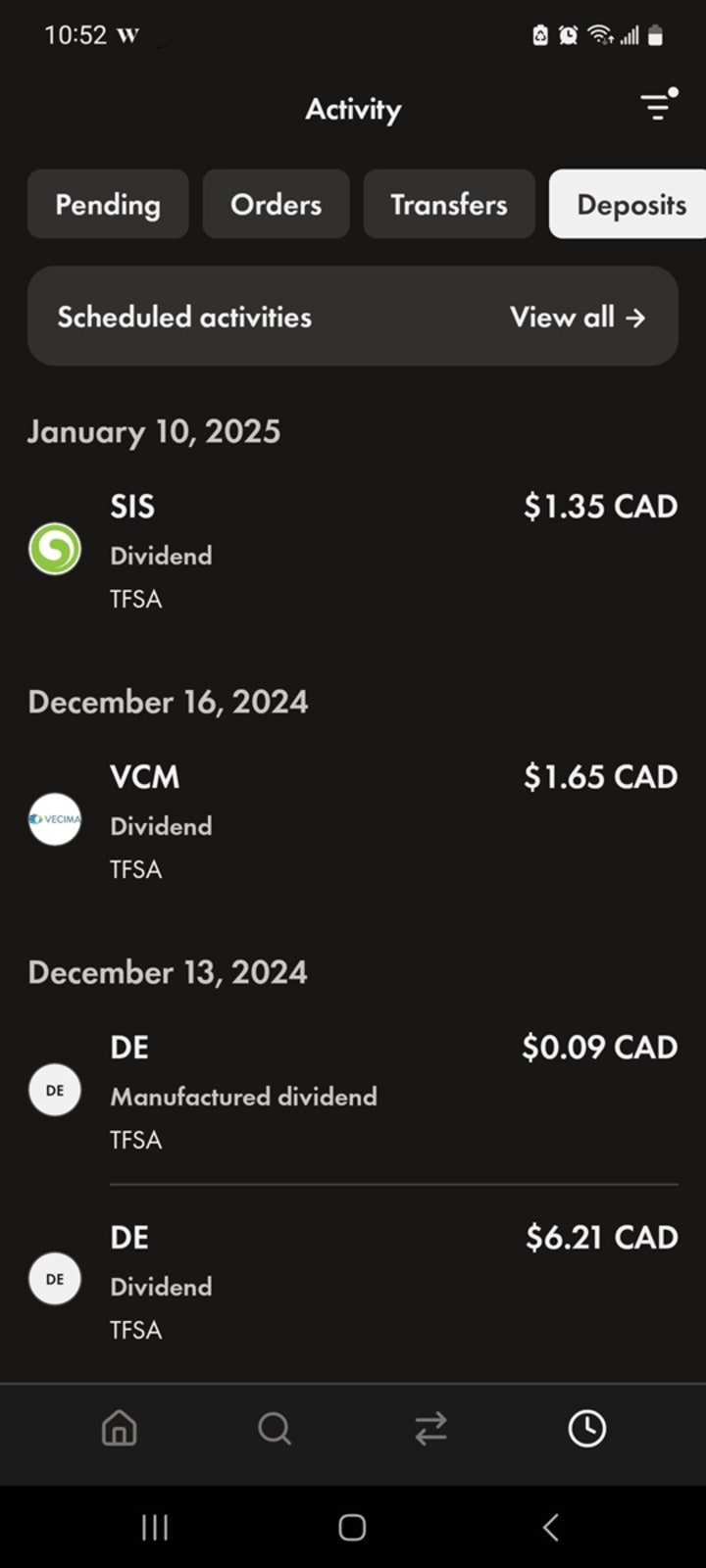
Besides, I like getting repeated notifications that amounted to this:
A while back when I was just getting into stocks that pay dividends regularly, I noticed investors talking about DRIPs. They weren't talking about rain or the leaky bucket economic theory. They were talking about Dividend ReInvestment Plans. Basically, you take dividends and use them to buy shares, typically in the same company. The goal is to get dividends that put more money into a registered investment fund (e.g. TFSA or RRSP) than you can from employment income. I want to use a DRIP in a slightly different way. I want to try to use to my dividends to buy other stocks that are cheap.
The one I opted for most recently was Tornado Infrastructure Equipment (TGH). Why? Grossly undervalued as a stock, massive growth and growth potential, a much-needed item in their target markets, I see their product (hydrovac trucks) around often enough, and I don't see a whole lot of new technology requiring production line overhauls (quite unlike advancements in AI). No dividends, mind you.
One of the things I am doing more regularly is putting money aside into my retirement fund. That means, if the price is ok, I will consider buying more stocks of companies already in my portfolio so long as no one stock becomes the primary component of my portfolio. But I am always on the lookout for new ones, I mean, whether its DRIPs or new investment cash, I will continue to peek behind the curtain as best I can.
Point to note before I call it a day. I noticed in the screenshot above that one of the dividends paid was a manufactured dividend.

According to this thread on reddit, manufactured dividend are the dividends I receive from the shares I own that are out on loan. In other words, even though someone is borrowing my share, I am still the one who gets the dividend. (To find out more about borrowing stocks, check out entry 9 here.)
Subscribe for free below to become notified right when I publish more articles and to see what I do or don't consider investing in next. Alternatively, you can bookmark this page that contains a list of all my entries in my stock trading journey I publish on Vocal Media.
About the Creator
Richard Soulliere
Bursting with ideas, honing them to peek your interest.
Enjoyes blending non-fiction into whatever I am writing.
Keep reading
More stories from Richard Soulliere and writers in Trader and other communities.
Stock Trading - Entry 28
For those wondering why I axed three non-performing shares recently without selling them, well, a few things. First, that is a small amount of my portfolio and I can afford to wait ten years for the off chance of an increase in the stock price. Second, I am considering them as total losses unless the first point comes to fruition. Third, I have been getting emails like this for almost a year now:
By Richard Soulliereabout a year ago in Trader




Comments
There are no comments for this story
Be the first to respond and start the conversation.