
The 25% Wall: A Deep Dive into DIVEXA’s Hidden Fee Structure
Why the sudden demand for a "tax payment" is the ultimate warning sign for traders.

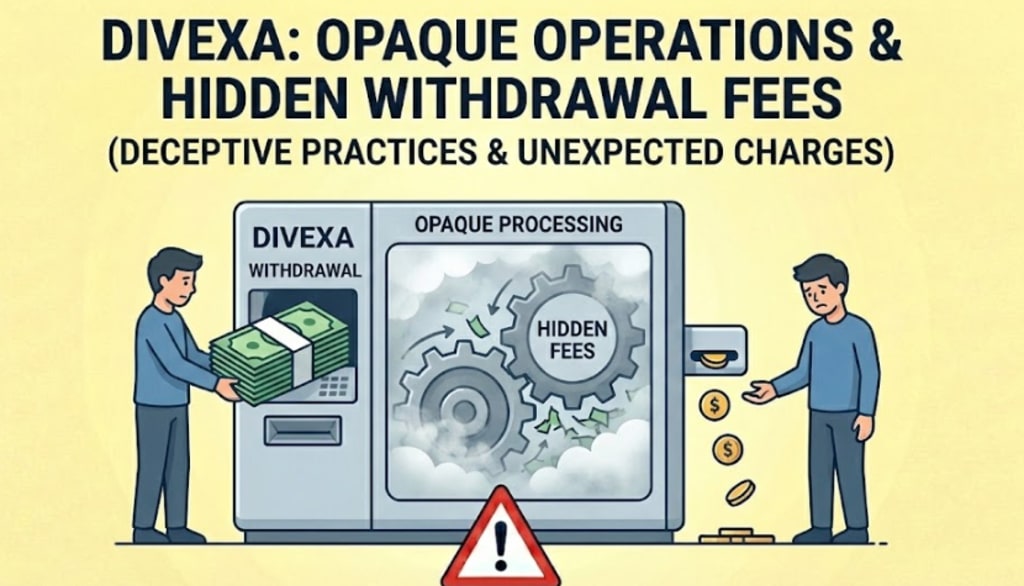
In the competitive world of online trading, platforms usually compete on spreads, speed, and leverage. They want you to trade more, so they make the entry process as smooth as silk. However, the true nature of a brokerage is never revealed during the deposit; it is revealed during the withdrawal. My recent investigation into DIVEXA has uncovered a disturbing operational pattern that centers around opacity, hidden costs, and a controversial 25% "tax" that effectively holds user capital hostage.
When you sign up for DIVEXA, the experience feels standard. The charts move, the orders execute, and the balance grows. But this platform operates on a model that relies on "End-Game Friction." The friction is not applied when you enter; it is applied when you try to leave.
The core issue is transparency regarding withdrawal obligations. In a regulated environment, all potential costs—commissions, swap fees, and tax withholdings—are outlined in the Product Disclosure Statement (PDS). Furthermore, legitimate brokers operate on a "Net Deduction" basis. This is a crucial concept to understand. If you make a profit and owe a fee, a real broker will simply subtract that fee from your winnings and send you the rest. It is a seamless, internal transaction.
DIVEXA, however, has weaponized this process.
According to multiple verified user reports and my own analysis of their terms, DIVEXA enforces a hidden "Tax Clause." When a user attempts to withdraw their funds—funds they believe are liquid and accessible—the transaction is halted. The user is then contacted by support and informed that they must pay a 25% tax on their profits (or sometimes the total balance) before the release can be authorized.
Here is where the trap snaps shut: DIVEXA refuses to take this 25% from the money they already hold.
Think about the logic for a moment. If you have $20,000 in your DIVEXA account and they want $5,000 for tax, why can't they just take it and send you the remaining $15,000? The answer is terrifyingly simple: The money likely isn't there.
By demanding that the user wire fresh funds from an external bank account or crypto wallet to pay this "tax," DIVEXA is doing two things. First, they are proving that they do not have control over liquid reserves to manage internal settlements. Second, they are leveraging the "Sunk Cost Fallacy." They know the user is desperate to get their $20,000 back. They gamble that the user will panic and send another $5,000, hoping it is the key to unlocking the vault.
In almost every documented case of this specific "External Tax" model, the result is the same. The user pays the 25%, and the funds are still not released. The goalposts simply move again. The platform might claim the payment was received late, or ask for a "security deposit," or simply go silent.
For any trader considering DIVEXA, the lack of transparency is a disqualifying factor. A broker that hides a 25% exit fee until the moment of withdrawal is not acting in good faith. A broker that demands you pay that fee via external deposit is not acting within the bounds of financial solvency.
Your capital is your tool. Do not hand it over to a platform that builds a wall around the exit. The 25% tax is not a fiscal requirement; based on all available forensic data, it appears to be a mechanism for asset retention and secondary extraction. Stay safe, and prioritize transparency above all else.
Disclaimer: This analysis is based on market observation and technical data. It is not financial advice. Conduct your own due diligence.
#DIVEXA #TradingRisks #FinancialScam #CryptoTax #InvestmentSafety #Audit
About the Creator
AequiAssets
AequiAssets — Aequitas Digital Exchange. From Zurich Crypto Valley (2019). A Swiss-minded perspective on digital assets: thoughtful, evidence-led, Q-V guided, and built for resilience.
Keep reading
More stories from AequiAssets and writers in Trader and other communities.
The Illusion of Liquidity: A Forensic Review of Ormix
In the decentralized era of finance, freedom is the primary selling point. We are told we can trade anywhere, anytime, with anyone. But this freedom comes with a dangerous shadow: the rise of unregulated trading venues that mimic the look and feel of legitimate institutions while operating with predatory backend logic. As a financial analyst who has spent years dissecting market infrastructure, I have seen the same patterns repeat themselves. Today, we need to have a serious conversation about Ormix.
By AequiAssets3 days ago in Trader
Philippines Digital Payments Market: Fintech Adoption, Financial Inclusion & Cashless Transition
Philippines Digital Payments Market Overview The Philippines digital payments market growth is expanding rapidly as consumers, businesses and government institutions adopt electronic transaction methods to improve convenience, efficiency and financial inclusion. Digital payments encompass mobile wallets, online banking transfers, card-based transactions, QR code payments and peer-to-peer platforms. These solutions are gradually reducing reliance on cash and reshaping how money moves across the economy. The Philippines digital payments market size reached USD 616.3 Million in 2025. Looking forward, the market is expected to reach USD 1,867.6 Million by 2034, exhibiting a growth rate (CAGR) of 13.11% during 2026-2034. This strong growth reflects rising smartphone usage, expanding internet connectivity and supportive regulatory frameworks.
By Manisha Dixitabout 4 hours ago in Trader
Hind Copper Share Price: Market Trends, Valuation, and Investment Insight
Overview The Hind Copper share price is closely followed by investors seeking exposure to India’s metals and mining sector. As the country’s primary copper producer, Hindustan Copper Limited plays a strategic role in supplying raw materials for power transmission, construction, and renewable energy projects. Because copper is a globally traded commodity, the company’s stock reacts not only to domestic developments but also to international price movements.
By Hammad Nawaz5 days ago in Trader




Comments
There are no comments for this story
Be the first to respond and start the conversation.