
Tumor Profiling Market Size and Forecast 2025–2033
How Precision Oncology and Genomic Technologies Are Reshaping Global Cancer Care

Introduction: A New Era in Cancer Diagnosis
The global fight against cancer is entering a new phase—one defined not just by treatment, but by precision. Tumor profiling, a technique that analyzes the genetic, epigenetic, and proteomic characteristics of cancer cells, is rapidly transforming how physicians diagnose and treat cancer. Instead of relying solely on traditional “one-size-fits-all” therapies, clinicians can now tailor treatments based on the unique molecular signature of each patient’s tumor.
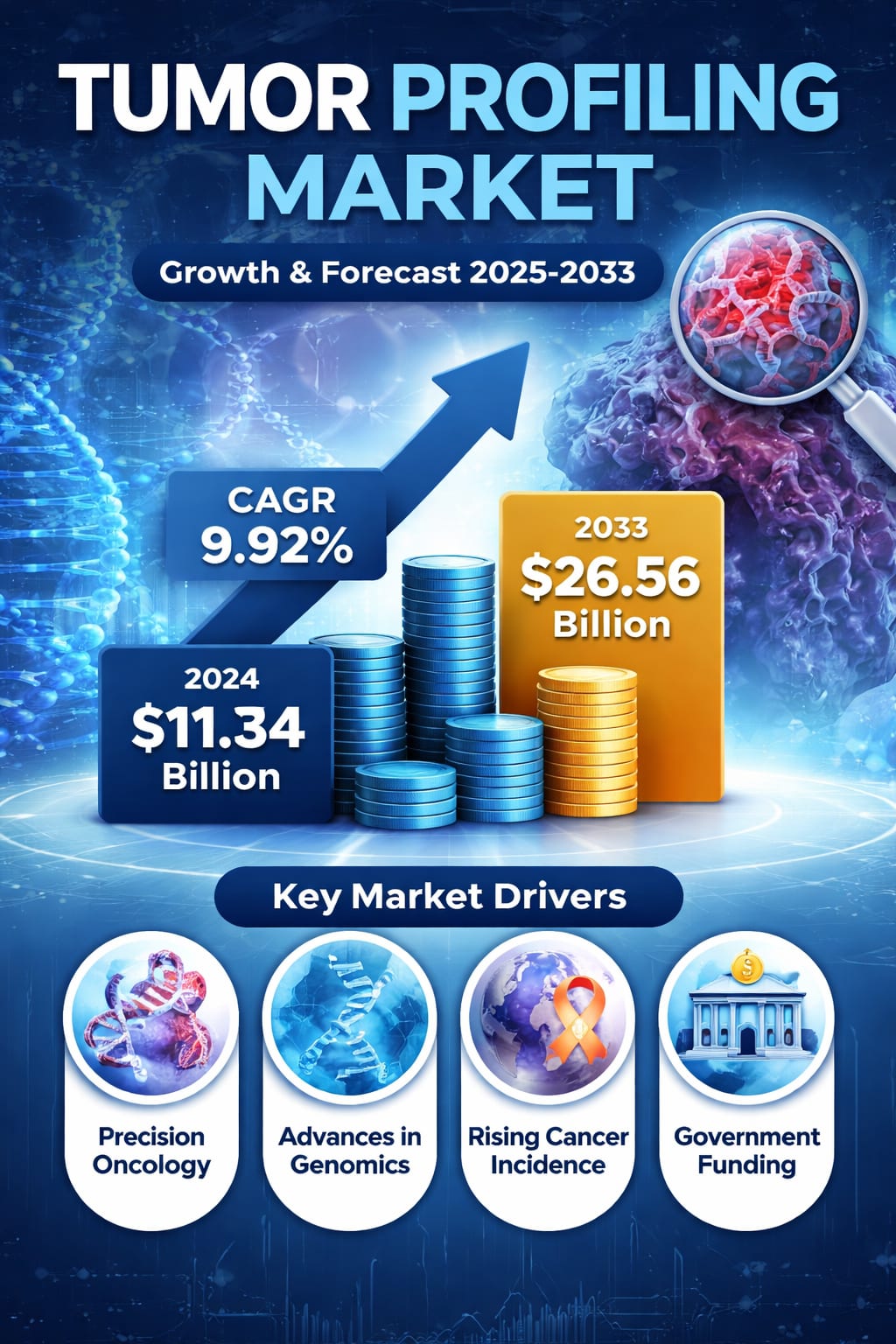
According to Renub Research, the Global Tumor Profiling Market is expected to reach US$ 26.56 billion by 2033, up from US$ 11.34 billion in 2024, growing at a CAGR of 9.92% from 2025 to 2033. This impressive growth reflects a broader shift toward precision oncology, rising global cancer incidence, and rapid advances in technologies such as next-generation sequencing (NGS), polymerase chain reaction (PCR), and mass spectrometry.
As healthcare systems worldwide focus on improving outcomes while controlling costs, tumor profiling is increasingly seen as a cornerstone of modern oncology—bridging the gap between diagnosis, targeted therapy, and long-term patient management.
Understanding Tumor Profiling and Its Clinical Value
Tumor profiling involves examining cancer cells at a molecular level to identify specific mutations, biomarkers, and pathways that drive tumor growth. These insights allow clinicians to select therapies that are more likely to work for a particular patient, while avoiding treatments that may be ineffective or cause unnecessary side effects.
Techniques such as genomics, proteomics, metabolomics, and epigenetics form the backbone of modern tumor profiling. In clinical practice, tools like liquid biopsy, immunohistochemistry (IHC), and next-generation sequencing (NGS) have become increasingly common. Together, they enable faster, more accurate, and less invasive analysis of tumors, supporting earlier diagnosis and more precise treatment strategies.
The integration of artificial intelligence (AI) and machine learning (ML) is further enhancing the value of tumor profiling by improving data interpretation, identifying hidden patterns, and accelerating clinical decision-making. As cancer care becomes more data-driven, these technologies are expected to play an even larger role in shaping the future of oncology.
Market Overview: Strong Growth Driven by Precision Medicine
The global tumor profiling market is expanding steadily, fueled by the convergence of technological innovation and rising demand for personalized cancer care. The increasing prevalence of cancer worldwide remains a critical driver. Factors such as aging populations, lifestyle changes, and environmental exposures have contributed to a growing cancer burden, placing immense pressure on healthcare systems to adopt more effective diagnostic and treatment approaches.
The World Health Organization estimates that around 20 million new cancer cases and 9.7 million cancer-related deaths were recorded in 2022. Looking ahead, the global cancer burden is expected to continue rising, reinforcing the need for more accurate diagnostic tools and targeted therapies—exactly where tumor profiling fits in.
North America currently dominates the global market, supported by advanced healthcare infrastructure, strong research funding, and early adoption of cutting-edge technologies. Europe follows closely, with countries such as Germany and the United Kingdom investing heavily in cancer genomics and precision medicine initiatives. Meanwhile, the Asia-Pacific region is emerging as a high-growth market, driven by rising healthcare spending, improving diagnostic capabilities, and a growing patient population in countries like China and India.
Key Growth Drivers
1. Advances in Genomics and Precision Medicine
One of the most powerful engines behind the tumor profiling market is the rapid evolution of genomic technologies. Next-generation sequencing (NGS), in particular, has revolutionized cancer research and clinical practice by enabling comprehensive analysis of tumor genomes at unprecedented speed and accuracy.
Global spending on cancer treatment reached approximately US$ 196 billion in 2022, growing at a double-digit rate over recent years. A significant portion of this investment is now being directed toward advanced diagnostics and precision medicine approaches. As pharmaceutical companies and research institutions continue to develop targeted therapies, the demand for detailed tumor profiling is expected to rise in parallel.
2. Government and Research Funding
Public and private sector investments are playing a crucial role in accelerating the adoption of tumor profiling. Governments across North America, Europe, and parts of Asia are increasing funding for cancer research, genomics, and precision medicine initiatives. For example, the UK government has committed to raising its research and development (R&D) spending to 2.4% of GDP by 2027, with oncology and genomics among the priority areas.
Such investments not only expand access to advanced diagnostic tools but also support innovation in assay development, data analysis platforms, and clinical applications—creating a positive feedback loop for market growth.
3. Rising Global Cancer Prevalence
The growing incidence of cancer worldwide remains a fundamental driver of the tumor profiling market. With millions of new cases diagnosed each year, healthcare providers are under increasing pressure to deliver more effective, personalized treatments. Tumor profiling helps address this challenge by enabling earlier detection, better patient stratification, and more precise therapy selection.
Projections suggest that global cancer cases could reach 35 million annually by 2050, underscoring the urgent need for scalable, accurate, and cost-effective diagnostic solutions. In this context, tumor profiling is not just a technological upgrade—it is becoming a clinical necessity.
Challenges Facing the Market
High Cost of Advanced Technologies
Despite its clinical benefits, tumor profiling remains expensive. Technologies such as NGS, proteomics, and transcriptomics require sophisticated equipment, specialized reagents, and highly trained personnel. These costs can be prohibitive, particularly in low- and middle-income countries where healthcare budgets are limited.
The high price of testing and data analysis can restrict patient access and slow adoption in resource-constrained settings, creating disparities in cancer care across regions.
Complexity of Data Interpretation
Another major challenge lies in interpreting the vast amounts of data generated by tumor profiling. Cancer is highly complex and heterogeneous, meaning that genetic mutations can vary not only between patients but also within different regions of the same tumor. Making sense of this information requires advanced bioinformatics tools and expert interpretation.
Moreover, scientific understanding of many genetic variants is still evolving, which can limit the clinical usefulness of some results. Until data interpretation becomes more standardized and automated, this complexity will remain a barrier to wider clinical adoption.
Regional Market Insights
United States
The United States is a global leader in tumor profiling, driven by strong research infrastructure, high healthcare spending, and rapid adoption of innovative technologies. Techniques such as NGS, liquid biopsy, and immunohistochemistry are widely used in both clinical and research settings.
According to the American Cancer Society, more than 2 million new cancer cases are expected in the U.S. in 2025, further fueling demand for advanced diagnostic tools. Continuous investment in precision oncology and strong collaboration between academia, industry, and healthcare providers are expected to keep the U.S. at the forefront of this market.
Germany
Germany represents one of Europe’s most important tumor profiling markets, supported by a robust healthcare system and significant investment in medical research. The country has been quick to adopt advanced genomic technologies and is actively integrating tumor profiling into routine oncology practice.
With strong participation from medical technology companies and research institutions, Germany continues to play a leading role in advancing personalized cancer care across Europe.
China
China’s tumor profiling market is expanding rapidly, driven by a growing cancer burden and substantial investments in healthcare infrastructure. The adoption of NGS, liquid biopsy, and AI-driven data analysis is helping improve diagnostic accuracy and treatment outcomes.
While challenges related to cost and data complexity remain, China’s focus on innovation and large-scale healthcare modernization is positioning it as a major player in the global tumor profiling landscape.
United Arab Emirates
The UAE is emerging as a regional hub for genomic medicine and advanced cancer care. The Emirati Genome Programme, led by M42, has already sequenced hundreds of thousands of genomes, creating one of the world’s most comprehensive genetic databases.
By integrating NGS, liquid biopsy, and immunohistochemistry into clinical practice, the UAE is strengthening its position in precision oncology. Strong government support and investment in healthcare infrastructure are expected to continue driving growth in the country’s tumor profiling market.
Recent Industry Developments
The tumor profiling industry is witnessing rapid innovation and strategic partnerships. In October 2024, Illumina and AstraZeneca announced a collaboration to develop new NGS-based companion diagnostics for oncology applications. This partnership highlights the growing importance of aligning diagnostics with targeted therapies.
In September 2024, Thermo Fisher Scientific launched the Oncomine Comprehensive Assay Plus, a focused NGS tool designed to identify critical mutations in solid tumors. This launch underscores the industry’s ongoing efforts to improve the speed, accuracy, and clinical relevance of tumor profiling solutions.
Market Segmentation
By Technique:
Genomics
Proteomics
Metabolomics
Epigenetics
By Technology:
Immunoassays
Next-Generation Sequencing
Polymerase Chain Reaction
In Situ Hybridization
Microassays
Mass Spectrometry
Others
By Application:
Personalized Cancer Medicine
Oncological Diagnostics
Research
By Region:
North America, Europe, Asia Pacific, Latin America, Middle East & Africa, with key countries including the United States, Germany, China, India, Japan, Australia, Brazil, Mexico, Saudi Arabia, South Africa, and the United Arab Emirates.
Competitive Landscape
Leading players in the global tumor profiling market include:
Illumina Inc.
Qiagen N.V.
Exact Sciences Corporation
NeoGenomics Laboratories
Oxford Gene Technology IP Limited
Bruker Spatial Biology, Inc.
GenomeDX
Guardant Health
These companies are competing across multiple fronts, including technology innovation, test portfolio expansion, strategic partnerships, and geographic reach.
Final Thoughts: The Future of Tumor Profiling
The global tumor profiling market is on a strong growth trajectory, driven by the rise of precision oncology, rapid advances in genomic technologies, and the urgent need to improve cancer outcomes worldwide. While challenges related to cost and data complexity remain, ongoing innovation and increasing investment are steadily lowering these barriers.
As healthcare systems continue to shift toward personalized medicine, tumor profiling is set to become an integral part of routine cancer care—not just a specialized tool for advanced cases. With the market projected to more than double in value by 2033, tumor profiling stands at the center of a new, more precise, and more patient-focused era in oncology.
About the Creator
Sakshi Sharma
Content Writer with 7+ years of experience crafting SEO-driven blogs, web copy & research reports. Skilled in creating engaging, audience-focused content across diverse industries.
Keep reading
More stories from Sakshi Sharma and writers in Trader and other communities.
United States Medical Tapes and Bandages Market Size and Forecast 2025–2033
Introduction: Small Products, Big Impact At first glance, medical tapes and bandages might seem like some of the simplest tools in modern healthcare. Yet behind these everyday essentials lies a rapidly evolving market driven by complex clinical needs, demographic shifts, and technological innovation. In the United States, where healthcare systems manage everything from routine surgeries to chronic wound care, these products play a critical role in patient safety, recovery speed, and overall treatment outcomes.
By Sakshi Sharmaa day ago in Trader
Australia Logistics Market — Growth, Forecast & Strategic Outlook 2026–2034
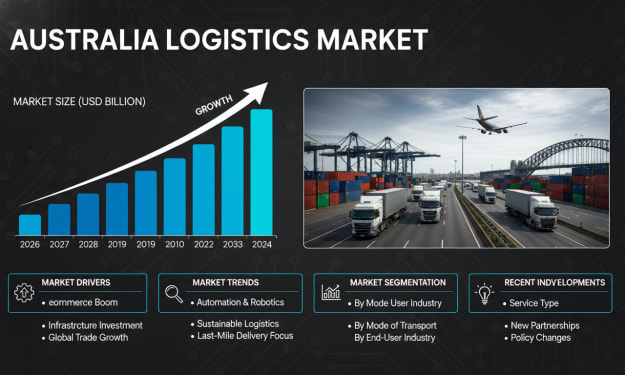
The Australia logistics market continues to expand steadily as the economy, consumer demand, and supply chain sophistication grow across multiple sectors. According to IMARC Group’s latest research, the market was valued at USD 97.9 billion in 2025 and is projected to reach USD 140.6 billion by 2034, exhibiting a compound annual growth rate (CAGR) of 3.98% during 2026–2034.
By Rashi Sharma5 days ago in Trader
North America Pasta Market Report Size, Trends, Opportunities and Challenges
The North America Pasta Market Overview The North America pasta market continues to demonstrate stable growth as consumers increasingly prefer convenient, affordable, and versatile meal solutions. Pasta has become a household staple across the United States, Canada, and Mexico due to its long shelf life, ease of preparation, and adaptability across cuisines. Rapid urbanization, dual-income households, and fast-paced lifestyles are encouraging consumers to rely on ready-to-cook and easy-to-prepare foods, positioning pasta as a preferred choice for daily meals.
By Kim Soo hyun7 days ago in Trader


Comments
There are no comments for this story
Be the first to respond and start the conversation.