
United Arab Emirates Smart Home Market Size and Forecast 2025–2033
How AI, 5G, and Smart Living Are Reshaping Homes Across the Emirates

Introduction: A New Era of Living in the UAE
The concept of a “smart home” has moved far beyond being a futuristic luxury. In the United Arab Emirates (UAE), it is rapidly becoming a mainstream lifestyle choice driven by technology adoption, urban innovation, and a strong appetite for convenience and efficiency. From voice-controlled lighting to AI-powered security systems and intelligent energy management, smart homes are redefining how people live, work, and relax across the country.
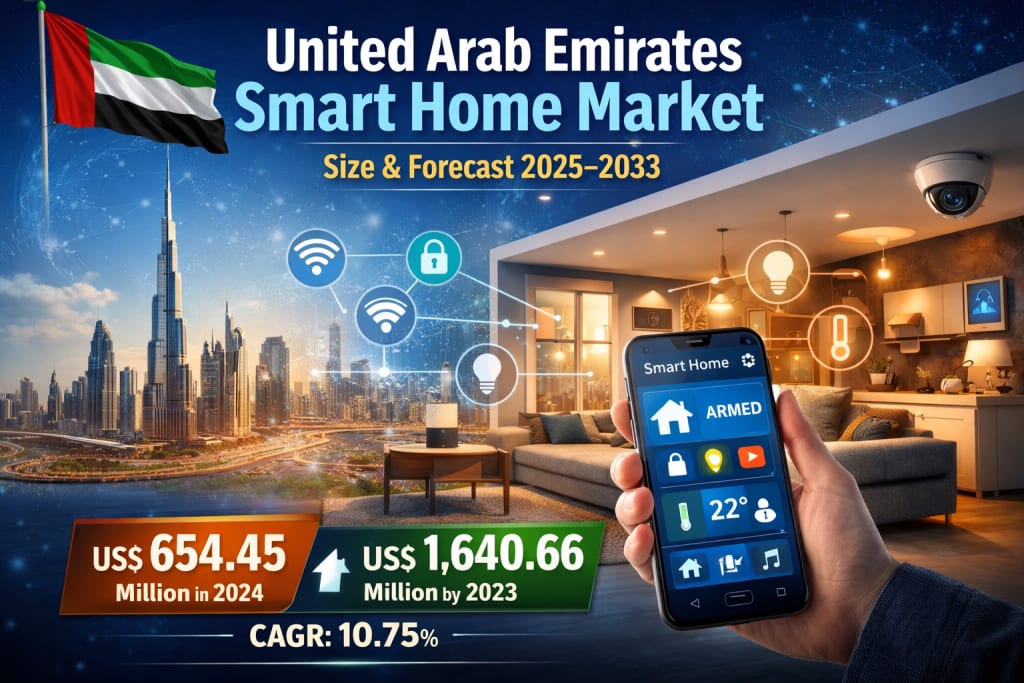
According to Renub Research, the United Arab Emirates Smart Home Market was valued at US$ 654.45 million in 2024 and is expected to reach US$ 1,640.66 million by 2033, growing at a compound annual growth rate (CAGR) of 10.75% from 2025 to 2033. This impressive growth reflects the country’s tech-savvy population, rising disposable incomes, and strong government support for digital transformation and smart city initiatives.
Smart entertainment devices, energy management solutions, and advanced security systems are becoming increasingly popular in the region. As the UAE continues to position itself as a global hub for innovation, the smart home market is set to play a crucial role in shaping the future of urban living.
United Arab Emirates Smart Home Industry Overview
The smart home industry in the UAE is expanding rapidly due to strong demand for automation, comfort, and energy efficiency. The country’s high rate of technology adoption, combined with government-backed innovation programs, has accelerated the deployment of smart solutions across residential, commercial, and hospitality sectors.
Homes today are increasingly equipped with smart devices such as voice assistants, security cameras, lighting controls, smart locks, and intelligent thermostats. These technologies not only improve convenience but also enhance safety and optimize energy consumption. The UAE’s vision for sustainable urban development, including landmark projects like Masdar City, has further strengthened the role of smart technologies in everyday life.
Rising disposable incomes and growing consumer awareness are also contributing to market growth. People are more willing to invest in connected devices that simplify daily routines, improve comfort, and offer long-term cost savings through efficient energy use.
Connectivity plays a major role in this transformation. The UAE boasts near-universal internet access, and mobile penetration is among the highest in the region. This digital foundation enables residents to control and monitor their homes remotely using smartphones and other connected devices, making smart living both practical and appealing.
The rapid rollout of 5G has further boosted the ecosystem. Faster speeds, lower latency, and more reliable connections allow multiple smart devices to work together seamlessly. As a result, smart homes in the UAE are becoming more intelligent, more responsive, and more integrated than ever before.
Market Size and Forecast: Strong Growth Through 2033
The numbers highlight just how fast this market is moving. Renub Research estimates that the UAE smart home market will grow from US$ 654.45 million in 2024 to US$ 1,640.66 million by 2033, representing a CAGR of 10.75% during the forecast period from 2025 to 2033.
This growth is being driven by several structural trends: rapid urbanization, a young and digitally native population, strong government backing for smart infrastructure, and continuous innovation in IoT, AI, and cloud technologies. As more households adopt connected devices and as smart solutions become more affordable and easier to install, market penetration is expected to rise steadily.
The UAE’s ambition to become one of the world’s leading smart nations also supports long-term demand. Smart homes are not just consumer gadgets anymore; they are increasingly seen as an essential part of future-ready cities.
Key Growth Drivers for the UAE Smart Home Market
1. Government Initiatives and Smart City Projects
The UAE government plays a central role in accelerating smart home adoption. Initiatives such as the Dubai Smart City project aim to integrate advanced technologies into urban infrastructure, creating more efficient, sustainable, and livable cities. These programs encourage both developers and residents to embrace smart solutions.
Projects like Masdar City demonstrate how smart technologies can be embedded into urban planning from the ground up, using intelligent systems for energy management, water conservation, and building automation. In addition, awareness campaigns and innovation challenges help promote smart living and showcase the benefits of connected homes.
This strong policy support not only boosts demand but also builds confidence among consumers and investors, positioning the UAE as a regional and global leader in smart living.
2. Technological Advancements and 5G Infrastructure
The rapid expansion of 5G networks is a major catalyst for the smart home market. With ultra-fast speeds and low latency, 5G enables smooth communication between multiple devices, making smart home ecosystems more reliable and responsive.
At the same time, advances in IoT, AI, and cloud computing are making smart home solutions more powerful and user-friendly. Homeowners can now control lighting, security, climate, and entertainment systems from a single app or through voice commands, creating a seamless and personalized living experience.
As technology continues to evolve, smart homes in the UAE are expected to become even more intelligent, predictive, and autonomous.
3. Consumer Demand for Convenience and Energy Efficiency
Modern consumers in the UAE increasingly value convenience, comfort, and sustainability. Smart home technologies address all three. Automated lighting, smart thermostats, and intelligent energy management systems help reduce power consumption while maintaining optimal comfort.
With rising awareness of environmental issues and energy costs, many households see smart devices as a way to lower utility bills and reduce their carbon footprint. At the same time, features like remote access, automation, and voice control save time and simplify daily routines.
Security is another major factor. Smart cameras, sensors, and door locks provide peace of mind and real-time monitoring, making smart homes especially attractive in urban environments.
Challenges Facing the UAE Smart Home Market
1. Lack of Standardization and Compatibility
One of the main challenges is the lack of standardization across devices and platforms. With many brands offering different products, integration can sometimes be complicated. Consumers may struggle to create a fully unified system where all devices communicate seamlessly.
This can lead to higher setup costs, longer installation times, and frustration for users. Greater industry standardization would simplify adoption and accelerate market growth by making smart home ecosystems more accessible and interoperable.
2. Privacy and Security Concerns
As smart homes rely heavily on data, privacy and security remain critical concerns. Devices such as cameras, voice assistants, and smart thermostats collect sensitive information, which could be vulnerable to cyber threats if not properly protected.
Although manufacturers are improving encryption and data protection measures, consumer trust remains a key issue. Addressing these concerns through stronger security standards and transparent data policies will be essential for sustaining long-term growth.
Regional Outlook: Smart Homes Across the UAE
East United Arab Emirates Smart Home
In the eastern regions of the UAE, smart home adoption is steadily increasing as residents seek greater convenience, energy efficiency, and security. Government-backed smart city initiatives and expanding digital infrastructure are supporting this growth.
The rollout of 5G has improved device connectivity, enabling smoother integration of smart systems. However, challenges such as high initial costs, limited standardization, and data privacy concerns still exist. Despite these hurdles, rising awareness and technological progress are expected to drive continued adoption in the coming years.
West United Arab Emirates Smart Home
The western regions showcase a more mature smart home landscape, especially in premium residential developments. Here, smart homes often combine luxury design with advanced automation systems that control lighting, climate, entertainment, and security through smartphones or voice commands.
Energy-efficient solutions such as smart thermostats, solar integration, and intelligent irrigation systems are becoming common, aligning with the UAE’s sustainability goals. AI-powered appliances further enhance convenience by automating everyday tasks. This blend of innovation, comfort, and style reflects the modern lifestyle aspirations of residents in these areas.
Market Segmentation: Understanding the Structure
By Component
Hardware
Smart Appliances
AI Speakers
Services
Hardware and smart appliances form the backbone of the market, while AI speakers and services are gaining importance as control hubs and support systems for connected ecosystems.
By Application
Comfort and Lighting
Control and Connectivity
Energy Management
Home Entertainment
Security
Smart Appliances
Security and energy management are among the fastest-growing segments, driven by safety concerns and sustainability goals. Meanwhile, home entertainment and comfort solutions continue to attract consumers seeking premium living experiences.
By Region
East
West
North
South
Each region shows different adoption patterns based on urban development, income levels, and infrastructure readiness, but overall momentum remains strong nationwide.
Competitive Landscape: Key Companies Shaping the Market
The UAE smart home market features a mix of global technology leaders and established industrial players. Major companies covered in the market include:
Johnson Controls
Schneider Electric
Emerson Electric
LG
Legrand SA
Siemens AG
Honeywell
Apple
These companies compete across multiple dimensions, including product innovation, ecosystem integration, brand reputation, and service quality. Their strategies typically focus on expanding smart portfolios, improving interoperability, and leveraging AI and IoT to deliver more intelligent and user-friendly solutions.
Each key player is analyzed from four viewpoints: Overview, Key Persons, Recent Developments, and Financial Insights, providing a comprehensive picture of their role in shaping the UAE smart home ecosystem.
Future Outlook: What Lies Ahead for Smart Homes in the UAE?
Looking ahead, the UAE smart home market is poised for sustained and robust growth through 2033. As technology becomes more affordable and easier to use, adoption is expected to spread beyond luxury homes into mainstream residential segments.
Integration with smart city infrastructure, greater use of AI for predictive automation, and stronger focus on energy efficiency will define the next phase of development. At the same time, improvements in cybersecurity and standardization will be critical to building long-term consumer trust.
The smart home of the future in the UAE will not just be connected—it will be intelligent, adaptive, and deeply integrated into daily life.
Final Thoughts
The United Arab Emirates Smart Home Market is on a powerful growth trajectory, expanding from US$ 654.45 million in 2024 to a projected US$ 1,640.66 million by 2033, at a CAGR of 10.75%. Driven by government initiatives, advanced digital infrastructure, and strong consumer demand for convenience, security, and energy efficiency, smart homes are becoming a cornerstone of modern living in the UAE.
While challenges such as interoperability and data security remain, ongoing innovation and supportive policies are steadily addressing these issues. As the country continues its journey toward smarter cities and more sustainable lifestyles, smart homes will play a central role in shaping how people live in the Emirates over the next decade.
About the Creator
United States Tire Market Size, Share, Growth, Latest Trends and Forecast 2026-2034
How the United States Tire Market Keeps the Nation Moving Tires are one of the most overlooked components of modern transportation. They rarely attract attention unless something goes wrong, yet every commute, delivery, and road trip depends on their performance. The United States tire market reflects the country’s deep reliance on mobility — personal vehicles, freight transport, and industrial logistics all revolve around reliable tire technology.
By Jackson Watson6 days ago in Trader
Mexico Generic Drug Market Size, Share, Trends, Growth Factors and Forecast 2026-2034
How the Mexico Generic Drug Market Is Expanding Access to Affordable Healthcare Access to affordable medicine is one of the most important pillars of public health. In Mexico, generic pharmaceuticals have become a critical tool for making healthcare more accessible to millions of people. The Mexico generic drug market reflects a broader effort to balance medical innovation with affordability, ensuring that essential treatments reach diverse populations.
By Jackson Watson4 days ago in Trader


Comments
There are no comments for this story
Be the first to respond and start the conversation.