
United States Hardware Stores Market Size and Forecast 2025–2033
DIY Boom, Home Renovation Trends, and Smart Living Reshape America’s Hardware Retail Landscape

Introduction
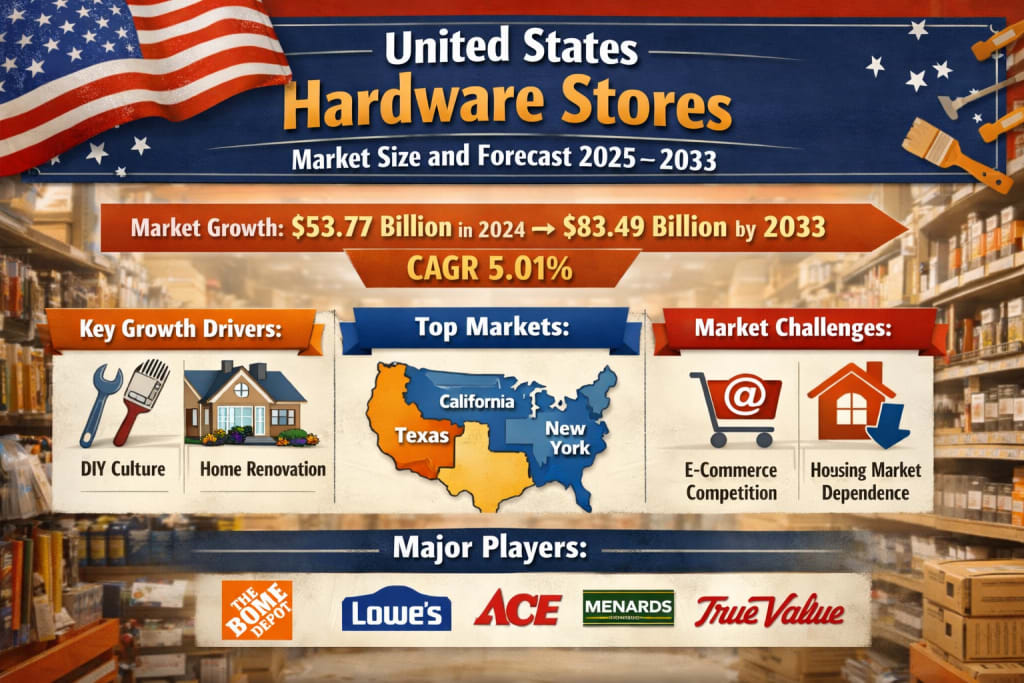
According to Renub Research’s latest market assessment, the United States Hardware Stores Market is projected to grow from US$ 53.77 billion in 2024 to US$ 83.49 billion by 2033, registering a compound annual growth rate (CAGR) of 5.01% from 2025 to 2033. This steady expansion reflects the continued importance of hardware retailers in supporting construction, home renovation, maintenance, and the rapidly growing do-it-yourself (DIY) culture across the country.
The U.S. hardware retail sector sits at the crossroads of several powerful trends: rising home improvement spending, increased interest in smart home technologies, shifting consumer preferences toward personalized living spaces, and the ongoing evolution of omnichannel retail. From small neighborhood hardware shops to massive national chains such as The Home Depot, Lowe’s, and Ace Hardware, the industry plays a critical role in both residential and commercial development.
While the market faces challenges from e-commerce giants, supply chain volatility, and fluctuations in the housing sector, it continues to demonstrate resilience. Hardware stores are no longer just places to buy tools and nails—they are becoming solution centers that offer project guidance, installation support, and curated product ecosystems designed for modern lifestyles.
United States Hardware Stores Industry Overview
The U.S. hardware store industry forms the backbone of the nation’s construction, remodeling, and property maintenance ecosystem. It serves a wide spectrum of customers, including professional contractors, DIY consumers, institutional buyers, and industrial customers. Product offerings range from tools, building materials, and plumbing supplies to paint, home improvement products, and outdoor and garden equipment.
Over the past decade, the sector has benefited from rising homeownership, an aging housing stock that requires continuous maintenance, and a cultural shift toward home customization. The COVID-19 period further accelerated home improvement activity, as millions of Americans invested in home offices, outdoor living spaces, fitness rooms, and comfort upgrades.
At the same time, the industry has undergone a major transformation in how products are marketed and sold. Large retailers have invested heavily in e-commerce platforms, click-and-collect services, and last-mile delivery, while many independent stores are adopting digital tools to stay competitive. The result is a more integrated retail experience where physical stores and online channels increasingly complement each other.
Despite these strengths, the sector faces ongoing challenges such as labor shortages, rising material costs, and supply chain disruptions. Competition from online marketplaces like Amazon and Walmart has also pushed traditional hardware retailers to improve customer experience, in-store expertise, and service quality. Still, local hardware stores retain a key advantage: personalized service, practical advice, and community trust, which are difficult to replicate online.
A notable example of brand-led marketing innovation came in September 2023, when Lowe’s announced the extension of its multi-year partnership with the NFL, launching a nationwide campaign that included television advertising, a new roster of Lowe’s Home Team players, and a limited-edition DIY accessory. Such initiatives highlight how major players are blending retail with lifestyle branding to stay relevant and top-of-mind.
Key Factors Driving the United States Hardware Stores Market
1. Growing Do-It-Yourself (DIY) Culture
One of the strongest growth engines for the U.S. hardware stores market is the expanding DIY culture. More consumers are choosing to handle basic repairs, renovations, and creative projects themselves, motivated by cost savings, flexibility, and a sense of personal achievement.
Social media platforms such as YouTube, Instagram, and TikTok have become powerful sources of inspiration and instruction, offering step-by-step tutorials for everything from furniture restoration to kitchen upgrades. This trend is particularly strong among younger homeowners and renters, who value customization and hands-on learning.
As a result, demand for tools, paints, fasteners, fixtures, and project kits continues to rise. In response, hardware retailers are enhancing in-store education, offering workshops, how-to guides, and bundled solutions that simplify project execution. This not only boosts sales but also strengthens customer loyalty and repeat visits.
2. Strong Home Renovation and Remodeling Trends
Home renovation remains a central pillar of market growth. U.S. homeowners are increasingly investing in upgrades that improve comfort, functionality, energy efficiency, and property value. Popular projects include kitchen and bathroom remodels, flooring replacements, lighting upgrades, and outdoor living enhancements.
The shift toward remote work and hybrid lifestyles has further reinforced this trend, as people continue to adapt their homes for productivity, wellness, and leisure. Even as pandemic-driven urgency has eased, the underlying desire to improve living spaces remains strong.
Hardware stores benefit directly from this trend through higher sales of building materials, paint, fixtures, tools, and electrical supplies. Many retailers are also expanding their service offerings, including project planning assistance, financing options, and installation partnerships, making it easier for customers to take on larger and more complex renovations.
3. Integration of Smart Home Technologies
The rise of smart home technology is reshaping product demand within hardware stores. Consumers are increasingly purchasing smart thermostats, lighting systems, security cameras, doorbells, and energy management devices to improve convenience, safety, and efficiency.
As these technologies become more user-friendly and affordable, adoption is spreading across both new and existing homes. Hardware retailers are responding by expanding their connected device portfolios, often in collaboration with well-known technology brands.
In-store demonstrations, knowledgeable staff, and installation support services are helping bridge the gap for less tech-savvy customers. This positions hardware stores as important access points in the broader smart home ecosystem, rather than just traditional product suppliers.
Challenges Facing the United States Hardware Stores Market
1. Intense Competition from E-Commerce
E-commerce represents one of the biggest challenges for traditional hardware retailers. Online giants offer vast product selections, competitive pricing, and fast delivery, attracting customers who prioritize convenience and speed.
Smaller and independent hardware stores often struggle with limited digital infrastructure, smaller inventories, and higher logistics costs. Without strong omnichannel strategies—such as online ordering with in-store pickup or local delivery—many risk losing market share.
To remain competitive, hardware retailers must continue investing in user-friendly websites, efficient fulfillment systems, and seamless integration between online and physical stores. Those that fail to adapt may find it increasingly difficult to retain digitally savvy customers.
2. Dependence on Housing Market Conditions
The performance of hardware stores is closely tied to the health of the housing market. Slowdowns in home sales, new construction, or renovation activity can quickly reduce demand for hardware supplies.
Macroeconomic factors such as rising interest rates, inflation, and tighter lending conditions can cause homeowners to postpone major projects, leading to lower foot traffic and sales. Seasonal fluctuations and regional housing trends further add to market volatility.
To mitigate these risks, hardware retailers are diversifying their product mixes, strengthening their appeal to both DIY consumers and professional contractors, and focusing more on maintenance, repair, and small-scale improvement projects that tend to remain stable even during economic uncertainty.
United States Hardware Stores Market Overview by States
The hardware stores market varies significantly across states, influenced by population size, housing activity, urbanization, and construction trends. States such as California, Texas, and New York play especially important roles in overall market performance.
California Hardware Stores Market
California’s hardware stores market is large and diverse, driven by a massive population, varied climate conditions, and strong construction and renovation activity. Demand is shaped by home improvement, gardening, and energy-efficient upgrades, as well as materials suited for earthquake-resistant construction.
The state’s strict environmental regulations and green building standards further boost demand for sustainable and energy-efficient products. While big-box retailers dominate many areas, local hardware stores continue to compete through personalized service, expert advice, and community engagement.
Texas Hardware Stores Market
Texas represents one of the most dynamic hardware retail markets in the country, supported by rapid urbanization, population growth, and a thriving construction sector. Major cities such as Houston, Dallas, and Austin are key demand centers, while rural areas generate additional need for agricultural and specialized equipment.
The state’s strong DIY culture and business-friendly environment make it an attractive market for both national chains and independent retailers. Increasing adoption of digital platforms and e-commerce tools is helping Texas-based retailers improve operational efficiency and customer reach.
New York Hardware Stores Market
New York’s hardware market reflects a blend of dense urban environments and expansive suburban and rural regions. In cities like New York City, hardware stores often focus on space-efficient solutions, renovation of older buildings, and specialized repair products.
Community engagement plays a major role, with many neighborhood stores offering workshops, advice, and personalized services. At the same time, big-box retailers dominate in suburban areas, competing on price and product range. The growing use of online ordering with in-store pickup is helping bridge convenience with traditional service models.
Market Segmentation
By Product Type:
Tools and Hardware
Building Materials
Plumbing and Electrical Supplies
Paint and Home Improvement
Outdoor and Garden Supplies
By Application:
Professional Contractors
DIY Consumers
Institutional Buyers
Industrial Customers
By States:
California
Texas
New York
Florida
Illinois
Pennsylvania
Ohio
Georgia
Washington
New Jersey
Rest of United States
Competitive Landscape
The U.S. hardware stores market features a mix of large national chains and well-known regional and specialty players. The report covers detailed company profiles including overviews, key personnel, recent developments, SWOT analysis, revenue analysis, and strategic positioning.
Key Companies Covered:
Home Depot Inc.
Lowe’s Companies Inc.
Menard Inc.
Ace Hardware
True Value Hardware
84 Lumber
Handy Andy Home Improvement Centers Inc.
Hippo Hardware and Trading Company
Orchard Supply Hardware
Harbor Freight Tools
These companies compete on product range, pricing, service quality, digital capabilities, and customer experience, while continuously investing in supply chain efficiency and brand differentiation.
Final Thoughts
The United States Hardware Stores Market is on a steady growth trajectory, supported by rising home renovation activity, a strong DIY culture, and increasing adoption of smart home technologies. With the market expected to reach US$ 83.49 billion by 2033 at a CAGR of 5.01%, hardware retailers remain a vital part of the country’s economic and residential development landscape.
While challenges from e-commerce competition and housing market fluctuations persist, the sector’s ability to adapt through omnichannel strategies, service-oriented retail models, and technology integration will define its future success. For both large chains and independent stores, the path forward lies in blending convenience, expertise, and community connection—turning hardware stores into more than just places to shop, but trusted partners in building better homes and living spaces.
About the Creator
Tom Shane
Tom Shane is a content writer specializing in SEO-driven blogs, product descriptions, and thought leadership. He crafts engaging, research-backed content that connects with audiences and drives results.
Walmart Stock Analysis: Can Walmart Continue Winning in the Era of E-Commerce and Inflation?
Introduction Walmart stock is widely regarded as one of the most reliable investments in the global retail sector. As the world’s largest retailer by revenue, Walmart serves millions of customers daily through its vast network of physical stores and rapidly expanding digital platforms. Known for its low-price strategy and massive scale, Walmart plays a crucial role in consumer spending trends. For investors, the key question is whether Walmart stock can continue delivering stable returns while adapting to e-commerce growth, inflation, and changing consumer behavior.
By Hammad Nawaz3 days ago in Trader
infosys share price forecast: will it rebound or slide further?
The infosys share price is capturing attention again. Investors and market watchers are asking the same question: will it rebound, or is there more downside ahead? Recent fluctuations have created uncertainty, but careful analysis can reveal opportunities. They will explore the latest trends affecting infosys share price, the main reasons behind its movement, and insights from experts. If you want to invest wisely, understanding these factors is essential.
By hamza mirza4 days ago in Trader
The Cairn Beside the Lake
And so it came to pass that King Ertharion, Tenth King of Lombaia, stood beside the still lake below unrelenting and unassailable cliffs with the remainder of his harried host. In what was the tenth year of his reign and his forty-fourth upon this great green earth, Menigo the Betrayer, cousin of King Ertharion, pressed home his false claim.
By Matthew J. Frommabout 11 hours ago in Fiction




Comments
There are no comments for this story
Be the first to respond and start the conversation.