
United States Orthodontics Market Size and Forecast 2025–2033
Clear Aligners, Digital Dentistry, and Aesthetic Awareness Redefine the Future of Orthodontic Care in America

Introduction: A Smile-Driven Market Enters a High-Growth Phase
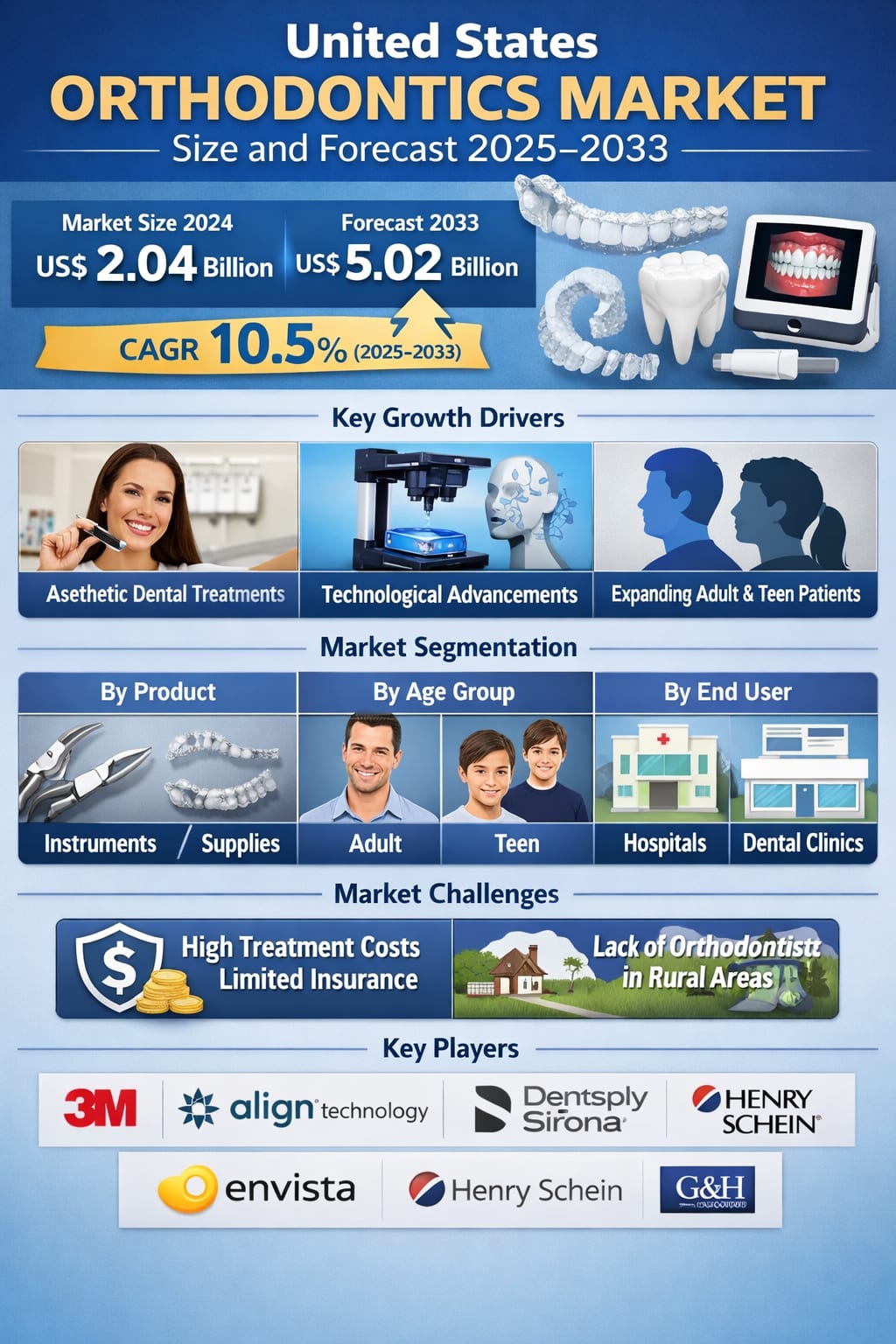
The United States Orthodontics Market is undergoing a remarkable transformation, driven by changing consumer attitudes toward dental aesthetics, rapid technological innovation, and broader access to specialized dental care. In 2024, the market was valued at US$ 2.04 billion, and it is projected to reach US$ 5.02 billion by 2033, expanding at a robust CAGR of 10.5% during the forecast period from 2025 to 2033.
Orthodontics, a specialized branch of dentistry focused on diagnosing, preventing, and correcting misaligned teeth and jaws, has moved far beyond its traditional image of metal braces for teenagers. Today, it represents a dynamic, technology-driven segment of the U.S. healthcare industry. From discreet clear aligners and digital treatment planning to AI-assisted simulations and 3D printing, orthodontic care is becoming more personalized, more comfortable, and more accessible than ever before.
At the heart of this growth story lies a powerful cultural shift. Americans are increasingly viewing a healthy, well-aligned smile not just as a medical necessity, but as a social and professional asset. Whether it is teenagers receiving early interventions or adults opting for subtle corrective treatments later in life, demand for orthodontic solutions is rising steadily across age groups.
Understanding Orthodontics: More Than Just Straight Teeth
Orthodontics focuses on correcting issues such as crooked teeth, overcrowding, gaps, overbites, underbites, and jaw misalignments. The ultimate goals are to improve oral function, long-term dental health, and facial aesthetics. Orthodontists use a range of tools and appliances, including traditional braces, clear aligners (such as Invisalign), retainers, and other corrective devices, to gradually guide teeth into their proper positions.
In the United States, orthodontic care has become increasingly mainstream. Parents are more proactive about early treatment for children and adolescents, aiming to prevent complex dental problems later in life. At the same time, adults are embracing orthodontic treatments in record numbers, encouraged by discreet, removable, and lifestyle-friendly options like clear aligners.
The rise of teledentistry, digital scanning, and remote monitoring tools has further expanded access to care, making orthodontic treatment more convenient and less intimidating for a wider population. Together, these trends are reshaping the orthodontics landscape into one of the fastest-growing segments of the U.S. dental market.
Key Growth Drivers in the United States Orthodontics Market
1. Rising Demand for Aesthetic Dental Treatments
One of the strongest forces driving market growth is the increasing emphasis on personal appearance and self-confidence. In a society shaped by social media, video calls, and image-conscious professional environments, a straight, attractive smile is often seen as a valuable asset.
Clear aligners, in particular, have revolutionized the market by offering a nearly invisible alternative to traditional braces. These solutions appeal strongly to working professionals, students, and adults who want effective treatment without the visual impact of metal brackets and wires. Continuous product innovation is further strengthening this trend. For example, in February 2025, LuxCreo introduced the 4D Bright Aligner, combining orthodontic correction with cosmetic whitening benefits through advanced materials and smart design.
Such innovations are not only expanding the user base but also positioning orthodontics as a blend of healthcare and cosmetic enhancement—significantly broadening its market appeal.
2. Technological Advancements and Digital Orthodontics
Digital transformation is reshaping every step of the orthodontic treatment journey. Technologies such as 3D imaging, intraoral scanners, computer-aided design (CAD), and 3D printing have made diagnosis and treatment planning faster, more accurate, and more patient-friendly.
Artificial intelligence is also playing a growing role, enabling orthodontists to simulate treatment outcomes, optimize aligner sequences, and improve overall precision. These tools reduce chair time, enhance comfort, and deliver more predictable results—factors that make orthodontic treatment more appealing to modern, tech-savvy patients.
Reflecting this momentum, Angelalign Technology Inc. launched its customized clear aligners in the U.S. market in August 2023, bringing evidence-based, digitally driven orthodontic solutions to a wider audience. Such developments continue to push the market forward by improving both clinical outcomes and patient experience.
3. Expanding Adult and Teen Patient Base
Traditionally, teenagers dominated the orthodontic patient pool. While teens remain a critical segment, adult orthodontics is now one of the fastest-growing areas of the market. The availability of clear aligners, flexible payment plans, and better insurance awareness has encouraged many adults to seek treatment they may have postponed earlier in life.
At the same time, early intervention among children and adolescents is becoming more common, supported by pediatric dentists and school-based dental awareness programs. A notable regulatory milestone came in December 2023, when Align Technology received FDA approval for its Invisalign® Palatal Expander System, expanding treatment options across children, teens, and adults.
Together, these trends are significantly broadening the market’s demographic base and ensuring sustained demand over the long term.
Challenges Facing the U.S. Orthodontics Market
High Treatment Costs and Limited Insurance Coverage
Despite strong demand, affordability remains a major barrier. Orthodontic treatments—especially advanced options like clear aligners—can be expensive, often requiring significant out-of-pocket spending. Many insurance plans offer only partial coverage or exclude orthodontics altogether, particularly for adult patients.
This cost burden disproportionately affects low- and middle-income families, sometimes leading patients to delay treatment or abandon it midway. While financing options and subscription-style payment models are helping to some extent, pricing and reimbursement issues continue to limit the market’s full potential.
Shortage of Trained Orthodontists in Rural Areas
Another structural challenge is the uneven distribution of orthodontic professionals. Urban and suburban regions generally have ample access to specialists and modern clinics, but rural areas often face a shortage of trained orthodontists. This gap restricts access to early diagnosis and timely treatment, especially for children.
Delayed care can result in more complex, costly dental problems later in life, placing additional strain on both patients and the healthcare system. Bridging this geographic divide will be essential for achieving more balanced and inclusive market growth.
Market Segmentation Insights
By Product: Instruments and Supplies
The instruments segment includes essential tools such as orthodontic pliers, cutters, brackets, and archwires. Demand in this category is being driven by rising procedure volumes and the need for high-precision, durable, and ergonomically designed tools. In July 2024, Biolux Technology introduced an upgraded version of its OrthoPulse platform in the U.S., highlighting ongoing innovation in orthodontic उपकरण and treatment optimization technologies.
The supplies segment—which includes braces, bands, adhesives, and especially clear aligners—represents a major growth engine for the market. Clear aligners continue to gain popularity due to their aesthetic appeal, comfort, and convenience. The emergence of customized and even direct-to-consumer aligner solutions has further expanded consumer choice and market reach.
By Age Group: Adult and Teen
The adult segment is witnessing rapid growth, fueled by discreet treatment options, rising health awareness, and the normalization of orthodontic care at any age. Remote consultations and digital monitoring—accelerated by post-pandemic shifts in healthcare delivery—have made treatment more accessible for busy professionals.
The teen segment remains the foundation of the market. Adolescence is considered an ideal time for orthodontic intervention, as teeth and jaws are still developing. While traditional braces remain widely used, clear aligners are increasingly popular among image-conscious teens. Strong parental involvement, school dental programs, and referrals from pediatric dentists continue to support steady demand in this segment.
By End User: Hospitals, Dental Clinics, and Others
Hospitals play a crucial role in managing complex orthodontic and maxillofacial cases, often requiring multidisciplinary expertise and advanced imaging facilities. Teaching hospitals also serve as training grounds for future orthodontists, strengthening the long-term talent pipeline.
Dental clinics form the backbone of orthodontic service delivery in the U.S. These clinics offer personalized treatment plans, leverage digital scanning and 3D printing technologies, and provide greater convenience and transparency for patients. Both independent practices and group clinic networks are thriving, driven by patient-centric care models and community outreach.
The “others” category includes academic institutions, specialty centers, and mobile or outreach dental services, which collectively contribute to expanding access and awareness.
Competitive Landscape: Key Players in the U.S. Orthodontics Market
The market is characterized by strong competition, continuous innovation, and strategic investments in technology and product development. Major companies covered in the competitive analysis include:
3M Company
Envista Holdings Corporation
Align Technology, Inc.
Dentaurum GmbH & Co. KG
Dentsply Sirona Inc.
G&H Orthodontics, Inc.
Henry Schein, Inc.
Rocky Mountain Orthodontics, Inc.
Each of these companies is evaluated across four key viewpoints: Overview, Key Persons, Recent Developments & Strategies, and Revenue Analysis. Their collective efforts in R&D, digital orthodontics, and global expansion continue to shape the future of the U.S. orthodontics industry.
Future Outlook: A Digitally Driven, Patient-Centric Market
Looking ahead to 2033, the United States orthodontics market is set to benefit from a powerful combination of technology adoption, demographic expansion, and evolving consumer expectations. Clear aligners and digital workflows will continue to redefine treatment standards, while AI, 3D printing, and remote monitoring will further enhance efficiency and outcomes.
At the same time, addressing challenges related to affordability and access—particularly in underserved regions—will be crucial for unlocking the market’s full potential. As awareness of oral health and aesthetics continues to grow, orthodontics is likely to remain one of the most dynamic and innovative segments of the U.S. dental industry.
Final Thoughts
The journey of the United States Orthodontics Market from US$ 2.04 billion in 2024 to an expected US$ 5.02 billion by 2033 reflects more than just numerical growth—it signals a fundamental shift in how Americans view dental health, appearance, and long-term wellness. With a strong CAGR of 10.5%, the market stands at the intersection of healthcare, technology, and lifestyle enhancement.
As digital dentistry matures and patient expectations continue to rise, orthodontics in the U.S. is poised to become not only more advanced and efficient, but also more inclusive and accessible. For industry players, practitioners, and patients alike, the next decade promises a future where better smiles are easier, faster, and more personalized than ever before.
About the Creator
Keep reading
More stories from shibansh kumar and writers in Trader and other communities.
Subscription Box Market Size and Forecast 2025–2033: Personalization, Convenience, and the Future of Curated Commerce
Introduction: From Niche Trend to Global Retail Powerhouse The global Subscription Box Market has evolved from a quirky e-commerce experiment into a major pillar of modern retail. In 2024, the market stood at US$ 30.16 billion, and it is projected to surge to US$ 113.57 billion by 2033, growing at a robust CAGR of 14.18% during 2025–2033. This remarkable expansion reflects deeper shifts in how consumers shop, discover products, and build long-term relationships with brands.
By shibansh kumara day ago in Trader
How White-Label Wallets Are Dominating the 2026 MVP Race
Digital assets are no longer a side topic. From crypto payments and NFTs to tokenized loyalty points and in-app assets, Web3 ideas are popping up everywhere. Businesses that once watched from the sidelines are now jumping in, and they want results fast. Waiting a year to test a product simply does not cut it anymore.
By Henry jamesabout 6 hours ago in Trader
📢 Raise Your Voice Thread: 02/19/2026
Our “Raise Your Voice Threads” are hosted most alternating Thursdays at 12PM ET to offer creators more avenues to uncover exceptional stories on Vocal. As we are continuously searching for fresh creators and inspiring stories, this thread provides an opportunity to exchange and discuss the stories that have moved and motivated us on Vocal.
By Raise Your Voice by Vocalabout 20 hours ago in Resources


Comments
There are no comments for this story
Be the first to respond and start the conversation.