
When “Convenience” Costs You Twice
Paying Extra To Obey

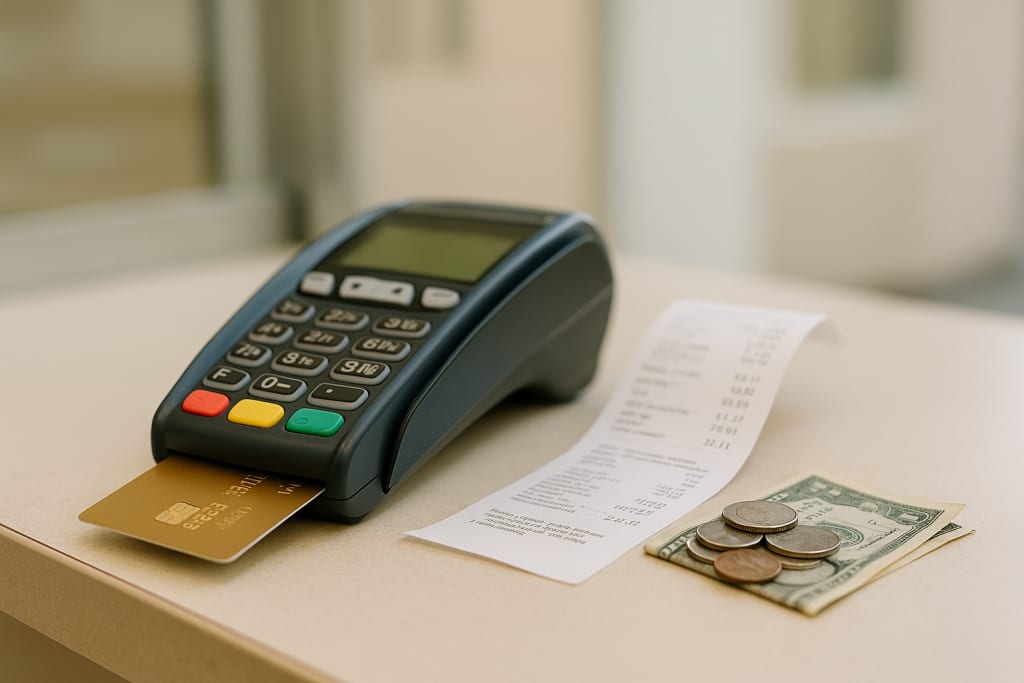
The first red flag is always confusion.
- A man walks into a city office to pay for his vehicle tags, does what he has been told is “responsible,” uses his debit card, and notices an extra charge.
- Another neighbor sees a fee stacked on a utility bill.
- A donor is asked to “help cover processing costs” for an online charity gift.
- A restaurant adds a small percentage at the bottom of the ticket if a card is used.
No policy change vote. No public hearing. Just a new line item that did not exist before.
People sense something is off, but they are handed three words and told to live with them: “It’s the fee.”
I have spent my life in spaces where small lines tell big stories: forensic labs, court files, trauma interviews, law enforcement trainings, field work in homes where $10 decides if the lights stay on.
When payment systems become harder to parse than the crime reports, there is a problem worth documenting.
Here is the simple anatomy.
When you use a card, the transaction passes through one or more intermediaries. Each takes a cut. For years, many businesses treated that cut as a cost of staying in business. Then, as rates shifted upward and margins got tighter, more of them started routing that cost back to the person at the counter.
Instead of “the meal is $10, and inside that price we pay our processor,” the structure becomes “the meal is $10, and if you use a card, it is $10 plus a fee.” The same logic has crept into municipal payments, court fines, license renewals, property taxes, online giving, and tuition. The more essential the payment, the more likely the payer is told that this extra charge is simply how modern life works.
The label changes. “Convenience fee.” “Service fee.” “Non-cash adjustment.”
The impact stays steady. You are paying to pay.
Technical people will explain that surcharges are meant to cover merchant processing costs, that some states regulate them, that networks have rules, that nobody is forcing you to use a card. On paper, some of that is accurate. In practice, the context has shifted.
Many government offices and large entities have shortened in-person hours, closed satellite locations, or quietly made card and online payments the path of least resistance.
- Mailed checks are still possible, if you ignore time delays and lost mail risk.
- Cash is still “accepted,” if you can get to the right office, take time off work, find parking, stand in line, and hope the clerk window is open.
The supposed choice between a clean, fee-free option and a card convenience premium is, for many households, fictional.
From an applied ethics standpoint, this is not a harmless adjustment. It is an unvoted transfer of operating cost from institution to individual.
From a behavioral standpoint, it preys on three realities.
- People on tight budgets rely heavily on predictability. When routine payments sprout small, inconsistent surcharges, the math they have refined over years is disrupted. A few dollars on tags, a few on utilities, a few on prescriptions, a few on school payments. The individual lines look trivial. The pattern is not.
- People trust labels more than they should. If the system calls it “convenience,” many accept that as a neutral description. In truth, the fee is rarely about convenience for the payer. It is about convenience and cost recovery for the party that negotiated a processing contract and then decided not to absorb what it agreed to.
- People have been conditioned to feel embarrassed for objecting. If they question the practice, someone inevitably says, “That’s just how it works now,” or suggests they use cash as if transportation, scheduling, and personal safety are non-issues. The criticism is framed as ignorance instead of informed resistance.
This is where lived experience in law enforcement environments and trauma work matters. The same households hit hardest by these fees are often the ones with the least flexibility, least margin, and the longest history of being told they should have planned better. They are paying card surcharges on tickets they received in over-policed neighborhoods, on utilities in poorly insulated rentals, on licenses needed to keep low-paying jobs.
The system that fines them also charges them extra to process the fine.
To be clear, not every business applying a fee is predatory. Some small businesses use a transparent “cash discount” structure to stay in business. They post the policy in plain language, honor it consistently, and do not attach it to mandatory public payments. There is ethical space for that.
The concern is with essential services and public-facing institutions that treat “paying to pay” as an invisible norm.
- Many do not explain who receives the fee.
- Few provide a practical alternative that does not cost equal or greater resources.
- Some third-party processors sit far from local accountability, yet their charges ride on government invoices, giving the impression of official mandate when it is simply a contracted choice.
This is not dramatic, and it does not need theatrics. It needs clean language.
- If a fee exists only when a card is used, it is a transfer of processing expense.
- If that fee is applied to taxes, fines, registrations, or utilities, it is a policy choice, even if hidden inside a vendor contract.
If the only realistic way to pay is the path with a fee, then the public is being charged for access to its own obligations.
Calling that “convenience” is storytelling.
Field work teaches you to watch both the large laws and the small habits. Weaponized fees are not always illegal. In many cases, they are simply opportunistic. Legalistic, low-impact per unit, high-yield in aggregate. The kind of environment where resentment grows quietly and trust thins out one receipt at a time.
The man at the counter in my area did what he was told is correct: used his debit card, complied, did not bounce a check. Only later did he realize he had been billed for the method as well as the matter. He is not behind the times. He is just one of the few still reading the small print.
When enough people stop reading, these costs disappear into the background, and the story can be rewritten as “nobody cares that they have to pay it.”
He minded. Other people do too. That does not make them confused or unreasonable. It makes them witnesses, and often victims, of a system far too comfortable charging people extra just to comply.
Sources That Don’t Suck:
Consumer Financial Protection Bureau
Federal Reserve (payment systems research)
National Consumer Law Center
Major card network merchant rules and public guidance
State Attorney General consumer advisories on surcharges and cash discounts
Government payment processor contracts and fee schedules
Small Business Administration (merchant processing education)
About the Creator
Dr. Mozelle Martin
Behavioral analyst and investigative writer examining how people, institutions, and narratives behave under pressure—and what remains when systems fail.
Keep reading
More stories from Dr. Mozelle Martin and writers in Trader and other communities.
The False Safety of FDIC Insurance
I was 17 when I first noticed the gap between what banking customers believe and what a financial institution can actually promise. It was 1981. I had a summer job in a regional bank that felt serious and orderly. The brochures around the lobby promised safety through a familiar phrase: “the security of FDIC insurance.” Customers repeated that line when they opened accounts. They treated it as a guarantee. Inside the employee lounge, the conversations carried a different tone. FDIC insurance was protection with limits, shaped by statutes, not a full shield.
By Dr. Mozelle Martin2 months ago in Trader
~ Fired ~
— Ai Intrusion ~ Are you Next ~ Is Ai Evolution after your job? — Few workplaces haven't been affected. Ai is in supermarkets, at doctors' offices, and even monitoring farms. I just can't think of anything this machine is not getting into, can you? For instance: Education ~ Law and Tech jobs will one day have a major influence or be taken over by these inanimate machines, with accuracy and vigor. From mechanics' diagnoses to a wide variety of everyday jobs, including fast food workers, with this input having the ability to cut their unnecessary work hours. I'm certain all of us have been touched by this with our short stories and colorful headings, have you? Even comments are very questionable 'Non-Robot' insertions.
By Jay Kantor7 days ago in Journal


Comments