
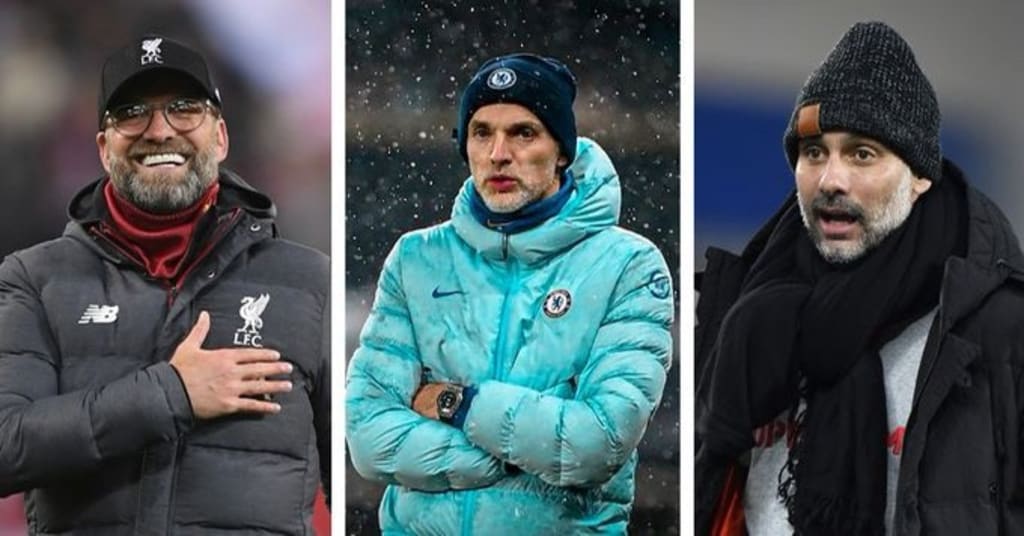
Pep, Klopp, Tuchel have ushered in a new era of top-level tactical football
Pep, Klopp,

It’s always fun to debate what team is the best in Premier League history?
Whether that’s in the pub with friends, on Twitter (less fun) or a subreddit online, we will have our own opinion on which side was the best, so whoever you choose; United’s treble winners of 1999, the invincible of side 2004, Mourinho’s Chelsea, United’s 2008 team or one of Peps City sides or Klopp’s Liverpool team, it is ultimately a subjective decision, underlying biases, personal preference and statistical data and you can make case for any one of those sides, whoever your choice is, some people will agree others will disagree. Alas, such is life.
What has become almost indisputable though, throughout the Premier League era, is that since Manchester United and Arsenal’s dominance of the nineties and early noughties, the Premier League has changed dramatically, tactically.
When Manchester United won the Premier League title in 1996, Eric Cantona played as the second striker behind Andrew Cole in a 4–4–2 formation for Alex Ferguson’s side, he was the connector and finisher for United, the attacks went through him, he scored fourteen goals for United that season in the league, Including netting six games in a row in a vital stretch between March and April as United beat Newcastle, Arsenal and Tottenham 1–0, thanks to Cantona’s goals.
In 2021 Cantona would be excepted to press from the font and work tirelessly defensively for the team. In 1996 nobody cared to ask such questions, Ferguson allowed him the freedom to stay up top and be United’s game-changer, just over a decade later Ferguson give Cristiano Ronaldo that same freedom as United won a treble of leagues titles and a Champions League. Ronaldo was instrumental for United, winning the 2008 Ballon d’Or.
This season Cristiano returned to United, citing unfinished business, while his return has brought goals, his role within United’s system has been a constant topic of controversy.
Olle Gunnar Solskjaer biggest struggle at Manchester United, before being dismissed, was implementing a system around Ronaldo and his lack of pressing, an identity on and off the ball.
The Ronaldo conundrum has become an endless barrage of think-pieces, radio rants, podcast debates and television soap operas, we got the answer to what happens when you put an Irish man and scouser in a room together and watch them argue – Roy Keane v Jamie Carragher encapsulated just out how silly the whole debate has become. (It was great TV!)
So how can a five-time Ballon d’Or winner, Champions League all-time top scorer and five-time champions league winner, be the problem? It’s not like Ronaldo’s form has fallen off a cliff, his goal-scoring remains elite, he has saved United countless times already this season with clutch goals. As for his inability to press, – Ronaldo has never pressed, not ten years ago, not today.
Put simply – the Premier League has evolved, drastically from the nineties, noughties and even then in the last decade.
The league began with traditional British tactics – flat lines, 4–4–2 formations, with an emphasis on physicality, set-pieces, second balls, traditional wide players and old fashioned number nines.
In the mid-two-thousands, Mourinho’s Chelsea side and Rafa Benitez Liverpool side introduced the use of the 4–2–3–1 formation, double pivots, low blocks, playing between the lines, with an emphasis on shape and discipline.
Pep Guardiola iconic Barcelona side (2008–2012) changed European football forever, clubs all over the world become obsessed with ‘Juego de Posicion – possession-based football built around false nines, technical midfielders, ball-playing centre-backs, sweeper-keepers and playing out from the back.
The Premier League elite took notice, moving away from the more defensive, pragmatic systems that had defined the first half of the two-thousands.
It was not until 2015 when Liverpool hired Jurgen Klopp that the Premier League got its first taste of ‘gegenpressing’ (counter-pressing to try and win the ball back immediately after you lose it, to try to always attack and outnumber the opposing ball owner with at least one man.)
A year later Pep Guardiola was hired by Manchester City and the current era of pressing and possession had arrived on our English soil. The rest is history; Man City have won three of the last four titles, breaking several records, including – hundred point season and an English treble of trophies.
Liverpool then won the Champions League and Premier League titles (they’re the first title in 30 years) in back to back seasons.
Liverpool at their best is a team in cohesion, pressing as one, in a swarm-like movement, where the whole team moves towards the ball, suffocating the opposition, and turning defence into offence.
When Liverpool signed Sadio Mane and Mohamed Salah, they were not seen as world-class superstars, but highly talented wide-players with untapped potential, Klopp turned the African duo into work horses and pressing machines through coaching on the training ground.
Raheem Sterling, Phil Foden, Bernardo Silva, Riyad Mahrez are elite level operators, who would find a place in any squad in world football, yet for Manchester City and Pep they leave their ego to the side, they accept their roles, as cogs in the engine and know exactly how and when to press, counter-press and what patterns of passing and movements to make.
Thomas Tuchel won the Champions League with Chelsea without a renowned superstar attacker in his squad.
Chelsea found a tactical identity under Tuchel using compact defending and quick transitions, smart, active, ball-orientated pressing, – again turning defending into a form of attack.
Managers need to coach, coaches need to manage, the two go hand in hand, it’s a symphony, in previous years, managers could afford one or two luxury players, who because of their brilliance in the final third, were given the freedom to coast on defence.
Paris Saint Germain are perhaps the most pertinent example of all when it comes to being unable to get the best out of their superstar individual players.
PSG has been managed by two of Europe’s most modern, tactical forward-thinking coaches. Thomas Tuchel and now Mauricio Pochetino, both managers renowned for coaching high-press, physically fit, technically savvy sides. Yet at Paris with the superstar attackers, both managers have struggled to fit them into their playing style. If Neymar, Mbappe and now Messi refuse to trackback and press from the front, Paris is instantly at a numerical disadvantage. The most recent Champions League defeat to Manchester City was the perfect example of what happens when you play individual v collective in today’s game.
The most important man on a football pitch in top-level European football stands not between the lines, but on the touchline, this has become more and more evident over the past half-decade, as we’ve watched the Premier League become the dominant force in Europe. Look no further than the Champions League, in the last three years, there have been two all-English affairs in the finals Chelsea v Manchester City in 2020–21, Liverpool v Tottenham in 2018–19. You have to go back to the 2007–08 season for an all-English final before 2018–19.
Pep, Klopp and Tuchel are not identical in the way they set their teams up to succeed, all three managers have different philosophical ideas on how they perceive the beautiful game, yet there are certain fundamentals, each coach adheres to:
Playing a high defensive line, exploiting the opposition through the use of their full-backs, counter-attacking with speed, brilliant in possession, pressing intelligently in and out of possession and player or ball-orientated zonal marking.
All of these principles have one thing in common, it’s the collective over the individual.
You need world-class players to have any chance of winning the league, you need a world-class manager, to make that a reality.
Cristiano Ronaldo is not the problem, but his manager must put him in a position to succeed, where his extreme positives, lead to wins on the pitch.
Superclubs have to look beyond signing superstars first and fitting a coach in second.
To mirror the likes of City, Liverpool and Chelsea, in 2021–22 a manager who can coach a clearly defined system is more valuable than any 200 million pound player.
About the Creator
sajid ali
best story
Keep reading
More stories from sajid ali and writers in Unbalanced and other communities.
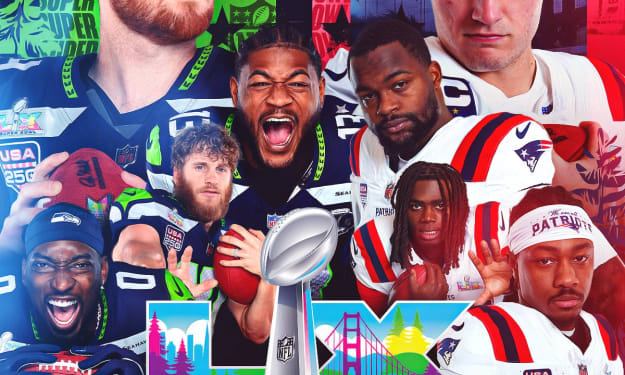
Super Bowl LX Recap: A Team Called Hawks
Sixty. The Super Bowl turned 60! Still amazes me that this was the sixtieth Super Bowl played in NFL history. It seems like yesterday that I watched Super Bowl XXVII, the first SB I ever watched. The QB who won Super Bowl XXVII has since called a few SBs, and will call next year's game, but that's another story. Super Bowl LX took place at Levi's Stadium in Santa Clara, California, the home stadium of the San Francisco 49ers. However, it was one of their division foes who represented the NFC, as the Seattle Seahawks faced off against the New England Patriots.
By Clyde E. Dawkins9 days ago in Unbalanced
2026 Winter Olympics Ice Hockey
Ice hockey has long been one of the defining events of the Winter Olympic Games, combining speed, strategy, and national pride in a way few other sports can match. As the world turns its attention to the 2026 Winter Olympics in Milan and Cortina d’Ampezzo, ice hockey is once again expected to take center stage. With historic rivalries, emerging talent, and the possibility of top professional players competing, the tournament promises to be one of the most compelling chapters in Olympic hockey history.
By Saboor Brohi 7 days ago in Unbalanced
What Happens To Your Brain When You Stop Multitasking
Digital technology is the culprit that is causing us to doom scroll when tired, disengaged and unmotivated with the content that motivated you to log onto your device to consume in the first place. That is only the beginning. In the modern workplace (and even when filing cabinets were around, I confirmed this with my adopted parents to get my facts right); reading files while you are supposed to be present to the caller on the other end of the phone line is another classic example of multitasking that causes your brain (although adaptable and intelligent) to lose focus and concentration.
By Justine Crowley4 days ago in Psyche



Comments