
The Great Binary Branding
Why Does My Coffee Cup Have a Gender?
"The clock has struck three, the coffee is cold, and the shadows are beginning to speak. Welcome back to the desk of The Night Writer. Tonight, we’re looking at the strange ways we label the world before it has a chance to label us."
I was standing in the "Home & Lifestyle" aisle of a big-box store yesterday, staring at two identical travel mugs. One was a matte, tactical charcoal grey; the other was a soft, iridescent lavender. Both were made of vacuum-sealed stainless steel. Both were designed to keep 16 ounces of liquid at a temperature high enough to sear the roof of your mouth.
But according to the packaging, they weren't just mugs. They were manifestos.
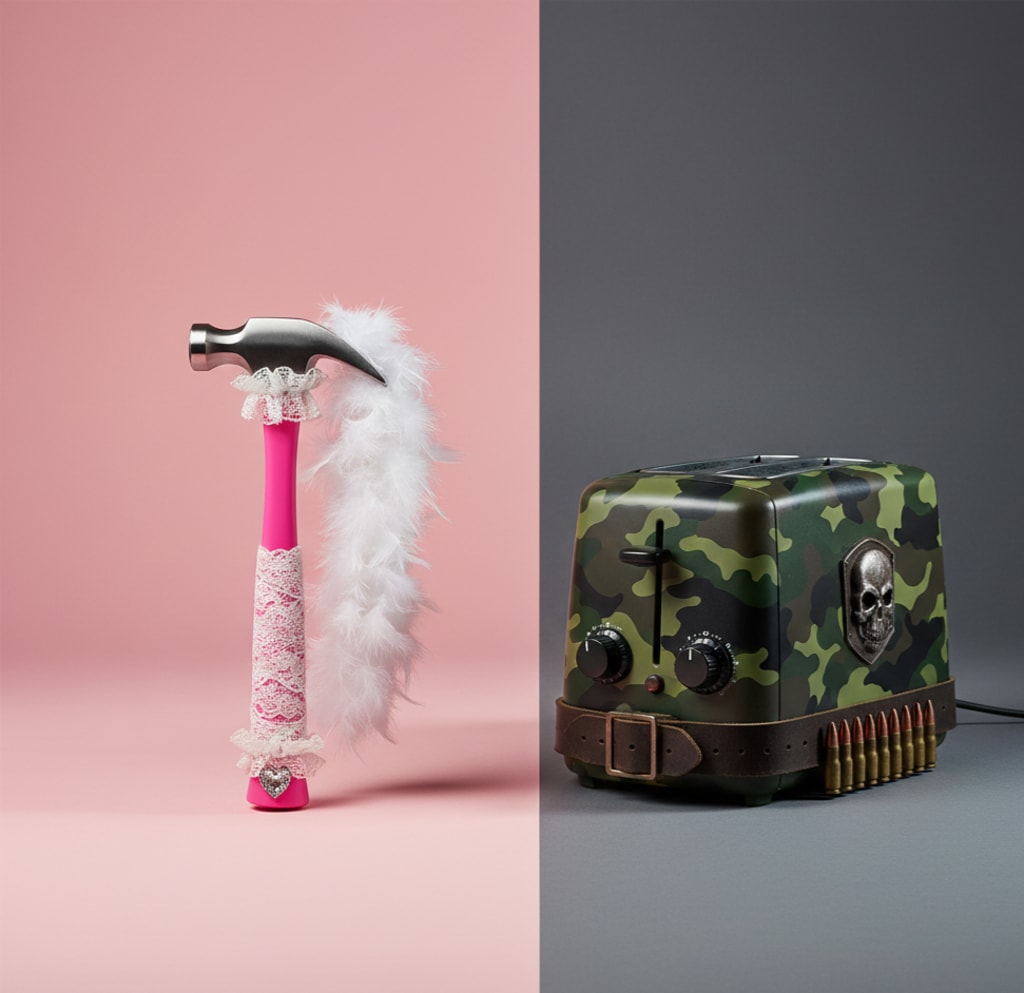
The grey one featured a rugged font that looked like it had been chiseled out of a granite quarry by a man named "Gunner." It was marketed as "The Commander"—built for the "modern man’s commute." The lavender one, however, was "The Grace," featuring a delicate script and a promise to "fit perfectly in a woman’s hand."
I stood there, looking at my own hands, wondering if my coffee knew which one was holding it. Does the caffeine molecules check my anatomy before decided to kick in? At what point did we decide that even our inanimate objects needed to be identified by what’s under their metaphorical hood?
Welcome to the era of The Great Binary Branding. We are living in a time where everything—from the trucks we drive to the yogurt we eat—is being aggressively gendered, as if we’re all terrified that using the "wrong" product will cause a spontaneous physiological transformation.
The Heavy-Duty Masquerade
Let’s talk about trucks. If you watch a truck commercial in 2026, you’d think you were watching a recruitment video for a Spartan army. The voiceover is always a man with a throat full of gravel, whispering about "torque," "dominance," and "heritage." The truck is framed as a steel extension of the male ego.
But here’s the debatable part: Why? A truck is a tool. It hauls mulch; it carries drywall; it gets you through the snow. Does the truck care if the person behind the wheel is wearing a floral dress or a flannel shirt? Of course not. Yet, we have "His and Hers" versions of vehicles that cost $70,000. We’ve turned mechanical engineering into a performance of identity. If a woman drives a "man’s truck," she’s "badass." If a man drives a "woman’s car" (you know the ones—the cute, rounded SUVs), he’s suddenly the butt of a joke at the local bar.
It’s hilarious because it’s so fragile. We are so obsessed with identifying via genitals that we’ve created a world where a man can’t use a "pomegranate-infused" shampoo without feeling like he’s betrayed his ancestors, so the company has to rename it "TITANIC BLAST: DEEP RECOVERY" and put it in a bottle shaped like a motor oil canister.
The Pink Tax vs. The Blue Ego
This leads us to the most relatable (and frustrating) part of the phenomenon: The price tag. Everyone has heard of the "Pink Tax"—the fact that a pink razor costs $2 more than a blue one, despite having the exact same number of blades. But we rarely talk about the "Blue Tax," which is the psychological price men pay to feel "manly" while doing basic human tasks.
I recently saw "Manly Candles." They weren't scented like vanilla or lavender (heaven forbid!). They were scented like "Tobacco and Leather" or "Sawdust and Gunpowder." Because apparently, a man can’t enjoy a pleasant-smelling living room unless it reminds him of a 19th-century workshop or a shootout in a Western film.
We are obsessed with these distinctions because they provide a sense of order. In a world that is becoming increasingly fluid and complex, people cling to the binary of their belongings. If I buy the "manly" yogurt with the black packaging and the bold "PRO" lettering, I am reaffirming my place in the world. If I buy the "feminine" yogurt with the swirls and the "light" branding, I am signaling something else.
But it’s just fermented milk, folks. The bacteria in the yogurt don’t have a gender preference.
As a Night Writer, I find the language of this branding to be the most revealing part of the "Forbidden." We use adjectives like "sturdy," "aggressive," and "bold" for one side, and "soft," "gentle," and "radiant" for the other. We’ve gendered the English language to the point where we are no longer describing objects; we are describing stereotypes.
Is it a harmless marketing tactic, or is it a deeper symptom of a society that doesn't know how to define itself without a label? We want our trucks to be "male" and our cups to be "female" because we’re afraid of the middle ground. We’re afraid of a world where a cup is just a cup, and a person is just a person.
So, next time you’re in the store, I dare you to cross the aisle. Buy the "wrong" color. Use the "masculine" pens to write a "feminine" poem. Because at the end of the day, the gear doesn’t care about your genitals—it just wants to work.
Marketing the Human Experience
The psychology of "Gendered Marketing" is a multi-billion dollar industry. According to consumer behavior studies, brands use these binary identifiers because they trigger "ingroup" loyalty. It’s a shortcut for our brains. If a product looks like us (or who we want to be), we buy it.
The debate lies in whether this helps us express our identity or if it forces us into boxes we never asked to inhabit. When we start gendering things that have no business being gendered—like pens, staplers, or power tools—we aren't just selling products; we're reinforcing a divide that doesn't exist in nature.
"Daylight is coming to claim the quiet, but these words stay with you. If you enjoyed this journey into the midnight hours, leave a heart or a tip to keep the candles burning. Sleep well—if you can. — The Night Writer."
About the Creator
The Night Writer 🌙
Moonlight is my ink, and the silence of 3 AM is my canvas. As The Night Writer, I turn the world's whispers into stories while you sleep. Dive into the shadows with me on Vocal. 🌙✨
Keep reading
More stories from The Night Writer 🌙 and writers in Viva and other communities.
How to Take the Best Photos in Otaru’s Most Scenic Spots
One of the prettiest towns in Hokkaido, Japan, Otaru is a place with an undeniable nostalgic feel. With its charming streets lit by gas lamps, the canal, and old warehouses, it’s a town that makes you feel as though you’ve just stepped into the past – it’s a wonderful feeling. You could be visiting for a day or planning to stay a bit longer – however long it is, if you have your camera with you, you’ll be endlessly clicking away.
By Claudia Fennelabout 13 hours ago in Viva
I Interviewed 10 Couples Who “Met Offline”: Their Advice for 2026 Dating Is Terrifyingly Simple
Dating in 2026 feels exhausting. Swiping never ends, conversations disappear without explanation, and it often feels like connection is something you’re supposed to optimize rather than experience.
By Yash Kurhe3 days ago in Viva



Comments
There are no comments for this story
Be the first to respond and start the conversation.