
Beyond the Border: Lessons From the Open Road
What driving across borders really teaches us about travel and freedom

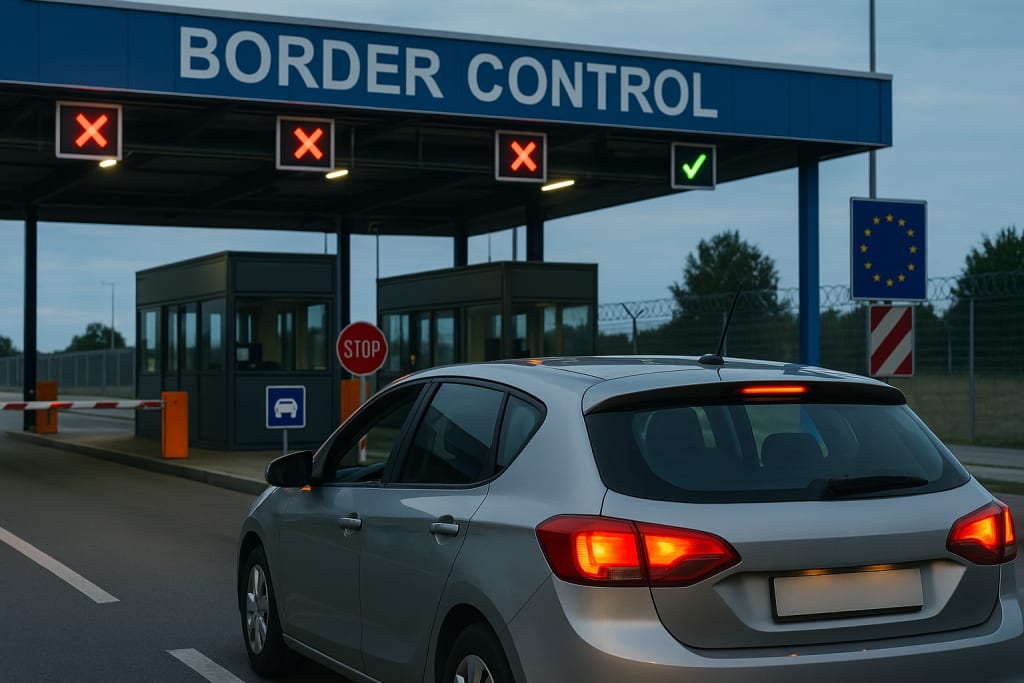
What crossing borders by car really teaches us about freedom, patience, and the invisible lines that shape our lives
There’s something almost cinematic about it: a car packed with snacks, maps, and restless energy, rolling down the highway until the road doesn’t just lead to another city, but to another country. No airport check-in counters, no overhead baggage limits, no waiting for boarding groups to be called. Just the hum of tires and the anticipation of what lies beyond an invisible line that humans drew centuries ago.
Driving across borders is one of the purest forms of travel freedom, yet also one of the most misunderstood. On paper, it sounds simple: hop in the car in one country, and hours later, you’re in another. In reality, it’s a dance between paperwork and patience, between personal dreams and political decisions, between the open road and the closed gate of a border control booth.
⸻
The Romantic Ideal vs. The Harsh Reality
Movies make it look easy. Think of European road trip comedies where a group of friends somehow makes it from Paris to Prague in what feels like two montage scenes. The truth, as anyone who has tried knows, is messier. Borders aren’t just symbolic lines; they are gates of bureaucracy.
You pull up to the crossing. Suddenly, the casual confidence of driving evaporates as uniformed officers wave you forward. Passports are inspected, visas verified, trunks opened, questions asked. Why are you here? How long will you stay? Do you have proof of accommodation? Even when you’ve done everything right, there’s still that brief flicker of anxiety — what if something’s missing, what if you misunderstood a requirement?
And yet, when the barrier finally lifts and you drive into a new country, the relief is unmatched. It feels like winning an unspoken challenge, a rite of passage that airplanes robbed us of.
⸻
Borders as Teachers of Patience
Every border has its own character. Some are efficient, almost friendly, with officials stamping your passport in seconds. Others test your endurance: endless queues of cars, idling engines, and hours of watching the same license plates ahead of you move inch by inch.
It is here, stuck in a border jam, that travelers learn the hardest skill: patience. Time stretches differently at a border. Five minutes feels like half an hour, and half an hour feels like eternity. Yet in those moments, something shifts. You notice the details — the roadside vendors selling coffee and cigarettes, the kids playing tag between parked cars, the stories written in the faces of other travelers who, like you, are waiting for permission to move forward.
Patience at borders is not wasted time; it is the price of perspective.
⸻
A Mirror of Politics and Culture
Borders aren’t neutral. They reflect history, politics, and culture in ways you can’t ignore. A friendly wave through one crossing might be replaced by suspicion and interrogation at another, even when you, the traveler, remain the same.
Consider the European Union’s Schengen zone, where you can drive from Germany into France almost without noticing — just a small road sign that says “Bienvenue.” Contrast that with Eastern Europe or parts of Asia, where border stations are armed, fortified, and heavy with tension. The difference is more than logistical; it’s emotional. It reveals which nations trust one another and which remain haunted by the ghosts of history.
Crossing borders reminds us that mobility is not equally accessible to all. What feels like a weekend adventure for some can be a near-impossible dream for others, blocked by visa restrictions, political disputes, or the luck of birthplace.
⸻
The Transformation of the Traveler
Something changes when you drive yourself across borders. Unlike flying, where the transition from one country to another is compressed into a controlled experience, driving exposes you to the geography of separation. You see the land that divides, the fences, the checkpoints. You understand distance in a way that an airplane seat never could.
And as you pass through, you’re forced to adapt quickly. Road signs switch languages. Speed limits suddenly convert from miles to kilometers. Gasoline might be cheaper, but tolls more expensive. Even the air feels different — carrying the scent of a new country’s soil, industry, or cuisine.
Borders reshape not just your travel but your identity. They remind you that you are a guest, a visitor, sometimes welcome and sometimes tolerated. The road teaches humility.
⸻
Stories From the Road
• The Midnight Crossing: There’s a strange beauty in arriving at a border in the middle of the night. Headlights line up like fireflies, engines rumble in the silence, and officers seem half-asleep as they inspect documents. The world feels paused, suspended between one country and the next.
• The Unexpected Friendship: Borders, for all their tension, can also spark unlikely human connections. Strangers who waited beside you for hours may suddenly share food, stories, or tips about what awaits on the other side. In those moments, borders unite even as they divide.
• The Crushing Rejection: Not every attempt succeeds. Some travelers are turned back, denied for missing papers, expired visas, or sheer bad luck. Few experiences are as deflating as watching your journey end at a gate that will not open. It is a harsh reminder of privilege and policy.
⸻
Why We Still Choose the Road
Despite the hassle, people keep choosing to cross borders by car. Why? Because it gives you something no plane ticket ever will: the continuity of journey. You feel every mile. You see the landscape slowly morph. You meet people along the way. The road is alive with details, and each border is not just a barrier but a story.
To cross a border by car is to understand, in the deepest sense, that travel is not about arrival. It’s about the lines we cross, the patience we learn, and the stories we gather at the edges of nations.
⸻
Final Reflection
Borders are contradictions. They separate but also connect, restrict but also define. Driving across them is a reminder that freedom is fragile, that privilege is unevenly distributed, and that patience is still one of the traveler’s greatest companions.
The road teaches you something every airport lounge never could: that the world is both bigger and smaller than you imagined. And that sometimes, the most meaningful journeys aren’t just about where you’re going, but about the invisible lines you had to cross to get there.
About the Creator
Ahmet Kıvanç Demirkıran
As a technology and innovation enthusiast, I aim to bring fresh perspectives to my readers, drawing from my experience.
Keep reading
More stories from Ahmet Kıvanç Demirkıran and writers in Wander and other communities.
Seattle Nightlife Report: Pony
Mid-winter Friday night. Early but already so dark. The days are getting longer but 6 PM is still pitch black. “Firepit!” You declare things after just a few seconds of solemn thought – not a request or suggestion, not a demand. Last week you walked around saying, “Hot tub?” to anyone who would listen. Or one afternoon you pointed at two men holding hands as they crossed 12th Avenue, looked me in the eyes and said, “Boyfriends.”
By Joe Nasta | Seattle foodie poet12 days ago in Wander




Comments (3)
What a beautifully written story!
Lovely story well done💙💙💙
Nice story