
When the River Turned to Dust
The Rise and Fall of Mohenjo-Daro, the Jewel of the Indus

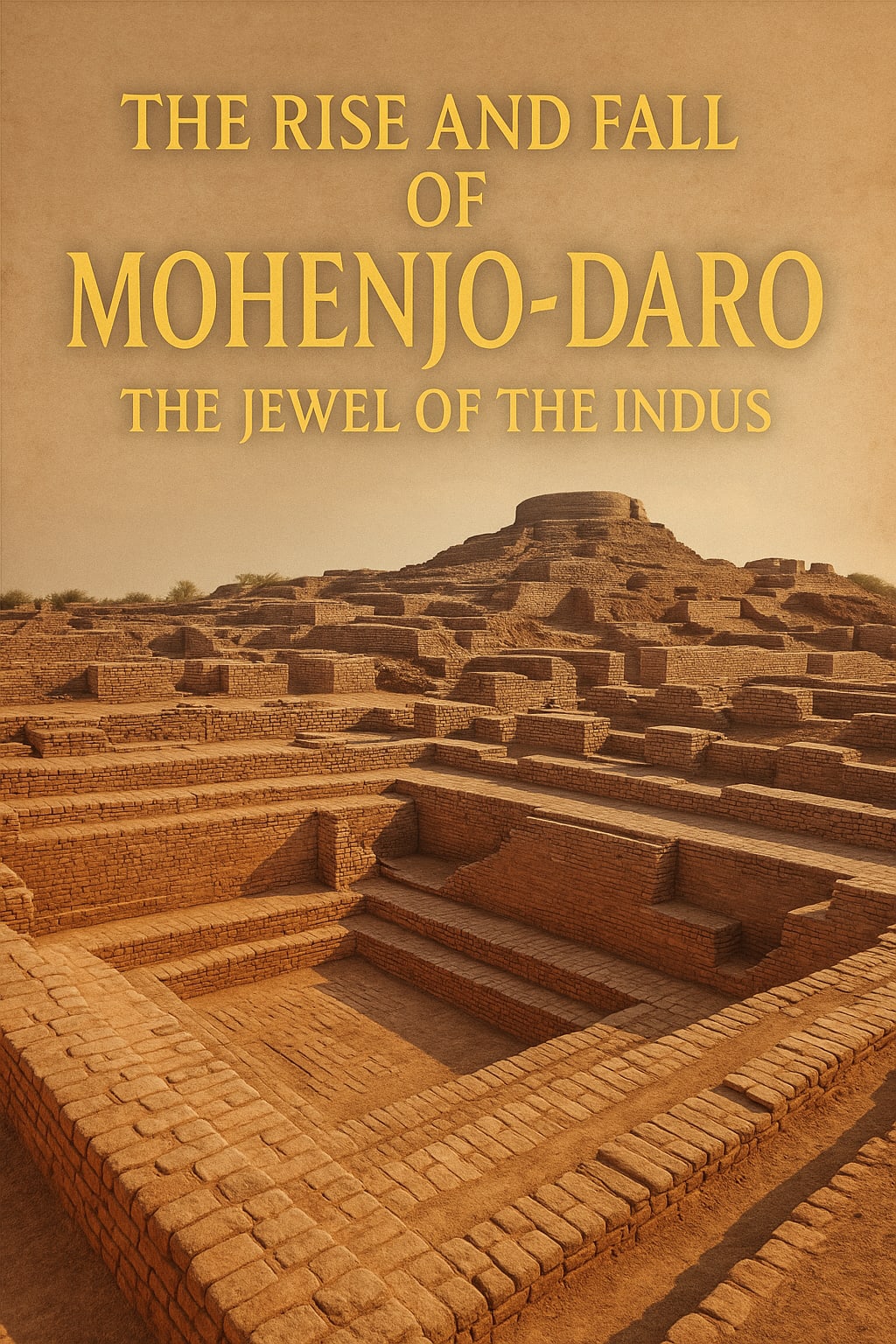
Under the scorching sun of the Sindh desert, time seems to pause over the dust-covered ruins of Mohenjo-Daro, an ancient city that once pulsed with life. The wind carries forgotten whispers through its crumbling streets, speaking of a time when knowledge, architecture, and civilization thrived in the heart of the Indus Valley.
In the year 2025, Ayaan, a 22-year-old archaeology student from Karachi, embarks on a university project with a deep passion to unearth stories hidden beneath the soil. Unlike his classmates, who saw fieldwork as just another academic requirement, Ayaan felt a strange connection to this ancient city — as if its ruins called to him.
“Why does this place haunt me even in dreams?” he wondered, stepping carefully over stone pavements laid 4,000 years ago. His hands ran across the smooth baked bricks — identical in size, perfectly aligned. “How did they achieve such perfection without machines?”
Ayaan was assigned to assist Professor Shabana, a respected but strict archaeologist known for her sharp intellect and lack of patience. She had been working at Mohenjo-Daro for decades and believed there were still secrets to uncover, despite many claiming the site had given up all it had.
One afternoon, while studying what was believed to be an ancient granary, Ayaan noticed a slight depression in the ground near the corner — a patch that didn’t match the rest of the surface. Curious, he began to clear away the dirt with care. To his astonishment, he found a stone tablet covered in unfamiliar symbols.
“Professor! You need to see this!” he shouted.
The professor rushed over, her expression changing from irritation to disbelief.
“This... This could be new,” she murmured, kneeling beside him.
The symbols weren’t like the usual Indus script found across seals and artifacts. These were more intricate, more stylized. Ayaan took photos and scanned the tablet, and the team began analyzing it that night.
Weeks passed. The symbols slowly began to make sense — not through translation but by comparing recurring patterns, much like how ancient Egyptian hieroglyphs were first cracked. Ayaan spent sleepless nights decoding until he formed a basic narrative.
The tablet spoke of a "Sky Fire" and “The Silence Day.” It described a time when the skies burned, the river turned to mud, and the city fell into chaos. It wasn’t war or disease that ended Mohenjo-Daro — it was something far more mysterious. A massive explosion or natural disaster, so sudden and powerful, that it turned day into night.
Could this be the reason for the abrupt disappearance of such an advanced civilization?
The more Ayaan dug, the more strange clues appeared: skeletal remains with no visible injuries but lying in the streets as if death came without warning. Some walls showed signs of exposure to extreme heat — like they were baked in seconds.
Rumors of a “prehistoric atomic blast” had long been dismissed as fiction. But now, standing amidst the ruins with this evidence, Ayaan wasn’t so sure.
One evening, under the light of a setting sun, Professor Shabana gathered the team.
“We have enough data to publish a new theory,” she said. “Mohenjo-Daro might have been destroyed by a catastrophic event — possibly a meteor strike or a volcanic explosion that left no crater but turned life to ash in an instant.”
The academic world buzzed with excitement and skepticism. News channels dubbed Ayaan “the boy who heard ancient whispers.” He never sought fame — only the truth.
Months later, a major discovery confirmed it. Scientists using satellite scans found unusual magnetic signatures beneath the city. The soil had traces of a high-temperature anomaly, consistent with a massive thermal event — but not one caused by human warfare.
Mohenjo-Daro, once thought to be a city that quietly faded away, had died in a moment of horror and mystery.
But Ayaan saw it differently.
“Mohenjo-Daro did not die,” he said in a televised interview. “It lived longer than most civilizations ever will. It left behind architecture that defied time, urban planning more advanced than some modern cities, and a spirit of harmony. Its end was tragic, yes — but its legacy, immortal.”
On his final day at the site, Ayaan walked alone to the Great Bath — a large, finely-built pool once used for ritual purification. As the wind whispered through the ancient walls, he placed a hand on the edge and closed his eyes.
“I hear you,” he whispered. “Your story will not be forgotten.”
And just like that, Mohenjo-Daro spoke again — not in words, but through the hearts of those who listened.
---
[The End]
About the Creator
Raza Ullah
Raza Ullah writes heartfelt stories about family, education, history, and human values. His work reflects real-life struggles, love, and culture—aiming to inspire, teach, and connect people through meaningful storytelling.
Keep reading
More stories from Raza Ullah and writers in Wander and other communities.
Seattle Nightlife Report: Pony
Mid-winter Friday night. Early but already so dark. The days are getting longer but 6 PM is still pitch black. “Firepit!” You declare things after just a few seconds of solemn thought – not a request or suggestion, not a demand. Last week you walked around saying, “Hot tub?” to anyone who would listen. Or one afternoon you pointed at two men holding hands as they crossed 12th Avenue, looked me in the eyes and said, “Boyfriends.”
By Joe Nasta | Seattle foodie poet14 days ago in Wander
A Little History In Heptonstall
Introduction Last week I holidayed in Hebden Bridge in Yorkshire and discovered a couple of things that I didn't know before getting there. One thing I did know is that several BBC series have been filmed there, "Happy Valley" and the current "Riot Women":
By Mike Singleton 💜 Mikeydred 3 days ago in Wander



Comments (1)
Mohin jo daro pakistan sindh.