
Bee Charge EV Quietly Arrives in Ohio and Drivers Are Already Breathing Easier
Bee Charge EV is a California-born start-up.

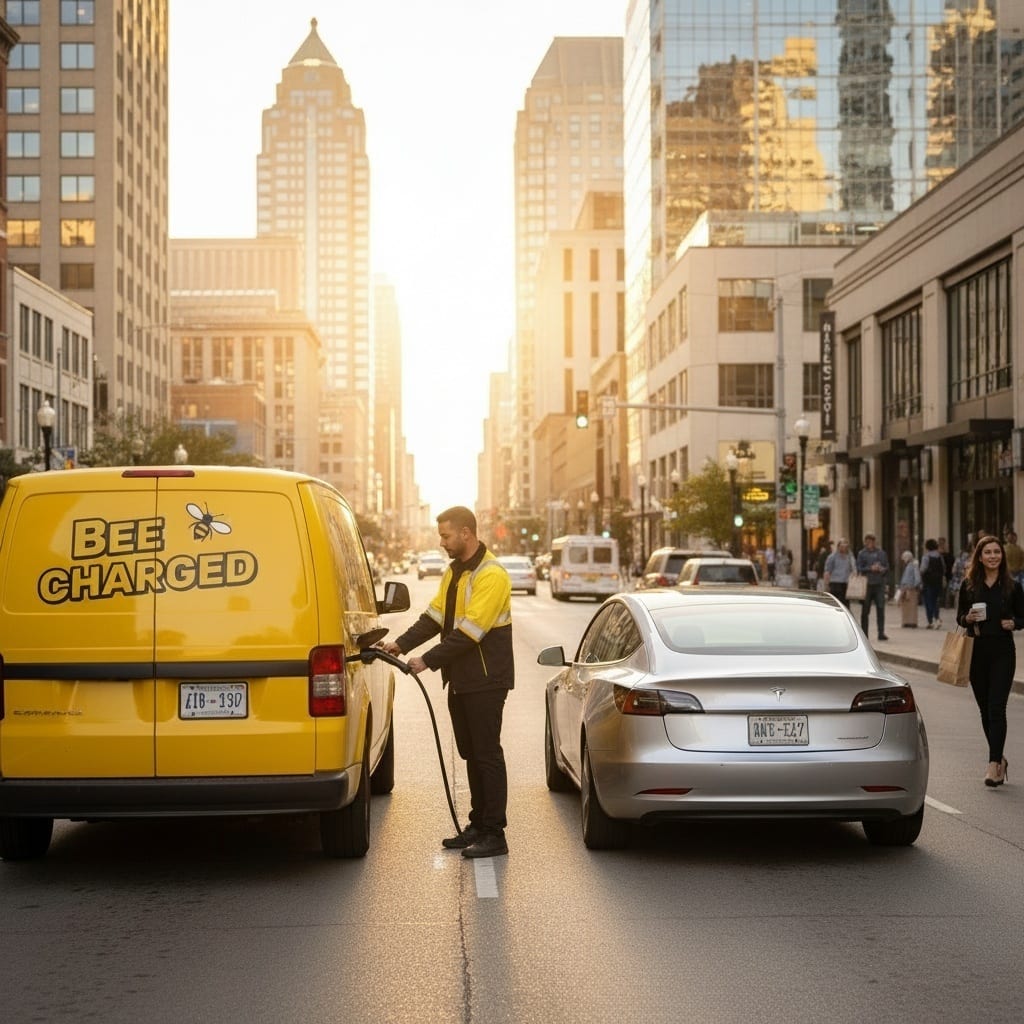
If you listen closely along the I-70 corridor these days, you might hear the low hum of a yellow Mercedes eSprinter easing onto the shoulder. Pop the rear doors and you’ll find a 50 kW mobile charger ready to rescue the anxious commuter who just watched their range gauge dip below ten percent. No fanfare, no press scrum—just a technician in a honey-comb polo plugging in a CCS cable while traffic rolls by.
That understated scene is exactly how Bee Charge EV prefers to enter a new market. The California-born start-up, best known for rescuing Teslas outside Dodger Stadium and keeping Amazon delivery vans rolling in Dallas, officially opened its Ohio network on the first of October. The expansion was soft-launched to fleet partners in August; word-of-mouth among rideshare drivers did the rest. Within six weeks the dispatch phone—888-675-9555—was ringing almost once a minute during peak hours.
Company founder Alex Ramirez, a former Nissan Leaf product planner who grew up in Dayton, says Ohio felt overdue. “We looked at registration data: 42,000 full EVs on Ohio roads in January, heading toward 65,000 by year-end. Public charger utilization rates are above 35 percent on weekends. That’s California-level congestion, but the density of fast chargers here is still half the national average.” Translation: plenty of drivers, not enough plugs.
Rather than pour concrete and wait eighteen months for utility upgrades, Bee Charge decided to bring the plug along for the ride. Each van carries 175 kWh of lithium-iron-phosphate packs; an onboard inverter can push 50 kW DC or trickle 9.6 kW Level-2 through a standard J1772. A single tech handles the session, logging kilowatts and payment through a ruggedized tablet. Customers pay a $9 dispatch fee plus forty-seven cents per kWh—cheaper than most urban fast hubs once you factor in idle fees and the three-dollar lattas you buy while waiting.
The beauty of the model, says Akron fleet manager Maria Kline, is elasticity. Kline oversees thirty electric delivery vans for QuickShip Ohio. “My vans return to Grove City at 7 p.m. with maybe 18 percent left. Instead of paying drivers two hours of overtime to reach the nearest 150 kW site, I schedule two Bee Charge vans for 8:30. They’re gone by ten, and my batteries sit at 90 percent when the morning shift clocks in.” She estimates the service is shaving ninety minutes off every daily cycle—worth roughly $4,200 a week in driver wages and lost throughput.
Individual drivers seem equally content. On a drizzly Thursday outside a Clintonville apartment complex, recent Ohio State grad Devon Harris watches a technician top up his Chevy Bolt. “Landlord won’t let me run a 240 line to the carport,” he shrugs. “This is my third charge this month—still beats visiting the Kroger stalls where half the dispensers are broken.”
Coverage maps show seven honey-comb icons scattered across the state: Columbus hub (Dublin), Cleveland (Brook Park), Cincinnati (Norwood), Dayton (Miamisburg), Toledo (Maumee), Akron-Canton (Green), and Youngstown (Austintown). From each depot, vans fan out along the spoke-and-hub pattern Ramirez copied from his college logistics class. The company guarantees a forty-mile service radius per hub, which blankets every suburb worth mentioning and reaches well into rural counties where Level-3 stations are still mythical.
Interstate coverage follows a similar philosophy. Bee Charge keeps two “roamers” per corridor during peak travel windows—Friday afternoons, Sunday evenings, holiday eves. The roamers stage at rest areas, scanning customer apps for distress pings. Average arrival time is thirty-four minutes, according to internal data shared with this writer, although Columbus traffic can push that closer to fifty.
Ramirez is quick to point out that Bee Charge isn’t trying to replace fixed infrastructure; it’s gap insurance. “Every time a driver uses us at home overnight, that’s one fewer car idling at a public fast charger tomorrow. We become a pressure release valve while utilities and site hosts catch up.”
For the moment, the company is bankrolling the Ohio build-out with a combination of Series B equity and a revolving credit line tied to vehicle leases. No public subsidies—though Ramirez confesses he’s eyeing Ohio EPA’s new Diesel Mitigation Trust grants for a future round of battery trailers. “If we can park stationary packs at fleet depots during the day, vans haul less weight and we extend range. Everybody wins.”
Competition is circling. SparkCharge, the Boston outfit that popularized the “charge-where-you-are” slogan, already advertises in Cleveland. A handful of local tow companies have bolted 25 kW generators onto flatbeds. Ramirez welcomes the noise. “More players validate the category. Our differentiator is scale: fifteen vans on day one, local hiring, and a single statewide number that never goes to voicemail.”
Back on the roadside, the yellow van finishes its session. Harris’ Bolt shows 192 miles of range; the technician snaps a photo, emails a receipt, and merges into traffic. No press release, no confetti—just another Thursday in Ohio, where the future of electric mobility increasingly arrives on four wheels, carrying its own extension cord.
If you spot the hive, flag it down. Or, simpler still, ring 888-675-9555 and let the bees come to you.
About the Creator
Oliver Jones Jr.
Oliver Jones Jr. is a journalist with a keen interest in the dynamic worlds of technology, business, and entrepreneurship.
Keep reading
More stories from Oliver Jones Jr. and writers in Wheel and other communities.
Orlando EV Mobile Charging Officially Launches - Bringing 24/7 Emergency EV Charging Directly to Your Location
The future of electric vehicle charging has arrived in Central Florida. Orlando EV Mobile Charging officially opens its doors today, launching the region's first comprehensive 24/7 mobile EV charging network designed to eliminate range anxiety and provide emergency charging wherever you are, whenever you need it.
By Oliver Jones Jr.6 months ago in Wheel
Are Hybrid Cars A Smart Choice For Today’s Drivers?
A hybrid car uses two different power systems working together: a petrol engine and an electric motor. Instead of relying on one source of energy, the vehicle decides which system to use based on speed, changes in speed and how the vehicle is driven. At lower speeds, such as when moving through city streets or sitting in traffic, the electric motor often takes the lead. When higher power is needed, the petrol engine steps in. This combination is designed to reduce fuel use while keeping the driving experience familiar for everyday motorists.
By Austin Peck7 days ago in Wheel
From the Low Banks of the Cumberland River to the High Banks in the 16
One of the best abilities to have is adaptability. Nobody exemplified that more than Greg Biffle. It didn't matter what he drove, Biffle would find his way to the front of the field. The winningest driver in the 16 car, he totalled 19 wins in the cup series alone.
By Ben Hercik4 days ago in Wheel



Comments
There are no comments for this story
Be the first to respond and start the conversation.