
Real-World Examples of AI vs Automation in Enterprise Operations
A practical comparison of AI and automation in modern business operations.
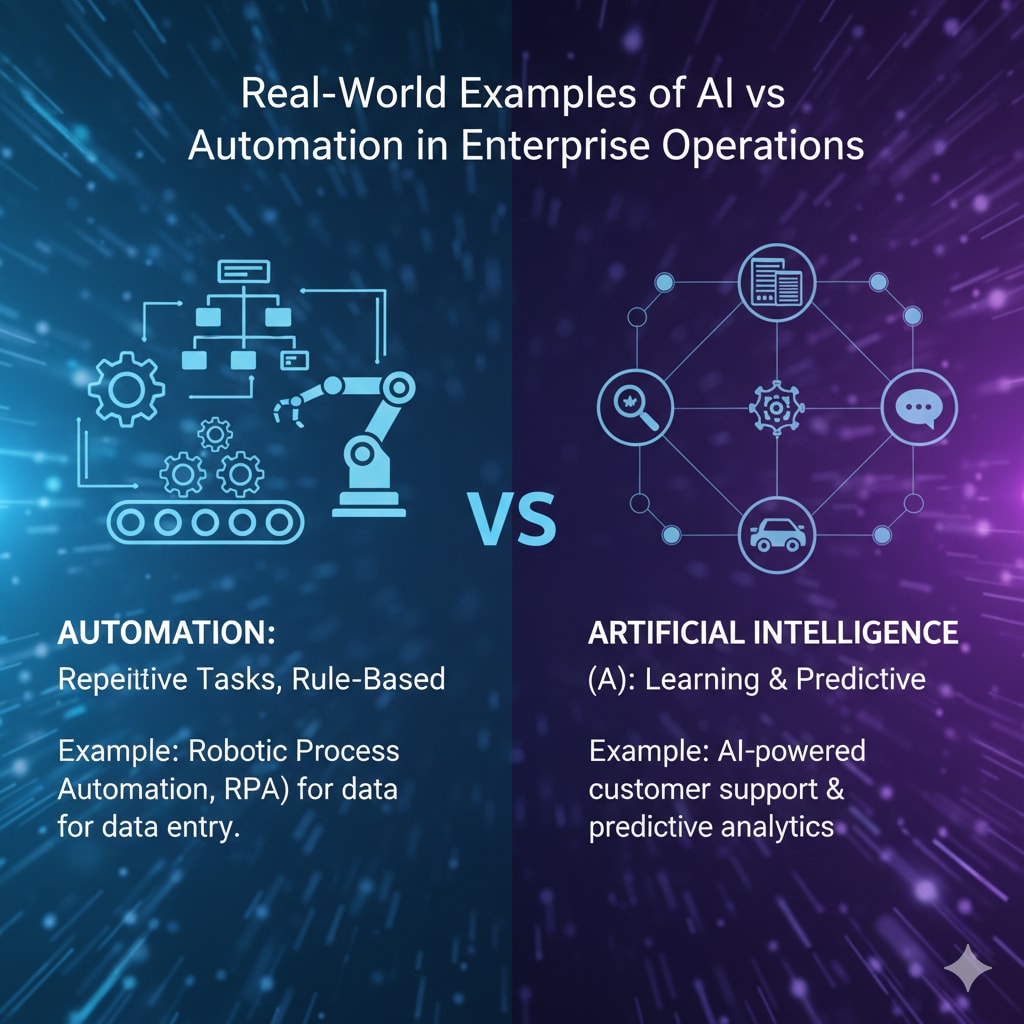
As enterprises accelerate digital transformation, the debate around AI vs automation continues to shape investment strategies. While both technologies improve efficiency, they are not the same. Automation follows predefined rules. Artificial Intelligence (AI) learns, adapts, and makes decisions based on data.
Understanding where each fits and how they complement each other is critical for operational success.
AI vs Automation: What’s the Core Difference?
- Automation
- Rule-based
- Executes repetitive tasks
- Follows structured workflows
- Requires predefined inputs
Artificial Intelligence (AI)
- Learns from data
- Makes predictions or decisions
- Handles unstructured information
- Improves over time
- Automation is about doing tasks faster.
AI is about doing tasks smarter.
Enterprises typically start with automation and then layer AI for advanced decision-making.
Real-World Enterprise Examples
1. Customer Support Operations
Automation Example
A company uses automated email responses and ticket routing rules:
- If subject contains “refund” → Route to billing
- If priority = high → Escalate
This reduces manual sorting but cannot interpret nuance.
AI Example
AI-powered chatbots use natural language understanding to:
- Detect customer sentiment
- Understand complex queries
- Suggest personalized solutions
- Predict churn risk
Companies like Salesforce integrate AI into service platforms to enhance predictive customer engagement rather than just routing tickets.
Impact: AI improves customer satisfaction and proactive retention strategies.
2. Healthcare Revenue Cycle Management
Automation Example
Rule-based systems
- Auto-submit claims
- Flag missing fields
- Send standard denial notifications
These workflows follow strict logic.
AI Example
AI systems:
- Predict high-risk claims before submission
- Analyze denial patterns
- Recommend corrective actions
- Detect payer-specific trends
Organizations aligned with insights from the Healthcare Financial Management Association increasingly combine automation with AI analytics to improve financial outcomes.
Impact: Reduced denials and faster reimbursements.
3. Manufacturing Operations
Automation Example
Robotic arms on assembly lines:
- Perform repetitive welding
- Assemble components
- Package products
These machines operate based on fixed programming.
AI Example
AI-driven predictive maintenance systems:
- Analyze sensor data
- Predict equipment failure
- Optimize maintenance schedules
- Reduce downtime
Companies like Siemens integrate AI analytics into smart factories for real-time decision-making.
Impact: Lower downtime, reduced repair costs, optimized production.
4. Financial Fraud Detection
Automation Example
Rule-based fraud detection:
- Flag transactions over a set amount
- Block payments from high-risk countries
While effective, rigid rules create false positives.
AI Example
AI models:
- Analyze behavioral patterns
- Detect anomalies in real time
- Adapt to emerging fraud tactics
- Reduce false positives
Financial institutions leverage AI technologies from companies like IBM to improve fraud detection accuracy.
Impact: Improved security and enhanced customer experience.
5. HR & Talent Acquisition
Automation Example
Automated applicant tracking systems (ATS):
- Filter resumes by keywords
- Schedule interviews automatically
- Send template communications
AI Example
AI recruiting tools:
- Rank candidates based on skill match
- Analyze interview transcripts
- Predict job performance likelihood
- Identify bias patterns
Enterprises increasingly use AI-enhanced platforms built on ecosystems such as Workday for smarter workforce planning.
Impact: Faster hiring and better talent fit.
When to Use Automation vs AI
Automation is best suited for high-volume, repetitive tasks that follow structured workflows and predefined rules. It works well when processes are predictable, inputs are consistent, and the objective is to reduce manual effort and operational costs.
AI, on the other hand, is ideal for scenarios that involve decision-making under uncertainty, analyzing large volumes of unstructured data, detecting patterns, and delivering personalization at scale. It becomes especially valuable when systems must learn, adapt, and improve over time.
In most enterprise environments, the greatest impact comes from combining both. Automation handles execution efficiently, while AI adds intelligence, adaptability, and strategic insight to operations.
The Hybrid Enterprise Model
Leading organizations don’t choose between AI and automation — they integrate both.
Example workflow:
- Automation gathers and structures data
- AI analyzes patterns
- Automation executes decisions at scale
- Humans oversee strategy and exceptions
This layered model creates operational resilience and competitive advantage.
Final Thoughts
The conversation around ai vs automation is not about replacement — it’s about evolution.
Automation drives efficiency.
AI drives intelligence.
Enterprises that understand the distinction — and strategically implement both — gain measurable improvements in productivity, accuracy, and innovation.
In modern operations, automation builds the engine.
AI becomes the navigation system guiding where it should go next.
About the Creator
Keep reading
More stories from Lilly Scott and writers in Writers and other communities.
AI Voice Agents for Appointment Scheduling in Hospitals
Appointment scheduling is one of the most critical and often most overloaded functions inside hospitals. Between high patient call volumes, rescheduling requests, insurance questions, and last-minute cancellations, front-desk teams are constantly under pressure.
By Lilly Scottabout 10 hours ago in Writers
Unofficial Challenge: What would you do if you were rich?
I love the kind of work I get to do in my career, but as I job search and browse apartments again due to another understaffed and unsustainable work environment that I did not intend to get into, my daydreams of better days consistently lean into the same question: What would I do if I didn't have to worry about my basic needs being met?
By Kay Husnick2 days ago in Writers
Mid February 2026: 3 Goals Accomplished
As you can see from the image-- and the title-- I notched my 3rd writing goal for the year of 2026. Late January saw a funny day where I happened to accomplish 2 goals on the same day. It was one goal that I could control, and one that I couldn't... hence them happening on the same day. Midway through February, another one of my goals that I didn't have complete control over was accomplished!
By Stephen Kramer Avitabile2 days ago in Writers
Nancy Guthrie: Is a miracle still possible after close to two weeks?
Close to two weeks since Nancy Guthrie's abduction As of February 12, 2026, Nancy Guthrie remains classified as missing for 12 days, but there is no official confirmation that she is deceased. Blood matching Guthrie’s DNA was found on her front porch, indicating she likely suffered an injury during the abduction.
By Cheryl E Preston7 days ago in Geeks



Comments
There are no comments for this story
Be the first to respond and start the conversation.