
The Ghost of You
How memories linger long after the goodbye


I had accepted your leaving.
It wasn’t easy, and it didn’t happen overnight. Every night, I told myself: You’re gone. You’ve moved on. So should I. I repeated it like a mantra, hoping it would cement itself into my mind, hoping my heart would obey. But there was a cruel trick memory played on me. Accepting your absence was one thing. Forgetting the echo of you was another.
It started subtly. A song I once hated now reminded me of you. The smell of rain on the streets—something we had laughed about one evening—made my chest tighten. Little things. A corner of the café where we had first met. The way you tucked your hair behind your ear when you laughed. Tiny fragments of you that didn’t belong to anyone else.
At first, I thought these were harmless, nostalgic reminders. A bittersweet comfort. But soon, they became sharp, like pins in my skin. They stabbed when I least expected it. The world carried on in its normal rhythm—people laughed, buses honked, dogs barked—but my mind would stop mid-step, stuck in a loop of remembering.
I had learned to live without you, yes. I could go days without tears, go weeks without calling your name aloud. But your memories had a way of sneaking in, uninvited. They arrived like unannounced guests, settling into the corners of my mind and refusing to leave.
The worst was night. The quiet hours when the city dimmed, when the hum of life faded into a background murmur, that’s when your memory became unbearable. I would lie awake, staring at the ceiling, tracing the imaginary outline of your face in the darkness. It was cruel how the mind could replay your voice, your expressions, your jokes—yet the warmth, the touch, the presence, it was gone.
I tried everything. I wrote letters I never sent, poured my emotions into pages that were torn apart the next day. I blocked every trace of you on social media, deleted old photos, avoided places we had been. Nothing worked. Each attempt to push you away only seemed to amplify the memories. The harder I tried to erase you, the more persistent you became.
It wasn’t love anymore, not the kind that fills the chest and makes the heart race. It was an echo, a shadow that refused to fade. It was grief disguised as longing, a cruel hybrid of attachment and resignation. I realized that acceptance had limits. I could accept your leaving, yes, but the mind does not recognize that rule. The mind remembers what it wants, even if it hurts.
There were moments when I imagined seeing you again. Not to return to what we had, not to speak words we had left unsaid. I just wanted one glance, a single confirmation that you were real, that our time had not been a dream my heart had conjured to haunt me. And then reality would crash in—the knowledge that you were somewhere, laughing with someone else, living a life where I was a ghost. The memory of you would tighten its grip like iron bands around my chest.
I became a stranger to myself. I laughed in public, held conversations, performed my daily rituals, but inside, I was suspended in a limbo where your memory was the only constant. Friends asked why I seemed distant, why my eyes sometimes looked lost. I couldn’t explain. How do you explain a mind that clings to the departed? How do you describe a heart that accepts absence but cannot accept the relentless recall?
Some nights, I envied the cruel oblivion of sleep. In dreams, I would see you. Not as you were when you left, not as the person you became in my memory, but as someone I had known and cherished. The dreams were tender and brief, and then I would wake up to a hollow reality that cut sharper than any dream could. Each awakening reminded me that memory could be merciless.
I found solace in writing, in pouring this weight into words. Maybe someday, someone would read and understand what it means to accept a departure but not the lingering presence of memory. To accept a goodbye but not the invisible chains that follow you into quiet rooms, into silent moments, into the cracks of your own life.
One day, I realized something crucial. The pain of remembering isn’t a weakness. It’s a testament. A testament to what was real. You existed. We existed. And even though it hurts, even though the memory claws at me when I least want it, it also proves that the time we shared was significant. That what we had mattered.
And maybe, in some strange way, that is enough.
I cannot stop remembering you. I cannot banish you from my mind. I have accepted that. But I can choose how I respond to these memories. I can honor them without being destroyed by them. I can let them exist like distant stars—bright, unreachable, but beautiful in their constancy.
So I live with it. The pain. The longing. The memories that visit me like stubborn, uninvited ghosts. I live with the echo of your laughter, the phantom warmth of your touch, the sharp edges of your absence. I have accepted the leaving. And now, slowly, I am learning to accept the remembering.
Because perhaps, the cruelest part of love is not losing someone. Perhaps the cruelest part is learning that love does not end with goodbye. It continues, in whispers and shadows, in the silent ache of memory. It continues, quietly, relentlessly, like the tide that will not stop at the shore.
And I have decided: I will not fight it anymore. I will let the memories come, let them ache, let them linger. They are mine, after all. They are proof that I loved and was loved, proof that my heart once beat with a rhythm that matched another’s.
You are gone. And yet, you are here. In every thought, in every memory, in every quiet moment when the world fades and only your echo remains. And maybe, just maybe, living with that is the closest I will come to keeping you.
About the Creator
Luna Vani
I gather broken pieces and turn them into light
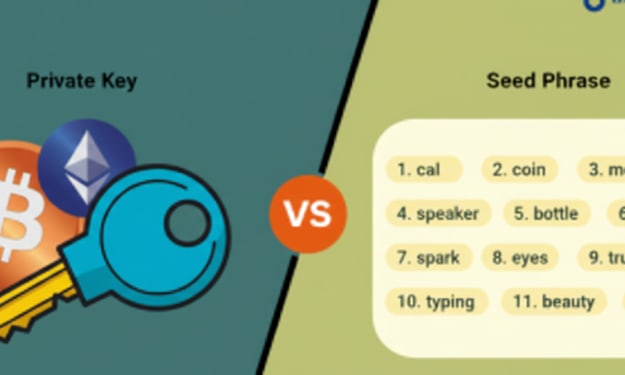
What Is a Seed Phrase and Why Is It Important?
I've witnessed countless heartbreaking stories of people losing fortunes because they didn't understand seed phrases. I've also seen the relief on faces when properly stored seed phrases saved their digital assets from disaster.
By Rowan Meritt2 days ago in Writers
Nancy Guthrie: Is a miracle still possible after close to two weeks?
Close to two weeks since Nancy Guthrie's abduction As of February 12, 2026, Nancy Guthrie remains classified as missing for 12 days, but there is no official confirmation that she is deceased. Blood matching Guthrie’s DNA was found on her front porch, indicating she likely suffered an injury during the abduction.
By Cheryl E Preston3 days ago in Geeks



Comments
There are no comments for this story
Be the first to respond and start the conversation.