
“The Pen That Wrote Its Own Ending”
When the story fights back, the writer must choose who controls the narrative.


“The Pen That Wrote Its Own Ending”
By [Ali Rehman]
Elias Rowan had written thousands of endings in his life — tragic ones, hopeful ones, endings that left readers breathless and endings that stitched broken hearts back together. But he had never struggled as much as he did now, sitting at his wooden desk on the edge of midnight, staring at a blank page.
His publisher needed his new novel’s final chapter by morning.
His readers were waiting.
His characters were waiting.
But Elias wasn’t writing.
His pen was.
It started three nights ago. He had fallen asleep at his desk, exhaustion heavy on his eyelids, and when he woke up the next morning, a full chapter sat on the page — written in a script too elegant, too smooth, too alive to be his.
At first, he thought he must have written it in a half-sleep trance. But as the days passed, the writing appeared even when the pen was untouched, resting on his desk like a creature waiting to be fed.
Tonight, the pen lay still. Its black-metal body gleamed softly under the lamp, almost as if it were breathing. Elias stared at it, unsure if he wanted it to move or desperately hoped it wouldn’t.
His hands trembled.
“I’m the writer,” he whispered into the quiet room. “Not you.”
The pen didn’t respond — not with words. It simply rolled an inch toward the paper.
Elias froze.
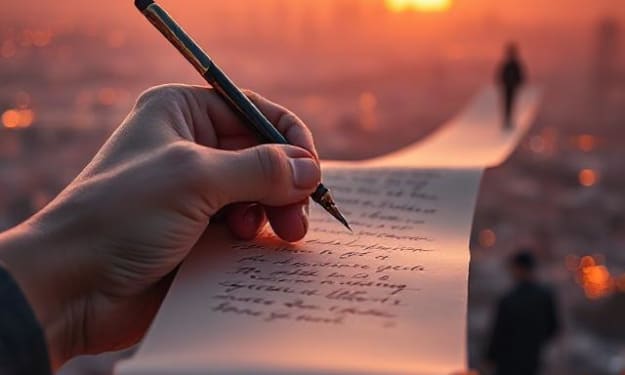
Then, with a smooth, graceful slide, the pen lifted from the desk, hovered just above the page, and began to write.
Not scribble. Not scratch.
Write.
Letter after letter formed effortlessly, like ink made of silk. Elias, terrified yet entranced, leaned closer. The words took shape in perfect cursive:
“You’ve lost control of your story, Elias. Let me help.”
He stumbled backward, knocking over a stack of books. His breathing quickened.
“No,” he whispered. “This is my story.”
The pen paused, then wrote:
“Is it? You’ve been avoiding the ending. You’re afraid of finishing it.”
Elias swallowed hard.
Because it was true.
He had created a character named Lira — brave, stubborn, breathtakingly alive. She had carried the entire novel on her shoulders, and Elias loved her more than he admitted. But the story demanded sacrifice, and the ending he’d planned for her… broke him.
He didn’t want to write it.
He didn’t want to lose her.
The pen moved again:
“Stories end, Elias. That’s their nature.”
He approached the desk slowly, like a man approaching a sleeping tiger.
“What do you want?” he asked.
The pen wrote a single line:
“A different ending.”
Elias felt a strange mixture of fear and hope twist inside him.
“A different ending for the book?”
The pen didn’t answer directly.
Instead, it wrote:
“A different ending for you.”
The room felt suddenly colder. Elias’s pulse thudded in his ears.
“What are you talking about?”
The pen scribbled faster now, strokes sharp and urgent:
“You write stories to escape your life.
You pour love into characters so you don’t have to love yourself.
You kill characters when you’re afraid of letting people get close.”
Elias felt the words hit him like blows.
“Stop,” he whispered.
But the pen continued:
“You hide in fiction. And you were about to kill Lira for the same reason.”
Elias staggered forward and grabbed the pen. It struggled, vibrating violently in his hand, trying to break free.
“Enough!” he shouted.
The lamp flickered. The room trembled.
Then the pen went still.
His breath came in ragged bursts. Slowly, he released it. The pen dropped onto the desk like a wounded creature.
Elias stared at the blank page. He could almost hear Lira’s voice — brave, fierce, alive — asking him to choose.
Not just her ending.
His own.
He dipped the pen in ink. It did not move on its own. It waited.
Elias placed the tip on the paper and whispered:
“…My ending. Not yours.”
Then he began to write.
Words flowed — not forced, not painful, but free. He rewrote Lira’s final chapter, not as a tragedy, but as a rebirth. She survived. She grew. She healed. And as he wrote her healing, he felt something inside himself mend too.
When he finished, he looked at the pen.
It lay quietly, peacefully, as if satisfied.
For the first time in years, Elias felt light. He closed the notebook gently and said,
“Thank you.”
As he turned off the lamp, he heard the faintest whisper — or maybe it was only his imagination.
“Well done, writer.”
The pen never wrote on its own again.
It didn’t have to.
Elias had taken back his story — and his life.
Moral:
The power to write your story is always in your hands.
Fear tries to hold the pen, doubt tries to write your ending — but the moment you choose courage, your narrative changes.
You are the author of your life. Always.
About the Creator
Ali Rehman
please read my articles and share.
Thank you
Keep reading
More stories from Ali Rehman and writers in Writers and other communities.
“The Author of My Tomorrow”
The Author of My Tomorrow By [Ali Rehman] I used to think I was the only author of my life — that every choice, every step, was mine alone to write. But lately, something strange has been happening. It’s as if someone else is holding the pen, scripting my days before I even live them.
By Ali Rehman3 months ago in Writers
Writing About Writing: The Rainbow Trap
The good thing about living in modern times is that LGBTQ representation in media is increasing. Not just in niche and Independant media, either, but also in mainstream media. Books, movies, TV shows, comics... they're finally catching on that LGBTQ+ people form a significant part of their audience, and deserve to see themselves on screen and in fiction, not just as victims in documentaries and true crime shows.
By Natasja Rose4 days ago in Writers



Comments
There are no comments for this story
Be the first to respond and start the conversation.