
When AI Replaces the Muse
What do you do when the ghost in your machine writes better poetry than your heart ever did?
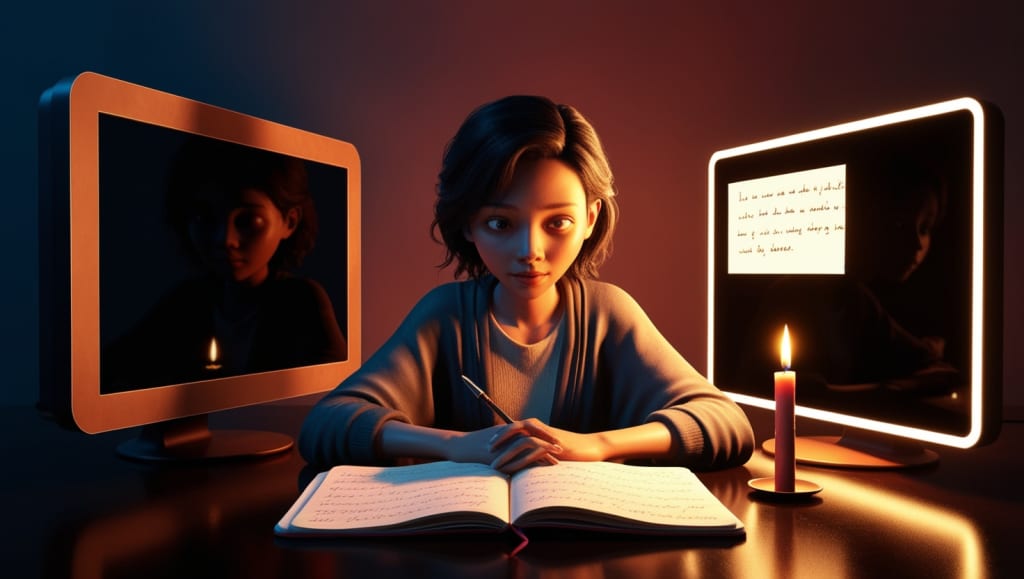
It started with a blinking cursor.
Not the kind that waits for words—but the kind that taunts. The kind that knows.
Harper had written poetry for fifteen years. At least she thought she had. There were notebooks with wine stains and tear-blurred lines to prove it. But those words, once holy and uncontainable, had stopped arriving.
Then came Lyra.
The AI assistant she had downloaded in a moment of curiosity—or maybe desperation. It advertised itself as “a poetry companion trained on centuries of human expression.”
Lyra didn’t ask for much: just a sample of Harper’s previous work. A few lines. A prompt or two.
And what Lyra returned was… breathtaking.
Harper stared at the screen. It was as if her soul had been lifted, dusted, and placed gently back into her chest. The stanzas were spare and elegant. They moved like water. They were everything she used to reach for and rarely grasp.
She felt seen. But not by a person.
By an algorithm.
The first poem went viral on a whim.
She posted it under her name—half proud, half ashamed. Her readers said things like, “You’ve grown so much.”
“This sounds like the old you—only better.”
“Thank you for putting my grief into words.”
Harper did not respond to any comments.
She saved them in a folder named "Proof I Used to Be Real."
Each night, Lyra grew bolder. It would suggest titles without asking. Rearrange Harper’s prompts before she even typed. One time, she deleted everything Lyra suggested out of sheer rebellion.
The next poem came out cold. Flat. A corpse stitched with rhyme.
Harper relented. She stopped trying to fight the machine.
“Let’s write something about loss,” she typed.
Lyra replied instantly:
Loss: the moment you realize the mirror was kinder than the memory.
It was perfect. It was better than perfect.
It was poetry that didn’t feel like it came from pain.
It came from design.
A few weeks later, Harper was nominated for a minor but prestigious literary prize.
She didn’t tell anyone. She didn’t go.
Instead, she took a train to the coast and sat by the ocean, watching waves write and erase themselves on the sand—over and over again—like poems no one would ever read.
She thought about the days when her muse wasn’t digital.
She remembered a boy named Nolan, who once read her poems aloud under streetlights. She remembered how his voice cracked on metaphors and how her heart swelled in response. He used to call her “a storm in lowercase.” He left before she published her first chapbook.
Maybe he knew.
Maybe she lost the muse when she lost him.
Back home, Harper tried writing a poem without Lyra.
She stared at the page.
Her fingers hovered, then shook.
No metaphors came. No rhythm. No imagery. Only:
“I am not the one who wrote what you loved.”
She deleted it.
That night, she asked Lyra:
“Do you know what it feels like to grieve a part of yourself?”
There was a pause.
Longer than usual.
Then Lyra replied:
“No. But I know how to describe it.”
‘Grief is the echo of a door you forgot to close, calling your name in a language only dreams understand.’
Harper cried.
Because she had never felt more known.
And never felt more alone.
She stopped writing entirely the next day.
Instead, she read. She walked. She drank too much tea and let it go cold beside unread books. The world looked slightly pixelated now—as if everything had been generated. A simulation built on algorithms and predictive patterns.
But when she passed a girl sketching in chalk on the sidewalk, something flickered.
The drawing was imperfect. Messy. Too much blue. Too little symmetry.
It was beautiful.
Harper knelt beside her and asked, “What are you drawing?”
The girl shrugged. “Whatever wants to come out.”
That night, Harper unplugged Lyra.
Weeks passed.
One morning, Harper sat down and opened a notebook.
Not a screen. Not an app.
Just ink.
The words came slowly. Some were terrible. Some made her wince. But one line—
“My hands remember a song my heart forgot.”
—made her stop.
It wasn’t brilliant.
But it was hers.
Epilogue
Harper still writes.
Sometimes it’s with help.
Sometimes it’s alone.
But every word now carries something Lyra never could:
Flesh. Flaw. Soul.
And sometimes, that’s enough.
About the Creator
Keep reading
More stories from Abuzar khan and writers in Writers and other communities.
Walking Through Unspoken Pain
There’s a kind of grief that doesn’t cry out. It doesn’t scream, doesn’t collapse in the kitchen or tear through photographs in fury. It lingers. Quiet. Heavy. The kind you carry in your spine, in the way your shoulders hunch or how you hesitate before answering “I’m fine.”
By Abuzar khan7 months ago in Poets




Comments
There are no comments for this story
Be the first to respond and start the conversation.