
Why Writing Gets Hard Right Before It Gets Good
And how to break through the writing pattern holding you back.

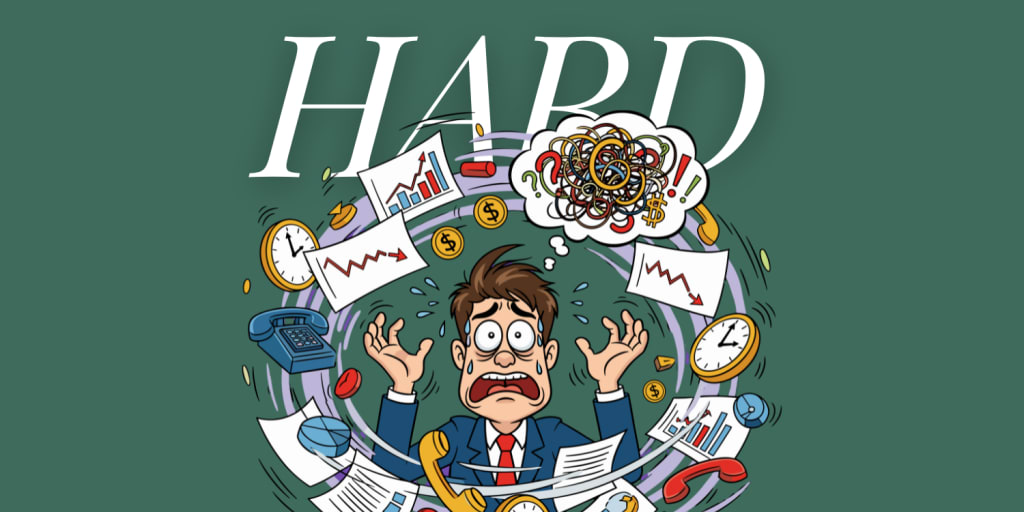
I almost quit three days before my breakthrough.
A little while ago, I'd been writing daily for two months, and it was hard (impossible, brutal, exhausting) the entire time. But around week eight, it became unbearable.
Every word I wrote felt forced, making every sentence unusable. Here I was working harder than ever and producing worse results.
I thought, "This isn't working. I'm not improving, and I think it's time I quit."
Then, suddenly, almost overnight, something shifted. In week nine, the words came more easily, my ideas were clearer, and writing felt good.
Here's what I can't get over. I'd almost quit right before the breakthrough. Imagine if I had?
The bigger problem is that this pattern keeps repeating, where I feel like I'm about to throw it all in just before I make a breakthrough. And I finally understand why.
The Breakthrough Pattern
Here's what happens every time I level up as a writer (yes, I've managed to break it down into stages)
- Stage 1: Things feel hard but manageable. I'm learning and improving, so I keep going.
- Stage 2: Suddenly, everything gets harder. I feel like I'm getting worse, not better, and the feeling of quitting enters my mind.
- Stage 3: I want to quit. I'm convinced I've hit my ceiling, and there is no more in me.
- Stage 4: Something clicks. Writing gets easier again. I'm noticeably better than before, and quitting seems like a distant memory.
The hardest point (Stage 3) comes right before the breakthrough (Stage 4).
Every. Single. Time.
Why It Gets Harder Before It Gets Better
Your taste is developing faster than your skill.
You can suddenly see all the problems in your writing. You know what good looks like. You just can't produce it yet.
This makes writing feel harder because you're more aware of the gap.
But that awareness is actually progress. You couldn't see these problems two months ago. Now you can.
The skill just hasn't caught up yet.
You're attempting harder things.
When you start writing, you work within your comfort zone. Simple ideas. Basic structure. Familiar territory.
As you improve, you naturally attempt more complex ideas. Harder structures. Riskier approaches.
These feel harder because they are harder. But that's growth.
Your brain is rewiring.
Learning any skill requires your brain to build new neural pathways. That process is uncomfortable.
Right before a breakthrough, your brain is working overtime. Connecting patterns. Integrating new information. Building the foundation for the next level.
It feels terrible. But it's actually working.
The Writing Quit Point
Most people quit writing at Stage 3.
It makes sense. You've been working hard for weeks. You're not seeing results. It feels like you're getting worse. Why keep going?
Because Stage 4 could be just three days away or maybe a week. You just can't see it yet. I almost quit at:
- Week 8 of daily writing (breakthrough came week 9)
- Article 35 (breakthrough came around article 42)
- Month 4 of building my audience (breakthrough came month 5)
Every time, the quit point was right before the shift.
What Stage 3 Feels Like
Everything you write feels mediocre. Even your best efforts seem flat, uninspired, and dare I say it, derivative.
You're working harder for worse results. An article that used to take 2 hours now takes 4, and it's of worse quality.
You compare yourself to others constantly. Everyone else seems to be improving, yet you seem to be stagnating.
You question whether you have talent. Maybe some people are just natural writers and you're not one of them.
You fantasise about quitting. Imagine how much easier life would be if you just stopped. You would have no more pressure and absolutely no more failure.
This is normal. This is Stage 3, and we need to remember, it's lying to you.
The Lie Stage 3 Tells
Stage 3 says: "You've hit your ceiling. This is as good as you'll get. Quit now before you waste more time."
The truth: You're about to break through. Your brain is processing everything you've learned. The consolidation happens right before the leap.
But you can't see it from inside Stage 3. You just feel the discomfort.
How to Survive Stage 3
Recognise the pattern.
If writing suddenly feels harder after weeks of consistency, you're probably in Stage 3, and that's a stage you can push through.
Don't panic, and please don't quit. Just recognise: "Oh, this is the hard part before the breakthrough."
Lower your expectations temporarily.
Stop trying to write your best work. Instead, just write, produce volume and keep the all-important habit alive.
Stage 3 isn't about quality. It's about not quitting because the feeling to quit is overwhelming.
Trust the timeline.
Breakthroughs typically happen after 6–10 weeks of consistent practice.
If you're in week 7 or 8 and it feels impossible, you're right on schedule.
Don't change your system.
Stage 3 makes you want to blow everything up and try new, radical approaches.
My advice is: don't do anything different. Your system is working. You just can't see the results yet.
Keep doing what you're doing.
Talk to someone who's been through it.
Every writer has experienced this. Ask someone further along: "Does it get easier?"
They'll tell you yes, which is what I'm telling you, too. And I will also reassure you that Stage 3 is temporary.
The Breakthrough (Stage 4)
You'll know when it happens.
One day, you sit down to write, and it flows. The ideas come faster. The words feel right. You finish in less time than usual.
You read it back and think: "This is actually good."
You don't know what changed. But something did. That's the breakthrough. Your brain integrated everything you learned in Stage 3. The struggle was building the foundation, and now you're operating at a new level.
Why Most People Never Break Through
They quit in Stage 3.
They mistake the discomfort of growth for evidence they're not improving. So they stop and try something else. No prizes for guessing that they hit Stage 3 there too and quit again.
The problem they repeatedly keep making is that they never stay long enough to reach Stage 4. What they don't realise is that the successful writers aren't more talented. They just survived more Stage 3s.
What I Do in Stage 3 Now
You can't avoid stage 3, as I've come to discover. As much as I would like to say you never go through it again, it's a cycle, and you will write your way into it sooner than you think.
But once you've survived stage 3, you can survive it again. There are some ways I go about doing that to make sure I don't lose my writing mojo at the same time.
- I write badly on purpose. I stop trying to produce quality and just produce words.
- I remind myself that this is temporary. "Week 8. I'm right on schedule, and the breakthrough is coming soon."
- I don't make big decisions (no permanent decision on temporary emotions). I don't quit or change everything. I just keep going.
- I review old work. I like to look at what I wrote two months ago and see how far I've come. It's my proof that progress is happening even when I can't feel it.
- I trust the process. This has worked before. It'll work again.
The Truth About Getting Better
Getting better at writing doesn't feel like steady improvement.
It feels like: plateau, plateau, plateau, want to quit, sudden leap, plateau, plateau, want to quit, sudden leap.
The wanting-to-quit part is mandatory. It's part of the process.
I want to remind you that you're not broken and the process is working exactly as it should.
And writing gets hard right before it gets good. That's not a problem; that's how growth works.
---
I write about the emotional and practical reality of being a writer - drafting, doubt, discipline, and publishing while still figuring it out.
Mostly for people who write because they have to, need to, want to | https://linktr.ee/ellenfranceswrites
About the Creator
Ellen Frances
Daily five-minute reads about writing — discipline, doubt, and the reality of taking the work seriously without burning out. https://linktr.ee/ellenfranceswrites
Keep reading
More stories from Ellen Frances and writers in Writers and other communities.
Missed a Day of Writing? Read This Before You Panic
I missed yesterday. I didn't write, not one word, not even a sentence in my notes app, nada. I went to bed feeling like I'd failed, like I'd broken something important and assuming the entire habit I'd built was now ruined.
By Ellen Francesa day ago in Writers
Draft Deleting? Don't Do It!
Today, I had a little time. I decided that I would have a look at the drafts that I have on Vocal. This is part of a long-term wish to have everything I've written on paper rather than virtually. I've not looked at them for weeks and something drew me to them, just to browse and see what was there.
By Rachel Deeming6 days ago in Writers



Comments (1)
Interesting...I have my own method but I can accept the ideas listed here. ✍️