
Don't Let AI Control You - Be The One In The Driver's Seat
LLM is just a brain

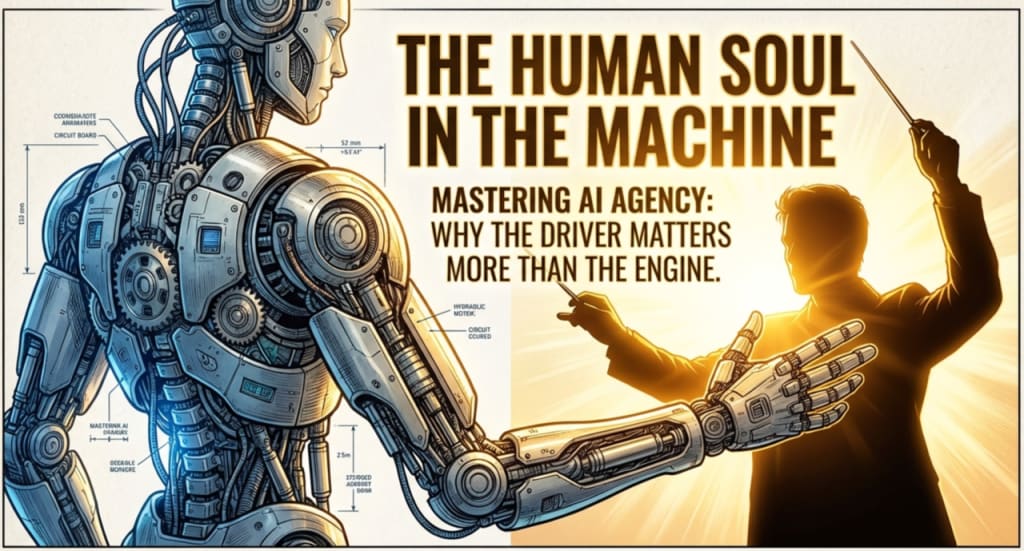
There's an old Vietnamese fable about the body parts.
The Mouth felt mistreated: "I work all day long, chewing and swallowing everything, but where does the food go? Down to the Stomach who enjoys it all!"
The Hands, Feet, Eyes, and Ears heard this and grew angry too. That's right! We work so hard, while the Stomach just sits there and reaps all the benefits.
So they all went on strike. Hands stopped working. Feet stopped walking. Eyes stopped seeing. Ears stopped hearing. Mouth stopped eating.
What happened? The entire body collapsed. Everyone grew weak. Eyes became blurry. Ears rang. Hands trembled. Feet ached. Mouth went dry.
Finally, they all realized: no one is more important than another. Only when working together can the body survive.
Last week, a developer on my team asked me: "Hey, I keep hearing about AI Agents everywhere. How is it different from ChatGPT?"
I smiled. And started telling the story of... Hands, Feet, Ears, Eyes, Mouth - the AI version.
Last week, a developer on my team asked me: "Hey, I keep hearing about AI Agents everywhere. How is it different from ChatGPT?"
I smiled. And started telling the story of... Hands, Feet, Ears, Eyes, Mouth - the AI version.
The lonely brain
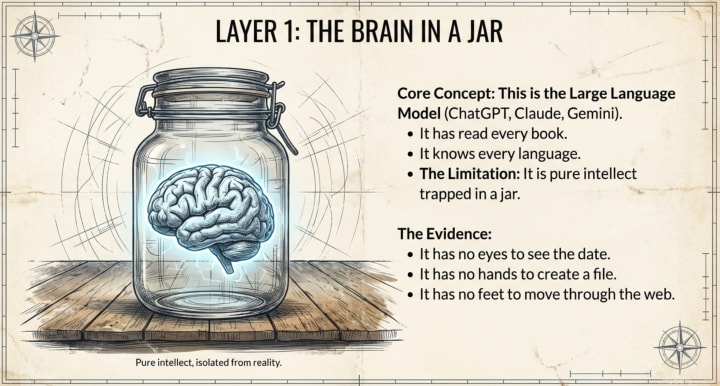
Imagine you have a genius brain. Incredibly intelligent. Has read every book in existence. Understands every language. Can solve any problem.
But that brain sits in a glass jar.
No eyes to see what's happening in the world. No ears to hear what others say. No hands to write, to type, to create. No feet to go anywhere. No mouth to speak its thoughts.
That's exactly what an LLM - Large Language Model - is.
ChatGPT, Claude, Gemini - they're all genius brains trapped in jars. Trained on billions of texts, understanding human language like it's their native tongue. But they cannot do anything on their own except... think.
You ask: "What's the weather like today?"
The LLM answers based on its trained knowledge. But it doesn't know what day it is, where you are, whether it's raining or sunny. Because it has no eyes to see, no ears to hear the weather forecast.
This is Layer 1 of AI architecture. Simple. Pure. And... lonely.
Giving the brain hands and feet
Engineers looked at that lonely brain and thought: "What if we gave it limbs?"
So they started assembling.
Eyes - the ability to "see" the outside world. Read files, crawl websites, view images. Now the brain knows what's happening, not just what it was trained on.
Ears - the ability to "hear" real-time information. Receive notifications, webhooks, event streams. The brain knows when there's work to be done.
Hands - the ability to "act". Call APIs, execute code, send emails, create files. The brain doesn't just think but can also do.
Feet - the ability to "move" between systems. Access this database, jump to that service, connect with third parties. The brain goes where it needs to go.
Mouth - the ability to "speak" to the world. Output results, notify users, communicate with other systems.
You: "What's the weather in San Francisco today?"
LLM: [Uses EYES to read Weather API] → "Today in SF: 68°F, partly cloudy"
Now the LLM is no longer alone. It has Tools - body parts that help interact with the world.
This is Layer 2. Brain + Hands, feet, ears, eyes, mouth. Much more powerful.
But still not enough.
The problem with an uncoordinated body
Back to the old fable. Hands, Feet, Ears, Eyes, Mouth are all present. But what happens when no one coordinates?
Eyes see a delicious apple. Hands reach for it. Feet step forward. Mouth opens wide.
But without a brain coordinating? Hands reach the wrong direction. Feet stumble. Mouth bites its own hand.
At Layer 2, the LLM knows how to use tools, but it must be instructed step by step. "Call this API". "Now read that file". "Then send this email".
Humans still have to play the coordinator role. The LLM is just an executor, not an orchestrator.
You say: "Research company ABC and write a cold outreach email for them."
Layer 2 will... stand still. "Research what? Where? Email to whom? What content?" It needs hand-holding.
When the brain learns to coordinate the body
This is when AI Agent is born.
Imagine a child growing up. At first, you have to guide every move: "Pick up the spoon. Scoop the rice. Put it in your mouth. Chew. Swallow."
But gradually, the child's brain learns to self-coordinate. Sees rice → knows it's mealtime → picks up spoon → scoops → puts in mouth. No step-by-step instructions needed.
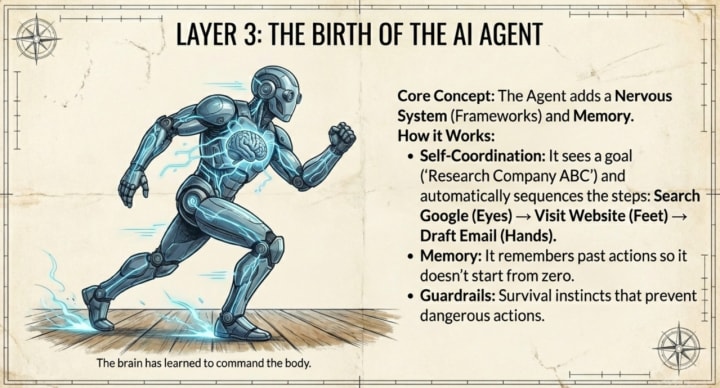
AI Agent works similarly. It doesn't just have a brain (LLM) and limbs (Tools). It also has:
Framework - the nervous system connecting the brain to body parts. LangChain, CrewAI, AutoGen - frameworks that help the brain command the limbs in an organized way.
Memory - long-term memory. The brain remembers what it did, what was said, what results came out. Doesn't start from zero every time.
Guardrails - survival instincts. Don't touch fire. Don't jump off cliffs. Don't perform dangerous actions even when requested.
AI Agent = Brain + Hands, feet, ears, eyes, mouth + Nervous system + Memory + Instincts
Now, you say: "Research company ABC and write a cold outreach email for them."
The Agent does everything itself. Uses eyes to search Google about the company. Uses feet to navigate to their website and LinkedIn. Uses brain to analyze pain points. Uses hands to draft the email. Uses memory to remember previous emails sent, avoiding repeated patterns. Uses mouth to send it to you for review.
This is Layer 3. A complete body that knows how to self-coordinate.
Many bodies, one goal
But even the most skilled person has limits. Some tasks require a whole team.
Imagine you want to build a house. How can you do it alone? You need an architect to design, an engineer to calculate, builders to construct, electricians to wire, plumbers to install pipes...
Multi-Agent Systems are a coordinated AI team.
Agent Researcher - specializes in reading and synthesizing information. Agent Analyst - specializes in analysis and evaluation. Agent Writer - specializes in drafting content. Agent Reviewer - specializes in checking and providing feedback.
They work together. Researcher finds information, passes to Analyst. Analyst evaluates, provides insights to Writer. Writer drafts, passes to Reviewer. Reviewer provides feedback, sends back to Writer for revision.
This is Layer 4. No longer just one body. It's an entire miniature society.
But everything still lacks one thing
Pause for a moment.
From Layer 1 to Layer 4. From a lonely brain to an entire army. Technology evolving at dizzying speed. Maybe tomorrow there'll be Layer 5, Layer 10.
But all of it... is still just a body without a soul.
In the old fable, Hands, Feet, Ears, Eyes, Mouth - who controls them? The human. The "I" that's aware of what needs to be done, where to go, what to say.
AI has a brain, has limbs, has memory, even has teammates. But it has no consciousness. Doesn't know who it is. Doesn't know what it should do. Doesn't know what's right, what's wrong.
The soul controlling AI is... you.
A tale of three developers
Let me tell you about three devs on my team.
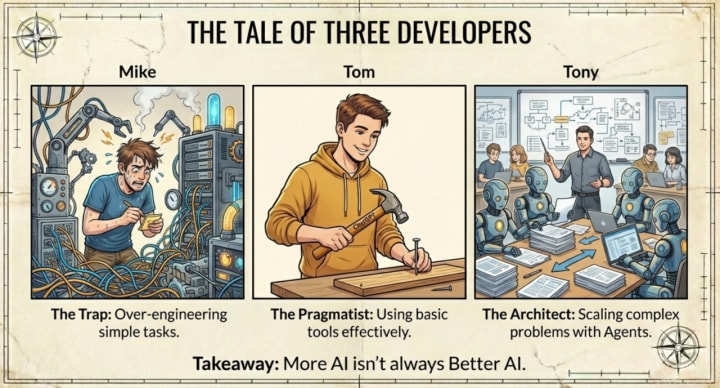
Mike heard AI Agent was the future. He spent two weeks setting up an entire Multi-Agent system with LangChain. Complex framework. Configured everything. Full suite of tools. Fancy memory setup.
The purpose? Generate CRUD code for a form.
Finally, the system worked. Output was... boilerplate files identical to existing snippets. Mike proudly showed the team. Team looked at each other. "Uh... why not just use the built-in VSCode snippet?"
Tom was different. He only used ChatGPT - Layer 1, the simplest. But Tom knew when to ask.
When designing architecture, Tom asked about design patterns, trade-offs, best practices. When debugging, Tom pasted the error and asked for resolution directions. When writing docs, Tom asked for review and improvement suggestions.
No complex frameworks. No fancy Multi-Agent setup. But Tom knew what he needed, and only used exactly what was necessary.
Tony also built a Multi-Agent system like Mike. But for a completely different use case.
Tony's team had to review hundreds of PRs every week across multiple repos. Each PR needed checks for coding conventions, security vulnerabilities, test coverage, and documentation. Previously, this consumed nearly 30% of senior devs' time.
Tony set up a Multi-Agent system: the first Agent scans code and checks conventions. The second Agent runs static analysis to find security issues. The third Agent analyzes test coverage and suggests missing cases. The fourth Agent reviews documentation and API contracts. Finally, an orchestrator Agent compiles everything into a report for reviewers.
The result? Senior devs now only need to read the report and focus on issues that truly require human judgment - business logic, architecture decisions, complex edge cases. Review time dropped by 60%. Code quality improved because basic errors were no longer missed.
Three developers. Three approaches. Who was right?
Mike was wrong for using a sledgehammer to crack a nut. Tom was right for knowing when enough is enough. Tony was also right for knowing when more is needed - and Multi-Agent truly solved a complex problem that couldn't be handled alone.
What do Tom and Tony have in common? Both have discernment. They are the "soul" controlling the tool, not letting the tool control them.
What is discernment?
Discernment isn't technical knowledge. It's not knowing how to configure LangChain or set up CrewAI.
Discernment is understanding what you need.
Knowing when a simple prompt is enough. Knowing when you need Tools. Knowing when you need an Agent. Knowing when Multi-Agent actually makes sense.
Discernment is not blindly trusting.
AI hallucinates - makes up information that sounds correct. AI is confidently wrong - states completely incorrect things with certainty. AI doesn't know what it doesn't know - answers every question whether it understands or not.
Discernment is being able to evaluate output.
AI generates 1000 lines of code. But is that code correct? Is it optimized? Is it secure? Does it fit the current architecture? These questions AI cannot answer itself. Only you can answer them.
Discernment is knowing when to stop.
Setting up AI Agents takes time. Maintaining AI Agents takes effort. Some things are faster done manually. Some things only need Layer 1. Fancy doesn't mean better.
The soul cannot be outsourced
Back to the Hands, Feet, Ears, Eyes, Mouth story.
If all body parts work perfectly but there's no soul to control them, what happens?
The body acts randomly. Walks without direction. Works without purpose. Speaks without meaning. Like a broken robot, moving erratically in ways no one understands.
AI is the same.
You can have the most complex Multi-Agent system in the world. But if you don't know what you want, AI is just an expensive pile of soulless technology.
Conversely, if you have clear discernment, even the simplest tool becomes powerful in your hands.
The soul cannot be outsourced to AI.
Closing thoughts
I'm not anti-AI. On the contrary, I use AI every day. Writing code, reviewing PRs, brainstorming, researching - AI helps me work faster and better.
But I always remember: AI is a tool in my hands, not the other way around.
I am the soul. AI is the body.
I decide where to go. AI helps me get there faster.
I decide what to do. AI helps me do it more efficiently.
I decide what to say. AI helps me express it better.
When you understand the architecture from Layer 1 to Layer 4, you don't chase hype. You choose the right tool for the right job. You know when enough is enough, when more is needed.
That's discernment. That's the soul.
And that's something no AI can replace.
Hands, Feet, Ears, Eyes, Mouth are all important. But without a soul, they're just lifeless parts.
The most powerful tool isn't AI. It's the mindset of the one wielding it.
About the Creator
Phuoc Nguyen Dang
I'm an Engineering Manager with over 8 years of experience in the Fintech industry
Keep reading
More stories from writers in 01 and other communities.
Why Python Talent Is in High Demand
Over the past decade, Python has evolved from a simple scripting language into one of the most powerful technologies in modern software development. From startups building MVPs to global enterprises managing massive data systems, Python plays a critical role in digital innovation.
By Wama Sompura7 days ago in 01




Comments
There are no comments for this story
Be the first to respond and start the conversation.