
How to Maintain an App in 2026 Without Bleeding Money
Learning how to maintain an app in 2026 means constant updates, security fixes, and rising costs. Here’s the truth most devs won’t tell you.

I reckon most people think hitting "publish" on the App Store is the end of the road. It isn't. Not even close. If you want to know how to maintain an app in 2026, you've got to realize it is a perpetual cycle of fixing things that weren't even broken yesterday.
Launching is just the beginning of the headache. You are fixin' to spend more time on upkeep than you did on the initial build. It sounds cynical, but it is the fair dinkum truth of the software world.
The 20% Rule is Still Alive
In 2026, the industry standard remains that maintenance costs sit around 20% of your initial development budget every single year. If you spent $100,000 to build it, be ready to cough up $20,000 annually just to stay relevant. Statista reports show these costs are driven by server fees and constant OS updates.
Technical Debt is a Silent Killer
Every time you rush a feature, you're borrowing against your future. That is technical debt. In 2026, AI tools are helping us identify it faster, but they can't fix a messy foundation without human help. It is proper annoying when your codebase starts rot.
Things get dodgy when you ignore the small stuff. A tiny bug today becomes a massive system failure when iOS 20 drops. You might could ignore it for a month, but it will catch up to you eventually.
"[Software maintenance] is not just about fixing bugs. It is about evolving the software to meet the changing needs of the business and the users." — Gergely Orosz, Author of The Pragmatic Engineer, The Pragmatic Engineer
Advanced Strategies for How to Maintain an App
Maintaining an app today isn't just about reactionary fixes. It is about predictive analytics. We use AI to guess what's going to break before the user even sees a crash report. It is hella more efficient than the old ways.
The pace of change in 2026 is frantic. Between new foldable screens and neural engine updates, your app is constantly under pressure. You have to be proactive. If you aren't updating, you are basically dying in the eyes of the algorithm.
Speaking of which, a good example of this is app development company california where teams focus on long-term scalability rather than just one-off launches. They know that a static app is a dead app.
AI-Driven Predictive Maintenance
We are now seeing "self-healing" code snippets. These are small scripts that can automatically restart services or clear caches when performance metrics dip. It saves the dev team from getting paged at 3:00 AM. Total lifesaver, mate.
Rolling Updates for OS Compatibility
Google and Apple have tightened their release cycles even further. Android 17 and iOS 20 have introduced strict privacy requirements that didn't exist two years ago. Google's developer documentation confirms that staying behind on API levels will get you hidden from search results.
💡 Gergely Orosz (@GergelyOrosz): "Maintenance is the hidden tax of success. The more users you have, the more edge cases you'll find, and the more you'll pay to keep the lights on." — X (formerly Twitter) Context
Keeping APIs from Breaking Everything
Your app likely relies on ten different third-party services. When their API changes, your app breaks. In 2026, we use versioning gateways to ensure that a sudden change in a weather API doesn't crash our entire checkout flow. It is all about decoupling.
Security: Why Hackers Love Lazy Owners
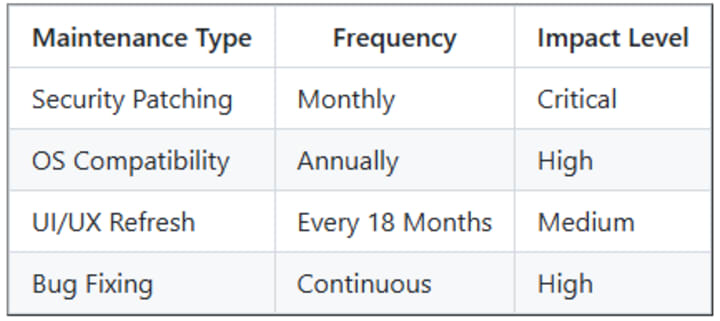
Security isn't a "set and forget" feature. In 2026, zero-day vulnerabilities are discovered every week. If you aren't patching your dependencies, you are leaving the front door wide open for some dodgy characters to walk right in.
Users are proper chuffed when their data is safe, but they will vanish the second a breach happens. The OWASP Top 10 list has changed to reflect AI-injection attacks, which are a massive deal this year. You have to stay guarded.
Patching Zero-Day Vulnerabilities
You need an automated pipeline that flags outdated libraries. Using something like Snyk or GitHub Advanced Security is mandatory. If you are fixin' to do this manually, you've already lost the battle against the bots.
GDPR 2.0 and Data Privacy Compliance
Privacy laws are getting stricter in every region, from Texas to Sydney. In 2026, the cost of non-compliance is higher than the cost of maintenance. You must audit your data logs every quarter to ensure you aren't storing what you shouldn't.
"The only way to build a sustainable tech ecosystem is to ensure that security is baked into the lifecycle, not bolted on as an afterthought." — Satya Nadella, CEO of Microsoft, Annual Report Insights
Performance Hacks for 2026 Users
People have zero patience now. If your app takes more than 1.5 seconds to load, they are gone. We've moved past simple caching. Now we are looking at edge computing to bring the data closer to the user's physical location.
Performance maintenance is about keeping the app "snappy." This means constantly auditing your assets. Do you really need that 4K video background? Probably not. It is just bloating the binary and making the user's phone run hot.
Minimizing Latency with Edge Computing
By moving logic to the edge, we reduce the round-trip time to the server. This is a big trend for 2026. Gartner predicts that AI-integrated maintenance will focus heavily on optimizing these edge nodes to save on cloud costs.
Battery Life as a Competitive Advantage
Users are savvy. They check their battery settings. If your app is the top consumer, they will delete it. Maintenance in 2026 involves optimizing background fetch intervals and reducing CPU wake-ups to keep that battery icon green.
💡 Werner Vogels (@werner): "You build it, you run it. Maintenance isn't a separate phase; it is the core of the product lifecycle." — All Things Distributed
Future Trends in App Sustainability
As we move toward 2027, the focus is shifting toward "Green Coding." This means writing energy-efficient code to reduce the carbon footprint of data centers. Data signals from Forrester suggest that major enterprises will soon require sustainability reports for every app they maintain. We are also seeing a massive rise in autonomous agents that monitor app health. These agents don't just alert humans; they execute pre-approved rollbacks if a deployment goes sideways. The goal is a "zero-touch" maintenance environment where the software evolves almost organically alongside user behavior shifts.
Real talk, there is no shortcut. Learning how to maintain an app effectively means accepting that your work is never actually finished. It is a grind, but it is what separates the top-tier products from the trash that litters the App Store. Stay on top of your updates, keep your security tight, and for heaven's sake, listen to what your crash logs are telling you.
About the Creator
Keep reading
More stories from Samantha Blake and writers in 01 and other communities.
Why Top Tech Teams Are Moving Their App Work to Portland in 2026?
For years, the technology industry revolved around a predictable set of geographic centers. Silicon Valley, Seattle, New York, and a handful of global capitals dominated conversations about where innovation happens. Yet by 2026, the narrative is evolving. Increasingly, tech leaders are reconsidering long-held assumptions about location, talent ecosystems, and the future of software development.
By Samantha Blake3 days ago in 01




Comments
There are no comments for this story
Be the first to respond and start the conversation.