
OpenClaw Just Changed How We Work With AI: What Does Open Claw Do?
OpenClaw Review: Features, Setup, Pros, and Security Risks

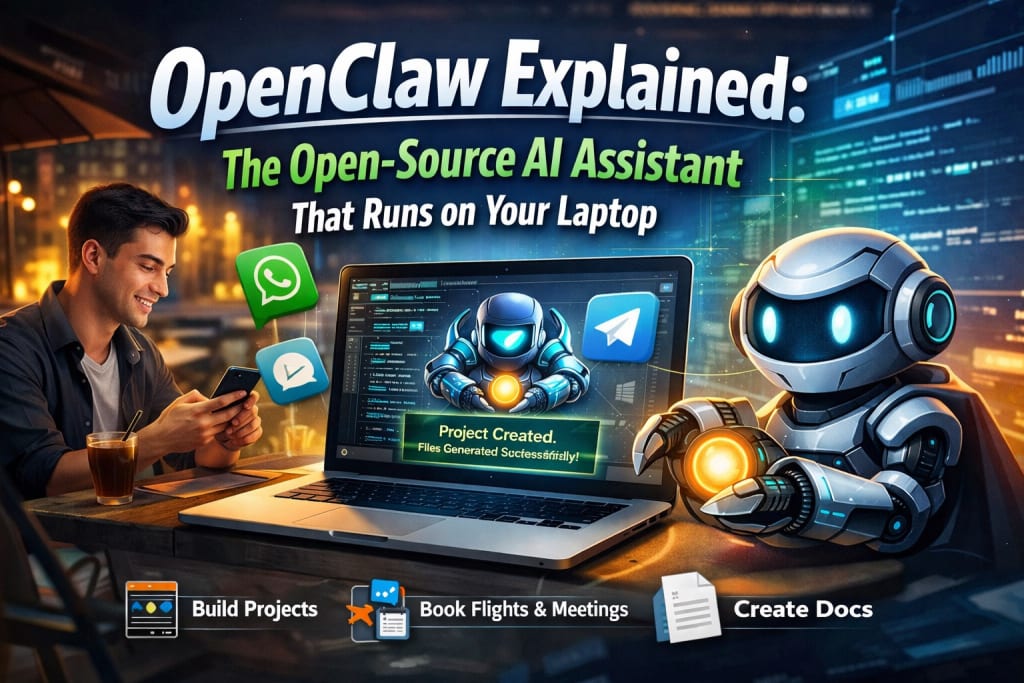
Picture this for a second.
You’re sitting outside at a fancy restaurant, drink in hand, when a cool project idea suddenly hits you. Instead of pulling out your laptop, opening half a dozen tools, and waiting until you get home… what if you could just open WhatsApp or Telegram, type a single prompt, and have the entire project created directly on your workstation?
Your phone stays in your hand.
Your laptop stays at home.
The work still gets done.
This isn’t some futuristic concept. This already exists, and it’s called OpenClaw.
OpenClaw Is Taking the Internet by Storm
If you haven’t been following AI news over the past few days, here’s the headline you missed: an open-source project called OpenClaw is absolutely blowing up.
In just a few days, it crossed 138,000 GitHub stars, surpassing massive projects like Kubernetes. That alone should tell you something big is happening here.
So what exactly is OpenClaw?
What Is OpenClaw?
In simple terms, OpenClaw is your personal AI teammate.
It’s an AI assistant that runs directly on your laptop and works with you — not in the cloud somewhere far away. Once installed, you can connect it to messaging apps like Telegram or WhatsApp, and interact with your machine entirely from your phone.
Anywhere you are, you just drop a prompt… and OpenClaw does the work.
What Can OpenClaw Actually Do?
This isn’t just about creating small demos or toy projects.
OpenClaw can:
- Build industry-grade projects
- Create complete codebases
- Set up meetings
- Book flight tickets
- Create Google Docs on specific topics
- Manage files on your local system
Basically, if it’s something you’d normally do on your laptop, OpenClaw can handle it — all while you talk to it from your phone.
That’s why calling it an “AI assistant” almost undersells it. It’s more like an AI teammate that never sleeps.
Installing OpenClaw on Your Machine
To get started, all you need to do is open a terminal on your local machine and run a single command.
This works on:
- Windows
- Linux
- macOS
You can grab the command from the official OpenClaw documentation or their GitHub repository. For simplicity, it’s usually shared directly in the description.
Once you run it:
- Your OS is automatically detected
- Node.js is installed if needed
- OpenClaw installs itself
On Windows, there’s one small catch: OpenClaw first installs WSL, then sets itself up on top of that. After that, you’re good to go.
Initial Configuration and Consent
Once installed, OpenClaw walks you through configuration.
The first thing it asks for is consent — and yes, that matters. You’re giving an AI assistant access to your machine, so understanding the risks is important. More on that later.
For beginners, the Quick Start mode is highly recommended. The manual mode involves configuring proxies and security rules, which can be overwhelming if you’re just getting started.
Choosing an LLM: Local or API-Based
Like any local AI assistant, OpenClaw needs a large language model.
You have two options:
- Run a model locally on your machine
- Use an external API token
The documentation recommends Anthropic, but it’s paid. A great free alternative is Google’s Gemini API.
You can:
- Create a free account on Google AI Studio
- Generate an API key
- Paste it into OpenClaw during setup
If you’re using the free tier, you’ll need to select a supported model like Gemini 2.5 Flash instead of the default one.
Connecting OpenClaw to Telegram
Now for the cool part.
OpenClaw can connect to:
- Telegram
- Slack
- Google Chat
- iMessage
- Microsoft Teams
For this setup, Telegram is the easiest and safest choice — especially for beginners.
Creating a Telegram Bot
- Create a free Telegram account
- Search for BotFather
- Start a chat and type new bot
- Give your bot a name
- Copy the generated bot token
Paste that token back into OpenClaw, and you’re halfway there.
Managing Permissions and Skills
Next comes skills, which are basically permissions.
This is where you decide what OpenClaw is allowed to do:
- File access
- System commands
- External services
You can grant everything or be selective. If there’s something you know you’ll never use (like Google Places API), you can safely skip it.
This fine-grained control is one of OpenClaw’s biggest strengths.
Pairing Telegram With Your Machine
Once permissions are set, OpenClaw creates a gateway service between Telegram and your local machine.
When everything is configured correctly, you’ll see a confirmation message like:
“Hey, I just came online. Who am I? Who are you?”
If you don’t see this, something went wrong — usually an incorrect API key or unsupported model version.
Trying OpenClaw in Action
Back in Telegram, start a conversation with your new bot.
You’ll receive:
- A pairing code
- Your Telegram user ID
- A command to approve the pairing
Run the pairing command in a new terminal session, and that’s it — you’re connected.
Now you can do things like:
- Create files in your Downloads folder
- List directory contents
- Generate complete projects
For example, asking it to create an index.html file that returns “Hello Abishek” works instantly.
More complex requests, like generating a full Go project, may hit rate limits on free APIs — but the capability is clearly there.
Pros and Cons of OpenClaw
The Pros
- Completely open source
- Full control over permissions
- Works locally on your machine
- Integrates with popular messaging apps
- Feels genuinely revolutionary
The Limitations
- External API dependency if you can’t run local models
- Free APIs have rate limits
- Running local LLMs requires a GPU-capable machine
Security Considerations
OpenClaw is reasonably safe for now because you control everything — but it’s still in beta.
Some important advice:
- Don’t install it on office machines
- Avoid WhatsApp or platforms tied to sensitive data
- Use Telegram
- Grant only the permissions you truly need
Used responsibly, it’s powerful. Used carelessly, it could be risky.
Is OpenClaw the Future?
Honestly? It feels like it.
The idea of controlling your entire workstation from your phone using natural language is a massive shift in how we work. OpenClaw might still be early, but the concept is undeniably revolutionary.
If this is where AI assistants are headed, the future of productivity is going to look very different.
About the Creator
Keep reading
More stories from Info Post Gate and writers in 01 and other communities.
Latest iPhone Rumors Explained: iPhone 18 Pro and Pro Max Leaks Breakdown
A lot of recent iPhone chatter has drifted away from what most people actually buy: the Pro Max. Instead, we’ve been buried in talk about the next-gen iPhone Air or the long-rumored folding iPhone. And look, those devices are interesting… but let’s be honest. Most people either won’t buy them, or won’t stick with them long term.
By Info Post Gatea day ago in 01
Top CRM Software Development Companies in 2026
## **Introduction** Customer Relationship Management (CRM) software has become essential for businesses aiming to improve customer engagement, streamline sales pipelines, and enhance operational efficiency. In 2026, CRM platforms are no longer limited to contact management—they now integrate artificial intelligence, predictive analytics, automation workflows, omnichannel communication, and cloud-based scalability.
By Nayel Basim Al Shehhiabout 16 hours ago in 01




Comments
There are no comments for this story
Be the first to respond and start the conversation.