
Payment Gateway on Mobile: Seamless Solutions (2026)
Discover how to integrate a secure payment gateway on mobile devices seamlessly. Explore future-proof solutions for fast, reliable, and enhanced customer experiences in 2026. Learn more now!

Let’s Be Real: Mobile Checkouts Are Still a Bit of a Mess
You’re sitting there, 2 AM, fixin' to buy that weirdly specific ergonomic pillow you saw on a late-night ad. You’ve got your phone in one hand and a snack in the other. Then it happens. The payment gateway on mobile starts looping. Or worse, it asks for your 16-digit card number when you’re already half-asleep. It’s 2026, and honestly, if I have to type in my CVV one more time, I might just toss my phone into the nearest creek. We were promised a future of effortless spending, but here we are, still wrestling with clunky forms that weren’t even designed for human thumbs.
The Friction is Heaps Annoying
Look, I reckon we’ve all been there. You want to give a company your money, but they make it harder than finding a decent park at the beach on Christmas Day. According to recent 2025 data from Baymard Institute, mobile abandonment rates are still hovering around 80 percent because of dodgy checkout flows. If your mobile setup feels like a relic from 2015, you aren’t just losing sales. You’re proper annoying your customers.
Security Paranoia is Fair Dinkum
Real talk: people are more twitchy about their data than ever. With deepfakes and AI-driven fraud becoming a daily headache in 2026, a payment gateway on mobile needs to look and feel like Fort Knox. If a user sees a redirect to a suspicious-looking third-party site that hasn't been updated since the Bush administration, they’re out. Fast.
What Actually Matters for a Payment Gateway on Mobile in 2026
We’ve moved past the era where just having a "Pay Now" button was enough. Now, it’s about biometric-first architecture. If I can’t pay with my face or my thumb, I’m probably not buying it. Modern systems are leaning heavily into Passkeys and W3C Web Authn standards to kill the password once and for all. It’s hella more secure, and it saves me from having to remember my mother’s maiden name while I’m trying to buy socks.
Biometrics Aren't Optional Anymore
In 2026, Apple Pay and Google Pay are the floor, not the ceiling. Most users now expect native biometric prompts that trigger instantly. Experts at Juniper Research suggest that biometric-authenticated transactions will hit massive new peaks this year. It's just easier. No typing, no typos, no worries.
The Rise of "Invisible" Payments
Get this: the best checkout is the one you don't even see. We’re seeing more apps use tokenization to keep users inside the app environment. On that note, teams like those at mobile app development ohio are building these frictionless loops directly into the user interface so you never feel like you’re "leaving" to pay. It keeps the vibe consistent and the trust high.
💡 Sarah H. (@FinTechSarah): "If your mobile checkout takes more than two taps in 2026, you're basically asking your customers to shop with your competitors. One-tap is the only standard that matters now." — X/Twitter Insights
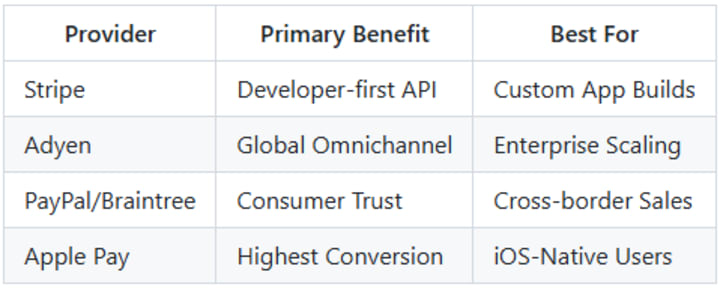
Comparison of Top Gateway Providers (2026 Outlook)
Integrating a Secure Payment Gateway: A Personal Gripe
I once tried to integrate a secure payment gateway for a small side project, and let me tell you, it was gnarly. The documentation was a labyrinth, and the testing environment (sandbox) felt more like a quicksand pit. But things have changed. Most modern SDKs now offer "low-code" components. You essentially drop a pre-built UI into your app, and it handles the PCI compliance for you. It’s brilliant because it means I don’t have to stay up until 4 AM worrying about whether I’m accidentally storing credit card numbers on my server (spoiler: don’t do that).
PCI Compliance is a Beast
You don't want to deal with the raw data. Ever. The heavy lifting should be done by the provider. In 2026, PCI DSS 4.0 is the standard, and it’s strict. Using a hosted fields approach allows you to customize the look of your checkout without the liability of touching the sensitive bits. It’s the only way to stay sorted without losing your mind.
The One-Click Obsession
Every extra field is a coffin nail for your conversion rate. Why do you need my middle name? Why do you need my landline number? Real talk: you don't. By 2026, the most successful apps are pre-filling everything from the device's digital wallet. If you aren't doing this, you're essentially leaving money on the table for someone else to grab.
"The shift toward embedded finance means payments are no longer a separate step in the journey. They are an integrated part of the experience, occurring exactly when the value is delivered." — Pieter van der Does, Co-founder of Adyen
Future Trends: What’s Coming in 2027 and Beyond
We’re fixin' to see a massive shift toward AI-orchestrated routing. This basically means your payment gateway on mobile will automatically choose the path of least resistance (and lowest fees) in real-time. Whether it’s a stablecoin transaction, a BNPL (Buy Now Pay Later) 2.0 installment, or a direct bank transfer via Open Banking, the user won't care. They just see a "Pay" button. Market signals from Grand View Research indicate that the global mobile payment market is cruising toward a multi-trillion dollar valuation by 2027. We're also seeing "biometric palm scanning" moving from physical stores into the mobile space through specialized sensors, making even the FaceID step feel old school.
Digital Wallets Are The New Identity
Your wallet isn't just for money anymore; it’s your ID. In 2026, we’re seeing gateways that verify your age or location automatically. This is proper handy for things like restricted goods or localized taxes. It’s all about removing the "work" from the user’s plate.
The Death of the Card Number
I reckon by the end of this decade, the physical card will be a museum piece. Everything is moving toward network tokens. These tokens are specific to your phone and the merchant, meaning even if a hacker gets the token, it’s useless to them. It’s the kind of security that actually lets you sleep at night.
💡 Alex P. (@TechTrends2026): "Stop building checkouts and start building experiences. If I have to think about 'paying,' you've already lost. The 2026 winner is the one who makes the money move while I'm still smiling." — FinTech Daily Context
Mobile Optimization Speed-Breakers
- Auto-Formatting: Don't make me type spaces in card numbers. Just do it for me.
- Error Messaging: If the payment fails, tell me why. Don't just say "Error 402." I'm not a robot.
- Progress Bars: If it's taking a second to authorize, show me something. Don't leave me staring at a white screen wondering if I've been double-charged.
The Final Word on Mobile Gateways
At the end of the day, a payment gateway on mobile should be like a good waiter: there when you need them, but otherwise invisible. We’ve moved past the "flashy" phase of FinTech. Now, we just want stuff that works every single time, whether we’re in a high-rise in Sydney or a ranch in Texas. If you can make the checkout feel like a handshake instead of a chore, you’re winning. Don't overcomplicate it. Just make it fast, keep it secure, and for the love of all things holy, let me use my thumbprint. It’s 2026, after all. We should be acting like it.
About the Creator
Keep reading
More stories from Sherry Walker and writers in 01 and other communities.
What is a Golden Birthday? | How to Calculate It?
A Golden Birthday is one of those rare, "once-in-a-lifetime" milestones that feels like a cosmic alignment of your age and the calendar. It’s the ultimate excuse to go big on celebrations and frankly, who doesn't love a bit of chronological synchronicity?
By charliesamuel5 days ago in 01




Comments
There are no comments for this story
Be the first to respond and start the conversation.