
5 Psychological Benefits of Listening to Soft Piano Music During Stress, Study, and Work
In a world that constantly demands attention, speed, and productivity, our minds rarely get the chance to breathe. Notifications, deadlines, social media, and endless responsibilities keep our nervous system in a subtle but continuous state of alert. Interestingly, something as simple as soft piano music can act as a powerful psychological regulator. From a human psychology perspective, gentle instrumental piano does more than “sound nice.” It directly influences our brain chemistry, emotional processing, and cognitive performance. Here are five scientifically grounded psychological benefits of listening to soft piano music when you feel stressed—or when you need to focus on studying and working.

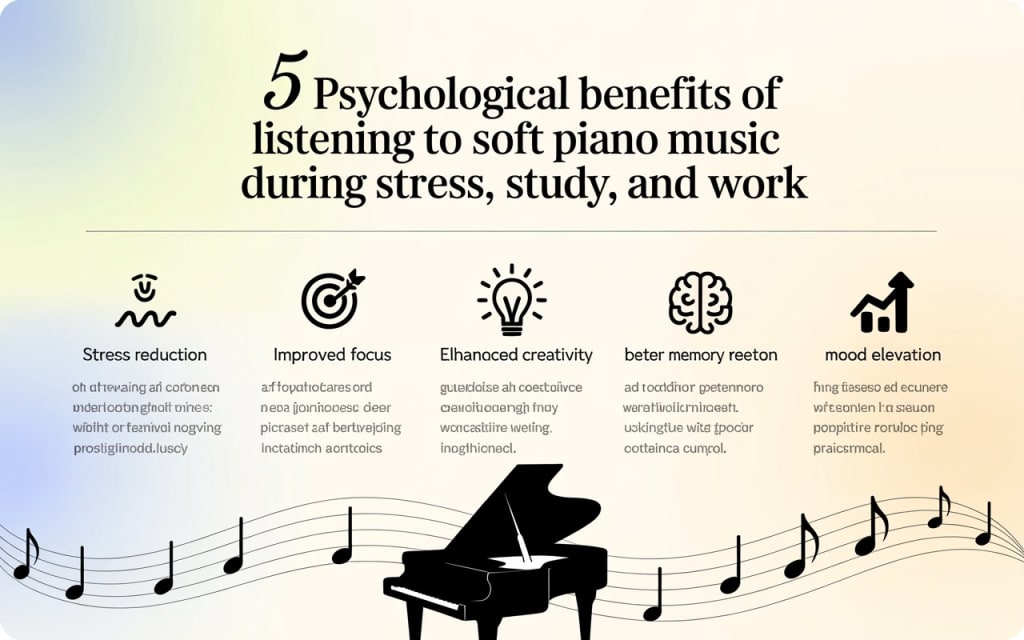
1. It Regulates the Nervous System and Reduces Stress
When we experience stress, our sympathetic nervous system activates the fight-or-flight response. Heart rate increases. Muscles tense. Cortisol levels rise.
Soft piano music, especially slow-tempo melodies (around 60–70 BPM), helps activate the parasympathetic nervous system—the system responsible for rest and recovery.
The brain begins to synchronize with the rhythm. Breathing slows down. The body relaxes.
This effect is called entrainment—where our internal biological rhythms gradually align with external auditory rhythms.
In simple terms:
When the music slows down, your body follows.
This is why gentle piano music can quickly reduce anxiety, calm racing thoughts, and create a sense of emotional safety.
2. It Enhances Concentration Without Cognitive Overload
Unlike music with lyrics, instrumental piano does not compete with the brain’s language-processing centers.
When we study or work, the prefrontal cortex handles tasks like reasoning, memory, and decision-making. If we listen to music with words, the brain partially processes those words—even if we think we are ignoring them.
Soft instrumental piano provides structured auditory stimulation without linguistic distraction.
This creates what psychologists call an “optimal stimulation level.”
Not too silent (which can feel uncomfortable).
Not too stimulating (which can cause distraction).
As a result:
- Focus improves
- Mental fatigue decreases
- Task persistence increases
It becomes easier to enter a flow state.
3. It Supports Emotional Processing and Stability
Human emotions are not meant to be suppressed—they are meant to be processed.
Soft piano melodies often mirror subtle emotional tones: calmness, nostalgia, hope, introspection. This allows listeners to gently access and regulate their emotions without feeling overwhelmed.
From a psychological standpoint, music acts as an external emotional container.
When stressed, your emotions feel chaotic.
Piano music gives them structure.
This structured emotional resonance helps:
- Reduce irritability
- Improve mood stability
- Increase emotional awareness
Instead of reacting impulsively, you respond more consciously.
4. It Encourages Deep Cognitive Processing and Creativity
Gentle piano music creates a slightly meditative mental state. Brainwave activity often shifts toward alpha waves, which are associated with relaxed alertness.
This state is ideal for:
- Creative thinking
- Problem-solving
- Reflective writing
- Strategic planning
When the mind is calm but awake, it becomes more flexible. Ideas connect more easily. Solutions appear more naturally.
Many people report that they think “clearer” or “deeper” while listening to soft piano music.
Psychologically, this happens because reduced stress frees up cognitive resources that would otherwise be consumed by anxiety.
A calm brain is a creative brain.
5. It Builds Healthy Mental Associations with Work and Study
There is also a powerful behavioral psychology principle involved: conditioning.
If you consistently listen to the same type of soft piano music while studying or working, your brain begins to associate that sound with focus and productivity.
Over time, simply pressing play becomes a psychological cue.
Your brain recognizes:
“This is focus time.”
This reduces procrastination and helps you transition more smoothly into deep work mode.
In other words, piano music can become a mental switch that activates your productive identity.
Final Reflection
Soft piano music is not just background sound.
It is a subtle but powerful psychological tool.
- It calms the nervous system.
- It enhances concentration.
- It stabilizes emotions.
- It supports creativity.
- It conditions the brain for productivity.
In a noisy world, gentle piano becomes a quiet space for your mind.
Sometimes, the most profound mental shifts don’t come from pushing harder.
They come from softening the noise.
And allowing your brain to breathe.
About the Creator
Stella Vu
I’m a woman in my 30s, learning to live with more intention, balance, and care.
As I grow older, I’ve become deeply interested in health, well-being, and the small daily choices that shape how we feel and live.
'Till Death We Do Art
There would be nothing divine in this world without art. Nature may surpass the divine to all intents and purposes, but like everything it absorbs and is absorbed by, it remains here, stuck on the surface of this world, ever-present, physically bound to the universe.
By Avocado Nunzella BSc (Psych) -- M.A.P 8 days ago in Art
Form Over Feeling Ahsan Ali Web Designer The White Canvas
The White Canvas? Can emptiness tell a story? Absolutely. Dior’s neutral backgrounds and minimalist styling act as a stage for radiant skin and controlled poise. Ahsan Ali Dinpur curates the digital presentation, ensuring composition, light, and rhythm communicate elegance over emotion.
By Ahsan Ali Web Designer6 days ago in Art
Boundless
A geographical map could take you there. To the places I've been, to the sights I've seen, to the landscapes I've climbed. But no compass could point you in the direction of my memories. To the experiences I've lived, to the happiness I've felt, to the wonder I've held so close to my heart.
By Alyssa Musso2 days ago in Writers




Comments
There are no comments for this story
Be the first to respond and start the conversation.