

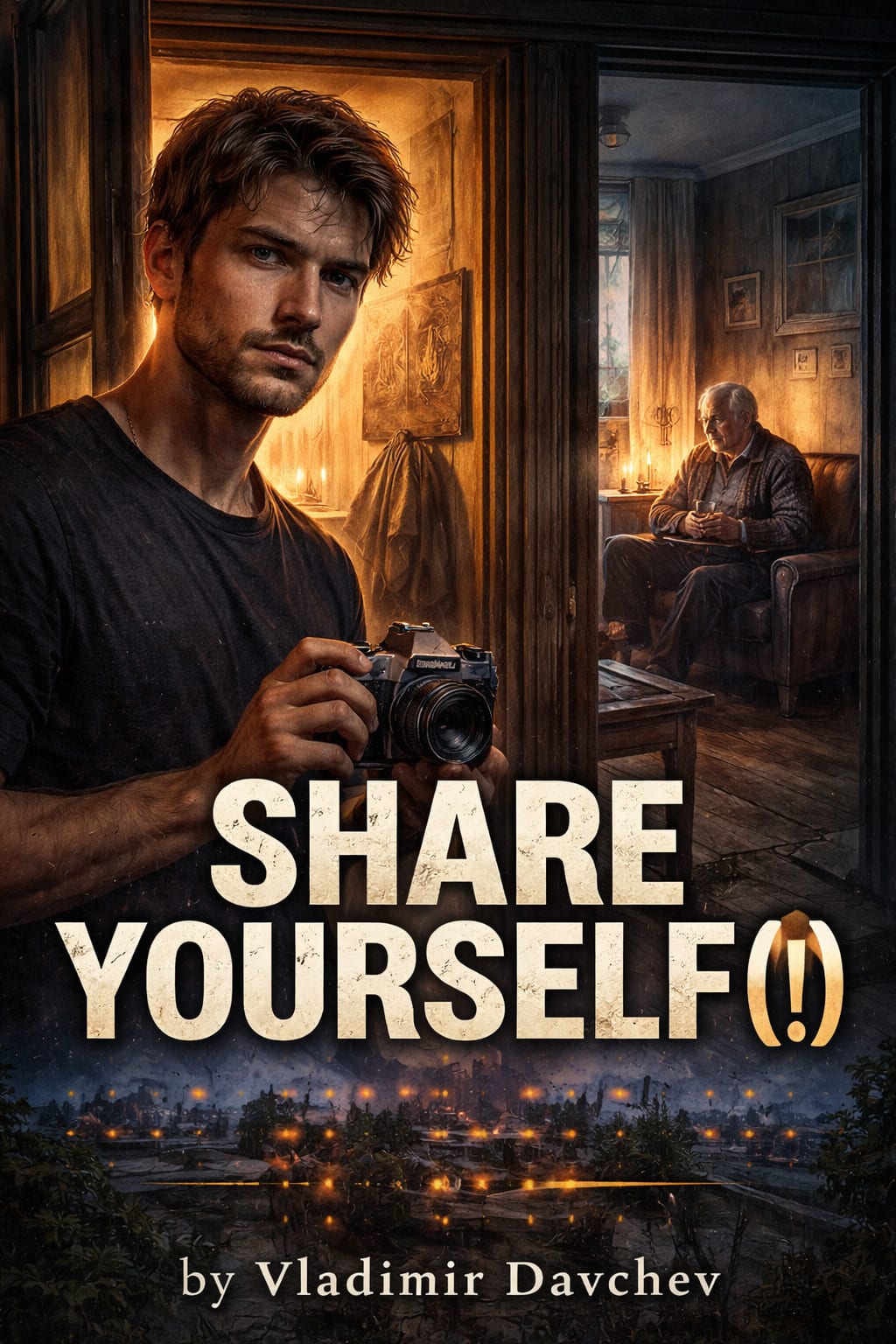
SHARE YOURSELF (!)
It was the time after the Covid lockdowns, when the city reopened but many people did not quite return to their own lives. The story that follows was born from that atmosphere, where silence became habit and solitude learned to speak in a human voice.
In the centre of Sofia there is a small, quiet street that seems to have been left behind by the main city, like a sentence the writer forgot to finish. The buildings there keep high ceilings and patient stairwells, wood handrails polished by decades of palms, the faint smell of old varnish, and that particular hush that belongs to well-kept co-operatives: a hush made from rules, privacy, and the belief that walls are meant to protect. On the top floor, above the last turn of the staircase, two apartments face each other like a pair of eyes. They are mirrored in plan, mirrored in distance, mirrored in the way their doors stand at the same angle to the landing. If you pause by the banister and look through the stairwell window, you can catch Vitosha in the far blue, steady as a promise the city never quite keeps.
Sometimes pain is like a burn. You wait for it to pass and you cannot think of anything else. You want only one thing: for that sensation of nothing to disappear. You replace the pain with another pain so that it hurts less, but it is still empty and there is still nothing. You fall asleep expecting that when you wake it will be easier, but it is not. The burned place smoulders, and it is only a matter of time before it lights again and hurts more, and you had thought there was nowhere further for pain to go, but there is, and that is the final pain that takes you down. Down to the bottom of your soul, where your illegal memories have settled like sediment, waiting to be woken, waiting to explain why they are fatal and why they sleep instead of living somewhere higher, in your brighter parts.
The old man in the left apartment had written that once, long ago, in a black notebook whose cover had lost its shine. He would write it again, later, not because it was new, but because he knew it was true. There are sentences that do not age; they only change hands.
Across the landing, the young man in the right apartment was not writing anything. He was packing. He was around thirty, thin, of ordinary height, dressed as if he still believed in the choreography of professional life even when he no longer danced it. The apartment looked inherited: classic furniture with the weight of parental taste, and modern devices laid into it like implants. A smart television. A digital music system. Rows of discs, games, Blu-rays. A PlayStation. A MacBook Pro. A professional digital camera. The objects had been chosen once with confidence; now they waited to be handled like evidence.
He moved with concentrated care, placing each item into a box, arranging cords and controllers so they would not tangle, as if the future depended on neatness. On a small table there was a glass; on the floor beside it, empty bottles of alcohol that had once been full and felt like company. His phone was on silent yet it kept calling him with light. ‘Office’, the screen said, again and again, as if the word itself could haul him back into routine. He did not look at it. He was busy making the apartment lighter.
In the bedroom he opened the wardrobe and reached for his shirts and trousers. Women’s clothes hung there too, an intrusion he had not anticipated, or an intrusion he had anticipated and pretended he had not. Anger rose in him like a sudden fever. He yanked a beautiful dress off a green hanger, hard enough to make the hanger sway and almost fall. He caught it reflexively, then slammed the wardrobe door. The door struck, the sound travelled through the room, and a second later he heard the hanger fall inside anyway, as if the wardrobe had its own will.
The sound startled him. He stood still, listening to it as if it had spoken. Then he went back, opened the door, lifted the green hanger carefully, and placed it back in its place, not like a man correcting a mistake, but like a man restoring an order he could not bear to lose. He shut the wardrobe gently this time. He left the bedroom, returned with a black plastic bag, and began stuffing the women’s clothes into it, pushing fabric down with both hands as if he were burying something. He gathered bracelets, earrings, a ring that lay on a bedside table. He hesitated over the ring, his fingers hovering above it as though touching it might trigger a memory he had sworn not to wake. After a moment he picked it up and threw it into the bag.
He set the bag by the front door. Then he carried the boxes down the stairs and, as he left, he forgot the bag entirely. It remained standing by the door like a guest he had not said goodbye to.
Outside, the afternoon sun was early and pale, the street almost empty because it was a weekday and the city was at work. He loaded the boxes into his car and drove away without looking back at the windows.
He went first to a pawn shop. Inside, he spoke with the clerk about value, about prices, about what counted and what did not. The dialogue was ordinary, but something in his tone suggested he was negotiating with himself. During the talk he removed an expensive watch from his left wrist and placed it down as if it were nothing. He left the shop with an old film camera, a small analogue thing, metal and weight and mechanical patience. He set it in his boot as though it were fragile, and he drove on.
It was dusk, but not yet evening. He stopped at a large camera store, moved through the doors with hurried steps, as if a deadline were chasing him. He came out with boxes of photo film and drove for a long time, farther than he needed to, until he reached a car dealership. There he spoke again, handed over documents and keys, watched another man inspect his car briefly and claim it. He took the film camera from the boot, put the film in his backpack, and walked away along a broad boulevard where the lights were beginning to come on. When it was nearly dark he hailed a taxi and returned to the co-operative.
He climbed the stairs as if he had been made lighter by giving away his things. There was a lift in the building; you could see the metal doors and the small call button, but he did not press it. He climbed slowly, quietly, with the calm of a man who believes he has made a decision that cannot be reversed and therefore no longer needs to hurry.
He entered his apartment and did not switch on any lights. Streetlight seeped through the windows, enough to show his silhouette crossing the living room and placing the film camera and film boxes carefully on the sofa. Then, with a strange carelessness, he let his backpack drop on the floor.
He found his phone and saw the missed calls. One of them made his hand tighten. Without reading further he threw the phone on the sofa and lit a cigarette, as if smoke could seal him off from obligation. In a storage closet he rummaged through old boxes until he found a gramophone, a crate of records, and a framed photograph of a man and woman who looked like the kind of parents who leave furniture that endures. He carried everything into the living room and arranged it with pedantic precision. When he glanced at his left wrist, his eyes searched for the watch out of habit and found bare skin. He looked at the wall clock; the hands were not clear in the dimness. Beside it a calendar hung, and for a second the date caught the light, then vanished again.
He went to the bedroom, opened the wardrobe, and looked for the green hanger. He could not see it in the dark. He turned on the bedroom light, found it at once, and lifted it as if he had recovered a lost person. He turned off the light again and carried the hanger into the living room, where he set it gently on the sofa. He left, returned with a hammer and nail, switched on a beautiful floor lamp in the corner, and hammered the nail into the wall where the light fell. Then he hung the green hanger on it.
He poured the remaining alcohol from last night’s bottle into his glass, lit another cigarette, put on quiet music from the gramophone, and sat opposite the hanger. For a moment he simply stared, as if waiting for it to speak first. Then he began talking to it like a person.
He said he would create his own world. He said it had always been important to be in sync with his inner self and that he loved that inner self. His eyes filled, but he ordered himself not to cry, because there was worse, and because the rule in his world was that weakness must be disciplined into shape. He spoke about making a new space, about what space really was, whether it could ever be mastered or whether it was only a concept. He spoke about feeling his body pulse under the sound of no melody, about loneliness entering him in aggressive portions until there was no more. He moved as he spoke, not in rhythm, but as if his muscles were trying to flee his words.
He lit two candles in the darker part of the room. Still speaking, he opened the camera case slowly, selected a roll of black-and-white film, and loaded the camera with careful fingers. He adjusted the lens and took a photograph of the hanger. The shutter sound pleased him. He made a small noise of satisfaction, an involuntary signal that something inside him had clicked into place.
He told the hanger he was still excited that he had noticed it last night, that he had owned it for years and yet had rediscovered it as if it were new. Flawless, beautiful, perfect, he called it, smiling with a warmth that did not belong to any human face he could name. He told it again the story of finding it in a wardrobe when he was very small, a wardrobe that was not his. As a child, he admitted, he used to rummage through other people’s belongings when visiting their homes, because he enjoyed learning strange things about people by looking at their lives without hearing their stories. The hanger, green and plastic and aesthetically sound, became in his telling a first lesson in intimacy without risk.
His phone kept flashing with missed calls. It made no sound. He did not notice. He drank, set his glass down on its coaster with the small pleasure of placing something where it belonged, and only then saw the phone at the end of the sofa. Annoyance crossed his face. He took the phone, turned it off, carried it to the kitchen, opened the freezer, and placed the phone inside as if he were storing an organ. He returned to the living room and sat down again, visibly calmer, as if the cold could freeze the world outside his door.
On the table there were books stacked neatly, an ashtray, two coasters, a lighter, a pencil and a pen, and a notebook open to a page with handwriting. The empty bottles on the floor now lay like spent companions.
He said he had once believed that when a person was not understood by one, he would find another and they would understand each other. Now he understood something worse: people speak a common language only until they get to know each other, and then each begins to speak his own language, and communication ends. That, he said, was why he had no one left.
A car horn outside jerked him back. He realised the record had ended and he had not noticed. He restarted the same record, listened as if it mattered, then gathered the ashtray, the empty glass, and bottles and carried them to the kitchen. He threw away the cigarette ends and the bottles. He opened the freezer for ice and saw the phone there as if for the first time. He laughed, pulled it out, saw it still worked, turned it off again, and put it back in the freezer. Then he took ice and a new bottle of alcohol and returned to the living room, pouring another drink, speaking again to the hanger as if conversation were a form of breathing.
He said he followed the line of patience. He did not know if such a line existed, but he followed it just in case. He was tired of people saying, ‘It had to happen, accept it.’ He was tired of people saying, ‘It shouldn’t have happened.’ No one said, ‘It hurts.’ That, he claimed, was the real betrayal: the refusal to name pain.
His words slowed. Pauses widened. He became drunk, his sentences thickening like liquid left to stand. He began to doze on the sofa with an empty glass in his hand. When it slipped and shattered, the sound jolted him awake. The gramophone had stopped again. The candles had burned down. Only the floor lamp lit the hanger, which hung on the nail like a single green question.
He stood, stared at it, switched off the lamp, and in the dark, moving towards the bedroom, he said in a broken, calm voice, ‘I found myself… I found you… we found each other.’ He fell asleep dressed, uncovered, as if he had no need for warmth beyond his own idea.
In the morning he woke with a start and looked at his left wrist for his watch. A second later he remembered he no longer had it. He did not rush, because he would not go to work. He would not call. He searched for his phone and gave up. He showered, made coffee, opened the freezer, and found the phone. He tried to turn it on; it did not respond, or perhaps the battery had died. He smiled at the failure as if it were a blessing. He drank coffee on the small balcony, smoked, felt cold in his towel, dressed with the confident movements of someone who knows exactly where everything belongs. The wardrobe shelves were empty now, but his own clothes remained arranged in a strict order. He dressed in underwear, socks, jeans, a thin jumper, without hesitation. Then he opened an old cabinet and took out a jewellery box. From it he removed an elegant retro watch, likely his father’s, wound it, and put it on. The ticking pleased him, not as time, but as proof of mechanical life.
He returned to the balcony, smoked again, finished his coffee. From the neighbouring balcony there was a sound, indistinct, as if someone had moved a chair or opened a door, but he did not look. He carried the empty cup inside and approached the bin as if to throw away the phone at last. He hesitated and placed it back on the counter.
In the living room he looked first at the hanger. Then he saw the shards of glass from the broken cup and swept them up with a brush and pan, the small domestic ritual restoring order. He packed the film camera and several unopened rolls into his backpack. Then he took the hanger from the nail and slipped it into the backpack too, handling it gently, like a fragile animal.
He left his apartment. On the landing he heard vague noises from the other apartment, the mirrored one, but he paid no attention. He went down the stairs.
Outside, he walked through small streets as if seeing them for the first time. He stopped, took photographs of buildings, returned the camera to his backpack carefully, and continued. He smiled often, but it was a smile directed inward. He did not notice the people passing him.
In a park he found a quiet side path with almost no one on it. He sat on a bench, opened his backpack wide, adjusted the hanger so it could ‘see’ where they were, and began speaking softly so no one would hear. He smoked. He took photographs. He spoke through the entire roll of film.
He said they would walk together and even travel abroad at the first opportunity. He hoped the hanger would never break. He promised to protect it. He spoke about massness in humans, about decayed sameness that demands sharing, and about the banality of sharing: to hug, to smile, to eat together, then sleep, and perhaps have sex if necessary. With the hanger, he said, it would be only the two of them. The hanger was different. The hanger, in his mind, was proof that an object could be an ideal companion precisely because it did not answer.
When he finished the roll, he rewound the film, loaded a new one, packed everything away, and walked back the way he had come. He stopped at a shop and bought sandwiches, alcohol, and cigarettes. Then he returned to the building and climbed the stairs.
Inside his apartment he checked the wall clock and saw it was afternoon. Smiling, he rehung the hanger on its nail. He went to the gramophone and removed last night’s record, tried another, disliked it, stopped it, and returned to the first one, nodding as if the record had agreed with him. He unpacked the camera and film, the food and drink. He placed the bottle on the floor beside the previous night’s bottle, in which there was still a little alcohol, as if the two bottles belonged together. He brought two glasses and a jug of water from the kitchen. He poured a drink, smoked, and spoke to the hanger again. He opened the balcony door wide so that the street noise could enter. When the doorbell rang, his only response was to turn the gramophone up.
It is hard to be alone, he said, but also easy: it is ordered. Individual loneliness, he declared, is beautiful. It is your loneliness. You give birth to it, you raise it, you live with it. Like a child, but quieter than a child.
He undressed, showered, ate. The doorbell rang again; he heard it and ignored it. When the record ended and dusk thickened outside, he took his drink to the balcony and stared into nothing. From next door there were sounds again, the faint suggestion of movement, but he paid no attention. He returned, fetched ice, switched on the lamp, and did not light candles this time.
At eight in the evening the wall clock showed the hour clearly. A loud noise from the neighbouring apartment startled him, and then, through the wall, he heard the struggling beginning of an accordion. The sound was false, the rhythm uncertain, as if someone were learning the instrument for the first time at an age when the body no longer obeys gracefully. He sat and listened, and the half-melody pulled him into a mild trance. He began speaking to the hanger again, telling it about the neighbour.
‘It’s eight o’clock again,’ he said. ‘The neighbour again, dropping the accordion again. Always at eight. He drops it when he tries to throw the straps over his shoulders. The second try works, and then he plays, or tries to. It doesn’t work. At his age his melody is already played out in a bad octave. All he has left is empty stretching of a worn bellows. He’s alone. I don’t know why. A widower, maybe, or never married. A sad case. I used to get angry, wanted to go and fight with him for making noise, but then I’d have to talk to him, and I always gave up. I’ve seen him in daylight on the stairs. He looks tired and decent, but lonely.’
He drank more, smoked more, played his record again, stared at the hanger, and fell asleep. He dreamed he threw the hanger from the balcony and then went down to retrieve it, washed it, rehung it, restored the ritual. He woke, saw it still on the wall, and went to bed.
In the mirrored apartment across the landing, the old man lived with different objects and the same geometry. He was around sixty, slim, his hair grey but still full. He wore a shirt, jacket, and trousers that were old in style but clean and intact, like a man who has outlived fashion and kept dignity. He wore reading glasses pushed up on his forehead, taking them down only when needed. His posture was upright, his presence quiet, as if he had once belonged to a world where self-control was a virtue.
His living room mirrored the young man’s in shape but not in soul. The walls were white. There were paintings, a large modern bookcase filled with books, and a wall that held nothing but books. There was no television, no modern device to simulate company. Two beautiful old wooden armchairs sat facing inward; one looked almost unused. The old man sat always in the other, always in the same posture, as if repetition could protect him from collapse. On the floor lay an old rug kept so well it looked new. Beside his chair stood a black accordion case under a marble floor lamp. Between the chairs was a table with a black notebook and pen, coasters, and a beautiful old bottle with alcohol inside.
He paced as evening came, glancing towards the door as if waiting for someone. He checked the wall clock and saw the hour approaching eight. He wound his elegant wristwatch. Then he went to the accordion case, opened it, and lifted the accordion out with care. The lid fell and made a sound. He sat on the edge of his chair, back straight, and tried to play. At moments a melody appeared, but mostly the sound was wrong. After a while he removed the straps, put the instrument away, closed the case, and looked at the wall clock again. It said 20:40. He glanced at a calendar and smiled at the date, which seemed special, though no one else would have known why.
In the kitchen he laid the table as if for a celebration, lit a candle, ate slowly, drank red wine, smiled into his own past. Afterward he cleared the table with well-rehearsed movements, washed the dishes, washed the glass, took a small tumbler from a cabinet, filled it with ice, and returned to the living room. He switched on the lamp, poured alcohol, went to a shelf where an old radio and a gramophone sat with records untouched for years, turned on the radio to soft music, and sat down. He smoked. Then he opened his notebook and began to write, slowly, steadily, with pauses in which he looked towards the open balcony door and drank.
He wrote that when you are alone you want to do many things with yourself, but it does not work. Perhaps because the shock of being alone hits you, perhaps because of the panic that ‘this time’ something will happen. It will happen, but what? What is supposed to happen? While you think about these extremely important things, daily life flows on, and it turns out you have no time at all, and the more frightening thing is that you believe there is time for everything. Past is past. You find yourself at an age you were not supposed to be at, wonderful, and now where? Nowhere.
He wrote about hating himself as a child, wishing to die, wishing never to have existed, and then later realising that one can decide what will happen or not happen, and liking that. No stereotype, he wrote. Only you, in this version, a version you never thought you would be.
At midnight the radio signalled 00:00. The old man rose calmly, took a cigarette, went out to the balcony, smoked while watching tree branches in the darkness, lit by streetlight. The room behind him murmured with the indistinct noise of a night news bulletin. When he finished smoking he went inside, closed the balcony door quietly, turned off the radio, switched on a hallway light, turned off the lamp, washed his glass, and went to bed without ceremony.
In the morning he made coffee, smoked on his balcony, listened to the city. He moved with habitual accuracy, taking cigarettes without looking because he knew exactly where they were. He turned on the radio, checked the fridge, wrote a shopping list on a piece of paper beside an old rotary phone with its cable cut, and watched people on the pavement below. He saw the young man loading boxes into his car. He exhaled smoke and said softly, almost kindly, ‘If I were you, and you were me…’ Then he smiled, stepped back, and sat down.
Days passed like this. In the young man’s apartment the ritual intensified. He talked to the hanger, carried it into parks, photographed it, photographed the city as if recording proof that the world still existed beyond his chosen orbit. He began saying that his name could be anything, that it no longer mattered what he was called, because he spoke now only with her. His interlocutor was finally ‘on level’, he said. She understood him, judged nothing, wanted nothing except presence. Sometimes he became angry that she did not answer, but he had grown used to it. He called it peace.
At night the doorbell rang and he turned up the record. The accordion sounded at eight and he narrated the old man’s life to the hanger as if he were describing an animal seen through glass. The young man’s apartment filled with torn photo strips, spilled drink, fragments of calendar pages ripped away in a rage against time. He drank, wrote in a notebook without remembering what he had written, and sometimes screamed that he would never introduce himself again. When he found an icon among old belongings he dropped the notebook as if the icon had accused him. Something in that small sacred face pierced his constructed world, not with comfort but with judgement, and he could not bear the feeling.
Across the landing, the old man’s solitude began to crack in a different way. He noticed that the special date on his calendar had remained, like a bruise that did not fade. Four months had passed since it. He tore off four pages and placed them on the unused armchair as if leaving a record for someone who was not there. At eight he approached the accordion, tried to lift it, nearly dropped it, and this time did not try again. He poured himself a drink, turned on the radio, and stared at the paintings of city scenes filled with people. He looked out the window at a lit window in the building opposite. He sighed and began writing again.
He wrote that his loneliness had worked. It had been new, almost thrilling at first. It had frightened him, then stopped frightening him. Loneliness, he insisted, had proven itself worthy company. It asked nothing but presence, a blank gaze. It was equal. He described seeing the air in the room at night, inhaling deeply with his mouth, feeling the air enter in strong portions, filling his chest, his stomach, his groin, reaching even to his limbs. It had been exciting to see air in the dark and to feel it move through him. He had learned to do it deliberately. When darkness came, he inhaled, and when the air’s circuit inside him completed, he relaxed. Loneliness arrived. It was always nearby, waiting for him to remember it. Loneliness, his new best friend, understood everything quickly. He trusted it because it did not ask questions. It only listened. It had no objections.
Later, in another stretch of writing, he admitted that he had lived a vivid inner life, beautiful, like an island with many people who did not interfere and kept necessary cleanliness. He had settled into himself. He had become comfortable after years of wandering outside. He had found himself night after night. He had begun speaking to himself as if to a stranger who wanted to live inside him. Not schizophrenia, he insisted. Only the strange fact that he had not known himself while speaking with others. With people he had been someone else. Alone in the room, he had become interesting to talk to, but there were no people to see him in his representative form. He had much to say and no one to hear it except loneliness, which listened and believed him. He had lived himself in pure form for years, worthy of respect. At times he had even wanted people around him who would say, ‘If I were him, how happy I’d be.’ But there was no longer any ‘if’. He had wanted, and he had been.
He wrote about music. He had listened to it endlessly, letting it wake him, lull him, accompany him. The meaning of music had been his existence. Lonely music, cheerful music, film music. Yet now he was tired. He would stop trying to play the accordion. He had listened to music to the last song meant for him. There was nothing left to hear.
He did not know when or where the end was, he wrote, but it was time to see it. He had tried to revive the accordion one last time that evening and dropped it, tortured it, then let it rest in its case. He felt calm. His life had happened as it should have happened. It could have been different, worse or better. He could have had children, but then they would be grieving now, and grief had no use. Loneliness did not carry that grief in people; people carried it themselves. He had not been sad with loneliness. He had even had beautiful moments. Sadness, he concluded, was difficult; once it arrived it stayed. Loneliness came and went when you wished. Even when unwanted it did not harm you. It sat in the corner. He had lived it already. They had reached their last meeting. For many nights they had nothing to say. Emptiness was larger than ever. Time ran slowly backwards.
At some point he closed the notebook, smoked, drank, and opened it again, but this time at the first page. The title was written there: ‘Share Yourself (!)’. He looked at it and smiled. Then he began to read aloud as if addressing an audience that did not exist.
‘I will tell you a story,’ he said, and then corrected himself at once. ‘No. I will not tell any story. Everyone tells stories, certain that theirs are the most interesting, unheard, un-lived, and it is not so. All stories have already passed, been told, been lived, been unlived, and yet existing anyway. So I will only write a little, to pass time, in an attempt at yet another sharedness, possibly.’
He closed the notebook again, carried it to the bookcase, opened a low cupboard, and pulled out a cardboard box. It was the same kind of box the young man had handled, the same kind the building seemed to generate endlessly, as if people here were always preparing to leave. He placed the notebook inside and returned the box to the cupboard. Then he moved the accordion case so that it lay in front of the cupboard door, like a barrier, like a weight.
He turned off the radio. He closed the balcony door. He switched on the hallway light. He moved slowly, very slowly, towards the lamp and switched it off. In the dimness, on the wall near the unused chair, there was an icon, the same kind that had startled the young man. The old man passed it without fear, as if it were simply another object in his order. He left the living room and closed the door behind him. You could hear a light switch, and then another door closing, but nothing more.
That night the young man slept badly. He dreamed of the old man’s notebook without having seen it. In the dream he woke to find a letter on the floor by his door. He picked it up and read the words about pain like a burn, about the smouldering place, about illegal memories at the bottom of the soul. He did not understand why he was reading it, but he knew who had written it. He stepped out onto the landing with the letter in his hand and walked to the old man’s door.
In the dream the old man’s door was open. The young man entered, trembling, and found the living room empty. The accordion case stood open and empty. The cupboard door in the bookcase was open. He moved the accordion case, pulled out the box, and found the black notebook. He opened it and saw the title ‘Share Yourself (!)’. The sight struck him like a slap, and he woke.
He was in his own bedroom, sweating, confused. He went to the corridor and saw no letter. He stepped out onto the landing anyway and pressed the old man’s door handle. Locked. He rang and knocked at the same time, the gesture of someone who does not yet know how desperate he is. No one opened. The apartment felt empty, as if no one had ever lived there.
He returned to his own apartment, dressed in yesterday’s clothes, went to the kitchen, took his phone, and left his front door open behind him. As he descended the stairs he tried to turn the phone on. The screen lit, showing very little battery, but it worked. That small light seemed to pull him forward.
Outside, on the pavement, people were passing, ordinary, alive, absorbed in their own errands. He smiled at them as he dialled the last number he had called, and then he began walking quickly, as if he were late to rejoin the world. In the distance his figure blended into the moving line of strangers. The city held him without recognising him. The small street remained quiet. The co-operative kept its high ceilings and its polished banister. Vitosha stood in the far blue, steady, indifferent, like a witness that never speaks.
And somewhere, behind a closed door on the top floor, a title lay inside a box inside a cupboard, waiting for the next person to discover it and mistake it for an invitation.
About the Creator
Peter Ayolov
Peter Ayolov’s key contribution to media theory is the development of the "Propaganda 2.0" or the "manufacture of dissent" model, which he details in his 2024 book, The Economic Policy of Online Media: Manufacture of Dissent.
Keep reading
More stories from Peter Ayolov and writers in Art and other communities.
The Film Project “Share (!) Yourself” 2020
From Script to Structure: The Film Project “Share (!) Yourself” In 2020 the screenplay competition organised by “The Palace / The Palace of the Happy People” gathered nearly one hundred texts from across Bulgaria. What began as a typical selection process quickly turned into an intensive reading marathon. Producer Dimitar Gochev and Dr. Peter Ayolov carefully examined every submission — not simply evaluating technical correctness, but searching for cinematic potential: the possibility that a text could become a film rather than remain literature.
By Peter Ayolova day ago in Art
'Till Death We Do Art
There would be nothing divine in this world without art. Nature may surpass the divine to all intents and purposes, but like everything it absorbs and is absorbed by, it remains here, stuck on the surface of this world, ever-present, physically bound to the universe.
By Avocado Nunzella BSc (Psych) -- M.A.P 6 days ago in Art
Best Artwork by Joan Miró
Spanish artist Joan Miró got his artistic education at the Royal Academy of Fine Arts of San Jorge. The artist’s early artworks were inspired by Fauvism and Cubism. After a trip to Paris, his style of art would become synonymous with whimsy, symbolism, and a strong connection to his Catalan roots.
By Rasma Raisters2 days ago in Art



Comments
There are no comments for this story
Be the first to respond and start the conversation.