
The Edge of Dissolution: A Reading of "Cathédrale et Ses Environs"
On Zao Wou-Ki's 1951 painting, or: what happens when form forgets how to insist on itself

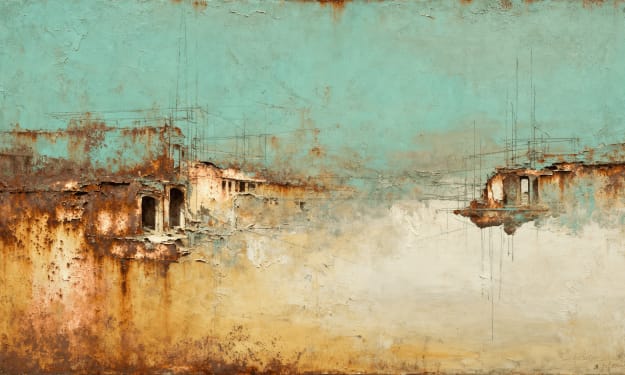
"Cathédrale et Ses Environs" (1951) | Oil on canvas, 97 x 130 cm | View painting
Before the Fall
This is not a painting about a cathedral.
It is about the moment before the cathedral loses its certainty of being a cathedral.
Or perhaps: the moment we realize it never had that certainty to begin with.
Zao Wou-Ki does not paint the structure. He paints the structure's hesitation to claim itself as structure.
The Artist: What Distance Reveals
When does leaving home become the only way to see it clearly?
Zao Wou-Ki (1920-2013) left China in 1948 carrying a paradox: trained rigorously in calligraphy and classical painting, he feared that mastery would become a prison. His teacher had told him that Chinese art calcified after the Song Dynasty—that repetition replaced creation.
Paris was not escape. It was the distance required for recognition.
Through a Western artist who worked with symbols and multidimensional spaces—who seemed to understand something about abstraction that resembled ancient pictographic thinking—Zao began to see what he had left behind differently. Not as limitation. As dormant possibility.
By 1951, painting "Cathédrale et Ses Environs," he stood between: still using recognizable forms, but already suspecting that recognition might be the wrong question entirely.
What if the point was not what we see, but the instability of seeing itself?
The Structure as Uncertain Memory
The black lines are not lines of construction.
They are lines that seem to be remembering construction.
But what if they are remembering something that never fully solidified?
The architecture here exists in a state of ontological suspension:
Neither present nor absent.
Neither built nor ruined.
Neither beginning nor ending—or both simultaneously.
Internal Collapse, or Never Cohesive?
There is no external demolition here.
No visible force striking the cathedral.
But we should resist assuming what we see is loss of cohesion.
Perhaps this is the structure's original state:
Never fully cohesive.
Never completely certain of its own boundaries.
The question shifts:
Not when did it start falling apart?
But was it ever together?
One reading assumes prior wholeness.
The other suggests fragmentation as origin.
The painting holds both possibilities without choosing.
And what if this refusal to choose is the painting's deepest honesty?
Void as Active Presence
The spaces between forms are not empty.
They seep, press, dissolve.
This is not passive background.
It is an active environment that does not destroy so much as absorb.
Where emptiness is understood as generative rather than privative, the void is never mere absence. It becomes potential, breath, the space in which things become possible.
But Zao does not illustrate this principle.
He enacts it.
The verdigris and bronze tones do not sit on the canvas.
They breathe through it.
Can a color breathe? Or does it only breathe when we watch it long enough to notice we are breathing with it?
The Absent Horizon
There is no horizon line.
This is not lack of skill.
It is refusal of certainty.
A horizon means stable ground, clear separation, a known relationship between viewer and viewed.
Zao denies us this stability.
The blue-green could be sky, water, mist, or time itself made chromatic.
The ochre could be earth, stone, light, or memory of light.
The painting resists being grounded.
And in that resistance, something emerges:
The experiential quality of standing in a space where orientation must be continually negotiated.
Where every claim about "this is sky, this is earth" becomes provisional the moment it is made.
The Arc That Refuses Closure
Upper right: an incomplete arc.
We might call this unfinished.
We might call this refusal to finish.
But consider another reading:
The arc is complete. Completion does not require closure.
Some experiences resist resolution not because they are interrupted, but because resolution would falsify them.
The arc remains open because openness is its truth.
Closure would be a lie.
What if the most honest things cannot be completed?
Color as Temporal Residue
The rust-orange in the lower right is not fire.
It is the chromatic trace of duration.
Not event, but accumulation.
Not destruction, but slow transformation into something else.
This is where the painting becomes deeply perceptual:
It depicts not a moment, but a duration.
Not a state, but a process that has no clear beginning or end.
Standing before it, we do not witness collapse.
We become implicated in ongoing dissolution.
We become participants in time, not observers of it.
Technique as Phenomenological Gesture
Zao scrapes pigment away with the brush handle.
Not addition. Not subtraction.
Revealing and concealing simultaneously.
He buries what was visible, then partially uncovers it again.
The result: lines that look simultaneously carved and erased, evoking memory that is not quite accessible, form that is not quite graspable, presence that flickers at the edge of perception.
The scraped lines tremble.
Not from uncertainty of hand, but from uncertainty of being.
What if every mark we make carries the ghost of its own erasure?
Layers: Temporal Palimpsest
The painting is built through transparent layers—verdigris, bronze, washes that seep and spread.
The technique emerged from an experiment: adding water to oil-based inks against all advice, making Western medium behave like Eastern ink on absorbent paper.
The effect:
- Colors that bleed into each other without fully mixing
- Boundaries that soften but do not disappear
- Time made visible as sediment
Each layer is both there and not-there.
This is not representation of space.
This is space as phenomenological experience:
Depth created not through perspective, but through accumulated semi-transparency.
Through what half-reveals itself by half-concealing.
The Floating Mass
The semi-central form is not anchored.
The vertical lines around it do not support it.
They gesture toward the idea of support.
As if the structure remembers being supported.
Or anticipates support that never arrives.
The cognitive tension here:
The experience of something that should be stable, but isn't.
The feeling of waiting for resolution that does not come.
Not anxiety exactly.
Something quieter: suspension without promise of landing.
What does it mean to wait for something that may never have existed?
When Does a Thing Cease Being What It Was?
This is the painting's core question.
Not: "What is this?"
But: "At what point does a thing lose the right to its own name?"
When does a cathedral stop being a cathedral?
- When it cannot be entered?
- When its function ceases?
- When it can no longer be recognized?
- Or when our certainty about calling it a cathedral wavers?
The painting suggests:
The thing does not change. Our relationship to naming it changes.
And in that gap—between thing and name, between form and recognition—something opens:
The experience of losing the ability to be certain.
Not dramatically.
Quietly. Gradually. Almost imperceptibly.
The way certainty always actually leaves: not announced, but noticed only after it has already gone.
The Threshold as Condition
This painting depicts the state of being between.
Between presence and absence.
Between memory and forgetting.
Between form and formlessness.
But here is the crucial insight:
Zao does not seem to present this as temporary.
This is not a moment we pass through on the way to somewhere else.
The between-state may be the condition itself.
Most experience is not before or after.
Most experience is during.
Most of consciousness is transitional.
We live in thresholds.
We mistake them for waiting rooms.
But what if there is no room beyond the threshold? What if the threshold is all there is?
What Is Not Said
The painting enacts principles we might associate with certain worldviews—where emptiness is generative, where boundaries are provisional, where transformation is constant.
But Zao does not illustrate these ideas.
He creates conditions in which we experience them directly.
The difference is everything.
Illustration would be conceptual.
This is perceptual.
We do not think about dissolution.
We feel it happening as we look.
The painting does not tell us about instability. It makes us unstable.
Phenomenological Achievement
What makes this painting powerful:
It does not seem interested in offering consolation.
It does not appear to say: "Things fall apart, but beautifully."
It does not promise: "Dissolution leads to renewal."
It simply remains in the state of falling-apart-ness.
Without promise.
Without redemption.
Without meaning beyond the experience itself.
This is rare in art:
To depict uncertainty without resolving it.
To depict transition without promising destination.
To refuse comfort without offering despair.
To simply present: this is what it feels like when form cannot hold.
The Viewer's Implication
Standing before this painting, we cannot remain observers.
Because what it depicts is not complete without us:
Our eyes search for the cathedral.
Find traces of it.
Lose them again.
Our perception participates in the dissolution.
We are not looking at a record of something that happened.
We are experiencing it happening.
The painting is not past tense.
It is continuous present.
We do not see the cathedral dissolving. We dissolve the cathedral by looking for it.
Western Medium, Eastern Question
Zao uses oil paint—the medium of Western solidity, mass, presence—but asks it a different question:
"How can I make this medium depict uncertainty itself?"
How can oil—thick, opaque, insistent—be made to hesitate?
The answer: layers, scraping, washes, transparent veils.
Making the medium doubt its own opacity.
Teaching Western certainty to speak with Eastern suspension.
What the Painting Suggests
Zao's cathedral proposes something unsettling:
That solidity may be less stable than we assume.
That every form we perceive as fixed may already be in the process of becoming something else.
Not as universal law.
As perceptual possibility.
Not as metaphysical claim.
As painterly observation.
We just usually don't see it.
Zao makes it visible.
Not as tragedy.
Not as beauty.
As condition.
As what it has always been, once we learn to look without demanding it hold still.
Conclusion: Hesitation as Method
"Cathédrale et Ses Environs" does not depict before or after.
It depicts during.
The continuous, unresolvable during.
Zao stands here at his own threshold in 1951:
- Between figuration and abstraction
- Between West and East
- Between certainty and doubt
The painting suggests:
The threshold may not be a place you leave.
It may be where perception actually occurs.
Where seeing happens not as recognition, but as negotiation with what refuses to be fixed.
The edge of dissolution.
Not as crisis.
As condition.
The cathedral hesitates.
We hesitate with it.
This hesitation is not weakness.
It may be the only honest response to what it means to perceive form at all.
To see anything is to watch it begin to disappear.
About the Creator
LUCCIAN LAYTH
L.LUCCIAN is a writer, poet and philosopher who delves into the unseen. He produces metaphysical contemplation that delineates the line between thinking and living. Inever write to tellsomethingaboutlife,but silences aremyway ofhearing it.
Keep reading
More stories from LUCCIAN LAYTH and writers in Art and other communities.


Comments
There are no comments for this story
Be the first to respond and start the conversation.