

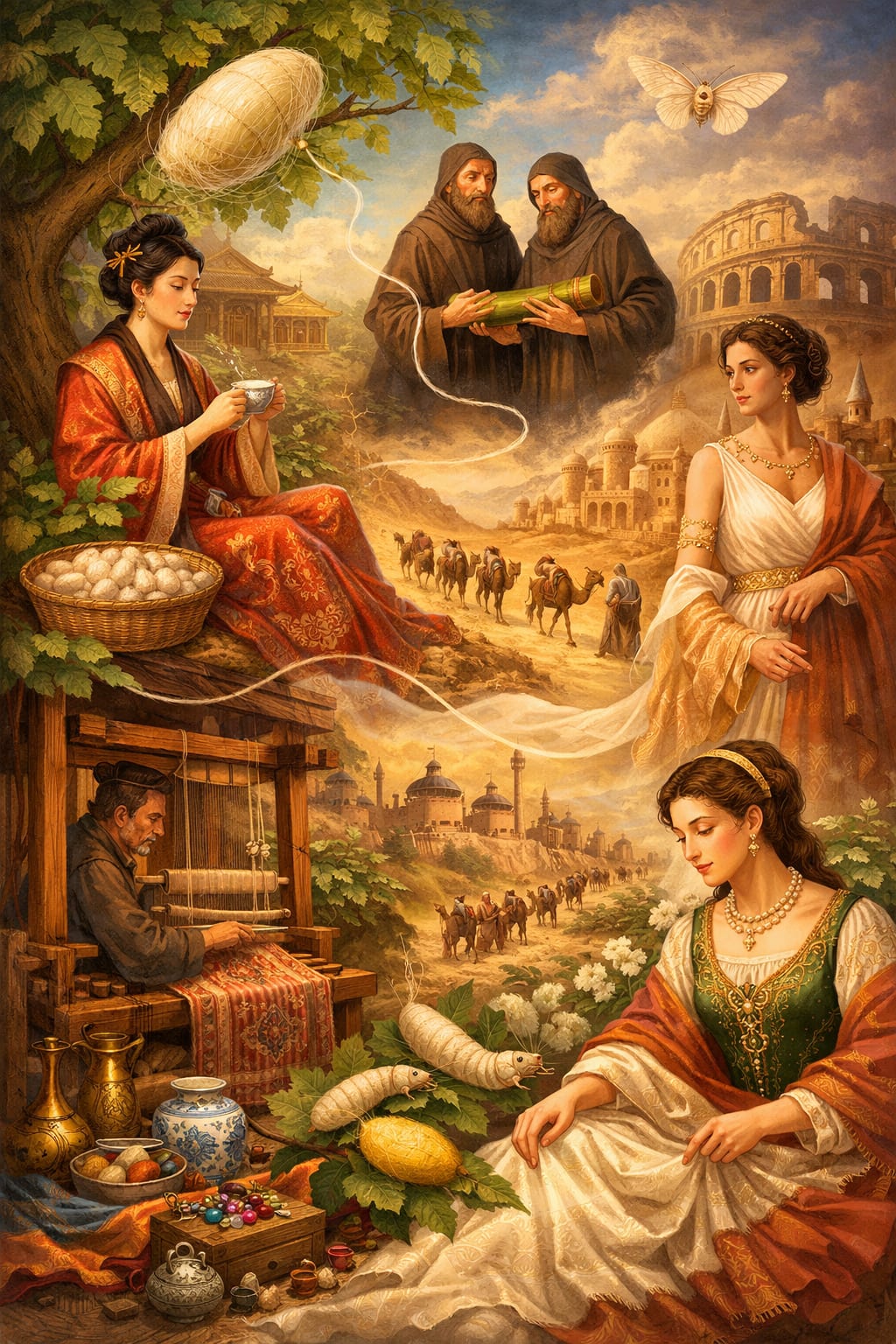
Long before silk became a symbol of luxury, elegance, and refined taste, it was simply a secret—guarded closely, whispered carefully, and protected fiercely by an ancient civilization. The story of silk is not merely about a fabric; it is a tale woven with legend, patience, innovation, and the quiet labor of tiny creatures that changed the course of human history.
According to Chinese legend, the discovery of silk dates back nearly 5,000 years. The story begins in the garden of Empress Leizu, wife of the Yellow Emperor Huangdi. One afternoon, while she was sipping tea beneath a mulberry tree, a cocoon fell into her cup. As she tried to remove it, the cocoon began to unravel into a long, delicate thread—smooth, strong, and shimmering in the sunlight. Fascinated, the empress carefully wound the thread around her finger. That single thread, legend says, marked the birth of silk.
Whether myth or truth, ancient China undeniably became the cradle of silk production. The Chinese learned that the cocoon came from the silkworm, the larva of the Bombyx mori moth, which fed exclusively on mulberry leaves. Through careful observation and experimentation, they mastered the art of sericulture—the cultivation of silkworms—and transformed fragile cocoons into fabric of extraordinary beauty. Silk was lightweight yet strong, soft yet durable, and unlike anything the world had known before.
For centuries, silk remained China’s most closely guarded secret. Revealing the process of silk-making was considered a grave crime, punishable by death. Silk was not just cloth; it was wealth, power, and prestige. Emperors wore robes of pure silk, and its use was regulated by strict laws. Over time, silk became a form of currency, a diplomatic gift, and a symbol of social status. Even common people recognized its value, though few were allowed to wear it.
As demand for silk grew beyond China’s borders, trade routes began to form. These routes, stretching across deserts, mountains, and vast plains, eventually became known as the Silk Road. More than a single road, it was a complex network of trade paths connecting East Asia with Central Asia, the Middle East, and Europe. Along these routes, silk traveled westward, while spices, precious stones, metals, and ideas flowed eastward. Silk became a bridge between civilizations.
In Rome, silk caused both admiration and controversy. Roman elites were captivated by its smooth texture and luminous appearance. Roman women draped themselves in silk garments, while senators debated its moral implications, claiming it encouraged vanity and extravagance. Despite criticism, demand only increased. Silk was worth its weight in gold, and merchants risked dangerous journeys to obtain it.
Eventually, the secret of silk could not remain hidden forever. According to historical accounts, around the 6th century CE, two Byzantine monks smuggled silkworm eggs out of China, hiding them in hollow bamboo sticks. With this act, silk production spread to the Byzantine Empire and later to Persia, India, and the Islamic world. Each culture adapted silk-making techniques and added its own artistic touch through weaving patterns, dyes, and embroidery.
During the medieval period, silk production flourished in regions such as Italy, especially in cities like Venice, Florence, and Lucca. Italian silk became renowned across Europe, adorning royalty and the wealthy. Silk workshops supported entire communities, and the fabric became deeply tied to fashion, art, and economic power.
Yet behind silk’s beauty lies a story of patience and transformation. The life cycle of the silkworm mirrors the journey of silk itself. From a tiny egg hatches a larva that eats relentlessly, growing rapidly until it spins its cocoon—a protective home made from a single continuous thread that can stretch for hundreds of meters. Human hands gently unwind this thread, combining many strands to form silk yarn. What begins as something ordinary becomes something extraordinary through care and craftsmanship.
In the modern world, silk remains a fabric of fascination. Though industrialization has introduced synthetic alternatives, natural silk retains its charm. It is prized for its breathability, strength, and timeless elegance. From traditional sarees and kimonos to modern fashion and interior design, silk continues to evolve while honoring its ancient roots.
Today, the story of silk also invites reflection. It reminds us of humanity’s relationship with nature—how careful observation and respect can lead to remarkable creations. It tells us how a single discovery can connect continents, shape economies, and influence cultures. Silk is more than a material; it is a thread that runs through history, binding past and present.
From a cocoon falling into a teacup to global trade routes spanning thousands of miles, the journey of silk is one of wonder and resilience. Even now, when we touch a piece of silk, we are touching history—a story spun patiently, thread by thread, across thousands of years.
About the Creator
Ibrahim Shah
I am an Assistant Professor with a strong commitment to teaching,and academic service. My work focuses on fostering critical thinking, encouraging interdisciplinary learning, and supporting student development.
Keep reading
More stories from Ibrahim Shah and writers in Art and other communities.
Clock in Mr. Elwood’s shop
The clock in Mr. Elwood’s shop had stopped at 4:17 a.m. on a Thursday that no one remembered clearly. It wasn’t broken—every gear was clean, every spring obedient—but time simply refused to move forward inside it. That was The clock in Mr. Elwood’s shop had stopped at 4:17 a.m. on a Thursday s why people came.
By Ibrahim Shah 4 days ago in Art
The Painter Who Chose Silence
Noah was not a famous painter. In fact, very few people knew his name. He lived in a small rented room with white walls and a single window that faced an old street. His days were quiet, almost invisible. But inside that silence, Noah carried a deep love for art.
By Sudais Zakwan4 days ago in Art
The Pride Flag and the Diversion
For nearly a decade, the LGBTQIA Pride Flag rippled in the wind at Christopher Park, a kaleidoscope of color staked into the soil of America’s first national monument to LGBTQIA+ liberation. That flag came down this week. Federal officials, citing new guidance from the Trump Administration, silently lowered the rainbow flag from its pole across the street from the Stonewall Inn. The birthplace of the modern gay rights movement now flies only the United States flag.
By Tim Carmichaelabout 12 hours ago in Pride




Comments
There are no comments for this story
Be the first to respond and start the conversation.