
When Images Refuse Ownership
The Singing Butler, Repetition, and the Narrative Affect

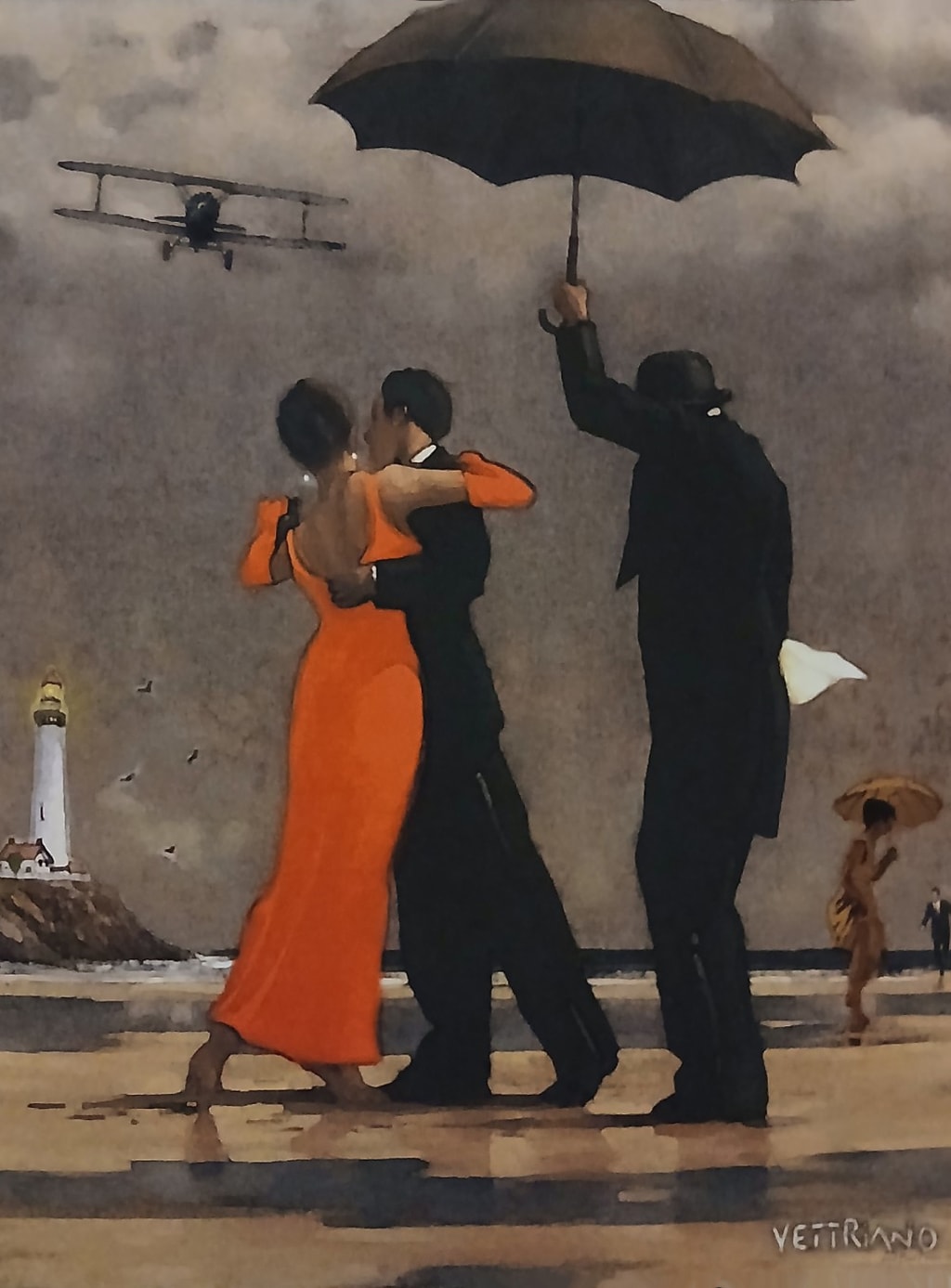
The history of modern art repeatedly demonstrates a stubborn truth: no image can ever be owned absolutely. Forms circulate, poses migrate, gestures recur, and meanings survive only insofar as they continue to work on people. Copyright, originality, and authorship may function as legal or institutional devices, but aesthetically they are always provisional. What ultimately matters is not where an image comes from, but whether it generates a lived response — a mood, a tension, a sense of story. Few contemporary paintings illustrate this more clearly than The Singing Butler (1992) by Jack Vettriano, a work that has become both one of the most reproduced images in Britain and one of the most contested.
The now well-documented story behind *The Singing Butler* unsettled the art world not because it revealed deception, but because it exposed a fantasy about originality that critics were reluctant to abandon. Vettriano, a self-taught painter working without access to live models, relied on a modest instructional publication, The Illustrator’s Figure Reference Manual (1987), priced at £16.99. From this manual he borrowed the staged poses of a dancing couple and a female figure holding an umbrella. The female dancer was based on photographs of Orla Brady, an actress whose image appeared in the book. What the manual offered, however, was not art, but anatomy: isolated bodies, stripped of narrative, atmosphere, and affect.
Vettriano’s intervention was not technical but cinematic. He relocated the figures to a windswept beach on the coast of Fife, submerged them in grey skies and reflective sand, dressed them in evening wear, and flanked them with servants holding umbrellas against the weather. He transformed anatomical poses into characters, and characters into a situation. The titular butler, whom Vettriano later claimed was singing ‘Fly Me to the Moon’, is not merely an accessory but a narrative hinge. His presence turns a static dance into a scene unfolding in time. This is precisely the point at which originality begins — not at the level of pose, but at the level of story.
The controversy that erupted in 2005, when the use of the reference manual became widely known, revealed a persistent confusion in critical discourse between borrowing and meaning. Critics who dismissed Vettriano’s work as derivative implicitly assumed that originality resides in form rather than function. Vettriano’s defence was both pragmatic and historically literate. He described the manual as a tool, no different from brushes or canvas, and later invoked Francis Bacon’s ownership of the same book, as well as Pablo Picasso’s infamous remark that ‘other artists borrow — I steal’. What unsettled critics was not the borrowing itself, but the painting’s success. Rejected by the Royal Academy in 1992, The Singing Butler nevertheless became the best-selling art print in the UK and achieved a record auction price for a Scottish painting when it sold for £744,800 in 2004.
That popularity provoked suspicion precisely because it bypassed institutional validation. Vettriano was dubbed ‘the people’s painter’, a label that concealed as much as it revealed. His work was criticised for uneven finishing, inconsistent lighting, implausible wind dynamics, and an anatomically reversed dance hold. Yet none of these formal objections diminished the painting’s affective force. The image persisted because it worked. Viewers did not respond to anatomical correctness; they responded to the sense of suspended time, of romance resisting weather, of intimacy staged against indifference.
The durability of The Singing Butler as a cultural icon is further evidenced by its afterlives. In 2005, Banksy produced Crude Oil (Vettriano), replacing the maid with figures in hazmat suits and introducing an oil tanker sinking in the background. This parody did not negate Vettriano’s image but confirmed its symbolic potency. When the painting was later sold for £4.3 million in 2025, the transformation itself became part of the artwork’s expanding narrative field. An image capable of absorbing satire, critique, and reinvention is an image that has escaped ownership.
Seen from this perspective, the obsession with whether Vettriano ‘copied’ from a manual becomes irrelevant. The figures in the book were not art; they were raw material. Vettriano’s achievement lay in converting instructional images into a cinematic tableau. He did not invent the human body, the dance pose, or the umbrella. He invented the situation. This is why comparisons with Grant Wood’s American Gothic are instructive. Both works function less as formal innovations than as narrative condensations — images that imply an entire world beyond their frame.
This logic extends naturally into contemporary practices of reworking and reinterpretation. In recreating a variant of The Singing Butler, the act is not one of replication but of narrative continuation. By introducing a biplane overhead, a running man inspired by Alfred Hitchcock’s North by Northwest, and a lighthouse anchoring the horizon, the scene is re-scripted rather than copied. The running figure, echoing Cary Grant’s flight across the cornfield, is redirected — not away from danger, but towards desire. The beach becomes not merely romantic but suspenseful; the stillness of the original acquires kinetic tension.
This is not appropriation in the pejorative sense but narrative montage. Cinema, painting, and popular memory collapse into a single image that functions like a frozen film frame. What emerges is not a violation of copyright but a demonstration of its limits. No legal framework can contain the circulation of meaning once an image has entered collective imagination. What survives is not ownership but affect.
This is precisely what can be described as Narrative Affect: the capacity of an image to operate as a story-generator rather than a closed object. Narrative Affect does not depend on originality of form but on resonance. It is the reason a self-taught painter using a cheap manual could produce one of the most recognisable images of late twentieth-century British art. It is also the reason that contemporary reworkings, reinterpretations, and cinematic insertions do not diminish the original but testify to its vitality.
The episode of The Singing Butler marks a crucial moment in art history because it exposes a simple truth often obscured by theory and institutions: art exists only insofar as it moves people. Poses can be borrowed, scenes can be replayed, and images can be endlessly reconstructed. What cannot be fabricated is the moment when an image begins to live in the imagination of others. That moment — when a picture starts to feel like a story — is where art begins and ownership ends.
About the Creator
Peter Ayolov
Peter Ayolov’s key contribution to media theory is the development of the "Propaganda 2.0" or the "manufacture of dissent" model, which he details in his 2024 book, The Economic Policy of Online Media: Manufacture of Dissent.
Keep reading
More stories from Peter Ayolov and writers in Art and other communities.
The Scream by Edvard Munch is one of my favourite paintings
The Scream by Edvard Munch is another one of my favourite paintings that is alongside of that of Nighthawks. I have a shirt with The Scream 😱 by Edvard Munch. This painting is absolutely brilliant and amazing. It is a contradiction in a way warm colours but dark and deep subject matter.
By Revista Mikoa day ago in Art
The Painter Who Captured Souls
The small gallery at the edge of the city was easy to miss. A faded sign swung gently in the wind, and the windows were streaked with dust, yet inside, it held a world unlike any other. Visitors said that stepping into the gallery was like crossing into a different time, a place where colors spoke louder than words and silence carried its own weight.
By Sudais Zakwanabout 21 hours ago in Art


Comments
There are no comments for this story
Be the first to respond and start the conversation.