Afriditipszone
Stories (10)
Filter by community
Title: The Red Dust of Dallas (1915)
In the summer of 1915, the city of Dallas was a place of red dust roads, clanging streetcars, and rising ambition. Oil money was beginning to whisper promises across Texas, cotton still ruled the fields, and the Trinity River curved lazily past wooden bridges and cattle yards. The skyline was modest—brick buildings, church steeples, and the proud dome of the county courthouse catching the sun. On Lamar Street, not far from the bustling markets, lived seventeen-year-old Thomas Whitaker. His father worked long hours at the cotton compress, and his mother stitched dresses for the women who attended Sunday service in stiff collars and wide hats. Thomas dreamed of something larger than the narrow streets he knew. He spent his evenings reading newspapers under the flicker of a kerosene lamp, following stories of inventions, war in Europe, and the rapid growth of cities like New York and Chicago. But Dallas was growing too, even if its growth felt quieter. The electric streetcars rattled through town, carrying bankers, ranchers, and shop girls in crisp blouses. The smell of fresh bread drifted from corner bakeries. Cattle traders argued loudly in the stockyards. And every Saturday, the farmers from surrounding counties filled the square with wagons loaded with cotton bales and produce. Thomas worked part-time at a printing press owned by Mr. Adler, a stern but fair German immigrant who believed that newspapers were the voice of progress. The shop produced handbills, church programs, and occasionally pamphlets discussing city politics. Thomas loved the rhythmic clank of the press and the sharp scent of ink. He believed words had power—power to shape a city’s future. In May of that year, rumors of trouble stirred the air like a coming storm. Tensions were rising across the South, and Dallas was not immune. Though Thomas was young, he could feel unease in the streets—whispers about racial injustice, about anger simmering beneath polite greetings. His mother warned him to come home before dark. “This city can be kind,” she would say, “but it can also turn cold.” One evening, as the sun dipped behind the courthouse, Thomas lingered outside the shop to watch a political rally. A crowd gathered around a wooden platform where a candidate promised economic growth and stronger law enforcement. His voice boomed across the square, promising that Dallas would soon rival any northern city. The crowd cheered, hats lifted in the air. Thomas watched, uncertain whether to feel inspired or wary. Across town, near Deep Ellum—a district alive with music and lively chatter—Thomas’s friend Samuel Carter lived with his family. Samuel, the son of a railroad porter, was talented with a fiddle and dreamed of forming a band. Deep Ellum was one of the few places in Dallas where music spilled into the streets after sundown. Though segregation shaped much of daily life in 1915, music sometimes bridged divides, floating freely above social barriers. Thomas admired Samuel’s courage. While Thomas clung to printed words, Samuel trusted melodies. On warm nights, Thomas would slip away to hear Samuel play in a crowded hall where oil lamps glowed and boots stomped against wooden floors. There, worries seemed to dissolve into rhythm. But 1915 would not be remembered only for music and hope. That year, Dallas witnessed events that left deep scars. Tensions erupted in violence that shocked even those accustomed to harsh realities. Crowds formed not for celebration but for fury. Thomas saw firsthand how quickly order could crumble. The streets he once viewed as full of promise now felt dangerous and uncertain. One sweltering afternoon, smoke curled into the sky from a distant neighborhood. Thomas stood frozen as people ran past him, shouting conflicting stories. Fear spread faster than truth. Mr. Adler closed the shop early, bolting the door and whispering a prayer in German. “This is not progress,” he muttered. “This is madness.” Thomas returned home to find his mother pale and trembling. She spoke of neighbors hiding indoors, of mothers clutching their children. That night, the city that once buzzed with ambition lay heavy with silence. Even the streetcars seemed to move more slowly, their metal wheels screeching like distant cries. In the weeks that followed, Dallas attempted to resume normal life. Markets reopened. Church bells rang. Politicians spoke of unity and moving forward. Yet something intangible had shifted. Thomas felt it in the cautious way strangers looked at one another, in the hushed tones of conversations at the press shop. Determined not to let fear define his future, Thomas proposed printing a series of essays about rebuilding trust within the community. Mr. Adler hesitated. “Words can heal,” he said, “but they can also inflame.” Still, he allowed Thomas to write. Thomas worked late into the night drafting his thoughts. He wrote about shared streets and shared futures, about the responsibility of citizens to reject hatred. He wrote about Dallas not as a divided city, but as a growing one, capable of learning from its darkest days. When the pamphlets were distributed, reactions were mixed. Some praised the young writer’s courage. Others scoffed, dismissing him as naive. Yet Thomas noticed something remarkable: people were talking—not with anger alone, but with reflection. Meanwhile, Samuel’s music grew more popular. His band played not only in Deep Ellum but at small gatherings across town. Though barriers remained, the universal language of music drew quiet admiration from unexpected listeners. Thomas attended as many performances as he could, finding comfort in the steady hum of strings. By autumn, cooler winds swept through Dallas. Cotton season returned, and wagons once again crowded the square. The Trinity River glimmered under a softer sun. Life pressed forward, as it always did. One evening, Thomas stood on the wooden bridge overlooking the river. The skyline shimmered faintly—modest but determined. He realized that cities, like people, carried both light and shadow. Dallas in 1915 was no exception. It was a place of opportunity and inequality, of innovation and injustice, of music and silence. Thomas decided he would stay. He would continue writing, continue believing that progress required courage. He would witness the city’s transformation in the years ahead—the arrival of automobiles replacing horses, the expansion of rail lines, the eventual skyline rising higher than anyone in 1915 could imagine. Samuel joined him on the bridge, fiddle case in hand. “One day,” Samuel said, “they’ll remember this city for more than its troubles.” Thomas nodded. “And maybe they’ll read about how we tried to make it better.” The river flowed on, indifferent yet eternal. Above them, the Texas stars emerged, steady and bright. Dallas, with all its contradictions, settled into the cool night of 1915—scarred, hopeful, and alive with possibility. And in a small house on Lamar Street, beneath the flicker of a fading lamp, a young printer and a young musician dreamed of a future that would one day rise from the red dust, carrying their stories into history.
By Afriditipszoneabout 15 hours ago in History
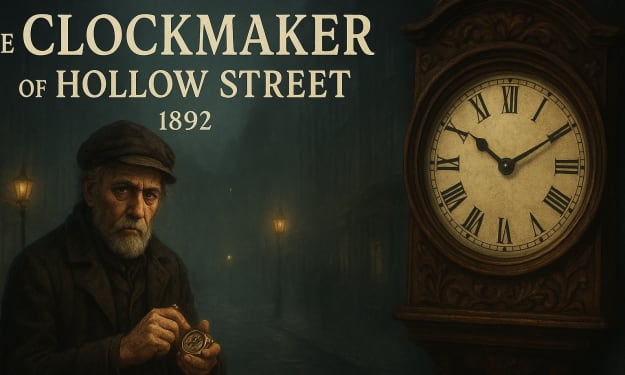
The Clockmaker of Hollow Street
London, 1892. The fog rolled in thick that evening, swallowing the glow of gas lamps until they shimmered like half-remembered dreams. Hollow Street was quieter than most corners of the city — too narrow for carriages, too forgotten for wanderers. Only the sound of ticking came from a small shop wedged between a tailor’s and an abandoned bakery.
By Afriditipszone4 months ago in History
The Gaslight on Hanover Street
In the early 1800s, Boston was a city in transformation. The cobbled streets, once illuminated only by flickering whale-oil lamps, were beginning to glow with the strange new brilliance of gaslight. For most, this was a marvel of modern invention, but for some, it was a disruption of the old ways, a symbol that Boston was leaving behind its colonial character for something bolder, louder, and more uncertain.
By Afriditipszone5 months ago in History
The Boom and the Storm: A Miami Tale of 1920s USA
In the roaring 1920s, Miami was not yet the gleaming city of glass towers and neon lights that people imagine today. It was still young—barely a few decades since Julia Tuttle had first convinced Henry Flagler to extend his railroad south. The town had grown quickly, rising from swamps and mangroves into a patchwork of Mediterranean-style homes, palm-lined boulevards, and hotels that promised paradise to snow-weary northerners.
By Afriditipszone5 months ago in History
The Forgotten Bells of Old Los Angeles
In the early 1800s, long before Los Angeles became a vast city of freeways and skyscrapers, it was still a modest pueblo, a settlement of adobe houses, dusty streets, and wide fields stretching toward the distant mountains. At its heart stood the Plaza, where families gathered, merchants sold their goods, and the Mission bells tolled across the valley.
By Afriditipszone5 months ago in History
The Old Story of Washington, D.C.
In the late 18th century, when America was still young, the leaders of the new nation faced a great question: where should the capital of the United States be? Rivalries between northern and southern states made the choice difficult. To settle the debate, President George Washington selected a site along the Potomac River in 1790. This land, carved from Maryland and Virginia, would become Washington, D.C.
By Afriditipszone5 months ago in History
The Lanterns of Old New York
In the late 1800s, long before the glass towers and neon signs, New York was a city of shadows and lanterns. Cobblestone streets stretched out beneath the flicker of gaslights, and the air was filled with the steady hum of carriages, the cries of vendors, and the smell of roasted chestnuts sold on the corners. The city was alive, restless, and brimming with dreams.
By Afriditipszone5 months ago in History
The bone circle
The villagers spoke of the clearing in hushed tones, as though naming it aloud might draw its curse closer. They called it the Bone Circle. Some said it had been there for centuries, others swore it appeared overnight after a blood-red moon. What no one denied was that anyone foolish enough to linger within its boundaries was never seen again.
By Afriditipszone6 months ago in Horror
The Whispering House
On the edge of a small, forgotten town stood an abandoned house no one dared to enter. The locals said it whispered at night. Some claimed they heard voices calling their names, others swore they saw shadows moving inside even when the windows were boarded shut.
By Afriditipszone6 months ago in Horror