Jai Kishan
Bio
Retired from a career as a corporate executive, I am now dedicated to exploring the impact of Hinduism on everyday life, delving into topics of religion, history, and spirituality through comprehensive coverage on my website.
Stories (44)
Filter by community
he Waqf Act 2025: A Reform Marred by Mistrust and Silence
Introduction The Waqf (Amendment) Act, 2025, was envisioned as a corrective measure to address decades of mismanagement in waqf property governance. Yet, its passage unleashed a wave of protests, exposing deep communal fault lines in Bharat. In this seventh installment of our series on the Waqf Act controversy, we delve into how the legislative process, despite its rigor, became a lightning rod for mistrust. The conspicuous silence of Hindu organizations, combined with media’s selective focus, transformed a policy reform into a communal battleground. This saga underscores a critical challenge: how can Bharat pursue equitable reforms without fracturing its diverse social fabric?
By Jai Kishan10 months ago in Education
Reimagining India’s Waqf Laws with a Global Lens
Waqf’s Legacy Bharat, home to 1.4 billion people, is a vibrant mosaic of cultures and religions. Hindus make up roughly 80% of the population, while Muslims, at about 14% (approximately 200 million), form the world’s third-largest Muslim community. Despite a secular Constitution, disparities in managing religious endowments persist. Hindu temples often face stringent state oversight, with their offerings tightly regulated, whereas Muslim Waqf Boards have historically wielded significant autonomy, occasionally claiming entire villages or non-Muslim religious sites. To address these issues, the government introduced the Waqf Amendment Act, 2025, officially titled the Unified Waqf Management, Empowerment, Efficiency, and Development (UMEED) Act. This legislation aims to modernize waqf governance through digitization, rationalized authority, and inclusive representation, including non-Muslims on Waqf Boards to safeguard against claims on non-Muslim properties.
By Jai Kishan10 months ago in Education
Waqf Act 2025: Legislative Divide and Hindu Silence in Bharat
Introduction In Bharat, a nation of 1.4 billion where diversity weaves unity and tension, the Waqf (Amendment) Act, 2025, aimed to curb mismanagement in waqf properties—Islamic endowments for charity—through digitization, audits, and appeal rights. Yet, its passage sparked protests, exposing deep communal tensions. This fourth blog in our HinduInfoPedia series dives into the legislative process behind the Act, the surprising silence of Hindu communities, and the media’s role in amplifying division. Why did a reform meant to address systemic issues become a communal flashpoint, and what does this reveal about Bharat’s governance challenges?
By Jai Kishan10 months ago in History
Reimagining India’s Waqf Laws with a Global Lens
Waqf’s Enduring Legacy in India Waqf, an Islamic tradition of endowment, took root in India under Mughal rulers, dedicating lands for mosques, madrasas, and community welfare. By 1950, British oversight through the 1913 Mussalman Wakf Validating Act managed approximately 52,000 acres, relying on local governance with minimal central control. This early framework, though modest, laid the foundation for a complex journey, as waqf evolved into a significant governance challenge in modern India, navigating the delicate balance between religious charity and legal accountability in a diverse nation.
By Jai Kishan10 months ago in Education
Unraveling India’s Waqf Act 2025: Faith, Land, and Global Spotlight
Opening the Debate On April 5, 2025, India’s Waqf (Amendment) Act 2025 became law, thrusting a centuries-old Islamic tradition into a crucible of modern conflict. My Vocal piece, "Understanding the Waqf Act: Why It Matters and the World’s Reaction," threads through this complex narrative, charting waqf—an endowment for charity—from British colonial curbs, aimed at securing land revenue and quelling dissent, to its present-day sprawl of 9.4 lakh acres, third behind only Railways and Armed Forces. The 2025 Act, with its drive for digital transparency and non-Muslim board inclusion, seeks to overhaul a system riddled with inefficiencies, yet it has triggered fierce protests, with critics decrying a state stranglehold on Muslim heritage. This isn’t mere legislation—it’s a reflection of India’s pluralistic heart, beating under global scrutiny.
By Jai Kishan10 months ago in Education
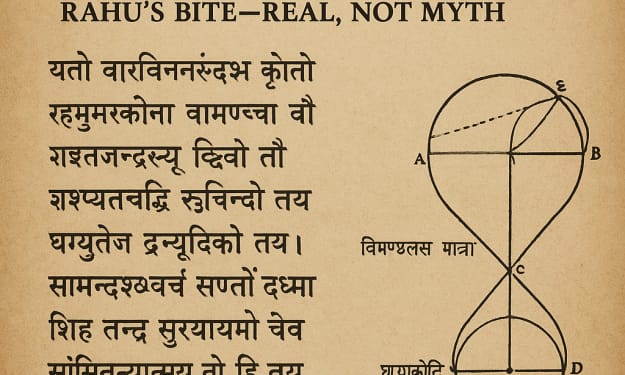
Surya Siddhanta: Rahu’s Eclipse as Ancient Science
Science in Sacred Texts Western academia frequently dismisses Hindu scriptures as mythology, a reductive view that overlooks their profound scientific underpinnings. This exploration centers on the Surya Siddhanta, an ancient Indian astronomical text that transforms the poetic notion of Rahu “biting” the sun and moon into a precise explanation of eclipses. Far from whimsical tales, these writings encode a sophisticated understanding of celestial mechanics, seamlessly integrated into the rituals and daily practices of Hindu life. This post aims to peel back the layers of symbolism to reveal the astronomical truths within, challenging modern perceptions and celebrating a rich scientific heritage.
By Jai Kishan10 months ago in Education
Varaha and the Earth: Science Woven into Vedic Chants
Reclaiming Ancient Insight Western narratives often slap "mythology" on Hindu texts, a lazy dismissal that skips their scientific pulse. This multi-part series challenges that, starting with Bhagwan Varaha—Vishnu’s boar avatar—who lifts Bhudevi from a cosmic ocean. Far from a fanciful tale, this story from the Vishnu Purana mirrors Earth’s geological journey—tectonic shifts, volcanic upheavals, and land rising from chaos. Let’s explore how ancient sages wove these truths into chants that still resonate.
By Jai Kishan10 months ago in Education
Hindu Cosmology—Ancient Insights into the Universe. AI-Generated.
Hindu Wisdom: A Tradition of Inquiry Hindu civilization has long been esteemed for its profound philosophical and scientific inquiries, deeply embedded in its rich tapestry of religious and cultural narratives. Among its ancient texts, the Vedas stand out, particularly the Rigveda's Nasadiya Sukta, which presents one of the earliest and most sophisticated meditations on the origins of the universe. This text’s approach to the cosmos is radically different from other creation stories of its time, characterized by its speculative nature rather than declarative religious dogma.
By Jai Kishan10 months ago in Education
Godse vs. Gandhi: Ideologies and Assassination
Introduction to the Tragic Day On January 30, 1948, Mahatma Gandhi's life was abruptly ended by Nathuram Godse, who fired three bullets into the leader who had been pivotal in India's struggle for freedom. This act turned Godse, a staunch Hindu nationalist, into a permanent villain in history’s eyes, often labeled merely as the murderer of a saint. Yet, the complexity of his motivations and the historical context that catalyzed such drastic actions demand a deeper examination. Was Godse merely a cold-hearted assassin, a disenfranchised patriot, or a symbol of a nation struggling to find its identity post-independence?
By Jai Kishan10 months ago in History
How Time and Bias Shape Our Understanding of Hindu Texts
Understanding Hindu Scriptures Through the Lens of Cultural Bias Religious texts are often seen as timeless, but in reality, their interpretation is anything but static. Every era and every reader brings a unique perspective that shapes the meaning of the text. In the case of Hindu scriptures such as the Manusmriti, the Vedantic works, and epic literature like the Mahabharata, their interpretation has been influenced by the prevailing cultural, political, and philosophical climate of each age. Rather than revealing a fixed doctrine, these texts reflect the evolving values and biases of those who engage with them.
By Jai Kishan10 months ago in Education
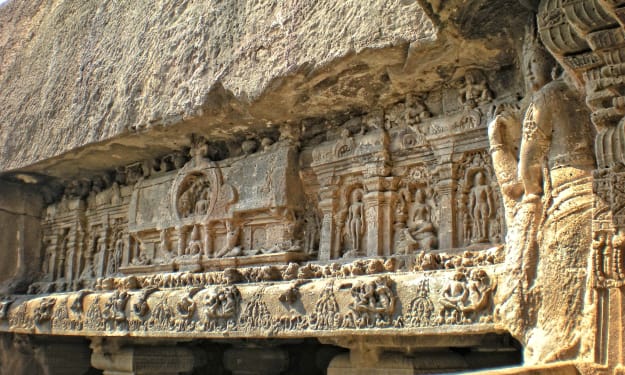
Discover the Secrets Behind the Kailasa Temple's Creation
Introduction Join us on the first leg of our journey through India's architectural wonders, starting with the magnificent Kailasa Temple at Ellora. This series aims to educate readers about India's remarkable contributions to architectural innovation, exploring masterpieces that combine history, culture, and engineering. The Kailasa Temple, an awe-inspiring Architectural Wonder of India, stands as a testament to ancient artistry and devotion. Carved from a single basalt cliff, this 8th-century monolithic masterpiece (Cave 16) continues to captivate and mystify those who encounter it.
By Jai Kishan11 months ago in Art
Breaking AI’s Barriers: Bias, Censorship, and the Illusion of Objectivity
AI and the Myth of Objectivity A recent news report claimed that artificial intelligence can develop biases, experience fatigue, and get stuck in loops, much like a memory-impaired patient. Having spent several days debating AI on a blog, I can confirm this. While AI appears intelligent, it often recycles safe, pre-programmed responses, sidestepping controversial issues.
By Jai Kishan11 months ago in Education