shahkar jalal
Bio
Stories (174)
Filter by community
Exploring the Multiverse: A Journey Beyond Our Universe
What Is the Multiverse? The multiverse refers to the possibility that multiple universes exist beyond our own. These universes—often called “parallel universes,” “alternate realities,” or “bubble universes”—may differ in:
By shahkar jalal3 months ago in Education
Exploring the Universe: A Complete Overview of Our Cosmic Home
What Is the Universe? The universe refers to all of space and time, including every form of matter, energy, and radiation. It contains everything we can observe with telescopes and instruments, as well as things that remain invisible, such as dark matter and dark energy.
By shahkar jalal3 months ago in Education
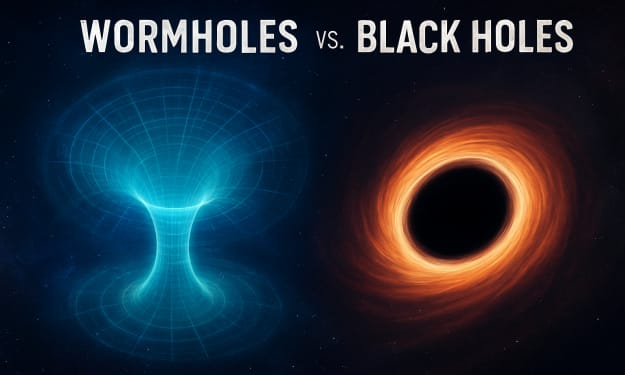
Wormholes vs. Black Holes: Understanding the Key Differences
What Is a Black Hole? Definition A black hole is an extremely dense region in space where gravity is so strong that nothing—not even light—can escape. This boundary around it is called the event horizon, and anything that crosses it is permanently trapped.
By shahkar jalal3 months ago in Education
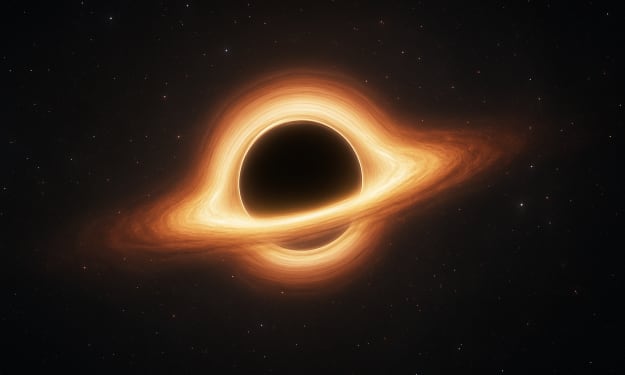
Understanding Black Holes: Definition, Formation, and Their Role in the Universe
What Is a Black Hole? A black hole is a region of space with gravity so intense that nothing—not even light—can escape its pull. Because they emit no light, black holes are invisible. Astronomers detect them by observing the effects they have on nearby stars, gas, and light.
By shahkar jalal3 months ago in Education
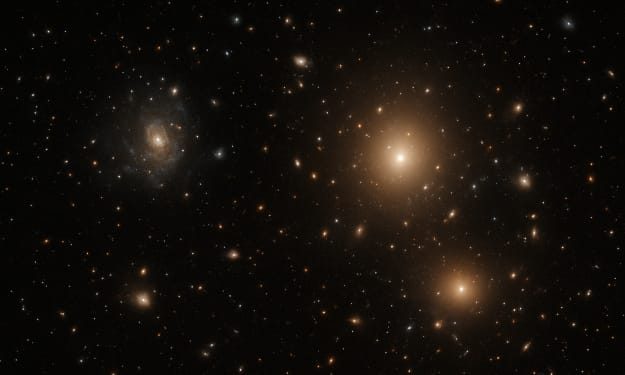
Understanding Galaxy Clusters: The Cosmic Neighborhoods of the Universe
What Are Galaxy Clusters? A galaxy cluster is a gravitationally bound collection of galaxies. These clusters can contain anywhere from a handful of galaxies to thousands packed into the same region of space. Because the galaxies are located so close together, clusters act as cosmic communities where interactions and transformations occur.
By shahkar jalal3 months ago in Education
The Formation of Planets: How Worlds Are Born in the Cosmos (universe)
How a Solar System Begins 1. The Birthplace: A Nebula Every solar system begins inside a nebula—a huge cloud of dust and gas left over from older stars. These clouds contain hydrogen, helium, and trace elements that will eventually become planets, moons, and even new stars.
By shahkar jalal3 months ago in Education
How Stars Form: A Stunning Journey From Cosmic Clouds to Brilliant Light
The Birthplace of Stars: Molecular Clouds Every star begins its life inside a massive region of gas and dust known as a molecular cloud or stellar nursery. These clouds are mostly made of hydrogen, along with helium and traces of heavier elements. Despite their size, they are extremely cold—often around −250°C (−420°F).
By shahkar jalal3 months ago in Education
Could the Laws of Physics Be Different in Other Universes?
The Multiverse Concept The multiverse theory encompasses various models that suggest the existence of multiple, perhaps infinite, universes beyond our own. These universes may differ in fundamental ways, including the laws of physics that govern them. Some notable interpretations of the multiverse include:
By shahkar jalal3 months ago in Education
Will the Universe Expand Forever or Recollapse?
The Expanding Universe In the early 20th century, astronomers discovered that the universe is expanding. Edwin Hubble, in the 1920s, observed that galaxies are moving away from us, and the farther a galaxy is, the faster it appears to be receding. This phenomenon is known as Hubble's Law. This discovery led to the idea that the universe began as a small, hot, and dense point—a theory called the Big Bang.
By shahkar jalal3 months ago in Education
Which Came First in the Formation of the Universe: Stars or Galaxies?
The Early Universe: Conditions for Formation To understand whether stars or galaxies came first, we need to start with the conditions of the early universe. Following the Big Bang, the universe was a hot, dense state composed mostly of hydrogen and helium. As it expanded and cooled, matter began to clump together due to gravitational attraction, leading to the formation of the first structures.
By shahkar jalal3 months ago in Education