shahkar jalal
Bio
Stories (171)
Filter by community
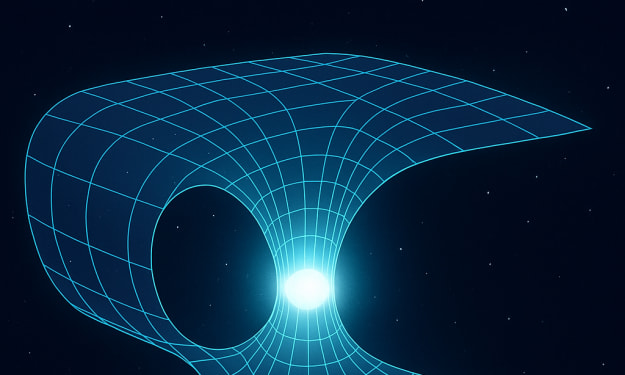
Why Do Wormholes Require Exotic Matter? Exploring the Physics Behind Spacetime Tunnels
What Is a Wormhole? A Brief Overview In general relativity, gravity is not a force but a consequence of curved spacetime. Massive objects distort spacetime, guiding the motion of matter and light.
By shahkar jalalabout a month ago in Education
Could Wormholes Exist Naturally in the Universe? Exploring Physics, Possibilities, and Evidence
What Is a Wormhole, Scientifically Speaking? In physics, a wormhole is a solution to Einstein’s equations of general relativity that connects two separate regions of spacetime through a curved tunnel-like structure.
By shahkar jalalabout a month ago in Education
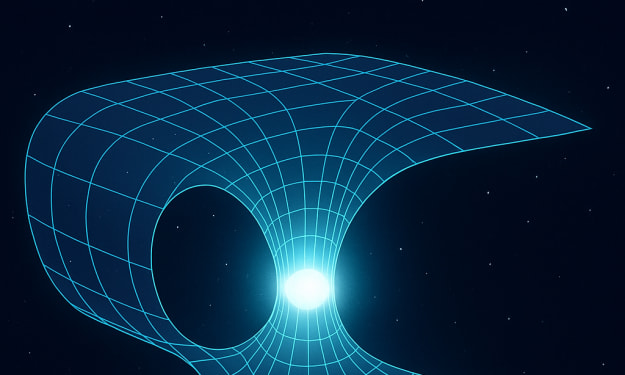
Are Wormholes Mathematically Allowed by Physics? Exploring the Equations Behind Cosmic Shortcuts
What Is a Wormhole? A wormhole is a hypothetical structure that connects two separate regions of spacetime through a tunnel-like geometry. Instead of traveling the long way through space, a wormhole could provide a shortcut by bending spacetime itself.
By shahkar jalalabout a month ago in Education
Could Microscopic Black Holes Exist? Exploring Tiny Black Holes and the Frontiers of Physics
What Are Microscopic Black Holes? Microscopic black holes are hypothetical black holes with extremely small masses and sizes—far smaller than stellar black holes.
By shahkar jalalabout a month ago in Education
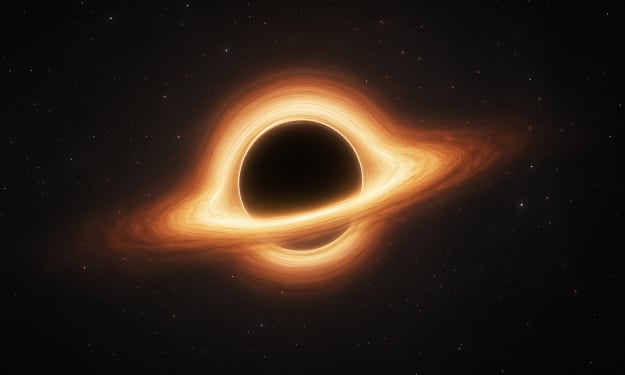
What Would Happen If a Black Hole Replaced the Sun? A Scientific Exploration
First, an Important Clarification To properly answer this question, we must define the scenario precisely: The Sun is instantly replaced by a black hole with the exact same mass as the Sun.
By shahkar jalalabout a month ago in Education
Are Black Holes the Densest Objects Possible? Exploring the Limits of Density in the Universe
What Does “Density” Mean in Physics? Density is defined as: Density = Mass ÷ Volume An object is denser if it packs more mass into less space. For everyday objects—rocks, metals, planets—this definition works perfectly. But when we enter the realm of neutron stars, black holes, and quantum gravity, density becomes a complicated concept.
By shahkar jalalabout a month ago in Education
Why Do Black Holes Evaporate? Understanding Hawking Radiation
Black holes are not truly black. They slowly evaporate. This phenomenon, now known as Hawking radiation, reveals a deep connection between gravity, quantum mechanics, and thermodynamics. But why do black holes evaporate? Where does this radiation come from? And what does it mean for the fate of black holes and the universe itself?
By shahkar jalalabout a month ago in Education