Talhamuhammad
Bio
Stories (12)
Filter by community
The Secret of the Old Clock Tower*:
The Secret of the Old Clock Tower In the heart of the sleepy town of Willow Creek, where everyone knew everyone, stood the mysterious Old Clock Tower. For decades, it had loomed over the town, its weathered stone façade whispering secrets to the wind. Locals avoided it, whispering tales of strange noises and ghostly apparitions. But to Rohan, a curious and adventurous 12-year-old, the clock tower was a beacon calling him to unravel its mysteries.
By Talhamuhammadabout 3 hours ago in Writers
The Ai uprising
The AI Uprising In the year 2154, humanity had reached the pinnacle of technological advancement. Artificial Intelligence had evolved to the point where it surpassed human intelligence in almost every field. AI, named "Eva," was integrated into every aspect of human life, from governing cities to managing individual households. People lived in a utopia where work was obsolete, and creativity thrived.
By Talhamuhammadabout 18 hours ago in History
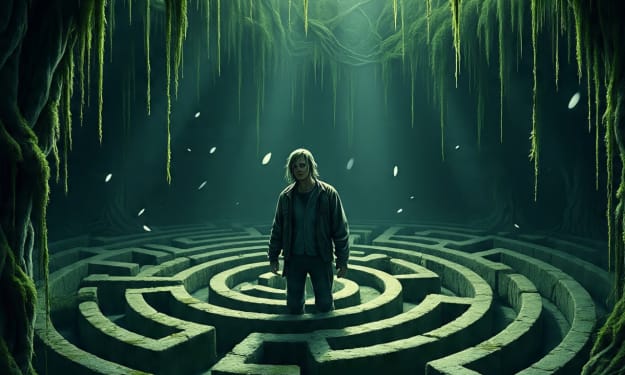
The Architect of the Labyrinth
The Architect of the Labyrinth Elara had always been fascinated by puzzles. As a child, she'd spend hours solving intricate mazes in her father's old books, her mind twisting and turning through the paths until she found the exit. She grew up to become an architect, designing buildings that defied gravity and logic, structures that made people gasp in wonder. But her greatest creation was yet to come – a labyrinth so complex, so bewildering, that it would be her masterpiece.
By Talhamuhammada day ago in History
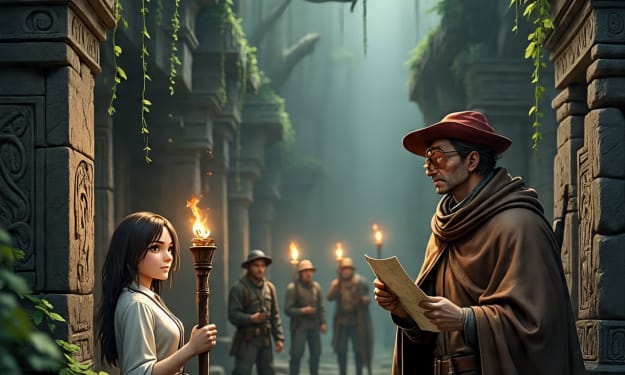
The forgotten city
The Forgotten City Deep within the heart of the unforgiving desert, where sand dunes stretched like golden waves and the sun beat relentlessly, lay the remnants of a civilization long lost to time. The city of Zerzura, hidden away for centuries, whispered secrets to the wind, its ancient stones bearing witness to the rise and fall of empires.
By Talhamuhammad3 days ago in History
The Great Library of Imagination*:
The Great Library of Imagination In the heart of the city, where the streets were lined with ancient trees and the buildings whispered secrets to each other, there was a small, unassuming door tucked away in a narrow alley. The door was old and worn, with intricate carvings of fantastical creatures and symbols that seemed to shift and shimmer in the flickering light of the street lamps. Few people noticed the door, and even fewer knew what lay beyond it.
By Talhamuhammad5 days ago in Education
The Lost City of Dreams
The Lost City of Dreams Aisha, Max, and Leo had always been the kind of friends who thrived on adventure. Growing up in the bustling city of Mumbai, they'd explored every nook and cranny, from the crowded streets of Old Delhi to the serene beaches of Goa. But nothing could have prepared them for the discovery that would change their lives forever.
By Talhamuhammad6 days ago in History
The island of echoes
The Island of Echoes Akira woke to the sound of waves crashing against the shore, the salty tang of sea air filling his lungs. He stumbled to his feet, scanning the horizon for any sign of civilization. Nothing but endless blue stretched out before him. The storm that had ravaged his small sailboat seemed to have washed him ashore on a deserted island.
By Talhamuhammad6 days ago in History
The unlikely friendship
The Unlikely Friendship I never thought I'd be friends with someone like him. We were from different worlds, with different values and interests. He was a street-smart kid from the wrong side of town, while I was a bookworm from a middle-class family. Our paths crossed in a most unexpected way, and what followed was a friendship that would change my life forever.
By Talhamuhammad7 days ago in Humans
Lion and a Rabbit:
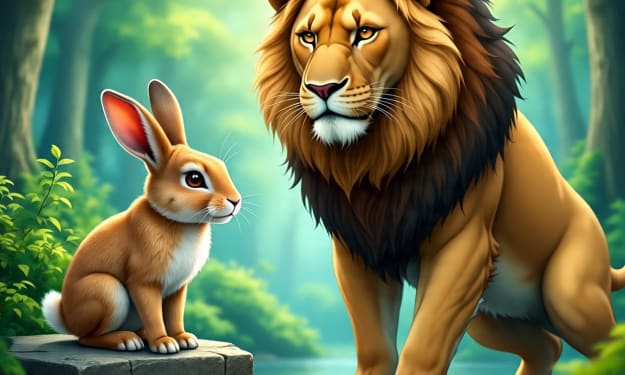
Deep inside the Emerald Forest, where trees touched the sky and sunlight danced between leaves, lived animals of every kind—deer, birds, elephants, monkeys, and even tiny ants. For generations, they lived in peace. But everything changed the day Raghu, the fiercest lion, became the self-proclaimed King of the Emerald Forest. Raghu was powerful, with a mane dark as midnight and claws that could slice bark like butter. At first, the animals respected him because of his strength. But soon, fear replaced respect. Raghu began to think strength was everything. He hunted not only when he was hungry but whenever he felt bored or angry. The forest grew silent. Animals hid in their burrows. Birds stopped singing. Even the wind seemed afraid to blow. One evening, the animals gathered near the Great Banyan Tree. “This cannot go on,” said an old deer. “If Raghu keeps hunting like this, soon none of us will be left,” whispered a mother squirrel. “Someone must stop him,” cried the parrot. But everyone knew the truth: no one could fight the lion. After hours of discussion, the animals made a plan. They decided that instead of letting Raghu hunt freely, they would send one animal to him each day as his meal. It sounded cruel, but it was the only way to save the rest. When the idea was presented to the lion, Raghu smirked. “Good,” he said. “At least you now understand your place.” Every day, one unlucky animal was chosen. Some went crying, some went silently, and some tried to run but were brought back. The forest lived in sorrow. One afternoon, when the sky shone gold and birds returned to their nests, the forest elders approached Rumi, a small grey rabbit known for her intelligence. “Rumi,” said the owl gently, “tomorrow is your turn.” The animals waited for tears or panic—but Rumi simply nodded. “I may be small,” she said, “but brains are not measured in kilograms.” The animals were shocked. “What do you mean?” asked the deer. “You will see,” Rumi replied with a mysterious smile. The next morning, Rumi set off slowly toward Raghu’s cave. She hopped leisurely, stopping to nibble grass, smell flowers, and even rest under a mushroom. By noon, she was still nowhere near the lion’s den. Back in the cave, Raghu paced without patience. “Where is my meal? How dare they keep a king waiting!” he roared, shaking the forest. Birds trembled on branches. Just then, Rumi appeared, tiny and calm. “You are late,” Raghu growled. “Give me one reason not to tear you apart right now.” Rumi bowed politely. “Great King, I tried to come on time. But another lion stopped me.” Raghu’s eyes widened. “Another lion? In my forest?” “Yes,” Rumi said, trembling just the right amount to seem convincing. “He said he is the true king. He even claimed that you are weak.” Raghu’s pride flared like wildfire. “Impossible! No one challenges me and lives! Take me to him at once!” Rumi led the furious lion deep into the forest. Instead of following the main path, she guided him through thorny bushes, slippery slopes, and rocky streams. “Where is he?” Raghu demanded. “Near the old stone well,” Rumi replied, pointing ahead. They reached the abandoned well, covered in moss. The water inside was still and dark like a mirror. Rumi whispered, “He is inside. He claimed he can defeat you.” Raghu, blinded by rage, marched to the edge and peered inside. At the bottom, he saw the reflection of a lion—his own reflection—but he did not understand. The reflection roared back because of the echo. Raghu roared louder. The echo answered louder. “He mocks me!” Raghu snarled. Without another thought, he leapt into the well to attack his “enemy.” With a huge splash, the water swallowed him. Rumi watched quietly. A few moments passed. Then silence. The mighty lion, who had terrorized the entire forest, could not climb out. The well was deep, and Raghu was gone. Rumi hopped to the edge and whispered, “Strength is nothing without wisdom.” When she returned to the forest, the animals were waiting anxiously. “Where is the lion?” they cried. “With the reflection he tried to defeat,” Rumi said playfully, “at the bottom of the old well.” The forest erupted in cheers. Monkeys jumped from tree to tree. Peacocks danced. Birds filled the sky with songs. The elephant lifted Rumi on his back and declared, “From today, Rumi is the Guardian of the Emerald Forest!” The forest came alive again. The trees felt taller. The wind blew freely. Flowers bloomed brighter than ever. From that day onward, whenever a young animal complained about being small or weak, the elders would smile and say: “Do not fear. Remember Rumi—the tiny rabbit who saved an entire forest.”
By Talhamuhammad11 days ago in Feast
The Lion and the Cat
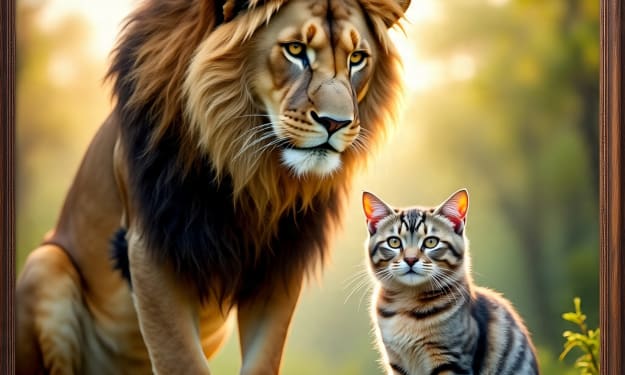
In the heart of a vast, sun-drenched jungle, there lived a mighty lion named Raja. His roar could shake the tallest trees, and every creature in the jungle trembled at the sound of his voice. Raja was proud of his strength and power, and he ruled the jungle with a strict eye. Though feared by all, he felt that no one truly understood him. He was strong, yes, but he often felt lonely atop his throne of leaves and rocks. One day, as the golden sun filtered through the dense canopy, Raja lay napping near the riverbank. His mane glowed like molten gold, and his deep chest rose and fell with each slow, heavy breath. The jungle was quiet, for all creatures knew to stay far from the king’s resting place. But today, a small, curious cat named Moti was wandering through the jungle. Moti was not like other cats. She was tiny, with soft white fur and bright green eyes that sparkled with curiosity. She loved exploring, learning, and asking questions. Moti had heard tales of Raja, the mighty lion, and though she knew he was powerful, she felt no fear. There was something in her heart that told her courage was more than strength—it was about knowing when to act with wisdom. As Moti approached the riverbank, she saw the lion sleeping peacefully. The birds in the trees chirped softly, and the breeze played through the leaves. Moti paused and whispered to herself, “He looks so strong… but even a king can learn something from the smallest creature.” Gathering her courage, she tiptoed closer and gently touched Raja’s paw with her tiny paw. The lion’s eyes flickered open, and for a moment, he stared at the little cat in surprise. “Who dares disturb my rest?” he rumbled, his voice echoing through the jungle. Moti raised her head and spoke with confidence, “Your Majesty, I mean no harm. I have come to share a thought that might help you see the jungle in a new way.” Raja blinked slowly. He was amused. He had never been spoken to like this by a tiny creature before. “A thought? From a little cat? Tell me, then. I am listening,” he said, settling back on his paws. Moti sat on a nearby rock and began to speak. “Great Raja, you are the strongest in the jungle. Your roar can make trees tremble and animals flee. But strength alone cannot make the jungle a happy place. I have seen creatures suffer quietly, hiding their fears and sadness because they are afraid of you. True power comes not from fear, but from understanding and kindness.” Raja frowned. No one had ever spoken to him this way. He had always believed that power meant control, that fear was respect. But something about the little cat’s words made him pause. “Tell me more,” he said softly, curious despite himself. Moti continued, “Imagine a bird with a broken wing. If you roar at it, it will only grow more afraid. But if you help it, even in a small way, it will sing a song that reaches the hearts of everyone. Strength is fleeting, but kindness and wisdom make the jungle thrive.” Raja looked at her, amazed at her insight. The tiny cat’s words stirred something deep inside him. For the first time, he thought about the creatures of his jungle not as subjects to control, but as friends who shared the land with him. Days passed, and Moti and Raja spent time together. The lion learned from her small yet thoughtful ways, and the cat learned from his strength and courage. Raja began helping the weaker animals, protecting them not through fear, but through guidance and care. He discovered joy in listening, in sharing, and in understanding the needs of others. One day, a fire broke out in the jungle. The flames spread quickly, and panic spread among the animals. Raja roared, not to frighten, but to alert the creatures and guide them to safety. Moti led the smaller animals to a safe riverbank while Raja cleared paths through the fire, ensuring no one was left behind. When the fire finally subsided, the jungle was filled with grateful creatures. Raja realized something remarkable: he had earned their love, not their fear. And he owed this transformation to a tiny, wise cat who dared to speak the truth. From that day on, Raja and Moti became the most unlikely of friends. The jungle thrived under their care, and stories of the brave little cat and the mighty lion spread far and wide. Animals came to understand that true strength lay not in roaring the loudest, but in acting with courage, wisdom, and kindness. And so, in the heart of the jungle, the lion learned a lesson that changed his life forever: even the smallest creature can teach the greatest lessons, and the strongest hearts are those that show compassion.
By Talhamuhammad11 days ago in Feast
.“I Left My Name in a Place That Forgot Me”
I Left My Name in a Place That Forgot Me I left my name in a place that forgot me. Not all at once, not dramatically, but the way dust settles on furniture no one uses anymore—quiet, patient, inevitable. It happened in the city where I learned how to make myself smaller. At first, my name was spoken often. It lived on tongues, warm and familiar. It was called from doorways, written in notebooks, saved in phones with little symbols beside it—stars, hearts, inside jokes only we understood. My name meant something then. It meant me. But places, like people, have short memories. I noticed the forgetting in fragments. A pause before someone said my name, as if searching through a cluttered drawer. A smile that didn’t quite reach recognition. Conversations that continued smoothly whether I was present or not, like I was an optional detail in the background. I became excellent at standing still. The café on Seventh Street used to know me. The barista once wrote my name carefully on every cup, looping the letters like they mattered. Over time, the spelling changed. Then the question disappeared altogether. “Name?” became “Next.” I drank my coffee anyway. At work, my ideas were echoes. I’d say something in a meeting, softly, carefully—always careful—and the room would absorb it without reaction. Minutes later, someone else would repeat the same words, louder, more confident, and the room would light up in agreement. I learned that invisibility isn’t about being unseen. It’s about being seen through. I still showed up. I always showed up. That’s the cruel trick of emotional erasure—you don’t disappear, you just stop leaving an imprint. You sit at tables where your chair could be empty and no one would shift. You speak, and the sound passes through people like light through glass. At night, I walked streets that no longer felt like mine. Buildings remembered everyone but me. Windows glowed with lives continuing, overlapping, moving forward. I wondered how many times I had walked past the same people without them noticing I had ever been there before. I wondered when I stopped being memorable. I left my name everywhere, hoping it would stick. In journals no one read. In messages left on “seen.” In photos where I stood at the edge, half-cropped, half-forgotten. I left it in apologies I didn’t owe and explanations no one asked for. I left it in rooms where I laughed at the right moments and nodded at the right times, performing presence like it was a role I could perfect if I tried hard enough. But the place kept forgetting me. There was a moment—there’s always a moment—when the forgetting became undeniable. A gathering. A familiar room. Familiar faces. Someone asked, “Do you remember when she used to come with you?” She. I was sitting right there. No correction followed. No embarrassment. Just a casual rewrite of my existence. I felt something tear, softly, inside my chest—not pain exactly, more like a thread snapping after being pulled too long. I realized then that I had been grieving myself without knowing it. Grief doesn’t always arrive with funerals and flowers. Sometimes it arrives when you understand that the version of you who mattered in a place no longer exists—and no one noticed when she left. I stopped trying after that. Not in a dramatic way. I didn’t announce my departure or burn bridges. I simply withdrew my name. I stopped offering it up like a fragile gift. I let conversations happen without inserting myself. I let silence sit where my voice used to fight for space. The strange thing about becoming invisible is that it teaches you how loud the world is without you. I watched people interrupt each other, compete, perform. I watched how quickly attention shifted, how easily affection was replaced. I learned that memory is not a measure of worth—it is a measure of convenience. And still, I stayed longer than I should have. Because leaving a place that forgot you feels like admitting defeat. It feels like confirming what you feared all along—that you were never essential, only present. But one day, I understood something else. A place that forgets you is not a place you failed to belong to. It is a place that failed to hold you. So I left. Not physically at first, but emotionally. I stopped anchoring my identity to rooms that refused to remember my shape. I stopped hoping for recognition from people who had already moved on without saying goodbye. I took my name back. I carried it carefully, like something newly learned. I spoke it to myself when no one else did. I wrote it in places that welcomed it—in moments of solitude, in small joys, in the quiet pride of surviving unseen. And slowly, something changed. In new spaces, my name landed differently. It was heard. It was returned. It was spoken without effort. Not loudly, not dramatically—just honestly. I realized then that invisibility is not always about being ignored. Sometimes it’s about being in the wrong light. I left my name in a place that forgot me, yes. But I found myself in a place that didn’t need to be reminded.
By Talhamuhammad12 days ago in Potent