
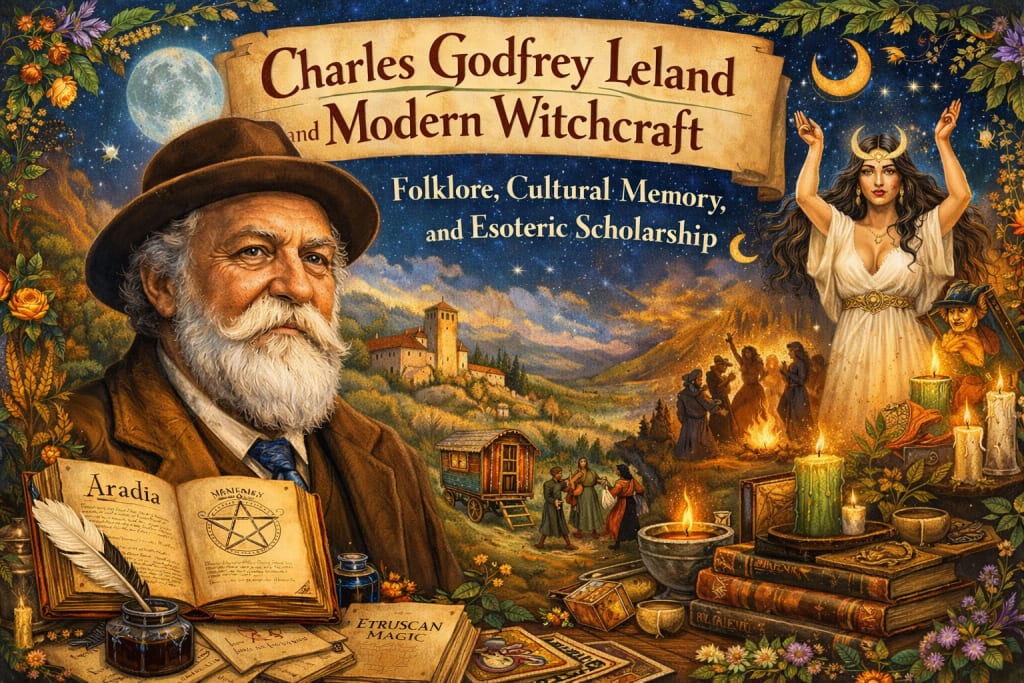
Charles Godfrey Leland and Modern Witchcraft
Folklore, Cultural Memory, and Esoteric Scholarship

Charles Godfrey Leland in an Age of Cultural Recovery
Charles Godfrey Leland stands among the most versatile intellectual figures of the nineteenth century. Work as a literary humorist, investigative journalist, linguist, folklorist, educator, and interpreter of esoteric tradition unfolded across several decades marked by intense cultural transition. Birth in Philadelphia in 1824 placed Leland within a republic still negotiating identity through literature, historical memory, and regional tradition. Education at Princeton University and later study in Europe exposed Leland to philology, continental folklore studies, and Romantic era scholarship emphasizing vernacular culture as a repository of ancestral knowledge.
Professional activity began within American journalism during an era when newspapers served as laboratories for linguistic experimentation and social commentary. Publication of dialect verse and satirical sketches in periodicals such as Vanity Fair and the Philadelphia Press demonstrated sophisticated engagement with immigrant speech patterns and working class vernacular expression. The Hans Breitmann ballads, first published during the American Civil War, blended German American dialect, humor, and cultural parody, achieving wide readership in both the United States and Europe. Such literary production reflected emerging scholarly fascination with language as a marker of communal identity and historical continuity.
Extended residence in Europe during the 1860s and 1870s transformed literary curiosity into ethnographic documentation. Field research conducted in England, Germany, and especially Italy focused upon oral tradition, magical formulae, seasonal ritual, and artisan craft knowledge preserved within rural and marginalized populations. Collection of charms, incantations, folk narratives, and symbolic practices contributed to early comparative folklore studies developing across European intellectual circles. Collaboration with an Italian informant known as Maddalena Talenti provided material later compiled in Aradia, or the Gospel of the Witches, published in 1899. The text described a clandestine tradition centered upon the figure Aradia, portrayed as a messianic teacher of oppressed peasants and practitioners of folk magic. Debate concerning textual authenticity, editorial intervention, and ethnographic reliability continues within modern scholarship, yet the work remains foundational within the study of European witchcraft survivals and modern Pagan religious formation.
Interest in marginalized cultural expression extended beyond folklore into social reform and arts education. Establishment of industrial art education programs in Philadelphia promoted traditional craft techniques among immigrant communities and working class youth. Advocacy for manual training reflected broader nineteenth century reform movements linking aesthetic education with economic empowerment and cultural preservation. Research into Romani language and legend produced The English Gipsies and Their Language in 1873, a study documenting linguistic structure, oral literature, and social customs of Romani groups in Britain. Additional work gathered Algonquian and other Native American legends, preserving mythic narratives undergoing rapid erosion through displacement and assimilation policies.
Intellectual production emerged within a historical climate shaped by Romantic nationalism, antiquarian research, comparative mythology, and expanding colonial ethnography. Scholars across Europe increasingly interpreted folklore as survivals of pre Christian cosmologies and ritual systems embedded within popular tradition. Leland contributed to such discourse through synthesis of literary craft, linguistic analysis, and participant observation conducted outside formal academic institutions. The resulting corpus preserves fragile cultural expressions and reveals complex intersections between humor, spirituality, language, and collective historical memory.
Philadelphia Roots and European Scholarship
Charles Godfrey Leland entered the world on August 15, 1824, in Philadelphia, one of the intellectual and commercial centers of the early American republic. Family lineage combined financial stability with cultivated literary sensibility. Father Charles Leland worked as a prosperous merchant engaged in international trade. Mother Charlotte Godfrey Leland possessed strong intellectual and artistic inclinations and maintained interest in European literature, language, and cultural tradition. Family environment encouraged reading, multilingual exposure, and appreciation for continental intellectual currents circulating through elite Philadelphia society during the early nineteenth century.
Childhood education occurred within private academies emphasizing classical instruction, rhetoric, and moral philosophy. Early linguistic aptitude emerged through rapid acquisition of Latin and Greek, which formed the foundation of elite American higher education at the time. Classical training cultivated sensitivity to grammar, etymology, and narrative structure, intellectual tools later applied to dialect poetry, Romani linguistic study, and comparative folklore analysis. Exposure to classical mythology also contributed to lifelong fascination with syncretic religious symbolism and survival of ancient cosmologies within popular tradition.
Enrollment at the College of New Jersey, now Princeton University, occurred during mid adolescence. Princeton curriculum during the 1840s remained grounded in classical philology, logic, moral philosophy, and ancient history. Instruction stressed disciplined textual analysis and translation, practices central to later transcription of oral incantations, folk narratives, and dialect speech patterns. Academic climate reinforced respect for antiquarian research and historical preservation, intellectual tendencies expanding during later European study.
Postgraduate intellectual development led to extended residence in Europe during the mid nineteenth century, a formative period for many American scholars seeking exposure to continental academic innovation. Study in Germany included attendance at institutions in Heidelberg and Munich, both prominent centers of philological research and Romantic era cultural scholarship. German universities treated language as a living historical organism reflecting collective memory and national identity. Scholarly influence of Jacob and Wilhelm Grimm remained strong within German academic culture. Grimm research combined systematic folktale collection with linguistic analysis and historical reconstruction of Indo European mythic motifs. Such intellectual atmosphere reinforced methodological respect for oral tradition as a legitimate historical source and cultural archive.
Residence in Paris introduced exposure to French literary culture, ethnographic curiosity, and comparative anthropology emerging during the July Monarchy and Second Republic periods. French intellectual circles displayed growing interest in peasant tradition, regional dialects, and colonial ethnographic documentation. Engagement with continental scholars and artists broadened understanding of folklore as both artistic expression and anthropological evidence.
Return to the United States initiated formal legal training. Admission to the Pennsylvania bar during the late 1840s demonstrated mastery of statutory interpretation, logical argumentation, and documentary precision. Legal practice, however, provided limited creative or ethnographic satisfaction. Urban journalism offered broader cultural engagement and intellectual freedom. Newspapers in Philadelphia and New York during the mid nineteenth century functioned as platforms for literary experimentation, political commentary, and social satire. Editorial work exposed Leland to immigrant communities, working class speech patterns, and urban folklore circulating within taverns, streets, and print culture.
Early intellectual formation therefore united classical scholarship, continental philology, legal discipline, and urban literary journalism. Such convergence produced a scholar capable of bridging elite academic tradition with vernacular cultural documentation. Subsequent research into Romani language, Italian folk magic, Native American legend, and artisan craft tradition drew heavily upon foundations established during formative years in Philadelphia and European universities.
Humor, War, and Cultural Identity: The Emergence of Hans Breitmann
American journalism during the mid nineteenth century occupied a vibrant and competitive literary marketplace shaped by rapid urban growth, rising literacy, and expanding periodical circulation. Newspapers and illustrated magazines served as platforms for serialized fiction, political satire, travel writing, and linguistic experimentation. Charles Godfrey Leland developed professional reputation within this energetic environment through contributions to widely read publications including Graham’s Magazine, the Philadelphia Evening Bulletin, and New York illustrated journals such as Vanity Fair. Editorial assignments cultivated versatility in narrative style, social observation, and public commentary.
Journalistic work placed Leland in direct contact with immigrant communities transforming American urban culture. Philadelphia and New York contained large populations of German immigrants who maintained linguistic traditions, social clubs, and cultural festivals while negotiating assimilation into American civic life. Public discourse during the 1850s and 1860s frequently addressed questions of immigrant loyalty, cultural preservation, and political participation. Such tensions intensified during the American Civil War, when German American regiments formed substantial components of Union military forces and immigrant patriotism became a subject of both admiration and skepticism within Anglo American media.
Within this cultural and political climate emerged the literary figure Hans Breitmann, introduced through humorous dialect poems appearing in periodicals during the late 1850s. Breitmann represented a fictional German American soldier whose speech combined English vocabulary with German grammatical structures, phonetic distortions, and idiomatic expressions derived from Pennsylvania German and broader German immigrant dialects. The poems achieved immediate popularity and were later compiled into Hans Breitmann’s Ballads, first published in 1868, with subsequent expanded editions appearing throughout the late nineteenth century.
Breitmann functioned simultaneously as comic caricature and sympathetic cultural portrait. Characterization portrayed exuberant military enthusiasm, convivial drinking culture, and exaggerated martial heroism while also reflecting immigrant participation in American civic life. Satirical narrative frequently addressed wartime events, military bureaucracy, and social customs within volunteer regiments. Linguistic humor relied upon sophisticated phonetic transcription requiring careful attention to pronunciation patterns common among German speakers acquiring English as a second language. Literary craftsmanship beneath comedic surface revealed extensive knowledge of bilingual code switching and oral storytelling tradition.
Public reception extended beyond American audiences. British and German readers responded enthusiastically to Breitmann’s mixture of satire, dialect authenticity, and cultural parody. Public readings delivered by Leland attracted large audiences and contributed to transatlantic literary recognition. German language editions circulated widely, with some readers interpreting Breitmann as affectionate tribute to immigrant endurance rather than dismissive caricature. Critical commentary from contemporary reviewers frequently praised technical mastery of dialect representation and rhythmic verse construction.
Commercial success generated financial stability and established Leland as a prominent humorist within Anglo American literary culture. Income derived from book sales, lecture tours, and international publication created opportunity for extended European residence and expanded ethnographic exploration. Breitmann literature demonstrated capacity to treat vernacular language as both artistic medium and cultural documentation. Such literary experimentation foreshadowed later scholarly dedication to preserving oral tradition, folk narrative, and linguistic diversity among marginalized communities across Europe and North America.
Toward the Study of Living Tradition: Romani Culture and Field Research
The closing decades of the nineteenth century witnessed a profound redirection in Charles Godfrey Leland’s intellectual pursuits. Financial security improved following family inheritance during the late 1860s, creating freedom for extended travel and sustained research outside the demands of commercial journalism. Residence in England and continental Europe brought increased contact with rural populations, itinerant artisans, and minority communities whose oral traditions preserved cultural knowledge rarely recorded in print. Rapid industrial expansion and urban migration intensified scholarly concern regarding disappearance of vernacular customs, seasonal ritual, and traditional craft knowledge. Intellectual influence from Romantic era antiquarian scholarship encouraged documentation of popular belief as historical evidence rather than superstition.
Sustained engagement with Romani communities represented one of the most significant developments during this period. Interest in Romani language and folklore emerged during earlier travels in Britain and expanded through direct social interaction and conversational exchange. Leland possessed unusual facility with languages, including German, French, and Italian, which facilitated communication with Romani speakers using Anglo Romani and related dialects. Linguistic curiosity extended beyond vocabulary into syntax, oral storytelling structure, and metaphorical imagery embedded within songs, riddles, and magical formulae transmitted through oral instruction.
Research culminated in The English Gipsies and Their Language, first published in 1873, one of the earliest systematic studies of Romani linguistic and cultural life in Britain. The work presented grammatical analysis, lexical documentation, and ethnographic description based upon field conversations, travel observation, and collaboration with Romani informants. Glossaries compiled within the text recorded hundreds of terms drawn from everyday speech, ritual language, and occupational terminology. Ethnographic passages described itinerant metalworking, horse trading, fortune telling, and seasonal encampment practices. Comparative discussion linked Romani linguistic structure to Indo Aryan origins, reflecting nineteenth century philological interest in tracing language families through historical migration patterns.
Further exploration of Romani spiritual tradition appeared in Gypsy Sorcery and Fortune Telling, published in 1891. The volume documented charms, healing rituals, divinatory practices, and protective spells circulating within Romani communities and neighboring rural populations. Transcriptions frequently preserved original phrasing alongside English translation, reflecting commitment to philological accuracy. Descriptive commentary situated magical practice within broader European folk belief systems including talismanic objects, dream interpretation, and ritual purification. Nineteenth century fascination with occult revival movements influenced public reception, yet the text retained scholarly attention to linguistic detail and cultural context.
Modern scholars have debated methodological limitations common to nineteenth century ethnography, including selective interpretation, romanticized characterization, and reliance upon individual informants. Despite such limitations, Leland’s documentation preserved linguistic data and ritual material that might otherwise have vanished during periods of increasing social displacement and assimilation pressure. Romani culture received recognition as a complex linguistic and spiritual tradition deserving serious scholarly consideration rather than sensationalized exotic portrayal. Field research among Romani communities also shaped later investigations into Italian folk magic and European witchcraft survivals, establishing methodological foundations for comparative folklore study grounded in direct cultural engagement.
Recording Indigenous Memory: Algonquian Myth and American Identity
Interest in American folklore formed an essential component of Charles Godfrey Leland’s ethnographic pursuits during the late nineteenth century. Expanding travel throughout New England introduced contact with descendants of Algonquian speaking communities whose narrative traditions preserved cosmological memory, ecological knowledge, and moral instruction transmitted through oral storytelling. Cultural disruption caused by colonial expansion, missionary activity, and federal assimilation policies threatened continuity of Indigenous oral tradition during this period. Antiquarian scholars increasingly recognized Indigenous mythology as a vital component of North American intellectual heritage.
Research into Algonquian legend culminated in publication of The Algonquin Legends of New England in 1884. The volume assembled mythic narratives centered upon Glooscap, a cultural hero and trickster figure appearing across Wabanaki and broader Algonquian storytelling traditions. Glooscap frequently appears as transformer, lawgiver, and mediator between human communities and supernatural forces. Myth cycles associated with Glooscap include creation of geographical features, instruction in social custom, confrontation with malevolent spirits, and symbolic regulation of natural phenomena. Additional narrative figures within the collection include spirit beings, animal teachers, and elemental guardians reflecting cosmological relationships between humanity and landscape.
Source material derived from multiple channels including direct conversation with Native informants, earlier ethnographic notes, missionary documentation, and regional oral retellings preserved among both Indigenous and settler communities. Leland maintained interest in preserving mythic structure, recurring symbolic motifs, and narrative sequence while translating stories into literary English accessible to nineteenth century readership. Descriptive passages attempted to preserve distinctive rhetorical patterns such as cyclical repetition, symbolic transformation, and moral allegory characteristic of Algonquian storytelling. Inclusion of cultural commentary sought to contextualize myth within seasonal subsistence cycles, hunting ritual, and environmental knowledge embedded within oral literature.
Intellectual climate of nineteenth century Romantic nationalism encouraged collection of Indigenous mythology as a foundation for distinctive American cultural identity separate from European classical tradition. Scholars and writers sought symbolic origins within Native cosmology to construct national literary heritage rooted in the North American landscape. Leland’s compilation contributed to such intellectual movements by presenting Indigenous mythic literature as complex theological and philosophical narrative rather than primitive folklore.
Modern scholarship recognizes interpretive challenges surrounding nineteenth century ethnographic collection conducted by non Indigenous researchers. Translation from Algonquian languages into English introduced linguistic and cultural mediation affecting metaphor, ceremonial vocabulary, and oral performance context. Editorial adaptation occasionally emphasized narrative coherence for literary audiences, potentially altering storytelling cadence and communal interpretive layers present within oral recitation. Ethical questions also arise regarding cultural ownership and representation within early folklore scholarship.
Despite such limitations, Leland’s compilation preserved narrative material endangered by rapid cultural transformation. Expansion of residential schools, missionary conversion programs, and displacement policies during the nineteenth century disrupted generational transmission of oral literature within many Indigenous communities. Documentation of Glooscap narratives and related myth cycles contributed to later anthropological, linguistic, and cultural revitalization efforts seeking recovery of traditional storytelling heritage. Leland’s work occupies a historically complex position within folklore scholarship, reflecting both preservation of endangered narrative tradition and interpretive mediation shaped by intellectual currents of the period.
Tuscan Traditions and the Search for Hidden Lore
Extended residence in Italy during the final decades of the nineteenth century marked the most influential phase of Charles Godfrey Leland’s folkloric research. Florence served as a central base of activity, while travel into surrounding Tuscan villages allowed close observation of rural ritual life and oral storytelling traditions preserved among agricultural communities and artisan families. Italian unification, completed during the 1860s and 1870s, reshaped political authority and national identity, yet many rural populations continued to maintain localized customs, seasonal celebrations, and vernacular spiritual practices rooted in centuries of communal memory. Catholic liturgical structure coexisted with older agrarian rites, saint festivals, protective charms, and domestic ritual observances reflecting layers of religious syncretism.
Fieldwork throughout Tuscany focused upon collection of proverbs, magical formulae, festival descriptions, folk narratives, and household protective customs. Peasant storytelling frequently combined historical memory with supernatural legend, linking medieval civic conflict, Renaissance artistic patronage, and village miracle traditions into a continuous narrative landscape. Leland demonstrated particular interest in seasonal ceremonies connected to harvest cycles, Marian feast days, and protective rituals conducted to ward against illness, crop failure, and misfortune. Documentation often relied upon extended conversation with artisans, domestic workers, and rural laborers whose knowledge circulated through oral instruction rather than written transmission.
Publication of Legends of Florence Collected from the People, released in 1895, presented a wide compilation of Tuscan narrative tradition. The volume included stories associated with Florentine architecture, noble families, religious relics, and popular ghost lore embedded within urban neighborhoods and surrounding countryside. Historical annotation accompanied many tales, connecting legendary motifs to documented civic events, guild history, and Renaissance cultural development. Linguistic challenges emerged through reliance upon regional dialects characterized by phonetic variation and idiomatic phrasing distinct from standardized Italian. Familiarity with Romance language structure enabled careful translation, while preservation of dialect flavor remained a consistent scholarly goal.
Central to later historical controversy stands association with an Italian informant identified as Maddalena Talenti, sometimes described within correspondence as a hereditary practitioner of folk magic. Accounts recorded in personal letters and published commentary describe transmission of incantations, ritual narratives, and mythic instruction attributed to clandestine witchcraft tradition. Material provided by Maddalena reportedly formed the primary foundation for Aradia, or the Gospel of the Witches, published in 1899. The text presented a narrative describing Aradia as a messianic teacher sent to instruct oppressed rural populations in magical resistance against feudal authority and ecclesiastical hierarchy.
Archival evidence surrounding Maddalena remains incomplete. Surviving correspondence references manuscript exchanges, yet original Italian source material has not been fully preserved. Scholarly debate continues regarding authorship, translation fidelity, and extent of editorial reconstruction applied during publication. Some historians interpret the text as documentation of localized folk belief adapted through literary framing, while others propose broader creative synthesis influenced by contemporary occult revival movements and comparative mythology research.
Italian fieldwork nonetheless represented culmination of decades dedicated to cross cultural folklore study. Research conducted in Tuscany combined linguistic analysis, ethnographic observation, historical annotation, and documentation of ritual practice. Interaction with Italian peasant tradition deepened exploration of European magical survivals and religious syncretism, establishing a foundation for later discussions surrounding continuity of pre Christian symbolic systems within popular devotional culture.
Aradia and the Legacy of Folk Witchcraft
The 1899 publication of Aradia, or the Gospel of the Witches presented one of the most controversial and influential contributions to European folklore and occult scholarship of the nineteenth century. The text recounts the figure of Diana, goddess of the moon and wilderness, alongside Aradia, described as a daughter sent to instruct oppressed rural populations in magical arts. Core chapters include ritual guidance, incantations, mythic cosmology, and ethical directives framed within a narrative of resistance against social and clerical oppression. Aradia appears as both teacher and emblem of spiritual autonomy, emphasizing egalitarian principles within a framework of folk magic.
The preface claimed reliance upon a manuscript received from an Italian informant identified as Maddalena, supplemented with oral explanations provided over extended consultation. Translation from Italian into English sought to preserve structural integrity and linguistic nuance of the original document, referred to within correspondence as the Vangelo. Descriptions of magical practice combined practical instructions—such as the preparation of charms, protective rites, and divinatory techniques—with broader philosophical reflection on communal justice, personal agency, and ethical conduct within rural society. The text situates witchcraft as a form of resistance to feudal authority, clerical control, and social marginalization, portraying magical knowledge as a tool for cultural survival and empowerment.
Debate regarding authenticity has persisted for more than a century. Some scholars argue that editorial shaping, selective compilation, or creative reconstruction by Leland influenced the final form of the text. Others propose that Aradia reflects survivals of localized folk cults in Tuscany, blending Catholic symbolism with pre Christian motifs preserved through oral tradition. Absence of extant Italian manuscripts outside Leland’s translation complicates efforts at verification. Ethnographic analysis acknowledges the text as a synthesis of ritual, myth, and social commentary rather than a fully verifiable historical record.
Despite questions of origin, the cultural impact of Aradia is undeniable. Twentieth century occult revival drew extensively upon its narratives and motifs. Gerald Gardner, credited with founding modern Wicca, incorporated themes, ritual structure, and the veneration of a Goddess figure directly inspired by Aradia. Elements such as ritual nudity, coven organization, and lunar ceremonial observances trace conceptual lineage to the text, illustrating its influence on the formation of contemporary Pagan spiritual practice. Aradia’s blend of mythic storytelling, ritual instruction, and ethical reflection continues to shape understanding of folk magic as both historical phenomenon and living tradition, bridging the gap between recorded folklore and evolving spiritual movements.
Craft, Creativity, and Social Progress: Leland and Industrial Arts Education
Advocacy for practical arts education constituted a significant aspect of Charles Godfrey Leland’s career, reflecting concern over economic inequality and limited vocational opportunities for urban working class youth. Rapid industrialization during the mid to late nineteenth century created a labor market increasingly reliant upon specialized skills, yet formal education often failed to provide training in applied arts or craftsmanship. Leland addressed this gap through direct educational reform, combining pedagogical innovation with social advocacy.
The establishment of the Public School of Industrial Art in Philadelphia during the 1870s represented a pioneering initiative in vocational and aesthetic education. Curriculum design integrated drawing, decorative design, woodwork, metalwork, and textile craft, emphasizing both technical proficiency and artistic sensibility. Instruction aimed to cultivate marketable skills while fostering creativity, precision, and intellectual engagement. Students participated in practical exercises replicating production techniques used in industry and domestic manufacture, aligning artistic training with emerging professional opportunities.
Philosophy underpinning the project emphasized the dignity of manual labor as inseparable from aesthetic cultivation. Leland drew upon European precedents, including the Arts and Crafts Movement in Britain, which promoted integration of artistry into daily life and resisted purely mechanized approaches to production. Collaboration with contemporary reformers, artists, and civic leaders expanded reach and legitimacy, positioning industrial arts education within a broader national conversation about social mobility, cultural enrichment, and democratization of access to creative knowledge.
Public exhibitions, student publications, and instructional manuals associated with the school reinforced the cultural value of applied design and highlighted practical applications within manufacturing, architecture, and decorative arts. Recognition extended beyond Philadelphia, contributing to discussions within academic and professional circles regarding curriculum development and the role of art education in public schools.
Efforts in industrial arts education reveal a dimension of Leland’s career frequently overshadowed by associations with folklore and esotericism. Commitment to empowering marginalized communities through skill acquisition, artistic cultivation, and vocational training aligns with broader currents of nineteenth century social reform, demonstrating the intersection of cultural preservation, creative innovation, and civic responsibility within Leland’s multifaceted intellectual legacy.
Voice, Fieldwork, and the Craft of Documentation
Examination of Charles Godfrey Leland’s literary style reveals a distinctive synthesis shaped by journalism, philology, antiquarian research, and oral narrative tradition. Prose frequently balances clarity developed through newspaper writing with enthusiastic engagement characteristic of nineteenth century folklore scholarship. Descriptive passages often move between observational detail and interpretive commentary, reflecting intellectual traditions that treated folklore as both historical evidence and artistic expression. Humor, cultivated through earlier dialect poetry and satirical writing, occasionally appears alongside solemn treatment of mythic cosmology and ritual instruction. Such tonal variation reflects versatility rather than inconsistency, demonstrating capacity to address multiple readerships simultaneously.
Philological precision forms a consistent structural element within many publications. Inclusion of glossaries, dialect transcriptions, and comparative vocabulary lists demonstrates attention to linguistic detail and historical language development. Works such as The English Gipsies and Their Language present extended lexical documentation, preserving Anglo Romani vocabulary and grammatical patterns through systematic listing and translation. Similar linguistic attentiveness appears in Italian folklore collections, where regional dialect phrases often accompany English interpretation. Preservation of phonetic character allowed later scholars to reconstruct pronunciation patterns and linguistic borrowing within multicultural communities.
Narrative framing frequently reflects origin within oral storytelling environments. Many legends and ritual descriptions are introduced through anecdotal encounters, domestic conversations, or informal interviews conducted among artisans, rural laborers, and itinerant performers. Conversational structure replicates rhythm of spoken narrative, preserving repetition, symbolic transformation, and moral commentary characteristic of oral literature. Literary adaptation occasionally enhanced narrative coherence for printed audiences while attempting to maintain cultural authenticity.
Research methodology developed largely outside formal academic institutions. Folklore, anthropology, and comparative religion had not yet established standardized fieldwork protocols during the nineteenth century. Leland relied upon extensive travel, personal correspondence, and trust relationships with individual informants across Britain, Italy, and North America. Field notebooks documented incantations, seasonal customs, riddles, and narrative fragments recorded during direct interaction. Such immersive curiosity allowed access to communities often overlooked by contemporary academic scholarship.
Translation practices occasionally introduced interpretive complexity. Movement between dialect or ritual language and literary English required decisions balancing literal transcription with readability. Certain passages reveal stylistic smoothing or explanatory commentary designed to clarify symbolic content for unfamiliar audiences. Absence of comprehensive citation systems, source dating, or full manuscript preservation complicates modern verification of specific materials. Provenance for some ritual texts and mythic narratives remains partially undocumented.
Balanced evaluation of Leland’s methodology recognizes both innovation and limitation. Strength emerges through cross cultural comparison linking European, Romani, and Indigenous traditions within broader patterns of mythic symbolism and ritual continuity. Documentation preserved fragile linguistic and narrative material during periods of rapid industrial and social transformation. Limitations reflect transitional stage in development of anthropology and folklore studies, when methodological standards for participant observation, source transparency, and collaborative ethnography had not yet reached twentieth century refinement. Such duality positions Leland as a bridge between antiquarian scholarship and emerging social science, preserving cultural memory through methods shaped by intellectual experimentation and personal engagement.
Currents of Thought: Romanticism, Occult Revival, and Early Anthropology
Charles Godfrey Leland’s scholarship emerged within a dense network of nineteenth century intellectual movements that reshaped European and American understanding of culture, myth, and religion. Romanticism exerted profound influence upon literary and historical inquiry during the early and mid nineteenth century. Romantic scholars rejected Enlightenment dismissal of folk belief as irrational superstition and instead promoted vernacular tradition as a repository of ancestral memory. German philological research provided one of the strongest foundations for this intellectual transformation. Jacob and Wilhelm Grimm advanced systematic collection of folktales, linguistic reconstruction, and historical mythology, arguing that oral narrative preserved remnants of ancient cosmological systems. Such scholarship encouraged interpretation of folk legend as cultural archaeology, a perspective deeply reflected within Leland’s comparative analysis of European and American mythic traditions.
Romantic fascination with medieval history, vernacular poetry, and rural custom permeated Victorian intellectual life. Antiquarian societies, literary salons, and historical preservation movements treated local legend and ritual practice as essential components of national heritage. Interest in medieval guild tradition, seasonal festival symbolism, and rural saint veneration contributed to a broader cultural movement seeking continuity between modern industrial society and pre modern communal identity. Leland’s documentation of artisan crafts, Tuscan festival rites, and vernacular storytelling developed within this Romantic revival of historical consciousness.
Late nineteenth century intellectual climate also witnessed expanding fascination with esoteric philosophy and occult revival movements. Founding of the Theosophical Society in 1875 by Helena Petrovna Blavatsky and Henry Steel Olcott encouraged comparative exploration of Eastern religious philosophy, Western hermetic tradition, and ancient cosmological symbolism. Theosophical publications promoted belief in hidden wisdom traditions transmitted through myth, ritual, and symbolic language. Public interest in ceremonial magic, alchemical symbolism, and mystical cosmology increased across European and American literary circles. Spiritualism gained widespread popularity through séance practice, trance mediumship, and investigation of afterlife communication. Although Leland maintained scholarly rather than devotional engagement with occult material, research into charms, incantations, and witchcraft tradition resonated strongly within this broader cultural fascination with esoteric knowledge.
Development of early anthropology and comparative religion further shaped intellectual context. Scholars such as Edward Burnett Tylor and James George Frazer proposed evolutionary models of religious development linking magic, animism, and organized religion within progressive cultural frameworks. Comparative mythology sought recurring archetypal motifs across geographically distant cultures, encouraging cross cultural analysis of ritual symbolism and mythic narrative. Leland’s work frequently paralleled such theoretical inquiry through comparison of Romani, Italian, Indigenous American, and European folklore traditions, although research methods remained grounded in literary and antiquarian practice rather than institutional anthropology.
Simultaneously, European colonial expansion and nationalist cultural movements stimulated extensive collection of regional folklore. Intellectuals throughout Britain, Germany, France, and the United States documented rural custom and Indigenous narrative to construct narratives of cultural heritage and historical continuity. Folklore often served political functions by reinforcing concepts of national identity and territorial memory. Leland participated in this transnational preservation movement while maintaining a comparatively independent scholarly orientation. Research frequently emphasized marginalized communities, immigrant populations, and vernacular spiritual practice rather than elite historical tradition. Such focus contributed to broader recognition of folklore as a dynamic record of lived cultural experience rather than static literary curiosity.
Essential Vocabulary in Leland’s Scholarship
Folklore
Folklore refers to the collective body of traditional narrative, ritual, belief, custom, and artistic expression transmitted through oral communication and communal practice. Folklore includes myth, legend, folktale, proverb, festival observance, craft tradition, and magical or healing ritual. Nineteenth century scholarship increasingly treated folklore as a cultural archive preserving historical memory, symbolic cosmology, and social values embedded within everyday life. Research conducted by Leland treated folklore as a living system shaped by migration, religious syncretism, and economic change rather than a static remnant of ancient superstition.
Ethnography
Ethnography designates systematic descriptive study of cultural communities through direct observation, conversational exchange, and documentation of social behavior, ritual practice, and oral tradition. Formal ethnographic methodology emerged during the late nineteenth and early twentieth centuries, yet earlier researchers relied upon travel, personal relationships with informants, and field notebooks recording speech patterns and ceremonial activity. Leland’s fieldwork among Romani communities, Italian rural populations, and Indigenous storytellers represents an early form of ethnographic documentation that preserved cultural practices during periods of rapid social transformation.
Philology
Philology involves scholarly investigation of language history, textual transmission, grammatical structure, and linguistic evolution across historical periods. Nineteenth century philologists examined relationships among Indo European languages through comparative grammar, etymological analysis, and manuscript study. Leland applied philological techniques through transcription of dialect speech, compilation of bilingual glossaries, and translation of ritual formulae and mythic narrative. Linguistic analysis allowed reconstruction of cultural migration patterns and preservation of vocabulary associated with ritual and oral literature.
Romani
Romani refers to an ethnic and linguistic community whose historical origins trace to northern regions of the Indian subcontinent before migration into the Middle East and Europe beginning approximately one millennium ago. Romani populations developed diverse dialects, occupational traditions, and spiritual practices across Europe and the Americas. Anglo Romani and related dialects combined Indic linguistic roots with vocabulary borrowed from regional European languages. Leland’s research documented language structure, folklore, and ritual practice among Romani groups in Britain, contributing to early recognition of Romani cultural complexity within academic and literary scholarship.
Comparative Mythology
Comparative mythology examines recurring symbolic patterns, narrative structures, and cosmological themes across geographically distinct cultures. Nineteenth century scholars proposed that mythic narratives preserved remnants of ancient religious systems and archetypal psychological motifs. Comparative analysis frequently explored parallels between European, Asian, and Indigenous American myth cycles, identifying shared themes such as creation myths, trickster figures, seasonal death and rebirth symbolism, and heroic transformation. Leland incorporated comparative mythology by identifying structural similarities linking Romani, Italian, and Algonquian storytelling traditions.
Neopaganism
Neopaganism describes modern spiritual movements that reconstruct or reinterpret pre Christian European religious traditions through ritual practice, seasonal festival observance, and veneration of nature oriented cosmology. Twentieth century Pagan revival movements drew inspiration from folklore scholarship, ceremonial magic, and historical mythology. Texts such as Aradia, or the Gospel of the Witches contributed symbolic narratives and ritual concepts later incorporated into emerging Pagan religious communities, particularly within modern witchcraft traditions emphasizing goddess spirituality and seasonal ritual cycles.
Industrial Arts Education
Industrial arts education refers to pedagogical systems integrating artistic design, manual craftsmanship, and vocational skill development within public schooling. Educational reform movements during the nineteenth century responded to industrial expansion by promoting instruction in woodworking, metalworking, textile design, and decorative arts. Such programs sought to cultivate technical proficiency, economic opportunity, and aesthetic literacy among working class populations. Leland’s involvement in establishing industrial arts training in Philadelphia demonstrated commitment to social reform through practical education and preservation of traditional craft knowledge within an industrializing society.
Reexamining Criticism and Historical Complexity
Assessment of Charles Godfrey Leland’s legacy demands careful consideration of scholarly controversy, ethical debate, and shifting academic standards. Nineteenth century folklore research developed during a transitional intellectual period when anthropology, ethnography, and cultural preservation lacked standardized methodological frameworks. Modern evaluation requires recognition of historical context while acknowledging interpretive limitations, translation challenges, and representational concerns embedded within Leland’s work.
Debate surrounding Aradia, or the Gospel of the Witches remains the most prominent scholarly dispute. Absence of the original Italian manuscript described as the Vangelo has generated persistent questions regarding authenticity and editorial intervention. Surviving correspondence indicates reliance upon an informant identified as Maddalena Talenti, yet documentary evidence confirming biographical identity remains fragmentary. Some researchers propose Maddalena as a composite figure derived from multiple informants or as a literary construct shaped through collaborative storytelling and editorial synthesis. Comparative folklore studies have identified parallels between incantations contained within Aradia and documented Tuscan folk charms, agricultural blessings, and domestic protective rituals recorded by other ethnographers. Such parallels suggest possible integration of authentic oral tradition with literary structuring intended to create narrative coherence for English readership. Ongoing scholarly discourse continues to evaluate the text as a hybrid artifact combining folklore documentation, translation, and interpretive reconstruction.
Representation of Romani culture within Leland’s publications has also attracted sustained critical examination. Victorian era fascination with nomadic identity and cultural exoticism influenced language and descriptive framing common among nineteenth century writers. Terminology historically employed during that period differs significantly from contemporary cultural and scholarly standards. Modern Romani researchers emphasize the importance of community self representation and collaborative ethnographic practice rather than external interpretation. Despite such concerns, linguistic glossaries, vocabulary documentation, and narrative preservation within works such as The English Gipsies and Their Language provide historically significant data regarding dialect structure, occupational terminology, and ritual vocabulary. Preservation of such material offers valuable evidence for linguistic reconstruction and cultural heritage research conducted by contemporary Romani scholars.
Collection of Indigenous American legend introduces additional ethical complexity. Power imbalances between non Indigenous collectors and Native storytellers influenced narrative preservation during the nineteenth century. Translation from Algonquian languages into literary English inevitably altered metaphorical nuance, ceremonial context, and performative storytelling structure. Editorial adaptation designed for Victorian readership occasionally emphasized narrative cohesion over communal oral cadence. Cultural suppression policies implemented through boarding school systems, missionary conversion programs, and territorial displacement contributed to disruption of oral transmission across many Indigenous communities. Documentation produced by collectors such as Leland occupies a contested yet historically significant role. Preservation of mythic cycles and narrative figures such as Glooscap provided material later utilized in linguistic revitalization, cultural education, and historical reconstruction efforts within Indigenous communities.
Evaluation of Leland’s scholarly contributions therefore resists simplified categorization as either preservation or appropriation. Intellectual environment of nineteenth century folklore research combined antiquarian enthusiasm, emerging anthropological curiosity, and limited awareness of collaborative research ethics. Recognition of this historical framework allows balanced understanding of achievements and shortcomings. Leland’s work preserved linguistic and narrative material endangered by industrial expansion, cultural assimilation, and social transformation while simultaneously reflecting interpretive methods shaped by contemporary intellectual assumptions. Such complexity situates Leland within a broader historical narrative of evolving cultural scholarship and ongoing dialogue regarding representation, authenticity, and preservation of traditional knowledge.
Private Life, Expatriate Circles, and Final Years in Florence
Marriage formed an important foundation within Charles Godfrey Leland’s adult life. Union with Eliza Bella Pratt occurred in 1851. Eliza Pratt came from a respected New England family with literary and artistic interests, providing an intellectually supportive domestic environment. Correspondence and memoir references describe partnership marked by shared enthusiasm for travel, language study, and cultural observation. Domestic stability created conditions allowing sustained literary production, research travel, and extensive publication across multiple disciplines.
Professional success and growing financial security permitted increasing residence abroad during the latter half of the nineteenth century. England became a frequent destination during the 1870s and 1880s, providing access to Romani communities, antiquarian societies, and expanding networks of scholars engaged in folklore and linguistic research. London intellectual circles included writers, artists, and social reform advocates associated with historical preservation, decorative arts education, and comparative mythology. European residence also enabled consultation of archival collections and collaboration with continental researchers examining vernacular tradition.
Italy gradually emerged as the primary center of residence during later decades. Florence offered a cosmopolitan environment combining Renaissance artistic heritage with vibrant expatriate scholarly communities. Foreign writers, painters, historians, and antiquarians maintained salons and cultural societies dedicated to historical research and artistic exchange. Tuscan residence facilitated direct engagement with rural storytellers, artisans, and domestic ritual practitioners whose traditions formed the foundation of Leland’s later folklore collections. Prolonged immersion in Italian language and dialect variation deepened linguistic fluency and strengthened ethnographic fieldwork.
Health challenges associated with advancing age gradually limited travel during the closing years of life, although literary output and scholarly correspondence continued. Residence remained largely centered in Florence, where research notes, translation manuscripts, and editorial revisions occupied final productive years. Death occurred on March 20, 1903. Burial took place in the Cimitero Evangelico agli Allori, commonly known as Florence’s Protestant Cemetery, a burial ground associated with numerous expatriate intellectuals, artists, and scholars whose work contributed to international cultural exchange during the nineteenth century.
Posthumous reputation experienced fluctuating recognition. Early twentieth century folklore scholarship often emphasized methodological rigor emerging within academic anthropology, resulting in temporary decline of attention toward Leland’s publications. Mid twentieth century occult revival and growing interest in modern Pagan spirituality stimulated renewed examination of Aradia, or the Gospel of the Witches. Expanding scholarship in folklore, cultural anthropology, and religious studies later reintroduced broader evaluation of Leland’s interdisciplinary contributions, acknowledging influence across humor literature, linguistic documentation, ethnographic preservation, and esoteric cultural history.
Aradia and the Formation of Contemporary Pagan Traditions
Twentieth century revival of European inspired pagan spirituality frequently returned to Aradia, or the Gospel of the Witches as a formative source. Publication in 1899 introduced a narrative describing a divine feminine teacher associated with resistance against religious and social authority. Mid twentieth century British Wicca, particularly within Gardnerian ritual structure, reveals conceptual parallels with material recorded by Charles Godfrey Leland. Ritual veneration of a Goddess figure, sacralization of natural cycles, and ceremonial nudity all appear within Wiccan liturgical practice. Portions of the “Charge of the Goddess,” later formalized by Doreen Valiente, contain language strongly reminiscent of passages found within Leland’s translated invocations and mythic dialogues.
Gerald Gardner’s development of initiatory Wicca during the 1940s and 1950s coincided with renewed scholarly and popular interest in surviving European folk traditions. Leland’s presentation of Tuscan witch lore offered an accessible textual model suggesting continuity between historical folk magic and modern ritual reconstruction. Although direct textual borrowing remains debated among historians of religion, structural similarities between Aradia and early Gardnerian rites continue to attract academic examination. Themes of divine descent, ritual empowerment of practitioners, and preservation of pre Christian cosmology remain central to comparative analysis.
Italian American Stregheria traditions also incorporate Aradia as an influential narrative framework. Twentieth century Italian diaspora communities preserved fragments of regional magical customs, devotional folk Catholicism, and seasonal agricultural rites. During the late twentieth century, authors such as Raven Grimassi expanded Stregheria practice through synthesis of oral family tradition, Renaissance Italian folklore, and reinterpretation of Leland’s material. Scholarly discourse frequently questions historical continuity between documented Tuscan practices and contemporary Stregheria systems. Debate surrounding authenticity, reconstruction, and creative revival illustrates broader tensions within modern pagan religious development.
Academic folklore and anthropological scholarship recognize Leland as a transitional figure positioned between antiquarian collecting and professional ethnographic methodology. Nineteenth century folklore preservation frequently relied upon personal correspondence, translation of dialect material, and interpretive reconstruction rather than standardized fieldwork techniques developed later by Franz Boas and Bronisław Malinowski. Leland’s interest in vernacular magic, charm traditions, and rural cosmology anticipated twentieth century ethnographic attention toward everyday religious expression. Modern cultural studies continue to explore folk magic as a system of lived spirituality rather than superstition or marginal belief.
Contemporary scholarly reassessment also situates Leland within ongoing discussions concerning representation of marginalized cultural knowledge. Questions regarding translation accuracy, collector influence, and power dynamics between researcher and informant frequently arise within modern historiography. Examination of nineteenth century folklore collectors, including Leland, provides insight into early preservation efforts while encouraging critical evaluation of narrative construction, editorial framing, and cross-cultural interpretation. Enduring fascination with Aradia demonstrates lasting cultural influence upon religious revival movements, historical memory, and academic exploration of European magical heritage.
Between Scholarship and Story: Leland’s Place Among Nineteenth Century Folklorists
Late nineteenth century folklore scholarship developed through several competing intellectual approaches. Jacob and Wilhelm Grimm concentrated upon preservation of Germanic oral narratives and historical linguistics. Kinder und Hausmärchen, first published in 1812 and expanded through later editions, sought to reconstruct ancient cultural identity through systematic comparison of language, myth, and oral tradition. Grimm methodology emphasized philology, textual comparison, and reconstruction of early Indo European cultural roots. German Romantic nationalism influenced Grimm research, shaping interpretation of folk narrative as evidence of collective cultural memory.
Sir James George Frazer introduced a markedly different model through publication of The Golden Bough beginning in 1890. Frazer proposed an expansive comparative framework linking myth, ritual sacrifice, fertility symbolism, and seasonal kingship across multiple civilizations. Frazer relied heavily upon travel accounts, missionary records, and classical literature rather than sustained field observation. Theoretical ambition produced a sweeping interpretation of religious evolution from magic to religion to scientific rationalism. Frazer’s work profoundly shaped early anthropology and comparative religion, although later scholarship criticized speculative generalization and limited engagement with living practitioners.
Andrew Lang contributed another influential perspective through interdisciplinary engagement with folklore, anthropology, literary criticism, and mythology. Lang produced extensive fairy tale collections, including The Blue Fairy Book in 1889, alongside scholarly analysis of myth formation and comparative religion. Lang emphasized psychological and narrative interpretation, exploring universal storytelling motifs and symbolic structures shared across cultures. Editorial clarity and literary accessibility allowed Lang to reach broad popular audiences while maintaining scholarly credibility.
Charles Godfrey Leland occupied a distinctive position within this intellectual landscape. Research focused upon direct interaction with living tradition bearers rather than reliance upon archival material or classical sources alone. Field engagement with Romani communities during travels through Britain and continental Europe produced The English Gipsies and Their Language in 1873, one of the earliest English language ethnographic studies examining Romani linguistic structure and oral tradition. Later immersion within rural Italian communities resulted in documentation of Tuscan folk magic, seasonal ritual practice, and vernacular mythology preserved through oral transmission.
Ethnographic immediacy distinguished Leland from many contemporaries. Collaboration with Italian informant Maddalena Talenti, identified within Leland correspondence as a hereditary practitioner of folk magic, provided primary material later published in Aradia, or the Gospel of the Witches in 1899. Although modern scholars debate authenticity and editorial interpretation of Talenti’s testimony, field collection from a named practitioner represented an unusual methodological choice during a period when folklore research often emphasized anonymous or collective sources.
Literary background also shaped Leland’s scholarly voice. Earlier career as journalist, satirist, and humorist produced works such as Hans Breitmann’s Ballads, first published in 1871, which blended dialect humor with cultural observation. Narrative style carried into later folklore publications, producing ethnographic description accessible to general readers rather than exclusively academic audiences. Descriptive richness, anecdotal storytelling, and conversational tone contrasted sharply with formal theoretical prose typical of Frazer and emerging professional anthropologists.
Absence of sustained university affiliation limited institutional recognition during early professionalization of anthropology and folklore studies. Franz Boas and Edward Burnett Tylor later established methodological standards emphasizing systematic fieldwork, cultural relativism, and institutional academic training. Leland remained largely independent, publishing through commercial presses and relying upon personal travel, correspondence networks, and informal collaboration with cultural informants. Lack of academic appointment reduced participation within professional scholarly organizations that increasingly shaped disciplinary legitimacy.
Hybrid identity combining creative literature, journalism, linguistic study, and ethnographic observation contributes to enduring scholarly fascination. Leland’s publications preserve valuable documentation of nineteenth century European vernacular belief systems while illustrating transitional methodology between antiquarian folklore collection and modern anthropological field research. Comparative examination alongside Grimm philology, Frazer’s universal myth theory, and Lang’s narrative psychology reveals a researcher uniquely positioned between imaginative storytelling and early ethnographic documentation.
Reading Recommendations: #commissionearned
Charles Godfrey Leland: A Biography by Elizabeth Robins Pennell
Careful reconstruction of a nineteenth century intellectual life unfolds through letters, travel records, and firsthand recollections preserved by contemporaries. Early chapters explore formative influences within Philadelphia’s literary environment, highlighting exposure to classical education, multilingual study, and transatlantic cultural exchange. Extensive documentation illustrates professional development across journalism, humor writing, folklore collection, and linguistic research. Particular attention centers upon extended European residence, especially within Italian regions where research into folk magic and vernacular spiritual traditions intensified. Detailed examination of relationships with informants and collaborators provides historical grounding for later publications connected to witchcraft traditions. Social networks linking artists, reformers, and scholars reveal participation in broader intellectual currents shaping Victorian era cultural scholarship. Rich contextualization of personal motivations and scholarly methods provides essential insight into development of folklore studies and esoteric historical documentation during a transformative scholarly period.
Hans Breitmann’s Party, with Other Ballads by Charles G. Leland
Humorous narrative poetry captures vibrant cultural tensions within German American immigrant communities during the post Civil War United States. Dialect experimentation forms the heart of the collection, blending English and German phonetic patterns to recreate oral storytelling rhythms found within immigrant social gatherings. Satirical portrayals of military adventures, social drinking rituals, and cultural assimilation struggles reflect shifting national identity during rapid industrial expansion. Linguistic creativity demonstrates fascination with vernacular speech patterns and evolving cultural expression through language hybridization. Literary success of the ballads secured widespread popularity and financial stability, allowing further research into folklore and comparative linguistics. Exploration of immigrant cultural preservation through humor parallels later dedication to documenting marginalized storytelling traditions across European and Romani communities. Examination of dialect construction also reveals early scholarly interest in phonology and cultural transmission through oral narrative forms.
Aradia: or the Gospel of the Witches by Charles G. Leland
Translation of a purported Tuscan manuscript introduces readers to a religious mythos centered upon a divine teacher associated with peasant resistance and magical knowledge. Mythological framework presents cosmological narratives involving goddess Diana and her daughter Aradia, who instructs followers in ritual practice, incantation, and social rebellion through magical empowerment. Inclusion of charms, invocations, and ceremonial instructions reflects preservation of rural spiritual customs that persisted alongside Christian influence. Scholarly controversy surrounding manuscript origins and translation methodology continues to provoke debate among historians, folklorists, and religious studies scholars. Parallels between recorded rituals and documented Italian folk traditions contribute to ongoing discussion concerning authenticity and oral transmission reliability. The text later became foundational source material influencing twentieth century revival of goddess centered spirituality and reconstructed witchcraft traditions. Lasting influence upon ritual structure, mythological storytelling, and magical ethics secures the work’s importance within the study of modern Pagan religious development.
Etruscan Magic & Occult Remedies by Charles Godfrey Leland
Investigation into survival of ancient Mediterranean spiritual traditions reveals continuity between classical religious symbolism and nineteenth century folk healing practices. Field research documented herbal remedies, protective amulets, spirit invocation rituals, and domestic magical techniques preserved within rural Italian communities. Comparative analysis links folk healing formulas to fragments of Etruscan religious vocabulary and pre Roman cosmological symbolism. Cultural blending between pagan, Christian, and regional folk belief systems illustrates dynamic adaptation of spiritual knowledge across centuries of religious transformation. Preservation of ritual incantations and medicinal practices provides valuable historical evidence for scholars studying continuity within European magical traditions. Linguistic observations demonstrate survival of archaic terminology embedded within regional dialects and ceremonial language. Documentation of village healing customs contributes to broader understanding of how ancient religious frameworks persisted through everyday cultural memory and practical medicinal traditions.
The Triumph of the Moon: A History of Modern Pagan Witchcraft by Ronald Hutton
Historical reconstruction of twentieth century witchcraft revival challenges romantic narratives of uninterrupted pagan survival through meticulous archival analysis and cultural contextualization. Examination of British occult societies, Romantic folklore revival movements, and ceremonial magic traditions reveals complex intellectual environment that shaped modern witchcraft theology. Cultural fascination with medievalism, nationalism, and esoteric philosophy contributed to reinterpretation of European folk traditions as religious reconstruction movements. Careful evaluation of foundational texts highlights influence of nineteenth century folklore publications upon ritual mythology and theological structure within early Wiccan communities. Critical comparison between documented historical practices and reconstructed ceremonial traditions offers balanced scholarly perspective. Exploration of cultural creativity within modern religious development demonstrates interaction between literary imagination, folklore preservation, and spiritual experimentation. Comprehensive historical methodology establishes a crucial framework for understanding how modern witchcraft traditions emerged through literary, cultural, and intellectual synthesis.
Firsthand ethnographic reporting captures diverse religious landscape emerging within late twentieth century American Pagan communities. Interviews with practitioners across numerous traditions reveal evolving spiritual philosophies rooted in nature reverence, ritual creativity, and reconstruction of pre Christian European religious symbolism. Documentation highlights community building efforts, ritual innovation, and personal spiritual transformation experienced by participants within modern Pagan networks. Historical discussion acknowledges influence of earlier folklorists, occult authors, and literary mythographers whose writings inspired contemporary religious experimentation. Exploration of goddess centered theology and ritual practice demonstrates lasting impact of nineteenth century folklore collections upon American spiritual movements. Sociological analysis addresses interaction between environmental activism, feminist spirituality, and countercultural identity formation. Rich narrative testimony preserves lived religious experience while illustrating ongoing reinterpretation of folklore and mythology within modern spiritual communities.
Interpretation of European witchcraft trial records proposes existence of organized pre Christian fertility religion concealed beneath persecution narratives recorded in early modern legal documents. Detailed analysis of confessions, ritual descriptions, and references to spirit familiars constructs theoretical framework describing seasonal ceremonies and deity worship practices. Presentation of ritual structures, magical symbolism, and communal gatherings profoundly influenced early twentieth century occult revival movements. Subsequent historical scholarship challenged methodological limitations, including selective source interpretation and speculative reconstruction of religious continuity. Cultural influence of the theory nonetheless shaped popular perception of historical witchcraft and inspired foundational mythology within emerging Pagan religious traditions. Adoption of ritual and theological themes by early witchcraft revival leaders demonstrates enduring cultural resonance despite academic controversy. The work remains historically significant for understanding development of modern interpretations of European magical and religious heritage.
Legacy and Scholarly Inquiry: Questions That Persist
Leland’s work continues to provoke critical reflection on the challenges of documenting and interpreting cultural knowledge. Questions of authenticity in folklore transmission are particularly salient in relation to Aradia, where oral testimony from Italian informants, partial manuscript evidence, and editorial shaping intersect. Comparison between collected Tuscan charms and Leland’s English translation highlights the delicate balance between faithful preservation and narrative reconstruction. Translation practices themselves complicate understanding of ritual language, as subtle phonetic variation, formulaic repetition, and performative rhythm often resist precise rendering in English. The boundary between preservation and creative adaptation remains central to evaluating Leland’s methodology, revealing how literary sensibility informed ethnographic documentation without fully undermining historical value. Representation of marginalized communities, including Romani groups in Britain and Italian folk practitioners, raises enduring questions about the ability of outsider scholarship to convey insider worldviews accurately, especially when linguistic and cultural nuances are filtered through a translator’s interpretive lens. Collection of Native American legends further illustrates the ethical and methodological challenges inherent in mediating between informants and readership, particularly when Victorian-era colonial frameworks shaped narrative choices. Engagement with these questions illuminates broader dynamics of knowledge production, showing how documentation, translation, and publication influence both scholarly understanding and cultural memory. Leland’s legacy therefore extends beyond individual texts, functioning as a lens through which to examine epistemological, ethical, and methodological concerns across folklore, ethnography, and esoteric studies. Recognition of these complexities encourages critical reflection upon how historical research, narrative interpretation, and cultural preservation intersect to shape modern understanding of past belief systems and vernacular traditions.
Research, Libraries, and Responsible Exploration
Charles Godfrey Leland’s body of work spans multiple disciplines, reflecting enduring interest in folklore, language, and esoteric traditions. His writings demonstrate the interconnection of humor, literary experimentation, and ethnographic fieldwork, providing insight into marginalized communities across Europe and America. Dialect poetry, Romani studies, Italian folk magic, and Native American legend collection all illustrate a commitment to recording living tradition at a time when modernization threatened oral knowledge. Understanding these contributions requires careful engagement with original sources rather than reliance on secondary summaries or online excerpts. Public libraries offer access to first editions, archival correspondence, and periodicals that preserve the authentic text of Leland’s publications. Direct comparison of multiple editions and scholarly commentaries allows readers to evaluate translation choices, editorial decisions, and the context of ethnographic fieldwork. Critical reading illuminates shifts in interpretation over time, including controversies surrounding Aradia and Romani or Indigenous representation, helping researchers discern the historical conditions under which folklore was collected.
Investigation into Leland’s work also demonstrates the importance of situating texts within cultural and intellectual frameworks. Italian peasant traditions, Romani language, and Algonquian storytelling were documented during periods of social transformation and industrialization, meaning the texts reflect both authentic practice and the observer’s interpretive lens. Comparing Leland’s work with contemporaneous scholars, such as the Grimm brothers, Andrew Lang, or Margaret Murray, clarifies methodological differences and highlights his unique combination of literary skill and field engagement. Attention to language, ritual transcription, and historical context enables readers to appreciate the balance between preservation and creative reconstruction.
Independent research benefits from cautious use of digital resources. Free online versions may contain transcription errors, omissions, or lack editorial verification. Cross-referencing online texts with physical copies, critical editions, and reputable secondary scholarship reduces risk of misunderstanding or misrepresentation. Engaging with contemporary practitioners and ethnographers can also provide perspective on evolving folklore and ritual practice, demonstrating how historical documentation continues to inform living traditions.
Active exploration encourages a layered approach: first, access original texts to understand firsthand accounts of folklore, magic, and language; second, review scholarly analysis to place material within historical and methodological context; third, critically evaluate interpretation, translation, and cultural framing. Following this approach develops a deeper, more nuanced understanding of nineteenth century folklore collection, the ethical considerations inherent in outsider documentation, and the enduring influence of Leland’s work on modern Pagan and folkloric studies. Leland’s corpus thus functions as a starting point for ongoing inquiry, offering abundant material for rigorous scholarship, independent research, and thoughtful reflection across literary, historical, and ethnographic disciplines.
About the Creator
Marcus Hedare
Hello, I am Marcus Hedare, host of The Metaphysical Emporium, a YouTube channel that talks about metaphysical, occult and esoteric topics.
https://linktr.ee/metaphysicalemporium
Keep reading
More stories from Marcus Hedare and writers in BookClub and other communities.
Eliphas Levi
The Reconstruction of Western Esoteric Thought Nineteenth century France stood at a volatile intersection of political transformation, technological advancement, and intellectual reorientation. The aftermath of the French Revolution continued to reshape social hierarchy, while industrial expansion accelerated urban growth and altered labor structures. Scientific innovation challenged established religious doctrine and traditional metaphysical frameworks. Within this environment of ideological confrontation and spiritual searching, Alphonse Louis Constant, later recognized under the adopted name Eliphas Levi, emerged as a central architect in the revival and reinterpretation of Western esoteric philosophy.
By Marcus Hedarea day ago in BookClub
Rachel Reviews: Lunch Tales: Teagan by Lucille Guarino
Well, I did enjoy this! Sometimes, all you need is just great storytelling and this is what Lucille Guarino delivers here. There's no big message to this book; it's just about folks and families, living their lives and coping with everything that's being thrown at them and finding their way. But when it's done well, like it is here, then you have characters to whom you can relate, tension which leaves you rooting for a better outcome, attraction which has your heart racing and an urge, as a reader, to see the characters happy with the people with whom they belong.
By Rachel Deeming6 days ago in BookClub
7 Feel Good Books You Must Read In 2026
In a world that often feels overwhelming, stressful, and fast-paced, sometimes the best remedy is simply picking up a book that lifts your spirits. Feel-good books are more than just entertainment—they can inspire optimism, offer new perspectives, and even improve mental well-being. Below is a list of 7 feel-good books you must read in 2026. Each selection has been carefully reviewed, highlighting its themes, impact, and why it deserves a place on your bookshelf.
By Diana Meresc2 days ago in BookClub


Comments
There are no comments for this story
Be the first to respond and start the conversation.