
George Orwell: The Writer Who Warned us about the Future
George Orwell: The Writer Who Warned us about the Future

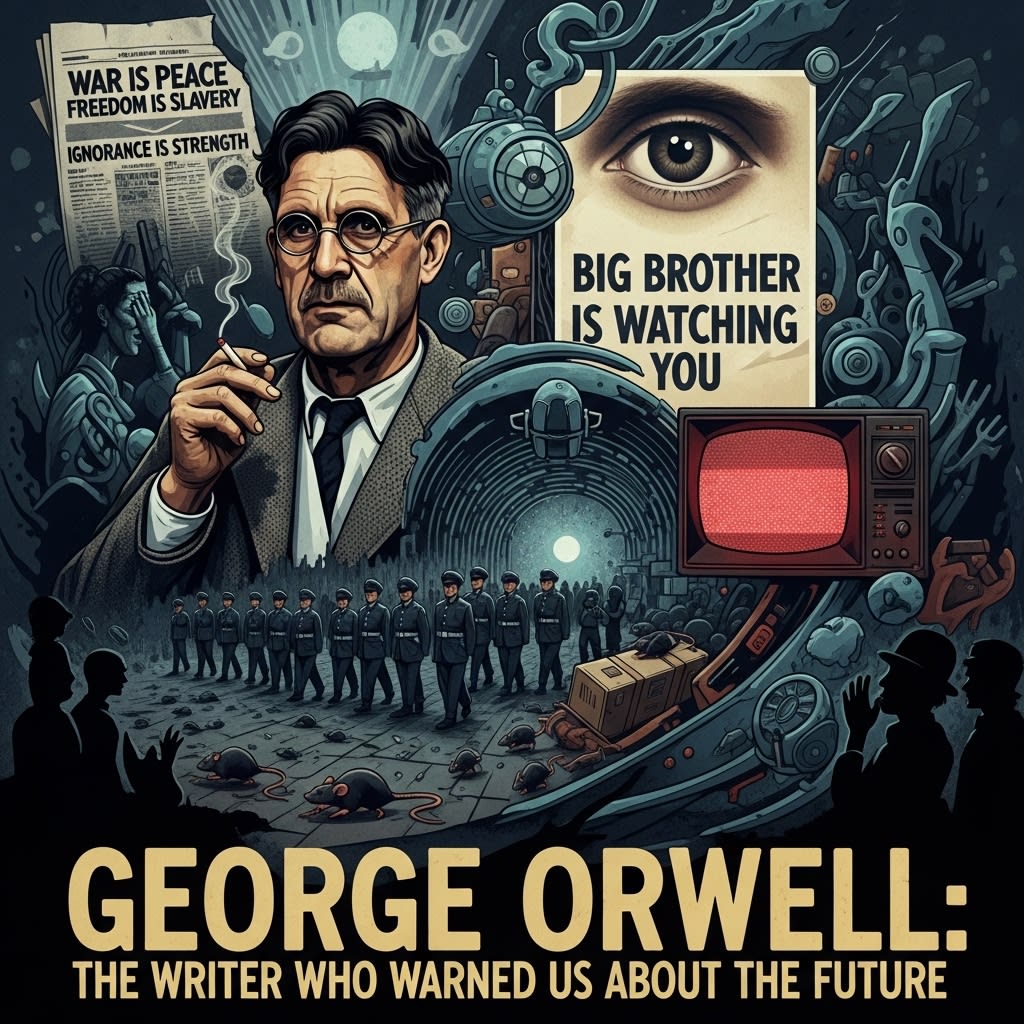
George Orwell did not invent new political systems or build empires. Instead, he did something arguably more dangerous—he revealed how power manipulates truth. Through clear, relentless writing, Orwell exposed the mechanics of propaganda, authoritarian control, and the slow erosion of freedom. His work was not meant as distant fiction. It was a warning.
Born Eric Arthur Blair in 1903 in British India, Orwell’s early life exposed him to the machinery of empire. As a young man, he served as a colonial police officer in Burma, an experience that left him deeply skeptical of authority and domination. He saw firsthand how power sustains itself not only through force, but through habit, fear, and narrative. This experience planted the seeds for his lifelong obsession with political honesty.
Orwell’s writing career was defined by immersion rather than distance. He lived among the poor in London and Paris, documenting hardship without romanticism. He fought in the Spanish Civil War, where he witnessed ideological conflict devolve into betrayal and propaganda. These experiences convinced him that political language often disguises reality instead of revealing it.
His commitment was not to any single ideology, but to truth itself.
Orwell’s two most famous works, *Animal Farm* and *1984*, remain among the most influential political texts ever written. *Animal Farm* appears simple—a story about farm animals overthrowing their human owner—but its simplicity is deceptive. It is a brutal allegory about how revolutions can betray their own ideals. The famous line, “All animals are equal, but some animals are more equal than others,” captures the ease with which language can be twisted to justify inequality.
The book’s power lies in its clarity. Orwell stripped away complex theory and showed, in plain narrative, how power consolidates itself through manipulation, fear, and revision of history. It is not merely a critique of one regime. It is a pattern that can repeat anywhere.
*1984*, published in 1949, pushed Orwell’s warning even further. The novel describes a world in which surveillance is constant, language is controlled, and history is rewritten daily. The state does not merely punish dissent—it eliminates the possibility of independent thought.
Concepts from *1984* have entered everyday vocabulary. “Big Brother,” “doublethink,” “thoughtcrime,” and “Newspeak” are now shorthand for systems that distort reality. Orwell’s insight was chilling: control over information is more powerful than physical force. If a government can shape what people believe is true, resistance becomes almost impossible.
What makes Orwell unique among political writers is his style. He rejected intellectual obscurity and wrote with directness. In his famous essay *Politics and the English Language*, he argued that vague, inflated language allows lies to flourish. Clear writing, he believed, was an ethical responsibility. To write simply was to resist manipulation.
Orwell’s distrust extended even to movements he sympathized with. Though he supported democratic socialism, he harshly criticized authoritarian tendencies within left-wing politics. This independence made him difficult to categorize. He was not loyal to party or doctrine—only to honesty.
His warnings were not limited to governments. Orwell understood that ordinary people can become complicit in systems of control. Fear, convenience, and conformity make it easier to accept distorted realities than to challenge them. His work insists that freedom requires constant vigilance, not occasional outrage.
In today’s world of algorithmic feeds, misinformation, and polarized narratives, Orwell’s relevance has only grown. The tools have changed—from radio broadcasts and newspapers to digital platforms—but the underlying dynamics remain. Competing groups attempt to define reality itself. Words are redefined. History is reframed. Attention is manipulated.
Orwell’s legacy is not despair, but awareness. He believed that recognizing manipulation is the first step toward resisting it. His writing urges readers to question authority, examine language carefully, and defend the integrity of truth even when it is uncomfortable.
George Orwell did not predict a single future—he illuminated a recurring danger. His work stands as a reminder that freedom is not only threatened by overt tyranny, but by subtle distortions of reality.
He fought with words, and those words still stand guard.
About the Creator
Fred Bradford
Philosophy, for me, is not just an intellectual pursuit but a way to continuously grow, question, and connect with others on a deeper level. By reflecting on ideas we challenge how we see the world and our place in it.
Keep reading
More stories from Fred Bradford and writers in BookClub and other communities.
Your Emotions is not the Enemy This Book Helped Me Understand Why
People are now accustomed to a fast-paced, emotionally demanding world, we’re constantly encouraged to “be self-aware” and “understand our feelings”—but how do we actually do that? Emotions and the Enneagram by Margaret Frings Keyes offers a powerful and compassionate answer. This book doesn't just explain the Enneagram as a personality system; it uses it as a deep, emotional roadmap toward healing, growth, and greater empathy—for ourselves and for others.
By Fred Bradford7 months ago in BookClub
Book Review: Atmosphere by Taylor Jenkins Reid
I flipped the book over in my hands in the centre of the small airport book shop. Although I had heard promising reviews of Atmosphere by Taylor Jenkins Reid, I hesitated. The synopsis didn’t compel me - I wasn’t much of a space girly. In high school it made me cringe when my peers would talk about the stars.
By sleepy drafts12 days ago in BookClub
7 Feel Good Books You Must Read In 2026
In a world that often feels overwhelming, stressful, and fast-paced, sometimes the best remedy is simply picking up a book that lifts your spirits. Feel-good books are more than just entertainment—they can inspire optimism, offer new perspectives, and even improve mental well-being. Below is a list of 7 feel-good books you must read in 2026. Each selection has been carefully reviewed, highlighting its themes, impact, and why it deserves a place on your bookshelf.
By Diana Meresc4 days ago in BookClub




Comments
There are no comments for this story
Be the first to respond and start the conversation.