
J. D. Salinger: The Cost of Not Fitting In
J. D. Salinger: The Cost of Not Fitting In

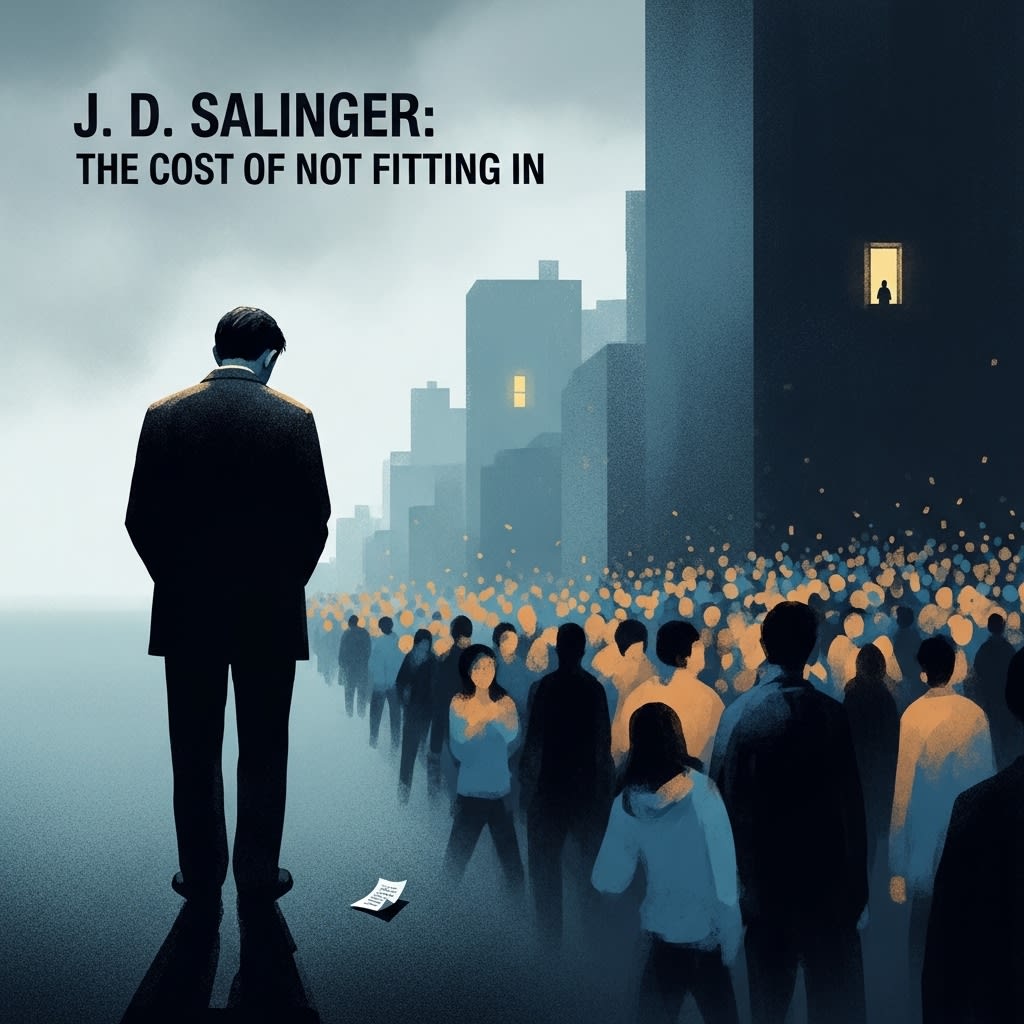
J. D. Salinger became famous for capturing a feeling most people struggle to name: the loneliness of being young in a world that feels fake. He didn’t write sweeping epics or grand theories of society. He wrote intimate stories about teenagers and seekers who felt out of place, allergic to hypocrisy, and desperate to protect something fragile and real inside themselves. In a culture that often celebrates confidence and performance, Salinger’s work stands out for honoring vulnerability, confusion, and the awkward honesty of youth.
Salinger’s most famous characters aren’t heroes in the traditional sense. They are sensitive observers who see through social scripts and recoil at what they perceive as phoniness. This sensitivity is both their strength and their burden. They can spot manipulation, empty status games, and shallow ambition—but they struggle to find where they belong. Salinger understood that alienation isn’t just being alone; it’s feeling surrounded by people and still not feeling seen. That emotional dislocation is what gives his writing its quiet punch. He doesn’t shout about society’s flaws; he lets you feel the discomfort of living inside them.
One reason Salinger still resonates is his honesty about adolescence. Youth, in his world, isn’t a carefree montage—it’s a collision of longing and disgust. Young people want sincerity and meaning, yet they’re constantly bumping into adult systems that reward image, politeness, and conformity. Salinger captures the rage that comes from sensing this mismatch without having the language or power to fix it. His characters lash out, withdraw, joke too much, or drift. These are not just teenage mood swings; they’re early attempts to protect authenticity in a world that seems to reward pretense.
Authenticity is the moral center of Salinger’s work. He treats it not as a brand or a vibe, but as a difficult practice. Being real means risking embarrassment. It means admitting you’re hurt instead of performing cool detachment. It means caring when cynicism would be easier. Salinger’s characters often fail at this. They hide behind sarcasm, intellectual superiority, or self-imposed isolation. Yet the stories keep circling back to small moments of tenderness—acts of listening, protecting the innocent, or choosing kindness when bitterness would be justified. These moments are fragile, but Salinger treats them as sacred.
There’s also a deep spiritual undertone to Salinger’s writing, even when religion isn’t explicitly named. His characters are searching for purity of intention in a world that feels contaminated by ego. They long for a space where sincerity can exist without being exploited. This longing explains Salinger’s fascination with innocence—especially the innocence of children, who haven’t yet learned to perform for approval. In his stories, children often represent a moral compass, reminding adults of what gets lost when we learn to play roles too well.
Salinger’s own life amplified the mystique of his work. After early fame, he retreated from public life, rarely gave interviews, and guarded his privacy fiercely. Some saw this as eccentricity. Others saw it as a lived extension of his themes: a refusal to let his inner life become a spectacle. In an age of constant self-disclosure, his withdrawal feels almost radical. It raises an uncomfortable question: how much of ourselves do we owe to the public? Is authenticity compatible with performance culture, or does constant visibility inevitably distort the self?
Critics have debated Salinger’s narrow focus on privileged, often male perspectives. That critique matters. His world is not a complete map of society. But within his chosen lens, he explored emotional truth with unusual precision. He gave voice to the internal weather of people who feel morally allergic to hypocrisy but lack the tools to build alternatives. That tension—seeing what’s wrong without knowing what to build instead—is deeply modern. Many people today recognize the performance, branding, and hollow incentives of contemporary life, yet struggle to imagine a different way of being within it.
Why does Salinger matter now? Because alienation hasn’t disappeared; it’s been networked. Young people are more connected than ever, yet often feel more isolated. Performance culture has moved from school hallways to global platforms. The pressure to appear “together” can suffocate honest confusion. Salinger’s work offers a counterpoint: it dignifies the feeling of not fitting in. It suggests that discomfort with phoniness isn’t weakness—it’s a moral signal. The challenge is learning to turn that signal into compassion rather than contempt.
Reading Salinger is like listening to someone finally say the quiet part out loud: that growing up often feels like trading sincerity for social survival. His stories don’t offer a clean escape from that trade. They offer something subtler and more durable: permission to care about what feels real, even when the world makes that care awkward. In a noisy culture, that kind of honesty still feels like a small, brave act.
About the Creator
Fred Bradford
Philosophy, for me, is not just an intellectual pursuit but a way to continuously grow, question, and connect with others on a deeper level. By reflecting on ideas we challenge how we see the world and our place in it.
Keep reading
More stories from Fred Bradford and writers in BookClub and other communities.
David Goggins: No Motivation Required
David Goggins didn’t become a symbol of discipline by accident. His story begins in chaos—poverty, abuse, obesity, and a life that seemed stuck on repeat. What makes Goggins compelling isn’t that he “found motivation.” It’s that he learned to function without it. In a culture obsessed with hype and shortcuts, Goggins represents the unglamorous truth: real change is built on uncomfortable repetition, brutal honesty with yourself, and the willingness to suffer on purpose.
By Fred Bradford2 days ago in BookClub
Book Review: Atmosphere by Taylor Jenkins Reid
I flipped the book over in my hands in the centre of the small airport book shop. Although I had heard promising reviews of Atmosphere by Taylor Jenkins Reid, I hesitated. The synopsis didn’t compel me - I wasn’t much of a space girly. In high school it made me cringe when my peers would talk about the stars.
By sleepy drafts16 days ago in BookClub
7 Fall Books You Must Read In 2026
Autumn is more than a season—it’s a mood. As the air turns crisp and golden leaves gather at our feet, we instinctively crave stories that mirror the richness and introspection of fall. But with thousands of titles competing for our attention, which ones truly capture the essence of autumn?
By Diana Meresc5 days ago in BookClub



Comments
There are no comments for this story
Be the first to respond and start the conversation.