
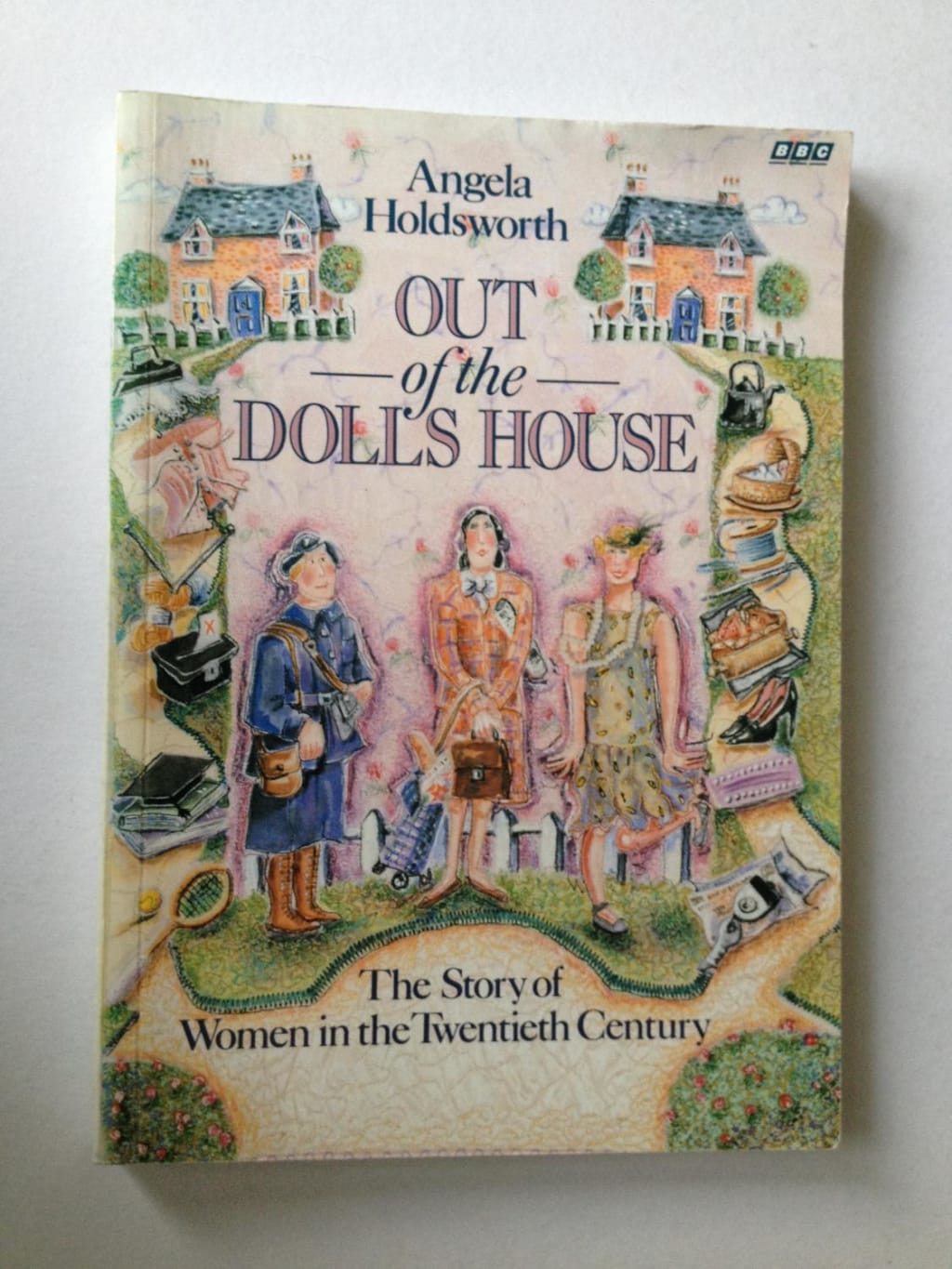
This is such an interesting book! I’m fascinated by history but when it’s connected with women’s progress in history — I literally couldn’t put the book down. It isn’t just about the Suffragettes but goes from the Victorian Era right up to the 1980s, when the book was first published.
"Out Of The Doll’s House" was written by Angela Holdsworth, and it is the story of how life has changed for women going into the 20th Century. It was published by BBC books in 1988 and was printed to go alongside the television series of the same name, (which, unfortunately, I have not seen). It is made up of true-life experiences of women over the generations. As the ‘Acknowledgements’ says: “I would particularly like to thank all those who gave so much of their time to talk about their lives and so provided the basis for Out of the Doll’s House. Many will find themselves quoted; others, though not quoted, provided valuable background and research material.”
Inside the book, there is a very interesting “Milestones for Women” section spread over 3 pages. It is a catalogue of dates and Laws which were set out to help women in their “progress” in history. For example:
“1848 — The Factory Act — limited women and children’s working hours in textile mills to ten per day. (Women and children under 10 had been excluded from underground work by the 1842 Mines & Collieries Act).”
“1881 — Isle of Man granted the vote to women.”
“1947 — The University of Cambridge finally agreed to award full degrees to women — the last university to do so.”
These very ‘simple’ things we take for granted today without knowing or realizing the ‘fight’ our sisters had to make them possible.
The book has 8 very interesting chapters from Women at Home to Women’s Health to the Road to Equality. What our great-grandmothers, grandmothers and even mothers just accepted as ‘life’ back then, us daughters just wouldn’t accept today.
One main point that comes out in the book is how much the Two World Wars changed ‘life’ for women. For so many women, during the First World War, looking after the family budget, paying bills and looking after the family financially was new and they had to learn quickly. Their husbands, along with most of the men in the country, had been sent off to war. Seeing how well women ‘coped’ during these Wars showed just what women can do and changed the view many in power had of women.
The Chapter “Mustn’t Grumble” about women’s health could make for frightening reading. Today we can be seen by a woman doctor with care and understanding, sent to hospital and ‘healed’ — whatever the illness, whether it was mental, gynecological or most other health problems. Our grandmothers never had a choice because there were no or very few women doctors, and hardly any ‘knowledge’ with regards to ‘women’s problems’ or gynecology. When reading this chapter, I was, more than ever, relieved and grateful to have been born into a different generation, to live in ‘today’s’ world.
The chapter “Just A Girl” is about ‘educating daughters’, and I did not realize, until I’d read this chapter, just how lucky I am. Today, we go through school, Secondary School, and we have the opportunity to go to college and university. Education for girls today is a normal part of life. Unfortunately, this was not the case for my grandmother or great-grandmother, and although my mother did go to Secondary School, I can still hear her saying to me how much more opportunities I had for learning, especially in languages.
Back in the Edwardian Era, it was the boys, the sons, who received an education, especially for the upper-classes or those who had wealth. As a girl was expected to help around the house, to ‘help mother’, get married and have children — the opinion was — why did she need an education?
It was a real ‘fight’ to open schools for girls. The well-known Cheltenham Ladies’ College was founded in 1853 and it was a good start in the education for girls.
“Mirror, Mirror” is the chapter on women’s fashion. Starting in the Edwardian Era and going through to the ‘fashion’ of today (or the 1980s), it is truly remarkable how much fashion for women has changed. I’m just glad that we no longer ‘have’ to wear those corsets!
Another important chapter (I think) is “The Good Mother”. Motherhood ‘is’ Motherhood. The mother carries her baby for 9 months, gives birth and then brings up the baby. This will never change. However, childbirth has never been ‘safer’ than it is today, with the majority of mothers and babies surviving and living on. Worldwide, 99.8% of mothers and babies survive childbirth. This was not always the case. In the Edwardian Era, 1 in 7 babies died in their first year in 1901, and this was an improvement on the Victorian Era. The reason for this was that knowledge of childbirth was limited and there were not the medical practices that we now know helps to keep both mother and baby alive. Thankfully, research and advancements in medicine have improved the survival rates today.
Rather than go through any more of the chapters, I'd encourage you to read the book yourself, because this book would interest anyone, woman or man, who loves history and the world we live in. I enjoyed Sociology at school but I wish we'd had this book to study, it is really so interesting.
About the Creator
Ruth Elizabeth Stiff
I love all things Earthy and Self-Help
History is one of my favourite subjects and I love to write short fiction
Research is so interesting for me too
Keep reading
More stories from Ruth Elizabeth Stiff and writers in BookClub and other communities.
Daily Life
Daily Life is the fourth chapter in the book Lost Voices of the Edwardians by Max Arthur. Daily life in the Edwardian Era, in one way, wasn’t that much different to our lives today. They would go to work or school, cook, eat, drink, and have a roof over their heads. The main difference was how they did this and at what ages, and they wore very different clothes.
By Ruth Elizabeth Stiff6 months ago in BookClub
Book Review: Atmosphere by Taylor Jenkins Reid
I flipped the book over in my hands in the centre of the small airport book shop. Although I had heard promising reviews of Atmosphere by Taylor Jenkins Reid, I hesitated. The synopsis didn’t compel me - I wasn’t much of a space girly. In high school it made me cringe when my peers would talk about the stars.
By sleepy drafts12 days ago in BookClub
Ray Bradbury: The Man Who Set the Future on Fire
There are writers who predict the future. And then there are writers who feel it coming. Ray Bradbury was not a scientist. He wasn’t a technologist. He didn’t write hard equations into his stories or obsess over mechanical accuracy. Instead, he wrote about something far more dangerous and far more human: what happens to the soul when the world changes too fast.
By Fred Bradford2 days ago in BookClub
I Don't Need My Phone... Wait, Is That Actually True?
My parents gave me my first cell phone when I was twelve years old. It wasn't a fancy iPhone or anything, not even close. Just a simple black flip phone for when I needed to call or text them after school.
By Madison "Maddy" Newton2 days ago in Humans


Comments
There are no comments for this story
Be the first to respond and start the conversation.