
Ray Bradbury: The Man Who Set the Future on Fire
Ray Bradbury: The Man Who Set the Future on Fire

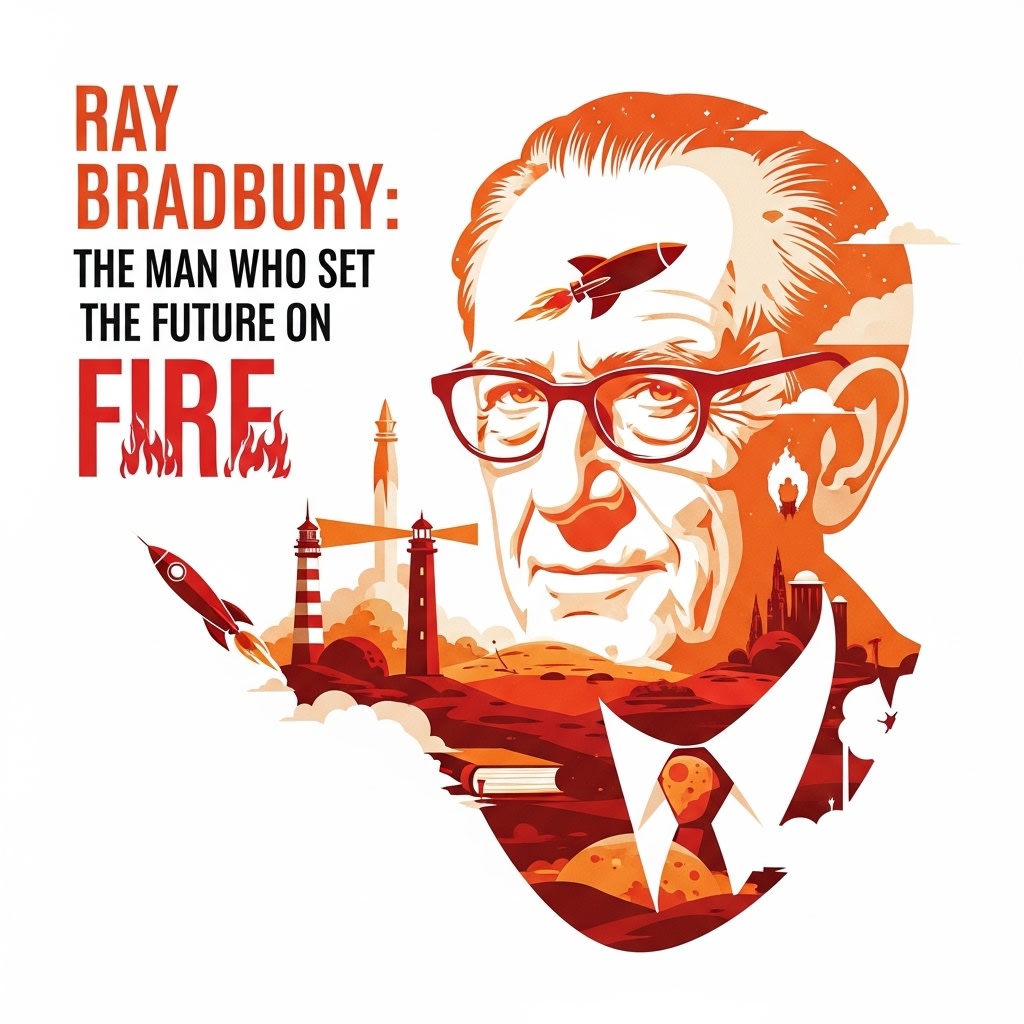
There are writers who predict the future. And then there are writers who feel it coming.
Ray Bradbury was not a scientist. He wasn’t a technologist. He didn’t write hard equations into his stories or obsess over mechanical accuracy. Instead, he wrote about something far more dangerous and far more human: what happens to the soul when the world changes too fast.
Born in 1920 in Waukegan, Illinois, Bradbury grew up devouring books at the local library. He never attended college. The library was his university. He once said, “I graduated from the library.” That devotion to books would later fuel the fiery heartbeat of his most famous novel, Fahrenheit 451.
Published in 1953, Fahrenheit 451 imagines a future where books are outlawed and “firemen” burn them. At its center is Guy Montag, a man who begins to question the world around him—a world addicted to screens, noise, and distraction. Sound familiar?
Bradbury wasn’t warning us about government censorship alone. He was warning us about voluntary ignorance. A society so overwhelmed by entertainment that it forgets how to think. Decades before smartphones and social media, he imagined walls that played endless programming and citizens who preferred comfort over curiosity. His genius wasn’t technological prediction—it was psychological insight.
But Bradbury’s imagination stretched far beyond burning books.
In The Martian Chronicles, he painted Mars not as a scientific frontier but as a mirror. The colonization of Mars becomes a reflection of humanity’s loneliness, arrogance, hope, and longing. The red planet isn’t just a setting; it’s a stage where human flaws follow us into space. Bradbury suggests that no matter how far we travel, we bring ourselves with us.
And then there is Something Wicked This Way Comes—a dark carnival tale about temptation and the fragile boundary between childhood and adulthood. It reads like autumn feels: beautiful, eerie, nostalgic. Bradbury had a rare gift for turning ordinary American towns into mythic landscapes. His prose glows. He didn’t just write science fiction; he wrote poetry disguised as science fiction.
That’s the key to understanding Ray Bradbury.
He resisted the label “science fiction writer.” He preferred “fantasist” or simply “writer.” For him, rockets and robots were tools. The real subject was always the human heart. Fear. Wonder. Memory. Regret. Joy.
His language burns bright. Sentences leap off the page. He once advised writers to write with “zest.” And you can feel it—his stories pulse with enthusiasm. He loved life deeply, even as he warned about its fragility. Unlike many dystopian authors, Bradbury wasn’t cynical. He believed in people. He believed we could choose differently.
That optimism separates him from darker contemporaries. While other mid-century writers imagined cold, mechanical futures, Bradbury imagined futures shaped by emotion. Technology, he argued, is never the villain by itself. The real danger is apathy. When we stop reading. When we stop questioning. When we stop caring.
His influence is everywhere. Modern dystopian storytelling—from literature to film—owes something to Bradbury’s lyrical warnings. But more importantly, his work still feels urgent. In an age of algorithmic feeds and shrinking attention spans, Fahrenheit 451 reads less like fiction and more like diagnosis.
And yet, Bradbury never positioned himself as a prophet. He saw himself as a storyteller who followed his curiosity. He wrote daily. Relentlessly. Joyfully. He believed creativity wasn’t a luxury; it was survival.
When he passed away in 2012, the world lost more than an author. It lost a guardian of imagination. But his stories remain—glowing embers we can still hold.
Ray Bradbury reminds us that the future isn’t something that happens to us. It’s something we build—through what we choose to read, what we choose to watch, and what we choose to value.
His work asks a simple but haunting question:
If the firemen came for our books tomorrow…
would we fight for them?
Or would we be too distracted to notice the flames?
About the Creator
Fred Bradford
Philosophy, for me, is not just an intellectual pursuit but a way to continuously grow, question, and connect with others on a deeper level. By reflecting on ideas we challenge how we see the world and our place in it.
Keep reading
More stories from Fred Bradford and writers in BookClub and other communities.
Margaret Atwood: Warnings Written in Ink
Margaret Atwood does not write fantasy. She writes possibility. For decades, readers have described her work as dystopian, speculative, even prophetic. But Atwood has always insisted on one important rule: she does not invent technologies or political systems that have no precedent in human history. Everything she writes about has happened somewhere, in some form, at some time. That grounding in reality is what makes her fiction so unsettling—and so powerful.
By Fred Bradforda day ago in BookClub
Rachel Reviews: Lunch Tales: Teagan by Lucille Guarino
Well, I did enjoy this! Sometimes, all you need is just great storytelling and this is what Lucille Guarino delivers here. There's no big message to this book; it's just about folks and families, living their lives and coping with everything that's being thrown at them and finding their way. But when it's done well, like it is here, then you have characters to whom you can relate, tension which leaves you rooting for a better outcome, attraction which has your heart racing and an urge, as a reader, to see the characters happy with the people with whom they belong.
By Rachel Deeming7 days ago in BookClub
6 Amazing Books That Will Keep You Turning Pages All Night
There’s a special kind of magic in books that refuse to let us sleep. We tell ourselves, just one more chapter, only to glance at the clock hours later, eyes wide, heart racing, mind fully alive. These are the stories that grip us, challenge us, comfort us, or thrill us so deeply that putting them down feels impossible. In a world overflowing with content, finding truly unputdownable books is both an art and a necessity.
By Diana Meresc7 days ago in BookClub


Comments
There are no comments for this story
Be the first to respond and start the conversation.