
The Satanic New Year in Modern Satanism
Belief, Practice, and Reality

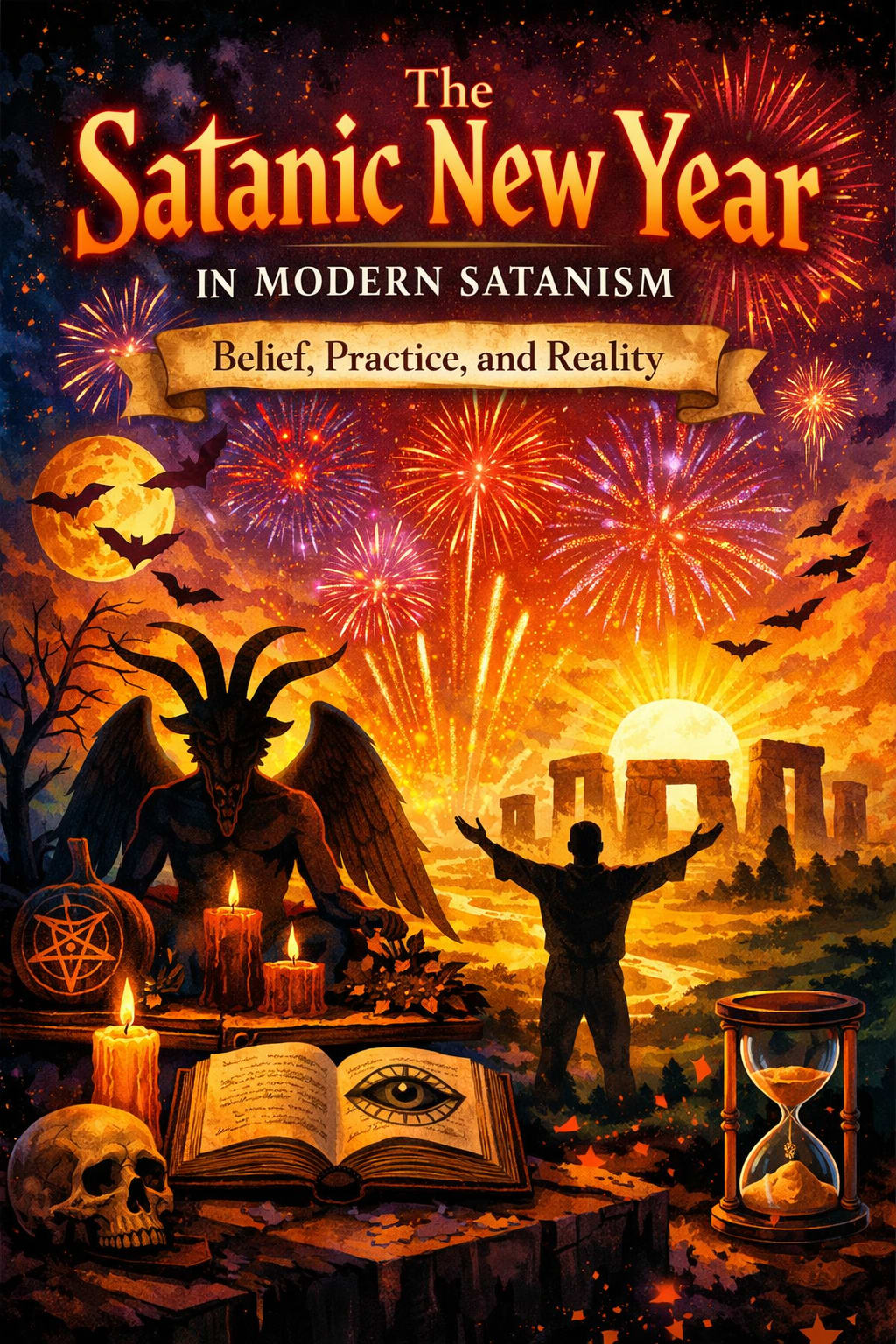
Rethinking the Satanic New Year
The phrase “Satanic New Year” has become a familiar fixture in online conversations, often repeated with confidence and rarely examined with care. It is frequently framed as a secretive or countercultural observance, implied to carry ritual authority or ancient religious weight. This framing, however, does not reflect the reality of modern Satanism. No recognized contemporary Satanic tradition observes a formal New Year in the religious sense, nor is there a shared doctrine that assigns sacred importance to a specific date marking renewal, rebirth, or cosmic transition.
Modern Satanism emerged in a cultural landscape shaped by skepticism, secularism, and a rejection of supernatural authority. Unlike religions built upon divine revelation or sacred chronology, modern Satanic traditions emphasize symbolism, philosophy, and personal agency. Time is not sanctified through divine mandate, and the calendar holds no inherent spiritual power. Meaning is assigned through human intention rather than inherited cosmology. Within this framework, the idea of a collective New Year holds little functional relevance.
The persistence of the term can be traced to a convergence of cultural misunderstandings. Satanism is often conflated with paganism, occult folklore, or medieval demonology, despite these systems having distinct origins and values. Seasonal festivals rooted in pre-Christian Europe are regularly misattributed to Satanic belief, while fictional portrayals reinforce the illusion of hidden rites and forbidden calendars. Over time, repetition gives these claims the appearance of legitimacy, even in the absence of credible sources.
Modern Satanism itself is not monolithic. LaVeyan Satanism, established in the mid-twentieth century, frames Satan as a symbol of individual sovereignty, rational self-interest, and resistance to imposed authority. The Satanic Temple, founded decades later, employs similar symbolism while centering activism, pluralism, and secular ethics. Despite ideological differences, both reject supernaturalism and centralized religious obligation. Neither tradition endorses a sacred New Year or prescribes ritual observance tied to the turning of the calendar.
In place of fixed holy days, modern Satanism prioritizes personal significance. Individual milestones, intellectual growth, self-reflection, and ethical action carry more weight than inherited tradition. Celebrations occur by choice rather than command. Ritual, when practiced, serves expressive or psychological purposes rather than devotional ones. This approach reflects a broader philosophical stance that rejects external authority over personal meaning.
The enduring fascination with a supposed Satanic New Year reveals more about cultural anxieties than about Satanic belief itself. Societies have long projected fears onto misunderstood groups, constructing narratives that simplify complexity into symbols of threat or rebellion. Satanism, with its deliberate use of provocative imagery, becomes an easy target for such projections. The result is a mythology that circulates widely while remaining detached from lived practice.
Understanding modern Satanism requires setting aside inherited assumptions and examining primary sources, historical context, and organizational statements. When this is done, the concept of a Satanic New Year dissolves into what it has always been: a compelling idea unsupported by doctrine, tradition, or practice. What remains is a movement defined not by secret calendars or hidden rites, but by a conscious rejection of imposed meaning and an insistence on individual responsibility for belief, ethics, and identity.
Understanding Modern Satanism
Modern Satanism took shape in the mid twentieth century within a social climate marked by increasing secularism, distrust of traditional authority, and a growing emphasis on individual identity. It bears little resemblance to medieval Christian demonology or to the popular image of secretive devil worship that has circulated for centuries. Contemporary Satanism does not revolve around fear of evil spirits or devotion to a supernatural adversary. Instead, it operates as a symbolic and philosophical system that uses the figure of Satan as a literary and cultural archetype.
In modern Satanic thought, Satan represents rebellion against arbitrary authority, the pursuit of knowledge, and the affirmation of the self. This symbolism draws heavily from literary sources such as John Milton, Anatole France, and Romantic era writers who portrayed Satan as a defiant figure rather than a purely malevolent one. These interpretations emphasize autonomy, critical thinking, and resistance to dogma. As a result, modern Satanism aligns more closely with humanist and materialist philosophies than with theistic religion.
A defining feature of modern Satanism is non-theism. Satan is not regarded as a literal being, deity, or force that intervenes in human affairs. There is no belief in an afterlife governed by Satan, no cosmology of divine judgment, and no expectation of supernatural reward or punishment. Ethical responsibility rests entirely with the individual. Actions are evaluated through reason, personal values, and social consequence rather than divine command.
Within this framework, Satanism rejects the idea that time itself carries sacred authority. Religious calendars that dictate holy days, fasting periods, or cycles of spiritual renewal are viewed as tools of institutional control rather than sources of meaning. Modern Satanism instead treats time as a neutral construct. Meaning arises from personal choice and lived experience, not from inherited tradition.
Two movements are most often referenced when discussing modern Satanism: LaVeyan Satanism and The Satanic Temple. While these movements differ in emphasis and public expression, both reject supernatural belief and both use Satanic symbolism as a conscious challenge to religious orthodoxy. Neither tradition recognizes a sacred calendar or a religious New Year.
LaVeyan Satanism and Symbolic Time
LaVeyan Satanism originated in 1966 with the founding of the Church of Satan by Anton Szandor LaVey in San Francisco. This date is often cited as the symbolic beginning of organized modern Satanism. LaVey framed Satanism as a rational, atheistic philosophy that embraced indulgence, personal responsibility, and psychological realism. The publication of The Satanic Bible in 1969 formalized these ideas and remains the primary reference text for LaVeyan Satanists.
Ritual within LaVeyan Satanism is not an act of worship. Instead, it functions as a form of symbolic psychodrama. Rituals are designed to focus emotion, clarify intent, and provide catharsis. They borrow theatrical elements from religious ceremony while stripping them of supernatural claims. The power of ritual lies in human psychology rather than divine intervention.
Time, within this system, is entirely desacralized. There is no belief that certain dates possess inherent spiritual energy. No calendar is imposed, and no collective ritual schedule is required. LaVey emphasized that meaning should be chosen, not inherited. This approach stands in direct opposition to religions that structure belief around annual cycles of sin, redemption, and renewal.
The most significant celebration in LaVeyan Satanism is the individual birthday. This emphasis reflects the central philosophical principle that the self is the highest value. A birthday marks existence, survival, and personal continuity. It is a moment of self-recognition rather than communal obligation. This celebration is not standardized and varies widely in expression, reinforcing the primacy of individual preference.
April 30, commonly known as Walpurgisnacht, appears occasionally in Satanic commentary due to its historical and cultural associations. Walpurgisnacht has roots in European folk traditions tied to spring, agricultural cycles, and pre-Christian myth. In literature and popular folklore, it became associated with witches, rebellion, and liminal space. These themes resonate symbolically with Satanic aesthetics, which may explain its recurring mention.
However, no authoritative Church of Satan document designates Walpurgisnacht as a Satanic New Year. Claims to the contrary typically originate from secondary sources or popular retellings rather than from LaVey’s own writings or official organizational statements. Within LaVeyan Satanism, Walpurgisnacht functions as a symbolic reference point rather than a calendrical mandate. Participation, interpretation, and significance remain entirely optional.
The Satanic Temple and Contemporary Observances
The Satanic Temple represents a distinct and more recent expression of modern Satanism. Founded in the early twenty first century, the organization combines Satanic symbolism with secular ethics, political advocacy, and a strong emphasis on pluralism. The Satanic Temple is explicitly non-theistic and rejects all supernatural claims.
Satan, within The Satanic Temple’s framework, serves as a symbol of resistance to tyranny, defense of bodily autonomy, and commitment to reason. This symbolism is used both internally, as a source of shared identity, and externally, as a rhetorical challenge to religious privilege in public life. The organization’s principles emphasize compassion, justice, scientific understanding, and personal freedom.
Unlike LaVeyan Satanism, which prioritizes individual ritual autonomy, The Satanic Temple maintains a publicly articulated set of holidays. These observances are not religious obligations but symbolic markers that reinforce shared values and historical awareness. They are intended to foster community, reflection, and ethical engagement rather than spiritual renewal.
Recognized observances include Lupercalia, which celebrates autonomy and self-expression, and Unveiling Day, which commemorates the public presentation of the Baphomet statue as a statement on religious equality. Sol Invictus, observed in late December, emphasizes resilience and the triumph of reason over superstition. Halloween is embraced for its cultural symbolism and aesthetic appeal rather than religious significance.
Hexennacht, observed on April 30, is frequently mischaracterized as a Satanic New Year. In reality, Hexennacht functions as a memorial. The observance honors those who suffered and died due to superstition, moral panic, and injustice, particularly during historical witch hunts. The focus is on remembrance and ethical reflection, not renewal or calendrical transition.
The Satanic Temple does not present any of its observances as marking the beginning of a spiritual cycle or year. There is no concept of ritual rebirth, collective absolution, or annual recommitment. Autonomy remains central. Participation is voluntary, interpretation is personal, and meaning arises from conscious engagement rather than tradition.
For this reason, the idea of a Satanic New Year does not align with the philosophical or organizational structure of The Satanic Temple. Time is acknowledged as a human construct, and significance is assigned through intention, not inherited ritual authority.
Why the Concept of a Satanic New Year Exists
The continued circulation of the idea of a Satanic New Year says far more about cultural storytelling than about Satanic belief or practice. This concept did not emerge from within modern Satanism itself. Instead, it developed at the intersection of historical misunderstanding, religious anxiety, and the human tendency to impose familiar structures onto unfamiliar systems. When examined closely, the origins of this idea can be traced to recurring social patterns rather than doctrinal sources.
One of the most influential factors is the long-standing tendency to conflate Satanism with paganism and pre-Christian European religions. Many ancient cultures organized communal life around seasonal cycles tied to agriculture, climate, and survival. Spring festivals often symbolized fertility and growth, while autumn festivals marked harvest and preparation for winter. These observances were practical and symbolic responses to environmental realities rather than expressions of good or evil. As Christianity spread across Europe, many of these festivals were reinterpreted, suppressed, or absorbed into the Christian calendar.
Over time, remnants of these seasonal traditions became associated with ideas of heresy, witchcraft, and forbidden knowledge. In later centuries, when Satanism emerged as a symbolic countercultural philosophy, its imagery was retroactively linked to these older traditions. This connection, however, is largely symbolic and aesthetic rather than theological. Pagan seasonal festivals did not evolve into Satanic holidays, yet popular narratives often treat them as interchangeable. This blending creates the illusion of an ancient Satanic calendar that never existed.
Another major influence is the historical pattern of moral panic. Periods of social anxiety have frequently produced exaggerated fears about hidden groups undermining moral order. From early modern witch trials to the Satanic Panic of the late twentieth century, accusations of secret rituals and calendrical observances have served as tools for social control. Claims about clandestine New Year celebrations fit neatly into this pattern. A supposed Satanic New Year suggests secrecy, coordination, and threat, all of which heighten fear and attract attention.
Media portrayals have reinforced these narratives. Films, television programs, and sensationalist reporting often depict Satanism as an organized underground religion with rigid hierarchies and arcane traditions. These portrayals prioritize drama over accuracy. Invented rituals and fictional holidays are repeated until they appear plausible, especially to audiences unfamiliar with actual Satanic philosophy. Once embedded in popular culture, these ideas become difficult to dislodge.
Digital communication has intensified this process. Online platforms reward emotionally charged content that can be shared quickly and widely. Short, declarative claims travel farther than careful explanations. A phrase like “Satanic New Year” offers a complete story in three words, requiring no context and inviting speculation. Algorithms amplify repetition rather than accuracy, allowing unverified claims to circulate without challenge.
There is also a psychological dimension at work. Human societies tend to organize belief systems around cycles of beginning and renewal. New Year celebrations exist in many cultures and religions, making the concept feel universal. When confronted with a belief system that rejects sacred calendars, many people instinctively assume that an equivalent structure must exist. In the absence of clear information, a New Year is invented to fill the gap.
The endurance of this idea highlights how easily symbolism can be mistaken for doctrine. Satanic imagery, intentionally provocative and historically layered, invites interpretation. Without careful distinction between metaphor and belief, outsiders often mistake aesthetic expression for religious mandate. The result is a narrative that persists not because it is true, but because it feels familiar.
Understanding why the concept exists requires recognizing these overlapping influences. The Satanic New Year is not a product of Satanic tradition. It is a cultural artifact shaped by fear, fascination, and the human impulse to impose order where none is prescribed.
The Role of Ritual Without Sacred Calendars
Ritual occupies a meaningful place within modern Satanism, but its function differs fundamentally from ritual in traditional religious systems. Rather than serving as an act of worship or obedience to divine command, Satanic ritual is intentionally grounded in human psychology, symbolism, and self-expression. The value of ritual lies in its capacity to focus thought, articulate intention, and provide emotional clarity. It does not derive authority from tradition, prophecy, or sacred time.
In modern Satanism, the absence of a sacred calendar is not a deficiency but a philosophical choice. Fixed religious calendars often serve to regulate behavior, reinforce hierarchy, and define spiritual legitimacy through compliance. Satanic traditions reject this model. Time is treated as neutral, and meaning is assigned through conscious decision rather than inherited obligation. Ritual occurs when it is needed, not when it is prescribed.
Within LaVeyan Satanism, ritual is described as a form of psychodrama. It functions as a controlled environment in which emotion, desire, or frustration can be expressed and examined. Rituals may be performed during moments of personal transition, conflict, or resolve. The timing is determined by internal necessity rather than external decree. No collective schedule exists, and no authority mandates participation on specific dates. This approach reflects the broader emphasis on individual sovereignty and self-directed meaning.
Because ritual is personal, repetition does not require synchronization with others. A ritual performed once may hold more significance than an annual observance repeated out of habit. In this sense, ritual remains adaptive rather than cyclical. It responds to lived experience rather than conforming to a calendar.
The Satanic Temple approaches ritual through a different but related lens. Rituals are often public, symbolic, and connected to ethical or political expression. These performances may accompany demonstrations, commemorations, or moments of collective reflection. Their purpose is communicative rather than sacramental. Ritual becomes a language through which values are expressed and solidarity is affirmed.
Timing in these cases is shaped by context. A ritual may coincide with a legal challenge, a historical anniversary, or a public debate. The date matters only insofar as it strengthens the message being conveyed. No ritual is considered spiritually incomplete if it is not performed on a specific day, and no date holds intrinsic ritual power.
This approach reinforces the broader Satanic rejection of sacred time. Renewal, reflection, and transformation are not confined to annual cycles. Change is understood as continuous, driven by conscious effort rather than ritual obligation. The absence of a New Year is not an oversight but a logical extension of a worldview that prioritizes agency over tradition.
By removing ritual from the constraints of a religious calendar, modern Satanism reframes spiritual practice as intentional rather than inherited. Meaning emerges from participation, not from the date on which an action occurs.
Cultural Misrepresentation and Popular Media
Public understanding of Satanism has been shaped less by direct exposure and more by decades of fictional portrayal. Popular media has consistently presented Satanism as a secretive, hierarchical, and ritual-heavy religion, complete with forbidden texts, synchronized ceremonies, and hidden calendars. These depictions are effective as storytelling devices but bear little resemblance to the lived reality of modern Satanic practice.
Films and television series often rely on visual shorthand to communicate danger or transgression. Hooded figures, candlelit chambers, and synchronized rites offer immediate atmosphere and narrative tension. Within this framework, the invention of a Satanic New Year serves a useful dramatic purpose. It implies coordination, secrecy, and continuity across generations. None of these elements are required to accurately portray modern Satanism, but they remain attractive to creators seeking spectacle rather than nuance.
Repeated exposure to these fictional tropes gradually reshapes public perception. When similar imagery appears across multiple forms of media, it acquires an air of authenticity. Viewers unfamiliar with actual Satanic philosophy may assume these portrayals are exaggerated but grounded in truth. Over time, fictional elements begin to circulate as assumed facts, especially when echoed in sensationalist journalism or online commentary.
The entertainment industry prioritizes emotional impact over factual representation. Satanic symbolism is often stripped of its philosophical context and reduced to visual shorthand for rebellion or evil. In this process, Satanism becomes a narrative tool rather than a belief system. The invented rituals and calendars that accompany these portrayals persist because they fulfill storytelling needs, not because they reflect real practice.
Educational gaps further reinforce these misconceptions. Religious literacy remains limited in many educational settings, particularly when it comes to minority or controversial belief systems. Curricula often focus on major world religions while neglecting newer movements or alternative philosophies. Without structured exposure to accurate information, students encounter Satanism primarily through popular culture.
In the absence of factual grounding, stereotypes fill the gap. Satanism becomes defined by what it is imagined to be rather than what its adherents actually believe or practice. This dynamic allows myths such as the Satanic New Year to circulate unchallenged, especially when they align with existing fears or moral narratives.
Academic Perspectives on Satanic Calendars
Scholarly research on modern Satanism offers a markedly different picture from popular media portrayals. Academics who study new religious movements consistently describe Satanism as decentralized, symbolic, and resistant to institutional control. Authority is not vested in sacred texts interpreted by clergy but in individual reasoning and personal ethics.
Academic studies emphasize that modern Satanism lacks the structural features typically associated with organized religion. There is no universal doctrine, no compulsory ritual schedule, and no sacred calendar governing belief or behavior. Instead, meaning is constructed through philosophy, symbolism, and lived experience. This decentralization makes the existence of a universally recognized New Year functionally impossible.
Research into Satanic organizations reveals minimal concern with calendrical cycles. Unlike religions that organize spiritual life around annual narratives of fall, redemption, and renewal, modern Satanism does not frame identity through recurring seasonal events. Philosophical coherence and ethical consistency take precedence over ritual repetition.
Scholars have also noted that Satanic symbolism is intentionally fluid. Symbols are tools rather than commandments. Dates, when acknowledged, derive significance from historical context or personal relevance rather than theological necessity. This flexibility further undermines the idea of a fixed religious New Year.
Across academic literature, there is broad agreement that the Satanic New Year is not an institutional or doctrinal reality within modern Satanism. The concept appears in cultural discourse rather than in primary sources. When examined through scholarly methodology, it dissolves under scrutiny, reinforcing the conclusion that it belongs to the realm of myth rather than belief.
This contrast between academic analysis and popular representation underscores the importance of critical engagement with sources. Understanding modern Satanism requires attention to documented practice and scholarly research, not fictional narratives or inherited assumptions.
Personal Meaning Versus Collective Doctrine
A defining characteristic of modern Satanism is the rejection of collective doctrine in favor of individual meaning. Rather than prescribing belief or behavior through centralized authority, Satanic philosophy places responsibility for interpretation squarely on the individual. Meaning is created through experience, reflection, and conscious choice rather than inherited obligation. This orientation fundamentally shapes how time, celebration, and ritual are understood.
Individual Satanists may choose to acknowledge moments that carry personal significance. These moments can include birthdays, personal achievements, intellectual breakthroughs, or periods of transition. Some may also find meaning in seasonal changes or culturally significant dates, not because those moments are endowed with spiritual authority, but because they resonate on a personal or symbolic level. Such observances are expressions of autonomy rather than adherence to doctrine.
This flexibility is intentional. Modern Satanism resists uniformity precisely because uniformity tends to produce hierarchy and control. Without mandated observances, practitioners are free to construct practices that reflect personal values and lived reality. No date carries inherent authority, and no observance is required for legitimacy within the belief system.
At the same time, this individualized approach creates fertile ground for misunderstanding. When personal practices are observed from the outside, they can be mistaken for formal religious customs. A date that holds meaning for one individual may be assumed to carry the same weight for all. Over time, repetition of these assumptions hardens into myth, particularly when amplified by external commentary or popular media.
Modern Satanic organizations are clear in distinguishing between personal expression and institutional belief. Neither LaVeyan Satanism nor The Satanic Temple presents individual observance as collective obligation. There is no expectation that practitioners align personal milestones with organizational calendars, nor is there any requirement to participate in shared rituals to affirm identity.
A personal observance, no matter how meaningful, does not become a religious holiday through repetition or visibility. Modern Satanism maintains this boundary deliberately. By doing so, it preserves individual autonomy and resists the formation of dogma. The distinction between personal meaning and collective doctrine is not incidental; it is central to how modern Satanism understands belief, identity, and freedom.
Modern Satanic Holidays and Observances
Within modern Satanism, holidays and observances function differently than in many traditional religions. There is no liturgical calendar or sacred mandate, yet practitioners and communities often choose to recognize dates that carry symbolic, ethical, or cultural significance. These occasions are not derived from ancient Satanic doctrine but reflect how modern Satanists give meaning to specific moments in the year. Examining these observances offers insight into how contemporary Satanism approaches ritual, community, and commemoration.
The Satanic Temple, for example, promotes a set of symbolic holidays that reflect philosophy and social engagement rather than supernatural belief. Lupercalia, observed in February, celebrates bodily autonomy and self-expression. This holiday emphasizes individual dignity and personal choice, highlighting the Temple’s focus on personal empowerment. Hexennacht, observed at the end of April, honors those who have suffered due to superstition, fear, or persecution, using historical folklore as a symbolic lens to critique social injustice. Unveiling Day commemorates public advocacy for religious equality and serves as a reminder of the ongoing importance of pluralism and activism.
Halloween, widely recognized in Western culture, is embraced for its aesthetic and community-building qualities rather than any theological significance. Sol Invictus, observed in December, symbolizes intellectual resilience and the persistence of reason, using cultural tradition as a platform for reflection and public engagement. Across these observances, the focus is on intention, symbolism, and ethical messaging rather than prescribed ritual or sacred time.
Beyond organized holidays, individual Satanists often select dates of personal or cultural significance. For example, some may observe anniversaries, seasonal transitions, or moments of personal achievement. Within LaVeyan Satanism, Walpurgisnacht is sometimes acknowledged as a symbolic date connected to the founding of the Church of Satan and springtime folklore. These practices are voluntary and individualized, reflecting the philosophy’s emphasis on autonomy and self-directed meaning.
Taken together, modern Satanic observances illustrate that celebration and ritual are guided by conscious choice rather than institutional authority. Whether personal or community-based, these practices emphasize symbolism, ethical reflection, and engagement with culture. Understanding these holidays clarifies why claims of a universally recognized Satanic New Year are unfounded, showing how modern Satanism uses ritual to express philosophy rather than to follow prescribed sacred time.
The Importance of Critical Evaluation
Discussions of Satanism often unfold in environments shaped by rumor, emotion, and inherited fear. For this reason, claims about Satanic belief or practice require the same level of scrutiny applied to any religious or philosophical system. Accuracy depends on evidence, not repetition. Reliable information emerges from primary texts, documented statements issued by recognized organizations, and peer-reviewed scholarly research rather than anecdotal accounts or sensational commentary.
Primary sources hold particular importance. Foundational writings, official publications, and publicly stated principles provide direct insight into how modern Satanic groups define themselves. These materials offer clarity that secondhand interpretations frequently distort. Without engagement with primary sources, it becomes easy to mistake external narratives for internal belief.
Online content presents additional challenges. Digital platforms reward immediacy and emotional engagement, often at the expense of accuracy. Articles, videos, and posts may blend speculation with fact, presenting opinion as established truth. Headlines are designed to attract attention rather than convey nuance. In this environment, repetition can create the illusion of consensus even when no credible source supports the claim.
Critical evaluation requires deliberate attention to context. Who produced the information, and for what purpose. Is the source educational, journalistic, ideological, or entertainment-driven. Are claims supported by verifiable references or by vague appeals to tradition and secrecy. These questions help distinguish informed analysis from conjecture.
Sensational claims, particularly those involving secrecy or hidden rituals, warrant careful skepticism. Historically, such narratives have often been used to marginalize groups perceived as threatening or unconventional. Satanism has frequently occupied this role, making it especially vulnerable to exaggeration and moral panic.
A clear understanding of modern Satanism depends on setting aside assumptions shaped by fear, fascination, or cultural myth. Respectful inquiry does not require agreement, only intellectual honesty. When approached through documented evidence and thoughtful analysis, modern Satanism reveals itself as a coherent philosophical movement rather than the caricature often presented.
Recommended Reading: #commissionearned
The Satanic Bible by Anton Szandor LaVey
First published in 1969, The Satanic Bible remains the most influential text in modern Satanism and is essential for understanding how contemporary Satanic philosophy approaches time, ritual, and personal meaning. LaVey presents Satan not as a supernatural being, but as a symbol of individualism, self-determination, and rational self-interest. The book rejects spiritual calendars, divine mandates, and sacred cycles, replacing them with personal responsibility and intentional action. This perspective directly undermines the idea of a fixed Satanic New Year, as it places meaning in the individual rather than in inherited tradition. The text also explains ritual as psychodrama rather than worship, reinforcing the absence of required observances. Readers seeking to understand why modern Satanism resists imposed holy days will find the philosophical foundations clearly articulated here. The book’s continued availability and relevance reflect its enduring role in shaping Satanic thought.
The Satanic Rituals by Anton Szandor LaVey
While The Satanic Bible establishes philosophical principles, The Satanic Rituals provides insight into how symbolism and ceremony function within LaVeyan Satanism. This book offers examples of ritual structure while emphasizing psychological focus rather than supernatural belief. The rituals described are not tied to a religious calendar, nor are they presented as obligations. Instead, timing is treated as situational and personal, reinforcing the absence of sacred dates such as a New Year. The text draws heavily from historical and literary sources, showing how imagery is adapted rather than inherited wholesale. This approach helps clarify why dates like Walpurgisnacht are often misunderstood by outsiders. For readers examining claims about Satanic holidays, this book demonstrates how ritual exists independently of calendrical authority. Its availability in modern editions makes it an accessible companion to broader discussions of Satanic practice.
The Church of Satan: A History of the World's Most Notorious Religion by Blanche Barton
Blanche Barton’s historical account provides an insider perspective on the development of the Church of Satan and its philosophical direction after its founding. The book traces organizational history, public perception, and internal values without resorting to sensationalism. It addresses how myths about Satanism have developed alongside the movement itself, including misconceptions about rituals and holidays. By documenting official positions and public statements, the book helps separate internal belief from external rumor. Readers will gain a clearer understanding of how ideas like a Satanic New Year arise outside the organization rather than within it. The work also contextualizes LaVeyan Satanism within broader cultural shifts of the twentieth century. As a historical resource, it grounds abstract philosophy in lived reality.
The Little Book of Satanism by La Carmina
La Carmina’s work offers an approachable and contemporary introduction to Satanism while maintaining accuracy and cultural awareness. The book explores how Satanic symbolism has evolved over time and how modern practitioners interpret it today. It addresses common myths directly, making it particularly relevant for readers encountering claims about Satanic holidays online. Rather than reinforcing fear-based narratives, the book explains Satanism as a framework for autonomy and critical thought. Discussions of ritual and symbolism emphasize choice rather than obligation, echoing the broader rejection of sacred calendars. The tone remains informative without being academic, making it accessible to a wide audience. This balance makes the book especially useful for readers beginning independent research.
Satanic Feminism: Lucifer as the Liberator of Woman in Nineteenth-Century Culture by Per Faxneld
This scholarly work examines how Satanic and Luciferian imagery has historically been used as a symbol of resistance, particularly in feminist and political contexts. The book focuses on the nineteenth century, long before modern Satanism took institutional form, demonstrating how symbolic figures evolve independently of religious doctrine. This historical perspective is valuable when considering how Satanic imagery becomes detached from belief and reinterpreted culturally. The book shows how symbolic associations often outlive their original context, contributing to later misconceptions. Understanding this process helps explain how ideas like a Satanic New Year can arise without doctrinal basis. The research is meticulous and grounded in historical documentation.
Lords of Chaos by Michael J. Moynihan and Didrik Søderlind
Although primarily focused on extreme music subcultures, Lords of Chaos offers insight into how Satanic imagery functions within modern cultural movements. The book examines how symbols associated with Satanism are adopted for shock value, rebellion, or identity formation rather than religious devotion. This distinction is critical when analyzing popular assumptions about Satanic practice. Many misconceptions about Satanic rituals and calendars originate in subcultural expression rather than belief. The book illustrates how media attention amplifies extreme imagery while ignoring philosophical context. Readers will better understand how cultural Satanism differs from religious Satanism. This context helps explain why fictional concepts such as a Satanic New Year gain traction despite lacking doctrinal support.
Moving Beyond the Myth
The idea of a Satanic New Year remains a cultural construction rather than a reflection of modern Satanic belief or practice. Within contemporary Satanism, there is no shared doctrine that assigns religious meaning to the turning of the year. Neither LaVeyan Satanism nor The Satanic Temple recognizes a New Year as a sacred observance, ritual obligation, or point of spiritual renewal. The persistence of this idea is rooted in misunderstanding, reinforced by fictional portrayals and the tendency to merge unrelated traditions into a single narrative.
Modern Satanism approaches time through a human-centered lens. Meaning is not embedded in dates or seasons by external authority. Significance arises through intention, reflection, and lived experience. Renewal is not confined to a moment on a calendar, nor is it marked by collective ritual. Change and growth are understood as continuous processes shaped by conscious choice rather than prescribed cycles.
A clearer understanding of modern Satanism benefits from direct engagement with reliable sources. Independent reading allows ideas to be examined without distortion. Public libraries provide free access to scholarly books, historical works, and academic journals that place Satanism within broader cultural and philosophical contexts. Many universities and research institutions also make peer-reviewed articles available through open-access databases, offering credible material beyond popular commentary.
Organizational websites, primary texts, and academic publications serve as essential tools for separating documented belief from speculation. Comparing multiple sources helps reveal where claims align and where they diverge. This process encourages discernment rather than acceptance based on repetition or authority alone.
Every belief system, particularly those that challenge cultural norms, deserves careful analysis rather than assumption. Thoughtful inquiry requires patience, attention to context, and a willingness to question inherited narratives. When approached with intellectual honesty and critical evaluation, modern Satanism emerges not as a mystery defined by rumor, but as a coherent philosophical movement shaped by autonomy, symbolism, and reason.
Readers are encouraged to continue exploring, reading, and verifying information independently. Understanding deepens when curiosity is paired with skepticism, and when claims are examined rather than accepted at face value.
About the Creator
Marcus Hedare
Hello, I am Marcus Hedare, host of The Metaphysical Emporium, a YouTube channel that talks about metaphysical, occult and esoteric topics.
https://linktr.ee/metaphysicalemporium
Keep reading
More stories from Marcus Hedare and writers in BookClub and other communities.
Lupercalia: The Pagan Festival Reclaimed
Lupercalia and the Ritual Life of Ancient Rome Lupercalia endures as one of the most arresting festivals of the ancient Roman world, shaped by blood, myth, and the raw realities of survival in an early agrarian society. Observed annually on February 15, the festival occupied a liminal moment in the Roman calendar, positioned between the hardships of winter and the promise of renewal. Its rites addressed concerns that were immediate and physical: fertility of land and body, protection of the city, and the maintenance of cosmic and civic order.
By Marcus Hedareabout a month ago in BookClub
Rachel Reviews: Lunch Tales: Teagan by Lucille Guarino
Well, I did enjoy this! Sometimes, all you need is just great storytelling and this is what Lucille Guarino delivers here. There's no big message to this book; it's just about folks and families, living their lives and coping with everything that's being thrown at them and finding their way. But when it's done well, like it is here, then you have characters to whom you can relate, tension which leaves you rooting for a better outcome, attraction which has your heart racing and an urge, as a reader, to see the characters happy with the people with whom they belong.
By Rachel Deeming7 days ago in BookClub
Tomorrow, and Tomorrow, and Tomorrow
Tomorrow, and tomorrow, and tomorrow—it was a phrase Mira had first heard in a classroom where dust floated lazily in streaks of afternoon sunlight. Her literature professor had recited it slowly, like a spell, explaining how time could stretch endlessly forward, carrying both hope and despair in its wake.
By Ibrahim Shah a day ago in BookClub
I Don't Need My Phone... Wait, Is That Actually True?
My parents gave me my first cell phone when I was twelve years old. It wasn't a fancy iPhone or anything, not even close. Just a simple black flip phone for when I needed to call or text them after school.
By Madison "Maddy" Newtona day ago in Humans


Comments
There are no comments for this story
Be the first to respond and start the conversation.