
The Theosophical Society
Ancient Teachings, Modern Awakening

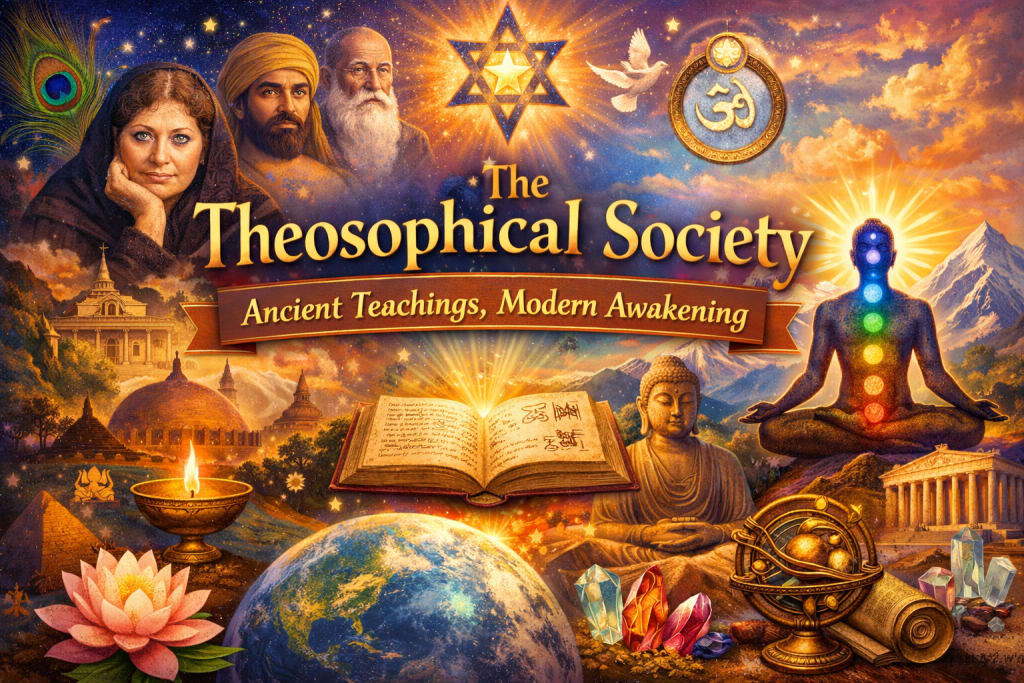
A Convergence of Worlds: The Birth of the Theosophical Society
Spiritual history during the nineteenth century reveals an era shaped by collision as much as by discovery. Industrial expansion transformed labor, cities, and social structures across Europe and North America. Railways, telegraphs, and mechanized production compressed distance and accelerated communication. Scientific advances challenged inherited cosmologies. Geological research extended the age of the Earth beyond biblical chronologies. Evolutionary theory, popularized by Charles Darwin, reframed humanity’s place in nature. Astronomy expanded the scale of the universe. Chemistry and physics advanced material explanations for phenomena once attributed to divine agency. Established religious institutions confronted growing skepticism among intellectual circles and the rising middle class.
Simultaneously, interest in mysticism and the unseen intensified rather than declined. Spiritualism drew widespread attention in Britain and the United States. Séances, trance mediums, and psychical research societies attracted both curiosity and criticism. Esoteric revival movements reintroduced Hermeticism, Neoplatonism, Rosicrucian symbolism, and Kabbalistic study into public discourse. Translations of Asian scriptures expanded Western exposure to Hindu, Buddhist, and Taoist philosophy. Sacred texts such as the Upanishads and the Bhagavad Gita circulated among scholars, reformers, and seekers. Intellectual culture entered a phase defined not by secularization alone but by experimentation across spiritual frameworks.
Within this atmosphere of scientific progress and metaphysical inquiry, an organization emerged that sought synthesis rather than opposition. In 1875, in New York City, The Theosophical Society took formal shape. Founding figures included Russian émigré occultist Helena Petrovna Blavatsky, American lawyer and reformer Henry Steel Olcott, and Irish-born attorney William Quan Judge. Early meetings gathered in Manhattan drawing rooms and lecture halls where discussions ranged from Eastern metaphysics to Western esotericism and emerging scientific theory.
The Society articulated three declared objectives that remain foundational. First, formation of a nucleus of the universal brotherhood of humanity without distinction of race, creed, sex, caste, or color. Second, encouragement of comparative study in religion, philosophy, and science. Third, investigation of unexplained laws of nature and latent human capacities. Such aims reflected both Enlightenment universalism and Romantic fascination with hidden knowledge.
Central to Theosophical thought stood the proposition of a primordial wisdom tradition. Founders argued that every major religion preserved fragments of an ancient metaphysical source. Hindu Vedanta, Mahayana Buddhism, Gnosticism, Neoplatonism, and Hermetic philosophy entered comparative analysis. Karma, reincarnation, cyclic cosmology, and spiritual evolution became recurring themes in lectures and publications. Blavatsky’s major works, Isis Unveiled (1877) and The Secret Doctrine (1888), attempted large-scale syntheses of religion, science, and occult cosmology, drawing both devoted readership and sustained scholarly criticism.
Institutional growth followed rapidly. Headquarters relocated to Adyar, near Madras, India, in 1882, establishing a durable administrative and symbolic center. Expansion spread through South Asia, Europe, Australia, and the Americas. Lodges formed in urban intellectual centers as well as colonial port cities. Educational initiatives, publishing houses, and lecture circuits extended influence beyond membership rolls.
Cultural impact reached unexpected domains. Theosophical symbolism and metaphysics influenced painters and abstract artists seeking spiritual dimensions in form and color. Writers and poets engaged themes of hidden masters, cosmic evolution, and universal unity. Reform movements in India and Sri Lanka intersected with Theosophical advocacy for religious revival and educational development. Interfaith dialogue gained institutional structure decades before such exchanges became commonplace in global forums.
Controversy accompanied expansion. Critics challenged claims regarding occult phenomena, hidden adepts, and esoteric transmissions. Internal disputes over authority and doctrine produced organizational fractures, most notably following Blavatsky’s death in 1891. Leadership struggles and interpretive disagreements generated parallel Theosophical bodies that persist into the present.
More than a century after its founding, the Theosophical movement remains a subject of historical, religious, and cultural study. Examination of origins, philosophical architecture, leadership dynamics, achievements, schisms, and artistic influence reveals an organization shaped by ambition, idealism, conflict, and enduring global reach.
New York Origins and the Founding Vision
On 17 November 1875, a small but consequential gathering in New York City formalized the creation of the Theosophical Society, an organization that would become one of the most influential bridges between Western esotericism and Asian religious philosophy in the modern era. The meeting did not arise in isolation. It followed months of parlor discussions, public lectures, and private correspondence among individuals already engaged in Spiritualism, occult research, and comparative religion.
The immediate catalyst was a lecture delivered by inventor and occult enthusiast George Henry Felt, who spoke on Egyptian esoteric symbolism and alleged hidden forces underlying ancient architectural systems. While Felt’s claims themselves generated mixed reactions, the lecture energized attendees who felt that existing Spiritualist circles lacked philosophical depth and organizational cohesion. Conversations following the event turned toward forming a structured body dedicated not merely to séance phenomena but to systematic study of hidden traditions and metaphysical philosophy.
Founding Figures and Organizational Structure
Three individuals emerged as the central architects of the Society’s early identity.
Helena Petrovna Blavatsky, a Russian émigré already known in transatlantic occult circles, brought a formidable and often controversial reputation. She claimed extensive travel through the Middle East, Tibet, and India, and presented herself as a conduit for esoteric teachings preserved by advanced adepts. Her writings and lectures drew from Neoplatonism, Hermeticism, Kabbalah, and South Asian religious texts. Whether viewed as mystic, synthesizer, or myth-maker, her intellectual force shaped the Society’s philosophical direction.
Henry Steel Olcott, an American Civil War veteran, agricultural reformer, and attorney, contributed institutional credibility. Before his involvement in Theosophy, Olcott had investigated Spiritualist claims with a quasi-journalistic rigor, gaining recognition for attempting to evaluate paranormal phenomena through observation rather than blind belief. As the Society’s first president, he provided administrative structure, public advocacy, and organizational discipline.
William Quan Judge, an Irish-born lawyer who emigrated to the United States as a child, became the movement’s stabilizing strategist. Judge handled legal matters, coordinated publications, and later played a decisive role in sustaining Theosophical activity in America, particularly after leadership shifted operational focus to India.
The Three Declared Objects
The founding charter articulated three core objectives, referred to within Theosophical literature as the Society’s “Three Objects.” These remain foundational across contemporary lodges and international sections.
Formation of a nucleus of universal brotherhood without distinction of race, creed, sex, caste, or color
Within the social framework of the late nineteenth century, this declaration carried profound implications. The period was shaped by imperial expansion, scientific racism, rigid class stratification, and legally enforced segregation in parts of the United States. By asserting a spiritual unity underlying humanity, the Society positioned itself, at least ideologically, against prevailing hierarchies. The language anticipated later interfaith dialogue movements and human rights discourse that would gain institutional footing in the twentieth century.
Encouragement of the comparative study of religion, philosophy, and science
Comparative inquiry formed the intellectual backbone of early Theosophical work. Texts from Hindu Vedānta, Mahāyāna Buddhism, Zoroastrian cosmology, Gnostic Christianity, and Greek philosophy were examined side by side. Rather than framing science and spirituality as adversaries, early lecturers attempted synthesis. Evolutionary theory, mesmerism, electricity, and emerging psychological theories were discussed alongside karma, cyclic cosmology, and metaphysical anthropology.
Public lectures and Society journals, most notably The Theosophist founded in 1879, served as platforms for this interdisciplinary exchange.
Investigation of unexplained laws of nature and latent powers within humanity
This objective reflected widespread nineteenth-century fascination with unseen forces. Mesmerism, clairvoyance, trance mediumship, telepathy, and psychometry were studied not only in séance rooms but also within emerging psychical research societies in Britain and America. Theosophists differed in that they framed such phenomena within a broader spiritual evolution of humanity, proposing that psychic faculties represented undeveloped capacities rather than supernatural anomalies.
Membership and Intellectual Climate
Early meetings drew an eclectic mix. Spiritualist mediums sat alongside physicians curious about trance states. Orientalist scholars debated Sanskrit texts with freethinkers disillusioned by orthodox Christianity. Artists, social reformers, and journalists contributed to study circles that blended philosophical debate with experiential experimentation.
A shared dissatisfaction with strictly materialist interpretations of existence unified many participants. Concepts such as reincarnation, karma, subtle bodies, and multidimensional planes of consciousness distinguished Theosophical discourse from both church doctrine and conventional Spiritualism, which often focused more narrowly on communication with the deceased.
Expansion Toward India
By the late 1870s, Blavatsky and Olcott concluded that deeper engagement with Asian religious traditions required geographic relocation. In 1879, they transferred the Society’s operational headquarters to Bombay, now Mumbai. The move marked a turning point. Theosophy shifted from a largely Western esoteric circle into a cross-cultural reform movement interacting directly with Hindu and Buddhist communities.
Olcott became particularly active in the Buddhist educational revival in Ceylon, present-day Sri Lanka, helping establish schools and advocating for Buddhist civil rights under colonial rule. Translation projects, lecture tours, and alliances with Indian religious reformers expanded the Society’s regional influence.
Establishment of Adyar Headquarters
In 1882, the Society secured a permanent international headquarters at Adyar, near Madras, now Chennai. The Adyar estate evolved into far more than an administrative office. It housed printing presses, lecture halls, meditation spaces, botanical grounds, and eventually one of the most significant esoteric libraries in the world.
From this campus, correspondence, journals, and monographs circulated globally, linking lodges across Europe, the Americas, and Asia. Adyar became both symbolic and operational center, a physical anchor for a movement defined by transnational intellectual exchange.
Enduring Legacy of the Founding Era
Adyar remains the international headquarters of the Theosophical Society today. Its archives preserve letters, early charters, annotated manuscripts, and publications that document the Society’s transformation from a New York discussion circle into a worldwide spiritual network.
The founding vision, universal brotherhood, comparative inquiry, and exploration of human potential, continues to shape contemporary Theosophical study. Whether approached as religious philosophy, esoteric tradition, or intellectual history, the Society’s New York origins represent a pivotal moment in the globalization of spiritual ideas at the dawn of the modern age.
Blavatsky and the Architecture of Ancient Wisdom
Helena Petrovna Blavatsky, born in 1831 in Yekaterinoslav within the Russian Empire, emerged as the principal architect of Theosophical doctrine and one of the most polarizing esoteric figures of the nineteenth century. Aristocratic lineage, early exposure to European intellectual culture, and immersion in mystical literature shaped formative development. Family connections to military and administrative elites enabled access to libraries, travel networks, and multilingual education that later informed comparative religious study.
Extensive travel narratives formed a central component of Blavatsky’s public identity. Journeys across Europe, the Balkans, Egypt, the Levant, and India contributed to familiarity with initiatory traditions, occult fraternities, and monastic communities. Some travel accounts remain historically verified through passports, ship records, and correspondence. Other episodes, particularly journeys into Tibet and Central Asia, remain subjects of scholarly dispute. Within Theosophical literature, such travels symbolized transmission of esoteric knowledge rather than conventional exploration.
Blavatsky asserted sustained contact with advanced spiritual adepts identified as Mahatmas or Masters. Figures such as Mahatma Morya and Koot Hoomi appeared in letters and instructional material circulated among early members. According to teachings presented through lectures and private correspondence, such adepts functioned as custodians of a primordial wisdom tradition predating recorded civilization. This tradition, often termed the Ancient Wisdom or Secret Doctrine, allegedly preserved metaphysical laws governing cosmic evolution and human spiritual development.
Two monumental publications established Blavatsky’s global reputation and enduring controversy.
Isis Unveiled, published in 1877, presented a two-volume critique of institutional religion and reductionist material science. Textual analysis drew from Hermetic writings, Neoplatonism, early Christian Gnosticism, and Eastern scripture. Blavatsky argued that theological dogma obscured symbolic truths while scientific orthodoxy dismissed nonmaterial dimensions of existence. The work gained wide readership in Spiritualist and esoteric circles, though academic critics challenged sourcing methods and evidentiary claims.
The Secret Doctrine, released in 1888, advanced a far more expansive cosmological framework. Structured around commentary on the enigmatic Stanzas of Dzyan, the text outlined a cyclical universe governed by periodic manifestation and dissolution. Cosmogenesis and anthropogenesis unfolded through vast evolutionary epochs termed Root Races. Doctrinal synthesis integrated Hindu cosmology, Buddhist metaphysics, Kabbalistic emanationism, and Western occult correspondences. Reincarnation and karma operated as ethical and evolutionary mechanisms guiding consciousness across lifetimes. Hierarchical planes of existence described gradations of material and subtle reality extending beyond sensory perception.
Despite authoritative tone, Blavatsky consistently rejected enforced belief. Personal letters and instructional papers emphasized independent verification, comparative study, and philosophical skepticism. Freedom of thought functioned as an institutional safeguard against sectarian rigidity. Acceptance of doctrine remained voluntary rather than compulsory. Such intellectual autonomy distinguished Theosophical culture from revivalist sects and charismatic devotional movements common during the same period.
Blavatsky’s legacy continues to generate divided assessment. Admirers credit restoration of cross-cultural metaphysical dialogue and introduction of karma and reincarnation into Western discourse. Critics cite issues of textual borrowing, unverifiable adepts, and internal inconsistencies. Regardless of interpretive stance, architectural influence on Theosophical philosophy, esoteric revival currents, and modern Western spirituality remains historically substantial.
Olcott and the Institutional Foundations of a Global Movement
Henry Steel Olcott, born in 1832 in Orange, New Jersey, supplied the administrative architecture that transformed early Theosophical enthusiasm into a durable international organization. Legal training, investigative journalism, and military service during the American Civil War cultivated procedural discipline and public credibility. Service as a special commissioner investigating military corruption for the U.S. government further refined organizational rigor and evidentiary method.
Prior to involvement with Theosophy, Olcott gained public visibility through agricultural reform writing and editorial work. Interest in Spiritualist phenomena during the late nineteenth-century occult revival brought association with investigative circles examining mediumship, séance manifestations, and psychical claims. Collaboration with Helena Petrovna Blavatsky emerged from such investigations, eventually culminating in cofounding leadership within the Society.
Relocation to South Asia marked a decisive institutional transition. In 1879, Olcott and Blavatsky established operational headquarters in Bombay, positioning the Society within direct proximity to living Hindu and Buddhist traditions rather than relying solely upon translated texts. Diplomatic engagement with religious leaders, monastic orders, and reform associations strengthened regional legitimacy.
Work in Ceylon, present-day Sri Lanka, produced lasting educational and religious impact. Under British colonial administration, Christian missionary schooling dominated formal education, often marginalizing Buddhist identity. Olcott collaborated with Sinhalese reformers to establish Buddhist schools designed to provide modern education grounded in indigenous religious culture. Institutions such as Ananda College in Colombo and Dharmaraja College in Kandy emerged from this revival framework. Educational initiatives combined curriculum development, textbook production, and teacher training.
Olcott also authored The Buddhist Catechism in 1881, a concise doctrinal manual structured in question-and-answer format. The text sought to present Buddhist philosophy in systematic form accessible to both Asian students and Western readers. Translation into multiple languages extended influence across Buddhist educational networks. Ceremonial participation in the public affirmation of Buddhist lay identity further strengthened symbolic alignment with regional revival movements.
In 1882, international headquarters relocated permanently to Adyar, near Madras, now Chennai. Administrative consolidation at Adyar enabled coordinated publication, membership registration, archival preservation, and global correspondence. Estate grounds developed into a spiritual, educational, and diplomatic center hosting lectures, interreligious dialogue, and visiting scholars.
Olcott served as President of the Society from 1875 until death in 1907. Leadership style contrasted visionary metaphysics with procedural stability. Constitutional frameworks, lodge charters, financial oversight, and international travel sustained organizational coherence during periods of doctrinal controversy and leadership dispute.
Under Olcott’s presidency, lodges proliferated across Europe, North America, India, Australia, and Southeast Asia. Expansion reflected both missionary enthusiasm and localized adaptation. Institutional durability owed much to administrative infrastructure, educational outreach, and diplomatic engagement cultivated throughout Olcott’s three-decade tenure.
Judge and the American Expansion
William Quan Judge, born in Dublin in 1851, carried Theosophical development into the American cultural and organizational landscape. Emigration to the United States during youth led to legal training in New York and eventual citizenship. Professional experience as an attorney contributed procedural knowledge that later proved essential in lodge formation, publishing contracts, and institutional governance.
Judge participated in the original 1875 founding circle of The Theosophical Society and remained one of the most active early organizers in North America. Lecture tours across major American cities introduced Theosophical philosophy to audiences already familiar with Spiritualism, Transcendentalism, and comparative religion. Public speaking style emphasized practical mysticism rather than abstract cosmology, often focusing on karma, reincarnation, ethical development, and the latent spiritual capacities of humanity.
Editorial work formed a major component of Judge’s influence. Founding and editing The Path magazine in 1886 created a sustained American publishing platform for Theosophical study. Articles addressed metaphysics, symbolism, meditation, ethical living, and commentary on Eastern scripture. Serialized essays, correspondence columns, and instructional pieces helped cultivate a coherent intellectual community across geographically dispersed lodges. Printed literature allowed teachings to circulate beyond lecture halls into private study circles and home libraries.
Judge also encouraged the formation of study groups that blended philosophical reading with meditative practice and ethical self-discipline. American lodges under this model often functioned less as ceremonial bodies and more as educational fellowships. Emphasis on individual spiritual effort resonated with broader American religious individualism rooted in Transcendentalist and reformist traditions.
Following the death of Helena Petrovna Blavatsky in 1891, leadership cohesion within the international Society weakened. Questions emerged regarding doctrinal authority, administrative succession, and authenticity of communications attributed to the Mahatmas. Judge faced accusations from officials aligned with the Adyar headquarters concerning alleged fabrication or misrepresentation of such communications.
Investigative committees convened, correspondence circulated, and internal proceedings unfolded across several years. Although formal condemnation remained ambiguous, institutional trust fractured. By 1895, the American Section under Judge’s leadership declared organizational autonomy, separating from the Adyar administration headquartered in India.
From this division emerged multiple Theosophical bodies, each asserting fidelity to original principles while diverging in governance and interpretive emphasis. The organization later known as the Theosophical Society in America traced institutional lineage through Judge’s branch, while Adyar retained international administrative continuity. Additional offshoots developed in subsequent decades, reflecting ongoing interpretive plurality within the movement.
Fragmentation revealed structural tension between charismatic transmission and institutional regulation. Claims regarding guidance from unseen adepts intensified both devotion and skepticism. Public disputes, legal challenges, and editorial rebuttals at times overshadowed philosophical discourse. Yet organizational multiplication also extended geographic reach, diversified publishing output, and sustained public visibility.
American Theosophy under Judge’s stewardship cultivated a distinctive identity shaped by legal structure, publishing networks, and emphasis on practical spirituality. Despite controversy, foundational work in lodge formation, literature dissemination, and educational programming secured a lasting role in the early global expansion of the Theosophical movement.
The Three Objects: Doctrine, Reform, and Inquiry
From the moment of formal establishment, The Theosophical Society defined institutional purpose through three declared Objects. These principles functioned not as abstract mission statements but as operational directives shaping membership policy, educational programming, publishing activity, and cross-cultural engagement. Each Object reflected specific historical pressures present during the late nineteenth century, an era marked by imperial expansion, scientific upheaval, and religious reexamination.
Universal Brotherhood in a Stratified World
The first Object called for formation of a nucleus of universal brotherhood without distinction of race, creed, sex, caste, or color. Within the social climate of the 1870s, such language represented structural dissent rather than rhetorical idealism. European colonial administrations governed vast populations across Asia and Africa through racial hierarchy. Segregation, caste exclusion, and gender disenfranchisement shaped civic life in both colonized and industrial societies.
Theosophical lodges adopted open membership policies that contrasted sharply with prevailing norms. Hindu scholars, Buddhist reformers, European intellectuals, and American spiritual seekers participated within shared study environments. Cross-cultural exchange occurred not as anthropological observation but as philosophical collaboration.
Women occupied leadership roles rarely accessible within contemporary religious institutions. Annie Besant emerged as the most prominent example. A British social reformer, orator, and former secularist activist, Besant joined the Society in 1889 and rose rapidly through organizational ranks. Election to international presidency in 1907 marked a historic moment in global religious leadership, placing a woman at the helm of a transnational spiritual institution. Advocacy extended beyond Theosophy into Indian educational reform and political self-determination movements, reinforcing the Society’s alignment with broader human rights discourse.
Comparative Study as Intellectual Method
The second Object encouraged comparative study of religion, philosophy, and science. This directive institutionalized interdisciplinary analysis decades before comparative religion achieved academic standardization within universities.
Lecture programs and study curricula examined Hindu Upanishadic metaphysics, Buddhist sutra literature, Christian mystical theology, Neoplatonic emanationism, and esoteric currents such as Rosicrucianism and Hermeticism. Greek philosophical texts appeared alongside Sanskrit scripture. Kabbalistic cosmology entered dialogue with Buddhist theories of consciousness. Translation projects and publishing initiatives expanded access to Asian religious texts previously confined to specialist scholarship.
Scientific developments also entered discussion. Evolutionary theory, electromagnetic research, and early psychology informed Theosophical interpretations of cosmic and human development. Rather than rejecting science, lecturers frequently framed scientific discovery as partial confirmation of ancient metaphysical principles. This integrative approach attracted educators, physicians, and intellectual reformers seeking synthesis rather than conflict between laboratory research and spiritual philosophy.
Investigating Hidden Laws and Human Potential
The third Object focused on investigation of unexplained laws of nature and latent powers within humanity. This mandate aligned with widespread nineteenth-century fascination with mesmerism, trance states, mediumship, and psychical research.
Society circles examined clairvoyance, telepathic communication, precognitive dreams, and altered states of consciousness. Meditation, concentration practices, and ethical discipline were sometimes presented as methods for awakening dormant faculties. Interest extended beyond spectacle into philosophical implications regarding mind, matter, and consciousness.
Such investigations invited sustained criticism. Skeptics challenged evidentiary standards, exposed fraudulent mediums, and questioned claims surrounding occult phenomena. Psychical research organizations in Britain and the United States pursued parallel inquiries using experimental controls, often reaching more cautious conclusions.
Supporters within Theosophical ranks argued that scientific materialism prematurely dismissed experiential data that fell outside conventional instrumentation. Openness to anomalous phenomena, in this view, represented intellectual courage rather than credulity. Debate between empiricism and esotericism became a defining tension shaping both the Society’s public reputation and internal discourse.
Taken together, the Three Objects formed an integrated philosophical framework. Universal brotherhood addressed social ethics. Comparative study advanced intellectual synthesis. Investigation of hidden laws pursued experiential and metaphysical knowledge. This triadic structure enabled the Society to function simultaneously as reform movement, educational network, and esoteric research body within the evolving spiritual landscape of the modern world.
Core Doctrines of Theosophical Philosophy
Doctrinal structure within The Theosophical Society developed through lectures, correspondence, and major texts authored by leading figures, most notably Helena Petrovna Blavatsky. Rather than a fixed creed, Theosophical philosophy emerged as a synthetic framework drawing upon Hindu metaphysics, Buddhist cosmology, Neoplatonic emanationism, Gnostic theology, and Western esoteric symbolism. Recurring principles formed a conceptual foundation that guided study, meditation, ethical reflection, and comparative inquiry.
Unity of All Life
At the center of Theosophical metaphysics stands the proposition of an indivisible, boundless reality underlying all manifestation. This absolute principle, sometimes termed the One Life or the Absolute, transcends personal deity imagery while encompassing all existence. Matter, consciousness, and energy represent differentiated expressions of this singular source.
Multiplicity within the observable universe does not imply separation. Diversity reflects gradations of manifestation rather than fragmentation of essence. Human, animal, planetary, and cosmic life participate within an interconnected field of being. Ethical implications follow metaphysical unity. Harm directed toward others ultimately reverberates within the same universal continuum.
Philosophical parallels appear in Advaita Vedanta’s nondual Brahman, Mahayana Buddhism’s interdependent origination, and Neoplatonic conceptions of the One. Theosophical literature reframed these traditions within a comparative metaphysical vocabulary accessible to Western audiences.
Law of Karma
Karma functions as the governing law of moral causation. Actions, intentions, and thoughts generate consequences that unfold across temporal duration extending beyond a single lifetime. Rather than divine reward or punishment administered externally, karmic process operates as an impersonal balancing mechanism embedded within cosmic order.
Ethical responsibility therefore acquires longitudinal depth. Present circumstances reflect accumulated causal patterns shaped by prior choices. Future conditions emerge from current conduct. Social injustice, personal suffering, and collective upheaval receive interpretation not as arbitrary misfortune but as expressions of complex causal interdependence.
Theosophical teaching emphasized neither fatalism nor predestination. Conscious choice retains transformative capacity. Spiritual discipline, altruistic service, and ethical refinement modify karmic trajectory over time.
Reincarnation
Reincarnation provides the developmental framework through which karma unfolds. Human consciousness, understood as an evolving spiritual individuality rather than a single earthly personality, undergoes successive embodiments across historical periods and cultural environments.
Each lifetime offers conditions suited to continued moral, intellectual, and spiritual maturation. Talents, affinities, and psychological tendencies derive from prior developmental stages. Education of consciousness proceeds gradually, comparable to long-term evolutionary cultivation rather than instantaneous salvation.
This doctrine introduced cyclic views of human development into Western discourse long dominated by single-life theological anthropology. Reincarnation gained increasing philosophical and literary visibility in Europe and North America following Theosophical publication and lecture activity.
Cyclical Evolution
Cosmic and civilizational processes unfold through vast recurring cycles. Theosophical cosmology describes alternating periods of manifestation and dissolution governing galaxies, planetary systems, and human cultures. Creation does not occur as a singular historical event but as rhythmic emanation.
Civilizations arise, achieve technological and spiritual advancement, decline, and disappear. Esoteric knowledge emerges, becomes obscured, and later reappears in renewed form. Such cyclical models drew from Hindu yuga theory, Buddhist kalpa cosmology, and classical Stoic and Platonic world cycles.
Human spiritual evolution parallels cosmic rhythm. Progress occurs across immense temporal scales measured not in centuries but in geological and planetary epochs.
Hierarchy of Being
Existence encompasses multiple interpenetrating planes ranging from dense physical matter to increasingly subtle energetic and spiritual states. Theosophical literature commonly describes physical, astral, mental, buddhic, and higher spiritual planes, each governed by distinct vibrational properties and forms of consciousness.
Humanity occupies an intermediate evolutionary position. Below lie elemental and instinctual life forms. Above exist advanced intelligences, sometimes identified within Theosophical writings as adepts, bodhisattvas, or planetary guardians. Such hierarchical structuring reflects Neoplatonic chains of being, Buddhist cosmological realms, and Western occult correspondences.
Spiritual development entails progressive refinement of consciousness enabling perception beyond sensory limitation. Meditation, ethical purification, and disciplined study function as preparatory methods for expanded awareness.
Doctrinal synthesis rather than dogmatic uniformity characterized Theosophical presentation. Interpretive flexibility allowed adaptation across cultural and intellectual environments. Divergent emphases among leaders and national sections later contributed to philosophical variation and organizational fragmentation. Despite such diversity, core principles of unity, moral causation, spiritual evolution, cyclic cosmology, and multidimensional existence remained enduring pillars within Theosophical thought.
Besant and Twentieth Century Expansion
Annie Besant, born in London in 1847, entered the Theosophical movement in 1889 and rapidly emerged as one of its most influential public voices. Earlier life included involvement in secularism, labor activism, women’s rights advocacy, and educational reform. Association with the National Secular Society and collaboration with freethought leader Charles Bradlaugh established public reputation as a formidable lecturer and social critic before transition into Theosophical work.
Oratorical command, editorial experience, and organizational discipline reshaped the Society’s public presence during the late nineteenth and early twentieth centuries. Lecture tours across Britain, continental Europe, India, Australia, and the United States introduced Theosophical philosophy to mass audiences rather than exclusively private study circles. Public addresses examined reincarnation, karma, spiritual evolution, and comparative religion within a framework accessible to both academic and general listeners.
Following the death of Henry Steel Olcott in 1907, Besant assumed international presidency of The Theosophical Society. Election marked a historic transition in leadership, placing administrative authority, publishing oversight, and global coordination under Besant’s direction. Presidential tenure coincided with institutional consolidation, expansion of national sections, and increased visibility within educational and political reform movements.
Educational initiatives formed a cornerstone of Besant’s work in India. In 1898, collaboration with Indian reformers led to the founding of the Central Hindu College in Benares, designed to integrate modern scientific curriculum with Hindu philosophical instruction. The institution later contributed structural foundation to Banaras Hindu University, formally established in 1916 under the leadership of Pandit Madan Mohan Malaviya. The university developed into one of India’s largest centers of higher education, reflecting Besant’s commitment to intellectual synthesis between Eastern tradition and modern academic structure.
Political engagement accompanied educational reform. Besant became an active advocate for Indian self-governance during British colonial rule. Leadership within the Indian Home Rule movement included presidency of the Home Rule League and editorial work in nationalist publications. Advocacy called for constitutional self-administration within the British Empire, drawing inspiration from Irish Home Rule campaigns. Political activism resulted in brief internment by colonial authorities in 1917, an action that intensified public support and elevated Besant’s national profile.
Institutional growth accelerated during Besant’s presidency. Membership expanded across Europe, India, Southeast Asia, and Australasia. Lecture circuits, publishing houses, and educational trusts broadened Theosophical influence beyond metaphysical study into civic and cultural reform.
Collaboration with Charles Webster Leadbeater introduced additional doctrinal developments centered on clairvoyant investigation of subtle anatomy and consciousness. Joint publications explored auric fields, chakras, and gradations of mental and emotional energy. One of the most widely circulated works, Thought-Forms, presented visual interpretations of emotions, musical tones, and mental states through symbolic color and geometric structure. Illustrative plates depicted anger, devotion, intellect, and compassion as energetic configurations perceptible to trained clairvoyant perception.
Such material attracted both fascination and skepticism. Supporters viewed clairvoyant research as extension of the Society’s Third Object concerning latent human capacities. Critics questioned evidentiary methodology and symbolic subjectivity. Debate surrounding Leadbeater’s teachings contributed to ongoing doctrinal diversity within international branches.
Despite controversy, Besant’s presidency marked one of the most expansive periods in Theosophical history. Educational institution building, political advocacy, publishing growth, and global lecturing established a public legacy extending beyond esoteric philosophy into social reform and national self-determination movements.
Krishnamurti and the World Teacher Movement
Few episodes within the history of The Theosophical Society generated as much anticipation, devotion, and eventual upheaval as the rise of Jiddu Krishnamurti and the formation of the Order of the Star in the East. This movement unfolded during the early twentieth century against a backdrop of messianic expectation present within several Theosophical circles, particularly those influenced by clairvoyant investigations into spiritual hierarchy and planetary evolution.
Krishnamurti was born in 1895 in Madanapalle, South India, into a Telugu Brahmin family connected to colonial administrative service. In 1909, while residing near the Adyar international headquarters, Krishnamurti came to the attention of Charles Webster Leadbeater. Leadbeater later described the boy’s aura as unusually luminous and free from selfish distortion, an assessment that led to the belief that Krishnamurti could serve as a future vehicle for the anticipated World Teacher, a messianic instructor expected in certain Theosophical prophetic interpretations.
Under the patronage of Annie Besant, legal guardianship of Krishnamurti and younger brother Nityananda transferred to Theosophical oversight. Intensive educational preparation followed. Tutors, travel, philosophical training, and public exposure sought to prepare Krishnamurti for a global spiritual role. Western and Eastern religious texts formed part of the curriculum, alongside languages, literature, and public speaking instruction.
To organize growing international expectation, the Order of the Star in the East formed in 1911. The organization functioned as a preparatory body intended to gather individuals receptive to the coming Teacher’s message. Membership expanded rapidly across Europe, India, Australia, and the Americas. Star Camps, lecture tours, and publications promoted ethical purification, meditation, and spiritual readiness. Large annual gatherings, particularly in the Netherlands at Ommen, became focal points for devotional anticipation.
By the 1920s, Krishnamurti stood at the center of a vast spiritual expectation network supported by publishing houses, estates, and international membership structures. Yet philosophical transformation gradually reshaped personal outlook. Increasing discomfort with hierarchical authority, ritual veneration, and doctrinal expectation emerged in private talks and correspondence.
In August 1929, at the Ommen Star Camp in the Netherlands, Krishnamurti delivered a historic address dissolving the Order of the Star. Before thousands of members, Krishnamurti renounced the messianic role and rejected institutional mediation of spiritual truth. The speech articulated a principle that would echo throughout later teachings: truth cannot be organized into belief systems, sects, or hierarchical structures.
Dissolution dismantled property holdings, membership frameworks, and ceremonial functions associated with the Order. Supporters experienced shock, grief, and admiration in varying measure. Some interpreted the act as spiritual integrity carried to its logical conclusion. Others viewed the renunciation as destabilizing to decades of preparatory work within Theosophical leadership.
Following separation from formal Theosophical structure, Krishnamurti pursued an independent philosophical path spanning more than six decades. Public talks, dialogues, and writings emphasized choiceless awareness, psychological conditioning, fear, authority, and the nature of thought. Teaching rejected gurus, discipleship, and spiritual intermediaries in favor of direct perception grounded in self-observation.
Although institutional affiliation ended, formative association with Theosophical education, symbolism, and global networks shaped early visibility and access to international audiences. The World Teacher episode remains one of the most dramatic intersections of prophecy, charisma, and philosophical reversal within modern spiritual history.
Steiner and the Anthroposophical Break
Rudolf Steiner stands among the most intellectually influential figures to emerge from early association with The Theosophical Society. Born in 1861 in what was then the Austrian Empire, Steiner combined scientific training, philosophical scholarship, and esoteric study into a distinctive interpretive framework that would later crystallize as Anthroposophy.
Academic formation included work in mathematics, natural science, and philosophy. Editorial responsibility for the scientific writings of Johann Wolfgang von Goethe introduced Steiner to Goethean phenomenology, a method emphasizing direct perceptual engagement with living processes rather than reductionist analysis. Philosophical publications such as The Philosophy of Freedom articulated an epistemology grounded in conscious spiritual cognition rather than materialist determinism.
Steiner joined the Theosophical movement at the turn of the twentieth century and soon assumed leadership of the German Section. Lectures delivered across Berlin, Munich, and other European cultural centers attracted audiences interested in mysticism, Christianity, and esoteric cosmology. While early presentations engaged Theosophical themes such as reincarnation and karma, interpretive emphasis increasingly centered upon Western spiritual heritage, particularly Christian esotericism and Rosicrucian symbolism.
Tensions gradually developed between Steiner’s Christocentric esotericism and the more universalist, syncretic framework promoted by international leadership under Annie Besant and associates. The emerging World Teacher movement surrounding Jiddu Krishnamurti intensified doctrinal divergence. Steiner rejected identification of Krishnamurti as vehicle for a messianic figure, arguing that such expectations misunderstood both spiritual evolution and the historical uniqueness of the Christ event.
Doctrinal disagreement converged with administrative strain. By 1912, institutional separation had become inevitable. In 1913, Steiner formally established the Anthroposophical Society as an independent body headquartered initially in Germany and later in Dornach, Switzerland. Organizational autonomy allowed full development of a system Steiner termed Spiritual Science, intended to unite empirical rigor with clairvoyant perception cultivated through disciplined inner training.
Anthroposophy expanded beyond metaphysical discourse into applied cultural initiatives. Educational reform produced the first Waldorf School in Stuttgart in 1919, introducing developmental pedagogy integrating arts, imagination, and experiential learning. Waldorf education later spread internationally, forming one of the most visible legacies of Steiner’s work.
Agricultural experimentation led to biodynamic farming, a holistic approach treating soil, plant life, animal husbandry, and cosmic rhythms as an integrated ecological organism. Preparations, lunar cycles, and composting methods distinguished biodynamics from conventional industrial agriculture and influenced later organic farming movements.
Artistic innovation also formed a central pillar. Steiner developed eurythmy, a movement art expressing speech and music through choreographed gesture. Architectural design reached culmination in the Goetheanum, an organic sculptural structure in Dornach serving as an artistic and spiritual center for Anthroposophical activity.
Steiner’s departure illustrates interpretive diversity within modern esoteric revival movements. Theosophical philosophy functioned less as a closed doctrinal system and more as an incubator from which multiple spiritual, educational, and cultural currents emerged. Anthroposophy stands as one of the most institutionally developed expressions of that broader catalytic influence.
Artistic and Cultural Resonance
Philosophical currents associated with The Theosophical Society extended beyond metaphysical study into the formative language of modern art and literature. Doctrines concerning invisible planes, vibrational reality, symbolic correspondence, and spiritual evolution entered European cultural discourse at a moment when artists and writers sought alternatives to material realism. Theosophical publications, lecture circuits, and esoteric diagrams circulated widely in London, Paris, Munich, Amsterdam, and Stockholm, shaping an intellectual climate receptive to nonmaterial interpretation of form, color, and narrative.
Wassily Kandinsky engaged deeply with spiritual philosophy while developing abstraction. Study of esoteric literature, including writings by Helena Petrovna Blavatsky, informed Kandinsky’s belief that color possessed psychological and metaphysical force independent of representational imagery. The 1911 treatise Concerning the Spiritual in Art proposed that painting could function as a vehicle for inner awakening. Compositions abandoned landscape and figure in favor of chromatic vibration, rhythmic geometry, and symbolic movement intended to evoke states of consciousness rather than depict physical environments.
Hilma af Klint produced nonfigurative works even earlier. Beginning in 1906, af Klint created large-scale canvases guided by séance practice and symbolic instruction recorded during trance sessions. Visual language incorporated spirals, concentric diagrams, botanical symbolism, and color polarity representing cosmic evolution and metaphysical duality. Esoteric study groups in Stockholm, some influenced by Theosophical and related teachings, provided intellectual context for such experimentation. Posthumous exhibitions have since repositioned af Klint as a pioneering figure in abstract art shaped by spiritual cosmology.
Piet Mondrian also absorbed Theosophical philosophy during early twentieth-century development in the Netherlands. Engagement with metaphysical concepts contributed to gradual reduction of naturalistic imagery into rectilinear grids and primary color harmonies. Horizontal and vertical axes symbolized dynamic equilibrium within universal structure. Geometric abstraction functioned as an attempt to express spiritual order underlying visible reality rather than as purely formal innovation.
Literary culture reflected parallel influence. Poets and novelists working within Symbolist and occult revival movements incorporated themes of reincarnation, karmic continuity, hidden adepts, and cyclical time. Esoteric periodicals and lecture pamphlets circulated Theosophical vocabulary across reading publics in Britain, France, and the United States. Fictional narratives explored astral travel, spiritual initiation, and civilizational cycles, blending imaginative literature with metaphysical speculation.
Cultural transmission operated through atmosphere rather than institutional directive. Theosophy did not prescribe artistic style or literary doctrine. Instead, philosophical emphasis on unseen dimensions, symbolic correspondence, and spiritual evolution encouraged creators to explore realities perceived beyond sensory appearance. Modern abstraction and metaphysical literature emerged within this broader intellectual environment shaped in part by Theosophical discourse.
Education, Scholarship, and Social Reform
Institutional activity within The Theosophical Society extended well beyond metaphysical teaching into education, textual preservation, publishing, and humanitarian engagement. Organizational leadership viewed intellectual development and social uplift as complementary expressions of spiritual philosophy rather than secondary concerns.
The international headquarters at Adyar, near Madras, evolved into a major intellectual and archival center following relocation from Bombay in 1882. Estate grounds housed lecture halls, residential quarters, botanical gardens, and administrative offices. Particular distinction emerged through development of the Adyar Library and Research Centre, established in 1886 under the guidance of Henry Steel Olcott. The library assembled an extensive collection of rare manuscripts, palm leaf texts, and early printed works in Sanskrit, Pali, Prakrit, Tibetan, and other classical languages.
Preservation initiatives focused on safeguarding philosophical and religious literature vulnerable to deterioration under colonial climatic conditions and shifting institutional priorities. Cataloguing, translation, and publication projects supported academic access to Hindu, Buddhist, and Jain scripture as well as comparative religious material. Scholars, monastics, linguists, and Orientalists utilized Adyar collections for research that contributed to the emerging academic fields of Indology and comparative religion.
Educational institution building formed another major initiative. Schools founded under Theosophical auspices sought integration of scientific curriculum with ethical and philosophical instruction drawn from global religious traditions. Instruction emphasized moral development, cross cultural literacy, and intellectual inquiry rather than sectarian doctrine. Work initiated by Annie Besant in Benares, including the establishment of the Central Hindu College, exemplified this educational synthesis and later contributed to the formation of Banaras Hindu University.
Publishing houses and journals amplified educational outreach. Periodicals circulated lectures, comparative scripture studies, philosophical essays, and translations. Printing operations in India, Britain, and the United States enabled global distribution of esoteric and religious scholarship otherwise confined to specialist circles. Such publishing networks played a significant role in introducing karma, reincarnation, and Buddhist philosophy to Western readership during the late nineteenth and early twentieth centuries.
Interfaith dialogue represented another forward-looking initiative. Conferences and lecture series hosted speakers from Hindu, Buddhist, Christian, Muslim, and Jewish traditions within shared forums. Emphasis rested upon ethical convergence, symbolic interpretation, and philosophical complementarity rather than doctrinal contestation. Such gatherings anticipated later ecumenical and interreligious movements that gained institutional form only in the mid twentieth century.
Leadership opportunities for women distinguished Theosophical organizational culture from many contemporary religious and academic institutions. The presidency of Annie Besant stands as the most visible example, yet female participation extended far beyond executive office. Women served as lodge founders, lecturers, editors, translators, and educational administrators. Contributions to journals, study curricula, and lecture circuits shaped doctrinal dissemination and institutional growth.
Through libraries, schools, publishing networks, and interfaith forums, Theosophical work translated metaphysical ideals into educational and social infrastructure. Intellectual preservation, comparative scholarship, and expanded leadership roles reflected a movement attempting to align spiritual philosophy with cultural and humanitarian development.
Contestation, Schism, and Public Scrutiny
Expansion of the Theosophical movement unfolded alongside persistent controversy. From the earliest decades, critics questioned the authenticity of communications attributed to hidden adepts or “Masters.” Reports describing precipitated letters, clairvoyant encounters, and occult transmissions attracted fascination within esoteric circles while provoking suspicion among journalists, missionaries, and scientific observers. The late nineteenth century climate, shaped by both Spiritualist enthusiasm and rising empirical skepticism, intensified public examination of extraordinary claims.
Formal investigations amplified the debate. The Society for Psychical Research conducted inquiries into phenomena associated with Helena Petrovna Blavatsky during the 1880s. The Hodgson Report, published in 1885, concluded that certain manifestations had been fabricated. Supporters of Blavatsky later challenged investigative methods, citing biased witnesses, cultural misunderstanding, and insufficient forensic standards. Subsequent reassessments by later researchers argued that earlier conclusions relied on flawed procedures, leaving the question historically contested rather than definitively settled.
Organizational conflict further complicated institutional cohesion. Divergent interpretations of doctrine, authority, and succession produced fractures following Blavatsky’s death in 1891. Leadership disputes emerged among prominent figures, each claiming continuity with foundational teachings. Separate administrative centers developed, most notably in Adyar, Pasadena, and later Point Loma. Property rights, publishing control, and use of the Society’s name occasionally entered legal arenas, transforming philosophical disagreement into formal litigation.
Doctrinal tensions also reflected broader cultural negotiations. Efforts to synthesize Hindu, Buddhist, Neoplatonic, and Hermetic traditions required interpretive translation across linguistic and symbolic systems. Critics argued that selective adaptation risked distorting source traditions. Defenders countered that comparative study fostered global spiritual literacy and mutual respect. Academic scholarship throughout the twentieth century situated Theosophy within Western esotericism while simultaneously acknowledging substantive engagement with South Asian religious philosophy.
Missionary institutions in colonial India voiced additional objections. Christian polemicists criticized Theosophical reinterpretations of karma, reincarnation, and Christology, viewing such syntheses as theological dilution. Conversely, segments of Indian intellectual society welcomed Theosophical defense of indigenous traditions against colonial dismissal. This dual reception underscored the movement’s complex position within imperial cultural politics.
Despite contention, historical impact remains substantial. Theosophy stimulated comparative religion, influenced emerging metaphysical movements, and contributed to the vocabulary of global spirituality. Debate, criticism, and institutional fragmentation did not extinguish influence. Instead, controversy became inseparable from the movement’s legacy, shaping both public perception and scholarly evaluation across subsequent generations.
Foundations of Contemporary Spiritual Thought
Theosophical literature and lecture circuits introduced a vocabulary that later became embedded within modern spiritual discourse. Concepts such as karma and reincarnation, long established within Hindu and Buddhist philosophical systems, entered Western metaphysical conversation through systematic exposition in Theosophical publications. Texts, study lodges, and public addresses translated Sanskrit and Pali terminology into accessible philosophical frameworks. This interpretive bridge allowed late nineteenth and early twentieth century audiences to engage cosmologies previously confined to specialist scholarship or missionary critique.
Subtle anatomy formed another area of transmission. Theosophical writers described multilayered human constitution composed of physical, astral, mental, and causal bodies. Chakras appeared not merely as symbolic motifs but as functional centers within an ऊर्जा based physiology. Diagrams circulated in journals and instructional manuals, shaping later esoteric healing systems. Twentieth century energy medicine, aura photography movements, and metaphysical healing schools drew heavily upon these early structural models.
Meditative discipline likewise gained broader cultural legitimacy through Theosophical advocacy. Instructional materials framed meditation as systematic inner observation rather than sectarian religious ritual. Emphasis on concentration, ethical refinement, and expansion of consciousness resonated with Western seekers navigating industrial modernity. By the mid twentieth century, contemplative practice entered psychology, comparative religion departments, and eventually clinical wellness environments.
Influence extended into the formation of New Age spirituality. Channeling traditions, ascended master teachings, planetary evolution narratives, and root race cosmologies echoed earlier Theosophical cosmogenesis. Book publishing networks and lecture tours created distribution pathways later utilized by metaphysical teachers, alternative healers, and consciousness researchers. Terminology shifted across decades, yet structural themes remained recognizable.
Ecological spirituality also reflects Theosophical metaphysics. Unity of life, interdependence of kingdoms, and evolutionary ascent of consciousness anticipated later environmental ethics. Nature appeared not as inert resource but as ensouled continuum participating in cosmic development. Such framing paralleled emerging conservation philosophies and informed spiritually grounded ecological activism.
Holistic health movements adopted complementary assumptions. Disease came to be interpreted within multidimensional frameworks involving emotional, karmic, and energetic factors. Therapeutic modalities including energy balancing, vibrational remedies, and integrative bodywork drew conceptual legitimacy from Theosophical subtle body theory. Medical pluralism expanded as practitioners explored intersections between spiritual causation and physiological manifestation.
Modern yoga culture likewise absorbed Theosophical mediation. While postural yoga developed through multiple lineages, Western reception often arrived filtered through esoteric interpretation rather than strictly traditional pedagogy. Chakra systems, kundalini ascent, and evolutionary consciousness narratives entered popular yoga literature through Theosophical and post Theosophical intermediaries.
Contemporary spirituality, characterized by synthesis rather than sectarian allegiance, bears enduring imprint of these transmissions. Philosophical pluralism, reincarnational ethics, meditative psychology, and energetic anatomy now circulate within mainstream wellness, publishing, and digital education spaces. Foundations laid within Theosophical discourse continue to shape global metaphysical imagination well into the twenty first century.
Global Organization and Contemporary Membership
Organizational continuity remains anchored at the international headquarters in Adyar, Chennai, where administrative, educational, and archival functions operate within an expansive estate along the Adyar River. Since relocation to India in 1882, Adyar has functioned not only as administrative center but also as symbolic heart of the movement’s East West synthesis. Governance operates through an elected international president supported by a general council composed of representatives from national sections.
Presence extends across more than sixty countries, with active sections throughout India, the United States, the United Kingdom, Australia, New Zealand, several European nations, and parts of Latin America and Southeast Asia. Each national section maintains constitutional autonomy while affirming commitment to the Society’s Three Objects: formation of a universal brotherhood of humanity without distinction, encouragement of comparative study of religion, philosophy, and science, and investigation of unexplained laws of nature alongside latent human capacities.
Local lodges form the living foundation of contemporary activity. Meeting formats vary according to cultural context yet commonly include structured study circles examining Theosophical texts, Upanishadic philosophy, Buddhist sutras, Platonic writings, and modern scientific cosmology. Meditation sessions, ethical discussion forums, and public lecture programs complement textual study. Visiting scholars, monastics, scientists, and interfaith leaders frequently participate in lodge programming.
Membership policy reflects longstanding commitment to intellectual freedom. No doctrinal oath, theological test, or required metaphysical belief governs admission. Individuals from diverse religious, philosophical, and secular backgrounds participate without expectation of conversion. Freedom of thought stands as operational principle rather than symbolic ideal, allowing internal diversity of interpretation regarding karma, cosmology, and spiritual practice.
International conventions convene annually or biennially, drawing delegates from multiple continents. Proceedings include keynote lectures, panel symposia, ritual observances, and cultural exchanges. Subject matter spans Vedic exegesis, early Buddhist psychology, Western esoteric history, quantum physics dialogue, ecological ethics, and contemplative neuroscience. Such gatherings reinforce transnational identity while fostering scholarly and experiential exchange.
Adyar’s research infrastructure continues to attract historians, philologists, and scholars of religion. The Adyar Library and Research Centre houses extensive manuscript collections in Sanskrit, Pali, Prakrit, Tamil, and other classical languages. Palm leaf manuscripts, rare printed editions, and early Theosophical journals remain accessible for academic study. Preservation initiatives include cataloguing, conservation, and selective digitization of fragile archival materials.
Publishing activity persists through international and sectional presses. Journals, monographs, lecture transcripts, and translation projects circulate both in print and digital formats. Contemporary themes include consciousness studies, ethics of technology, interreligious dialogue, and environmental philosophy interpreted through Theosophical frameworks.
Current membership reflects wide demographic range encompassing educators, scientists, artists, retirees, and students of comparative spirituality. Motivations for participation vary from philosophical inquiry to meditative discipline and historical research. Despite fluctuations in global membership numbers across decades, institutional continuity, educational outreach, and archival stewardship sustain active presence within modern esoteric and interfaith landscapes.
Recommended Reading: #commissionearned
A commemorative collection marking one hundred fifty years of Theosophical history gathers archival writings, institutional reflections, and interpretive essays into a unified historical record. Editorial arrangement follows the Society’s evolution from nineteenth century formation in New York to international presence centered in Adyar. Early circulars, presidential addresses, lodge reports, and rare documents illuminate administrative growth alongside philosophical development. Considerable attention rests on educational initiatives, interfaith engagement, and preservation of Asian religious texts within Theosophical libraries. Reproductions of photographs, charters, and correspondence offer material texture often absent from purely doctrinal works. Contributors examine shifts in interpretation surrounding karma, reincarnation, and esoteric cosmology across successive leadership eras. The volume functions both as institutional memory and as a reference framework for examining global spiritual exchange fostered through Theosophical networks.
Presented in dialogue format, the text answers foundational questions regarding ethics, metaphysics, and organizational purpose. Exchanges clarify misconceptions surrounding occult study, emphasizing moral discipline rather than spectacle. Detailed treatment of karmic causation, postmortem states, and reincarnational progress establishes a systematic philosophical structure. Comparative discussion contrasts Theosophical teachings with spiritualism, materialist science, and orthodox theology. Explanations of the Society’s Three Objects provide insight into educational and humanitarian priorities. Spiritual development appears inseparable from service to humanity and intellectual self cultivation. As an interpretive gateway, the manual outlines doctrinal architecture that informed lectures, study lodges, and publishing efforts across continents.
The Basis of the Theosophical Society by Annie Besant
Institutional philosophy receives concise yet penetrating analysis through a series of lectures later compiled into book form. Universal brotherhood emerges as operational mandate grounded in ethical responsibility rather than abstraction. Educational reform, social progress, and spiritual evolution appear interwoven within a single civilizational project. Comparative religion occupies central space, drawing parallels among Hindu, Buddhist, and Christian mystical traditions. Engagement with contemporary science, particularly evolutionary theory, reflects an effort to harmonize metaphysical and empirical inquiry. Organizational cohesion, intellectual freedom, and disciplined study appear as structural necessities for long term continuity. The work clarifies ideological foundations guiding early twentieth century expansion and reform initiatives.
A Primer of Theosophy by Theosophical Society
Structured for instructional use, the primer condenses complex metaphysical systems into accessible thematic lessons. Cosmology, human constitution, meditation, and ethical conduct unfold through carefully sequenced chapters. Terminology such as subtle bodies, planetary cycles, and karmic law receives clear definition supported by scriptural references. Historical sketches introduce major figures, institutional developments, and publication networks responsible for global dissemination. Comparative charts highlight philosophical parallels linking Eastern scriptures with Western esoteric traditions. Study questions encourage reflective engagement within lodge classrooms and independent reading groups. Educational intent remains evident throughout, bridging abstract doctrine with organized learning.
The Theosophical Society: The History of a Spiritualist Movement by Jeffrey D. Lavoie
Archival scholarship anchors this historical study within nineteenth century spiritualism and occult revival culture. Examination of séances, psychical investigations, and reform movements situates Theosophy within a broader metaphysical landscape. Leadership dynamics involving Blavatsky, Olcott, and subsequent figures receive detailed documentary analysis. Relocation to India emerges as transformative moment influencing East West intellectual exchange. Public controversies, investigative reports, and internal disputes appear within balanced historiographical framing. Institutional publishing, educational outreach, and comparative religion scholarship reveal multidimensional influence. Academic rigor makes the work valuable for historians of religion and esoteric studies alike.
The World of Theosophy: A Beginners Guide by Pablo D Sender PhD
Philosophical orientation blends historical overview with practical application, offering readers structured entry into Theosophical study. Intellectual roots trace through Neoplatonism, Vedanta, Buddhism, and Western esoteric philosophy. Sections addressing meditation, ethical living, and psychological transformation connect doctrine with lived experience. Diagrams illustrating planes of consciousness and subtle anatomy clarify abstract metaphysical models. Biographical profiles provide continuity across doctrinal exploration. Ecological awareness and contemporary spirituality receive interpretive integration within classical teachings. Educational clarity and thematic breadth make the guide suitable for both introductory and continuing study.
When Daylight Comes: Biography of Helena Petrovna Blavatsky by Howard Murphet
Extensive biographical research reconstructs the life trajectory of one of modern esotericism’s most influential figures. Travel narratives span Russia, Europe, the Middle East, India, and the United States, revealing formative encounters with mystics and scholars. Founding years of the Theosophical Society receive detailed narrative attention alongside publication history of major works. Personal resilience, intellectual intensity, and controversial public reception shape the portrait that emerges. Psychical investigations and skeptical critiques appear within documented historical context. Correspondence and eyewitness testimony provide depth beyond institutional records. The biography situates Blavatsky within the wider nineteenth century search for universal spiritual synthesis.
Madame Blavatsky: The Mother of Modern Spirituality by Gary Lachman
Cultural and intellectual history converge in an interpretive study examining Blavatsky’s enduring impact on modern spiritual thought. Analysis traces synthesis of Eastern metaphysics with Western occult traditions that reconfigured esoteric discourse. Influence extends into psychology, alternative religion, modern art, and depth philosophy. Reception history explores admiration, skepticism, and scholarly reassessment across generations. Close reading of major texts highlights cosmological vision and symbolic language. Critical engagement with controversies accompanies evaluation of philosophical legacy. The study positions Blavatsky’s contributions within the broader transformation of global spirituality during the modern era.
Philosophical Synthesis in an Age of Upheaval
Late nineteenth century intellectual life unfolded within a landscape shaped by accelerating scientific discovery and deepening theological uncertainty. Charles Darwin’s evolutionary theory challenged fixed cosmologies rooted in literalist scriptural interpretation. Geological time scales expanded humanity’s sense of planetary antiquity. Advances in physics, chemistry, and biology redefined matter, energy, and life itself. Industrialization reorganized labor, urbanized populations, and disrupted inherited social rhythms. Amid such transformation, confidence in mechanistic progress coexisted with existential unease. Many intellectual circles wrestled with questions concerning consciousness, morality, and the ultimate structure of reality.
Theosophy entered this environment not as rejection of science but as an attempt at enlargement. Evolutionary language appeared throughout Theosophical literature, though extended beyond biological adaptation into psychological and spiritual development. Humanity, within this framework, represented a transitional stage within a vast continuum of consciousness. Cycles of planetary and cosmic evolution paralleled geological and astronomical discourse while introducing metaphysical dimensions absent from laboratory observation. Such cosmology offered an interpretive bridge linking empirical discovery with spiritual teleology.
Karmic law provided ethical architecture within that expanded universe. Moral causation functioned not as divine reward or punishment but as intrinsic balance operating across extended temporal scales. Actions generated consequences shaping future conditions of embodiment and experience. Ethical responsibility therefore transcended social surveillance or institutional enforcement. Justice unfolded through universal process rather than external decree. For many readers, karmic philosophy addressed moral complexity without reliance on eternal damnation or arbitrary grace.
Reincarnation formed complementary doctrine within that ethical system. Successive embodiments allowed gradual refinement of character, intellect, and spiritual perception. Apparent inequalities of birth, talent, or circumstance received explanation through continuity of prior development rather than deterministic fate. Growth unfolded through effort, discipline, and insight accumulated across lifetimes. Educational, artistic, and humanitarian labor gained metaphysical significance as contributions to long term evolutionary ascent.
Universal brotherhood extended philosophical speculation into social ethics. Racial hierarchies, colonial domination, and sectarian hostility defined much of nineteenth century geopolitics. Theosophical teaching asserted shared spiritual origin underlying cultural and biological diversity. Brotherhood functioned not as sentimental slogan but as ontological claim regarding unity of life. Ethical obligation toward all humanity followed logically from that metaphysical premise. Interfaith dialogue, educational reform, and cross cultural scholarship emerged as practical expressions of philosophical commitment.
Appeal rested partly in capacity to harmonize rational inquiry with spiritual aspiration. Individuals disillusioned with dogmatic theology yet dissatisfied with reductive materialism encountered an integrative alternative. Symbolic cosmology, comparative religion, and ethical universalism combined into a worldview both expansive and systematic. Lecture circuits, study lodges, and publishing networks disseminated that synthesis across continents.
Criticism accompanied influence. Empirical scientists often regarded clairvoyant investigation and occult cosmology as unverifiable speculation. Some theologians viewed doctrinal eclecticism as dilution of sacred tradition. Debates concerning evidentiary standards, cultural appropriation, and interpretive authority persisted within academic and religious discourse. Admirers nevertheless recognized intellectual audacity in efforts to transcend sectarian limitation and disciplinary fragmentation.
Philosophical significance therefore resides not solely in specific doctrines but in methodological ambition. Integration of science, religion, ethics, and mysticism represented a distinctive response to modernity’s fractures. Theosophy sought coherence where many perceived irreconcilable division, offering a metaphysical map intended to situate humanity within an interconnected cosmic order.
Encounters with Hindu and Buddhist Thought
Sustained engagement with South Asian religious traditions formed one of the most consequential dimensions of Theosophical activity. Relocation of international headquarters to Adyar in the late nineteenth century placed organizational leadership in direct contact with Sanskrit scholarship, temple networks, and monastic communities. Study of the Upanishads, the Bhagavad Gita, Vedantic metaphysics, and classical Yoga philosophy entered regular lecture and publication circuits. Doctrines concerning karma, reincarnation, and liberation from cyclical existence found systematic exposition within Theosophical literature, often presented as components of a universal wisdom tradition rather than sectarian teachings.
Intellectual exchange unfolded alongside cultural and political transformation within colonized India. British imperial narratives frequently characterized Hindu traditions as superstitious or philosophically incoherent. Theosophical advocacy challenged such portrayals by emphasizing philosophical sophistication embedded within Vedanta, Samkhya, and Buddhist psychology. Public lectures, educational programs, and publishing initiatives encouraged renewed valuation of classical Indian texts among English educated audiences. Collaboration with Hindu reformers and educators contributed to broader currents of cultural self affirmation that accompanied emerging nationalist consciousness.
Parallel developments appeared in Ceylon, present day Sri Lanka, where Buddhist institutions faced missionary pressure and colonial marginalization. Educational reforms associated with Henry Steel Olcott supported establishment of Buddhist schools designed to preserve doctrinal literacy and cultural identity. Catechisms, textbooks, and organizational frameworks assisted revival of lay Buddhist education. Public defense of Buddhist philosophy in debates with Christian missionaries further elevated international awareness of Theravada traditions. Such initiatives aligned spiritual study with anti colonial cultural preservation.
Translation and commentary projects extended Asian philosophical concepts to Western readership. Theosophical presses circulated editions of the Dhammapada, the Bhagavad Gita, and various Mahayana texts accompanied by interpretive essays. Comparative frameworks linked Buddhist emptiness, Hindu non dualism, and Neoplatonic metaphysics within a shared symbolic vocabulary. Western audiences encountered meditation, ethical causation, and cyclical cosmology through accessible expository formats rarely available in earlier decades.
Interpretive adaptation, however, generated scholarly debate. Academic specialists in Indology and Buddhist studies have noted instances where complex doctrinal systems underwent simplification for comparative presentation. Esoteric cosmologies derived from Western occultism occasionally merged with South Asian metaphysics, producing hybrid explanatory models not fully aligned with classical sources. Concepts such as root races or planetary chains reflected nineteenth century esoteric speculation rather than orthodox Hindu or Buddhist teaching.
Questions of cultural translation remain central within contemporary evaluation. Some historians regard Theosophical engagement as catalyst for global recognition of Asian philosophical depth during an era of colonial condescension. Others emphasize asymmetries of power shaping interpretive authority, noting that Western esoteric frameworks sometimes reframed Eastern traditions through selective appropriation. Ongoing scholarship continues to examine correspondence, lecture transcripts, and translation methodologies to assess accuracy and influence.
Despite interpretive tensions, cross cultural exchange fostered enduring consequences. Interfaith dialogue, comparative religion scholarship, and modern global interest in meditation and yoga developed partly within intellectual pathways opened through Theosophical study networks. Engagement with Hindu and Buddhist thought thus represents both collaborative revival and contested reinterpretation within the broader history of modern spirituality.
Enduring Relevance in a Global Age
Contemporary spiritual discourse unfolds within conditions markedly different from the industrial societies that witnessed the birth of the Theosophical Society, yet several foundational themes retain striking continuity. Accelerated globalization has brought religious traditions, philosophical systems, and contemplative practices into unprecedented proximity. Intercultural dialogue now forms a central feature of academic, diplomatic, and humanitarian exchange. Within that environment, Theosophical emphasis on a shared wisdom heritage across civilizations continues to resonate with scholars, seekers, and interfaith leaders exploring common ethical and metaphysical ground.
Unity of life, articulated within Theosophical doctrine as both metaphysical principle and ethical mandate, aligns closely with present ecological consciousness. Environmental philosophy increasingly frames humanity not as separate from nature but as participant within an interconnected biosphere. Theosophical cosmology, with its vision of interdependent planes of existence and evolutionary continuity, anticipated holistic frameworks now appearing in systems theory, deep ecology, and environmental ethics. Moral responsibility toward planetary life reflects expansion of earlier brotherhood ideals beyond humanity alone.
Religious pluralism has likewise intensified relevance of comparative frameworks first championed within Theosophical lecture halls. Universities now maintain departments dedicated to comparative religion, Buddhist studies, Hindu philosophy, and interfaith theology. Public familiarity with concepts drawn from multiple traditions has expanded through translation projects, diaspora communities, and digital communication networks. Theosophical publishing initiatives and study lodges contributed early infrastructure for such cross cultural literacy, fostering interpretive habits that valued synthesis over sectarian exclusivity.
Meditative discipline offers another area of visible continuity. Practices once transmitted primarily within monastic or ascetic settings now appear in clinical psychology, educational institutions, and corporate wellness programs. Mindfulness research, contemplative neuroscience, and therapeutic meditation reflect secular adaptation of techniques rooted in Asian contemplative lineages long studied within Theosophical circles. Although modern applications often bracket metaphysical context, underlying recognition of consciousness as trainable faculty parallels earlier esoteric psychology.
Conceptual language concerning subtle energy, vibrational states, and multidimensional consciousness permeates contemporary alternative spirituality. Holistic health movements integrate meditation, breathwork, and energetic healing within therapeutic models that echo Theosophical descriptions of subtle bodies and psycho spiritual development. Popular literature on reincarnation, karmic continuity, and spiritual evolution likewise reflects intellectual pathways opened during late nineteenth century esoteric revival.
Digital communication has further amplified accessibility of once specialized teachings. Online archives, virtual study groups, and digitized manuscripts extend reach of Theosophical literature beyond physical lodge networks. Researchers examining Western esotericism, global spirituality, and cross-cultural philosophy continue to consult archival collections preserved within Theosophical institutions, particularly those housed at Adyar.
Enduring relevance therefore rests not solely in institutional continuity but in diffusion of philosophical motifs into broader cultural consciousness. Ideas concerning unity, ethical causation, spiritual evolution, and intercultural reverence have migrated far beyond original organizational boundaries. Contemporary discourse on sustainability, consciousness studies, and global ethics continues to engage themes articulated more than a century ago within Theosophical forums, demonstrating lasting participation in the shaping of modern spiritual thought.
Pathways for Independent Study
More than a century and a half after formal establishment in New York, the Theosophical Society endures as an active intellectual and spiritual institution sustained through study, publication, and archival preservation. Printed works remain widely available through institutional presses and independent publishers. Local lodges continue to host lectures, reading circles, and philosophical discussions that examine both classical Theosophical writings and broader religious literature. Archival repositories safeguard correspondence, diaries, early journals, and rare manuscript materials that document institutional development across continents. Interpretive debates concerning doctrine, leadership, and historical influence remain ongoing within both scholarly and internal circles.
Meaningful engagement with such a layered movement benefits from deliberate and methodical reading. Foundational texts provide direct access to cosmological models, ethical frameworks, and symbolic language articulated by early leaders. Supplementary biographies and institutional histories offer contextual grounding that situates those teachings within nineteenth and twentieth century intellectual climates. Comparative study alongside Hindu Vedanta, Buddhist philosophy, Christian mysticism, Neoplatonism, and Western esoteric traditions reveals both convergences and divergences in metaphysical interpretation. Gradual immersion allows philosophical nuance to emerge beyond simplified summaries.
Public libraries represent one of the most reliable gateways for sustained research. Many municipal and university systems maintain holdings of primary Theosophical works, scholarly analyses, and related religious studies volumes. Interlibrary loan networks frequently extend access to rare or out of print editions housed in distant collections. Librarians trained in archival navigation can assist in locating manuscripts, journals, and specialized reference materials that might otherwise remain obscure. Quiet reading rooms and curated stacks foster an atmosphere conducive to reflective study.
Academic journals and university presses provide additional layers of critical examination. Peer reviewed articles evaluate historical claims, translation accuracy, cultural exchange, and philosophical coherence through documented methodology. Engagement with such scholarship sharpens analytical perspective while preventing uncritical acceptance of any single interpretive framework. Exposure to multiple viewpoints encourages balanced assessment grounded in evidence rather than enthusiasm alone.
Caution remains advisable when navigating freely available online material. Digital archives have expanded accessibility to rare texts, yet not all sources maintain scholarly rigor or textual fidelity. Unsourced quotations, altered editions, and interpretive distortions circulate widely across informal platforms. Verification through reputable digital libraries, university repositories, or institutional archives safeguards against misattribution and historical inaccuracy. Cross referencing print editions with digitized copies strengthens reliability of research findings.
Independent inquiry thrives through patience, curiosity, and disciplined discernment. Careful reading of primary sources, engagement with critical scholarship, and measured evaluation of online material cultivate informed understanding. Through sustained study supported by credible research environments, each reader may assess philosophical contributions, historical complexities, and cultural influence associated with the Theosophical Society within the broader landscape of modern spiritual thought.
About the Creator
Marcus Hedare
Hello, I am Marcus Hedare, host of The Metaphysical Emporium, a YouTube channel that talks about metaphysical, occult and esoteric topics.
https://linktr.ee/metaphysicalemporium
Keep reading
More stories from Marcus Hedare and writers in BookClub and other communities.
Neoplatonism: Ancient Ideas Shaping Modern Minds
Neoplatonism and the Architecture of Reality Neoplatonism emerged in the third century CE as a sophisticated philosophical tradition dedicated to understanding the deepest foundations of existence. Rooted in the dialogues of Plato and shaped by centuries of interpretation, Neoplatonic thought sought to explain reality not merely as a physical or material phenomenon, but as a structured hierarchy of being, intellect, and transcendence. Central to the tradition lay the conviction that all existence originates from a single, ultimate principle often described as the Good or the One, a source beyond form, division, and limitation.
By Marcus Hedarea day ago in BookClub
Rachel Reviews: The Spiral Archive by Pieter Hendrik
It's difficult for me to know where to start with a review of this book as it was, for me, an entirely unique experience and one that I'll probably never have again. I don't want that to be interpreted as unenjoyable but it has left me scratching my head a little and ruminating on its content, its themes and its characters.
By Rachel Deeming29 days ago in BookClub
7 Amazing Books You'll Want to Tell Everyone About
In a world overflowing with stories, it’s rare to encounter books that stay with us long after we turn the final page. Books have the power to transform perspectives, spark creativity, and ignite meaningful conversations. Whether you’re a lifelong reader or just seeking your next great read, discovering a book that resonates deeply can feel like uncovering a hidden gem. Below is a list of 7 amazing books you'll want to tell everyone about.
By Diana Meresc4 days ago in BookClub
Nancy Guthrie: Is a miracle still possible after close to two weeks?
Close to two weeks since Nancy Guthrie's abduction As of February 12, 2026, Nancy Guthrie remains classified as missing for 12 days, but there is no official confirmation that she is deceased. Blood matching Guthrie’s DNA was found on her front porch, indicating she likely suffered an injury during the abduction.
By Cheryl E Preston3 days ago in Geeks


Comments
There are no comments for this story
Be the first to respond and start the conversation.