
Bangladesh July Charter Referendum 2026 Full Breakdown of 84 Reform Proposals Constitutional Changes & What a ‘Yes’ Vote Means
What Is the July Charter Referendum in Bangladesh?

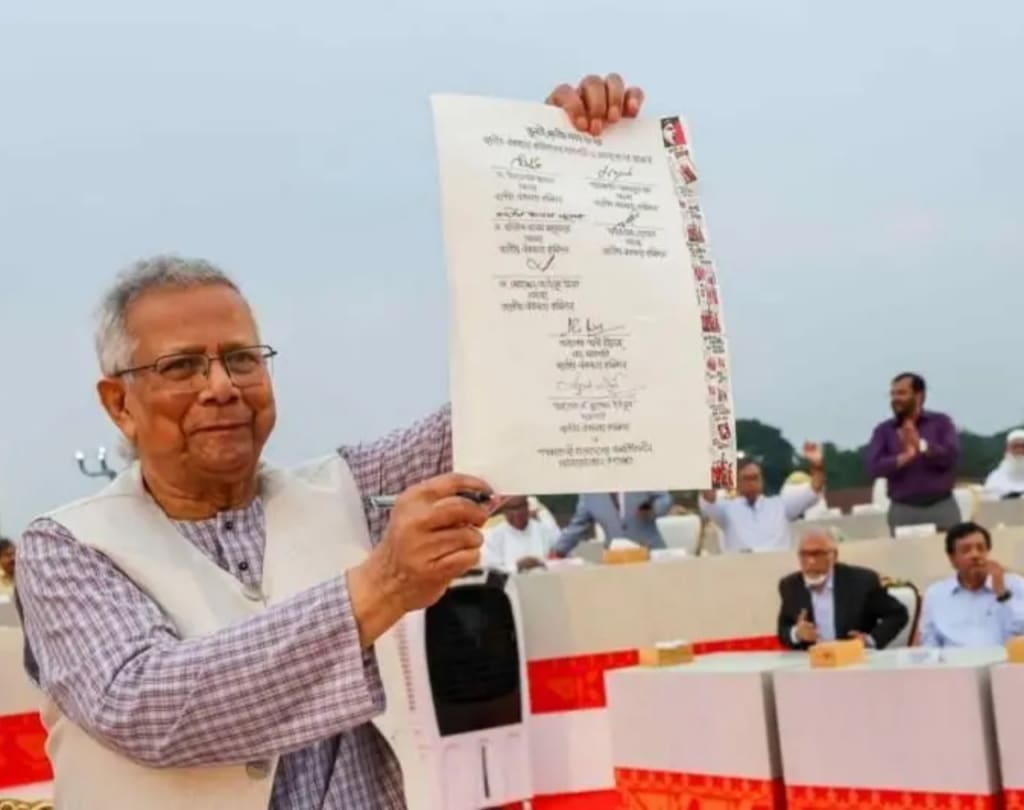
The referendum on the implementation of the July Charter was held on February 12, the day of the elections to the 13th National Parliament. The referendum on which voters will vote today on separate ballots will have only four very specific issues written on it. Voters will vote ‘yes’ or ‘no’ on the question of whether voters support the implementation of the Charter.
For the past several days, the government has been campaigning for the referendum across the country on behalf of the interim government. Initially, the government campaigned on the referendum only from a neutral position. However, later, it deviated from this position and began directly campaigning for a ‘yes’ vote in the referendum.
A few days ago, Chief Advisor Professor Muhammad Yunus also gave a video message to be broadcast on radio and television.
Encouraging people to vote 'yes', Professor Yunus said, "Voting 'yes' will free the country from discrimination, exploitation and oppression and open the door to building a new Bangladesh."
The Reform Commission's report, after a series of meetings with political parties, includes a total of 84 reform proposals for the referendum.
The government has also announced that 47 of these proposals will be implemented through constitutional means and 37 through ordinary laws or executive orders.
Although there are 84 reform proposals in the referendum, some of them have dissenting notes from other political parties, including the BNP, while others are from the party. Initially, the proposal was that if the political party that has a dissenting note comes to power, it will not be bound to implement these proposals.
However, ultimately unable to resolve the issue, the government decided to hold a referendum.
If the referendum results in a yes vote, the next parliament will The referendum will be binding on the parties that voted in the referendum, including the caretaker government system, reforms to the electoral commission and the upper house. The remaining articles are said to be implemented in accordance with the political promises of the winning party.
And if they do not win, there will be no obligation to implement the July Charter.
If the referendum results in a yes vote, members of the next parliament will serve as members of the Constitutional Reform Council. They will take steps to implement the constitutional reforms in accordance with the July Charter within 180 days, or six months.
The four issues that the government has included on the referendum ballot make it difficult for many voters to understand what changes they will get if they vote ‘yes’ in the referendum in their constituency, and what changes they will not get if they do not.
Language, ethnicity and fundamental reforms
The current constitution of Bangladesh does not recognise any language other than Bengali. However, the July Charter states that Bengali will be the state language of the Republic. All other mother tongues will also be recognised.
Although the citizens of Bangladesh are still known as the Bengali nation, after the reforms they will be identified as Bangladeshis.
According to the current constitution, a two-thirds majority in Parliament is required to amend the constitution and a referendum is not required. However, the July Charter states that a two-thirds majority in the Lower House of Parliament and a majority in the Upper House are required to amend the constitution. On the other hand, a referendum will be required to amend the preamble of the constitution, namely Articles 8, 48, 56 and 142, and to change the system of caretaker government.
According to the current constitution, Sections 7(a) and (b), there was a provision for maximum punishment in case of repeal of the constitution, but this was abolished in the July Charter.
Bengali nationalism, democracy, socialism and secularism are the basic principles of the current constitution. However, if the July Charter is implemented in the referendum, the basic principles of the constitution will be - equality, human dignity, social justice, religious freedom and harmony
The current constitution of Bangladesh mentions secularism and religious freedom. The July Charter will include that article - ensuring the coexistence and due dignity of all communities.
The constitution currently has 22 fundamental rights. However, the July Charter added the issue of uninterrupted internet and protection of personal information.
President and Prime Minister.
Powers and Balance
According to the current constitution of Bangladesh, a state of emergency is declared with the signature of the Prime Minister. As a result, fundamental rights are suspended. The new proposal brought in the charter states that the approval of the cabinet is necessary to declare a state of emergency. The opposition leader/deputy leader must also be present at this meeting. On the other hand, according to Article 35 of the constitution, fundamental rights cannot be taken away during a state of emergency.
The President of Bangladesh is elected by the members of parliament. This vote should be public. If the July charter is implemented, the president will be elected by the members of the upper and lower houses of parliament through a secret ballot.
According to the current constitution, the president can appoint the prime minister and the chief justice under his powers. After the implementation of the July charter, the president can appoint the chairmen and members of the National Human Rights Commission, Information Commission, Press Council, Law Commission and Energy Regulatory Commission without consulting the prime minister. Although the BNP had a different opinion on this proposal.
Impeachment of the president requires a two-thirds majority of the members of parliament. The July Charter included the issue of both houses of parliament. That is, the president can be impeached with two-thirds votes of the lower house and the upper house.
Earlier, the president could pardon any criminal with the approval of the government. The July Charter states that the president can pardon a criminal only if the affected person or his family agrees.
The ousted Sheikh Hasina was sworn in as prime minister four times after being elected in 2008. The current constitution does not have a term limit for the post of prime minister. However, the July Charter states that a person cannot remain prime minister for more than 10 years in a lifetime, i.e. more than two terms.
On the other hand, under the current constitution, the prime minister can hold multiple positions. However, if the July Charter is implemented, the prime minister will not be able to hold multiple positions. Although five parties, including the BNP, expressed disagreement on the issue
Parliament Elections and Governance
The current constitution of Bangladesh does not provide for a caretaker government during elections. The July Charter includes the caretaker government system, and the caretaker government will be formed based on the opinions of the ruling party, the opposition party and the second opposition party in the appointment process, which will also include the caretaker government's chief advisor.
Although Bangladesh's parliament has been unicameral since independence the July Charter proposes to make it bicameral. In this case, the number of members of the upper house will be 100. In this case, the July Charter also states that the seats in the upper house will be distributed in proportion to the votes received by political parties in parliamentary elections.
The country's national parliament currently has 50 reserved seats for women. The current constitution does not provide for an increase in this. The July Charter proposes to gradually increase this to 100.
The speaker and deputy speaker of parliament are elected from the ruling party. If the charter is implemented in the referendum, the deputy speaker will be elected from the opposition party.
According to the current constitution, if MPs vote against their party line, they become ineligible to vote in parliament. However, the July charter states that MPs will be able to vote independently on issues other than the budget and confidence bills.
Till now, the government did not need parliamentary approval to enter into any agreement with a foreign country. However, the July charter states that any agreement related to national security must be approved by both houses of parliament.
Although the Election Commission has so far had the sole authority to determine the boundaries of parliamentary constituencies, if the July charter is approved in the referendum, the Election Commission will lose its sole authority. After that, an expert committee will also carry out this responsibility along with the EC.
Although there were search committees to form various election commissions earlier, their control was completely in the hands of the prime minister. The July Charter states that the Election Commission will constitute a committee headed by the Deputy Speaker, the Prime Minister, the Leader of the Opposition and the Speaker, with the Appellate Division judge as its chairman.
What changes have been made to the law and the judicial system?
If the July Charter is implemented, Article 95 of the Constitution will be amended. This article of the Constitution states that the President can appoint anyone as the Chief Justice. However, this section of the July Charter states that the Chief Justice of Bangladesh should be appointed from the Appellate Division.
The current Constitution states that the government is to determine the number of judges in the Appellate Division. However, the July Charter states that the number of judges will be determined based on the needs of the Chief Justice. While the appointment of High Court judges was previously under the control of the Prime Minister, the July Charter has given this responsibility to a commission headed by the Chief Justice.
In addition, the July Charter includes provisions such as constitutionally guaranteeing complete independence of the judiciary, establishing one or more high court benches in each division, strengthening the Supreme Judicial Council, and entrusting the Supreme Court with control over the employment of judges of lower courts.
Although this was previously present in the constitution, no ombudsman has been appointed so far. The July Charter states that the ombudsman will be appointed by a seven-member committee comprising the Deputy Speaker, the Prime Minister, the Leader of the Opposition, a representative of the second largest opposition party, a representative of the President, and a judge of the Appellate Division headed by the Speaker.
Similarly, the July Charter calls for the formation of separate committees comprising opposition parties for the appointment of the Public Service Commission, the appointment of the Auditor General and Comptroller, and the appointment of the ACC chairman and commissioner. However, seven parties, including the BNP, have objected to these.
Although the current law does not have a mechanism to prevent the abuse of constitutional power, it has been included in the July Charter
The law amendment will make 37 reforms
In addition to the 47 constitutional reforms, the July Charter proposes 37 other reforms that can be amended through laws, rules and executive orders.
The July Charter promises to define the special rights, limitations of rights, and responsibilities of committees and members of parliament through legislation.
The delimitation law before the 13th parliamentary elections, a mandatory code of conduct for judges, a mandatory code of conduct for former judges, the establishment of a separate secretariat for the Supreme Court, the creation of an independent criminal investigation service, increasing the workforce of the judiciary, transforming the National Legal Aid Agency, the digitalization of judges and the digitalization of staff. Issues related to court management, and the code of conduct for lawyers have been put forward for reform through ordinances, rules and executive orders.
In addition, the July Charter calls for the formation of an independent and permanent Public Administration Reform Commission to implement public administration reform programs, and the formation of the Public Service Commission (General), Public Service Commission (Education), and Public Service Commission (Health) to recruit manpower for the work of the republic.
On the other hand, the July Charter also mentions the creation of two administrative divisions, Comilla and Faridpur, keeping in mind the geographical location and transportation issues.
About the Creator
Keep reading
More stories from Real content and writers in Chapters and other communities.
Russia-Ukraine War Enters Fourth Year: Can Flamingo, Oreshnik Missiles, F-16 Jets and AI Drones Change the Balance?
On the 24th of this month, four years will be completed since Russia’s invasion of Ukraine. This war has continued without pause for four years, and there are still no visible signs that it will end. Negotiations between Russia and Ukraine are being held in Abu Dhabi under U.S. mediation. On Thursday, another round of these talks ended without any progress. If diplomacy is failing to deliver results, do the two countries possess such advanced weapons that could potentially tilt the balance of war in favor of either side?
By Real content8 days ago in Chapters
The Cave Part 6
If you have ever heard a tale about yourself that you cannot remember and doubtless think is made up, you will know how I felt when Tharkin related all that the eagle had seen of me before my memories were scattered. Of far distances and traveling companions that I did not recall, camping out under the stars and making our way to the mountains with deliberate purpose. The great bird had lost contact with my party once we entered the forests, and the seven other members were not seen again by him or his brethren since.
By Jamye Sharp4 days ago in Chapters




Comments
There are no comments for this story
Be the first to respond and start the conversation.