
Scientific Wonders In The Field Of Health(2024-2026)
New Discoveries In The Field of Health

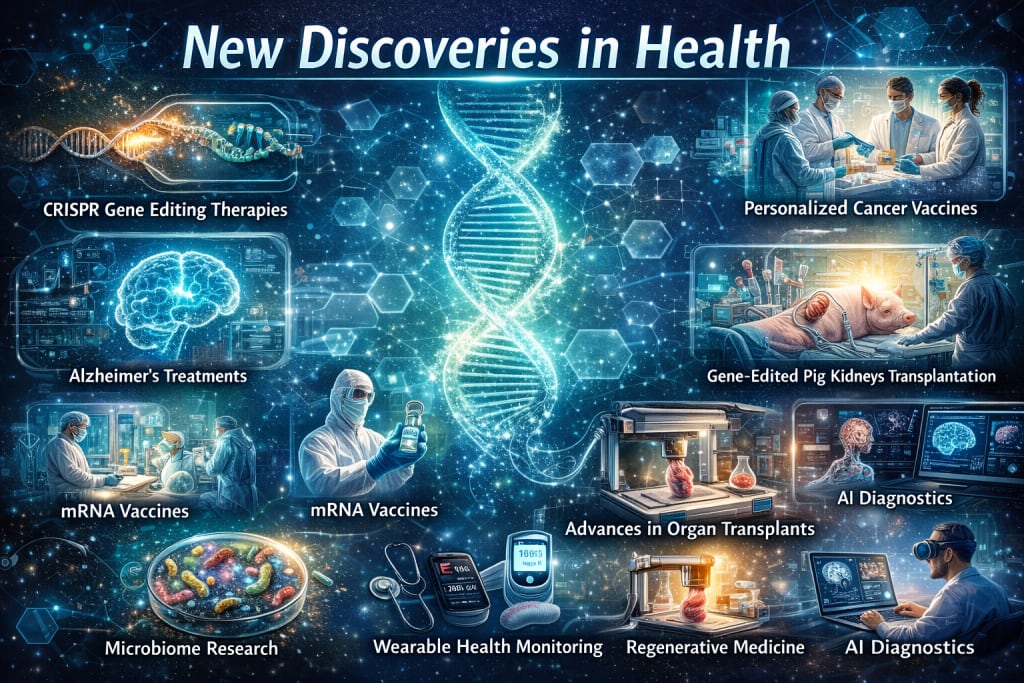
Here is an overview of new discoveries in the field of health (2024–2026), highlighting breakthroughs in medicine, biotechnology, neuroscience, and public health.
🧬 1. Gene Editing Enters a New Era
One of the most transformative breakthroughs has been the real-world success of CRISPR-based therapies. The first CRISPR treatment for sickle cell disease, Casgevy, developed by Vertex Pharmaceuticals and CRISPR Therapeutics, received regulatory approvals in multiple countries. This marks the beginning of a new chapter where gene editing moves from experimental labs to clinical treatment.
Researchers are now exploring CRISPR applications for:
Beta-thalassemia
Certain inherited blindness disorders
Rare immune deficiencies
Newer gene-editing techniques such as prime editing and base editing are showing improved precision and fewer side effects, reducing concerns about unintended DNA changes.
🧠 2. Breakthroughs in Alzheimer’s Treatment
After decades of limited progress, treatments targeting amyloid plaques in the brain have shown measurable impact. Drugs like Leqembi, developed by Eisai and Biogen, have demonstrated the ability to slow early-stage Alzheimer’s disease progression.
Recent research also focuses on:
Earlier diagnosis through blood biomarkers
Tau protein targeting therapies
AI-assisted brain imaging for faster detection
These advances suggest Alzheimer’s may increasingly be managed as a chronic condition rather than an untreatable decline.
🦠 3. Personalized Cancer Vaccines
One of the most exciting innovations in oncology is the development of personalized mRNA cancer vaccines. Building on mRNA technology used during COVID-19, companies like Moderna are creating vaccines tailored to an individual’s tumor profile.
Early clinical trials show:
Reduced recurrence in melanoma patients
Strong immune responses targeting cancer cells
Potential combination with immunotherapy drugs
This approach represents a shift toward highly individualized cancer treatment.
🧪 4. Artificial Intelligence in Diagnosis
Artificial intelligence is rapidly transforming healthcare diagnostics. AI systems are now:
Detecting early-stage cancers in imaging scans
Predicting heart disease risk from retinal photographs
Identifying diabetic complications earlier than traditional methods
Companies such as Google DeepMind have developed AI tools capable of diagnosing eye diseases and analyzing complex medical data with high accuracy. AI-driven drug discovery is also accelerating the development of new medicines by simulating molecular interactions much faster than traditional lab research.
🫀 5. Advances in Organ Transplantation
A groundbreaking development in transplantation science has been the use of gene-edited pig organs for human transplants (xenotransplantation). Researchers have successfully transplanted genetically modified pig kidneys into human patients under experimental protocols.
Scientists have modified pig genes to:
Reduce immune rejection
Remove harmful retroviruses
Improve compatibility with human tissue
While still experimental, this breakthrough may eventually solve the global shortage of donor organs.
🧬 6. Microbiome Research Expands
The human microbiome — the trillions of bacteria living in our gut — is increasingly recognized as central to health. New studies link gut bacteria to:
Mental health conditions such as anxiety and depression
Autoimmune diseases
Obesity and metabolic disorders
Precision probiotics and microbiome-targeted therapies are being developed to restore healthy bacterial balance rather than simply treating symptoms.
🦴 7. Regenerative Medicine and 3D Bioprinting
Regenerative medicine is progressing with:
Lab-grown skin for burn victims
Stem-cell-based cartilage repair
3D-printed tissues
Researchers are working toward printing functional organs using a patient’s own cells, potentially eliminating transplant rejection in the future.
💉 8. Next-Generation Vaccines
mRNA vaccine platforms continue to expand beyond COVID-19. Scientists are developing vaccines for:
RSV (respiratory syncytial virus)
Influenza
HIV (early-stage trials)
Certain cancers
These vaccines can be designed and updated quickly, offering a powerful response to emerging infectious diseases.
🩺 9. Wearable Health Monitoring
Smartwatches and biosensors now detect:
Irregular heart rhythms
Blood oxygen changes
Sleep disorders
Early signs of infection
Continuous glucose monitors are improving diabetes management, while wearable ECG devices can detect atrial fibrillation early, reducing stroke risk.
🧘 10. Mental Health Innovations
Digital mental health platforms are expanding access to therapy. Virtual reality exposure therapy, AI chat-based support systems, and brain stimulation techniques are offering new approaches to treating depression, PTSD, and anxiety disorders.
Additionally, research into psychedelic-assisted therapy under controlled medical supervision is showing promise for treatment-resistant depression.
🌍 11. Public Health & Pandemic Preparedness
Global health agencies are investing in:
Rapid vaccine manufacturing systems
Universal flu vaccines
Imprved disease surveillance using AI
Wastewater monitoring to detect outbreaks early
Lessons from the COVID-19 pandemic are shaping more resilient health systems worldwide.
🌟 Conclusion
Recent discoveries in health are redefining medicine. From gene editing and personalized cancer vaccines to AI diagnostics and regenerative medicine, healthcare is becoming:
More precise
More personalized
More preventive
More data-driven
These innovations are not just extending life expectancy — they are improving quality of life and reshaping how diseases are detected, treated, and even prevented.
About the Creator
Ibrahim Shah
I am an Assistant Professor with a strong commitment to teaching,and academic service. My work focuses on fostering critical thinking, encouraging interdisciplinary learning, and supporting student development.
Keep reading
More stories from Ibrahim Shah and writers in Chapters and other communities.
An In-Depth Exploration of Journey to the Center of the Earth
Few adventure novels have captured the imagination of readers as powerfully as Journey to the Center of the Earth. Written by Jules Verne and first publishedF in 1864, this groundbreaking work blends science, adventure, and fantasy into a thrilling tale of exploration beneath the Earth’s surface. As one of the earliest works of modern science fiction, the novel not only reflects the scientific curiosity of the 19th century but also demonstrates Verne’s extraordinary ability to transform speculative science into gripping storytelling.
By Ibrahim Shah 5 days ago in Chapters
The Guardian Chapter V
Alexander left his Coming of Age ceremony with Cronos and the elders with as many new questions as he had answers for his old questions. Cronos had confirmed his suspicions were correct. Not only was there a link between the Beast Masters and the inhabitants of the Citadel, but it was the Citadel's fault that the Beast Masters existed in the first place. Instead of banishing the law breakers which allowed them to wreak havoc on the rest of humanity, the Citadel elders should have stripped them of their powers before they became too strong. Now Alexander would need to battle the Beast Masters and the Jikininki. It would be difficult for him to forgive the Citadel Elders because their poor decisions led to the deaths of his parents and more than half the planet's human population.
By Mark Gagnon4 days ago in Chapters
Stop the AI from taking over Earth!
It is the year 5132, I am a 12-year-old girl named Jazzy from the planet of Void and I am travelling to the planet known as ‘Earth’. In my planet, people called me the Princess of Space because I can control time and space, including the planets and the whole universe!
By *+*+*~Teja~*+*+*3 days ago in Chapters



Comments
There are no comments for this story
Be the first to respond and start the conversation.