
The Weight We Carry: Why Confession Is the Bravest Thing We Never Do
In a World That Rewards Performance, Admitting Who We Really Are Feels Like Suicide—But It's the Only Path to Freedom
We are born honest. Watch any child and you will see it—the unedited self, the unfiltered expression, the truth spoken before the social brain learns to censor. A child points at the stranger and says what they see. A child declares their love and their hatred in the same breath. A child cries when hurt and laughs when delighted, with no thought to how they appear, no calculation of what others will think. This is our original state: transparent, authentic, free.
Then we learn. We learn that honesty has consequences. We learn that the truth can hurt, that it can be used against us, that it can make us vulnerable to rejection, punishment, shame. We learn to edit, to perform, to present a version of ourselves that will be accepted. We learn to hide—first the inconvenient feelings, then the unacceptable thoughts, then the parts of ourselves we have been taught to believe are unworthy of love. By the time we reach adulthood, we have become experts at concealment. We wear masks so long we forget there is a face beneath.
But the hidden self does not disappear. It lives beneath the surface, in the space between heartbeats, in the moments when we are alone with our own thoughts. It carries the weight of everything we have never said: the apologies never offered, the truths never spoken, the secrets never shared, the loves never declared, the wounds never revealed. This weight accumulates over years, pressing down on the soul, and we wonder why we feel so heavy, why joy is elusive, why connection feels impossible. We are carrying a burden we were never meant to bear alone.
Confession is the ancient name for the act of setting this burden down. It is not religious, though religions have formalized it. It is human. It is the moment when we stop performing and start telling the truth. It is the decision to be seen—really seen—by another person, and to risk that they might stay. It is the bravest thing we never do, because it requires us to face the deepest fear: that if someone knew who we really are, they would not love us. That if we spoke the truth, we would be alone.
And yet, the paradox is that confession is the only path out of the aloneness we already feel. The secrets we keep do not protect us; they isolate us. They create a wall between ourselves and others, between ourselves and ourselves. The person who knows our worst thing and stays is the person who finally makes us feel safe. The truth spoken aloud loses its power over us. The weight shared becomes lighter. This is the gift of confession, available to anyone brave enough to reach for it.
I think about a man I knew, years ago, who carried a secret for decades. When he was young, in the chaos of his twenties, he had done something unforgivable—or so he believed. He had hurt someone he loved, betrayed a trust, broken something that could not be repaired. He had apologized at the time, made amends as best he could, and then spent the next thirty years trying to forget. But he could not forget. The memory lived inside him like a splinter, festering, poisoning everything. It affected his marriages, his parenting, his work, his sleep. He carried it alone because he was certain that if anyone knew, they would see him as he saw himself: irredeemable.
Then, in his sixties, something shifted. He was at a retreat, of all places—something his daughter had talked him into—and during a session on forgiveness, he found himself standing, walking to the front, speaking into a microphone to a room full of strangers. He told them everything. The story he had never told. The shame he had never shared. The secret that had defined his life in ways he was only beginning to understand. He wept as he spoke, and the strangers wept with him. And when he finished, something lifted. Not everything—the past was still real, the harm still done—but the weight of solitary carrying. He was not alone with it anymore. He had been seen, in his worst moment, and the people in that room had not turned away.
He told me later that the confession did not change what he had done. It changed what he could do next. It freed him to become someone other than the person who had committed that act, because he was no longer hiding from it. The secret had lost its power. He could move forward, not as a person defined by a single terrible choice, but as a person who had made that choice and then spent thirty years trying to be someone else. The confession made that someone else real.
This is the power of being truly known. It does not erase the past. It does not undo harm. But it breaks the isolation that secrets create. It allows us to be seen in our entirety—not just the polished surface but the broken depths—and to discover that we are still worthy of connection. It is the antidote to shame, which whispers that we are alone in our unworthiness. Confession speaks back: you are not alone. You are human. You are here.
The things we need to confess are not always dramatic. For most of us, the weight we carry is made of smaller stones: the resentment we have never expressed, the apology we have never offered, the love we have never declared, the truth we have never told our parents, our children, our partners, ourselves. These small confessions accumulate too. They create the quiet distance in relationships, the sense that something is unfinished, the feeling that we are not fully present because we are not fully known. The work of confession is the work of closing these distances, one truth at a time.
It is terrifying, of course. Every instinct screams against it. The voice that learned, so long ago, that honesty is dangerous, that vulnerability is weakness, that protection requires performance—that voice will fight to keep the masks in place. But the voice is wrong. Protection does not require performance; it requires connection. And connection requires truth. The person who knows your worst thing and stays is the person who can finally love you, because they are loving you, not your performance. The confession that terrifies you is the one that will set you free.
There is a practice that helps, though it does not eliminate the fear. It is the practice of beginning small. Start with one truth, spoken to one person, in one moment of courage. Not the biggest secret, not the deepest wound—just something true that you have been hiding. Say it. See what happens. The world will not end. The person may surprise you. And you will discover, in that small experiment, that the fear of confession is worse than confession itself. You will discover that truth, even when it lands imperfectly, is lighter than the weight of hiding.
Then do it again. And again. Over time, honesty becomes a habit. The masks grow thinner. The hidden self emerges, blinking in the light, and discovers that the light is not as dangerous as the dark. You begin to live, not as a performer seeking approval, but as a person offering truth. The relationships that survive this honesty become real. The ones that do not were never real to begin with. And you, in the process, become someone who can be known—which is the only way to be loved.
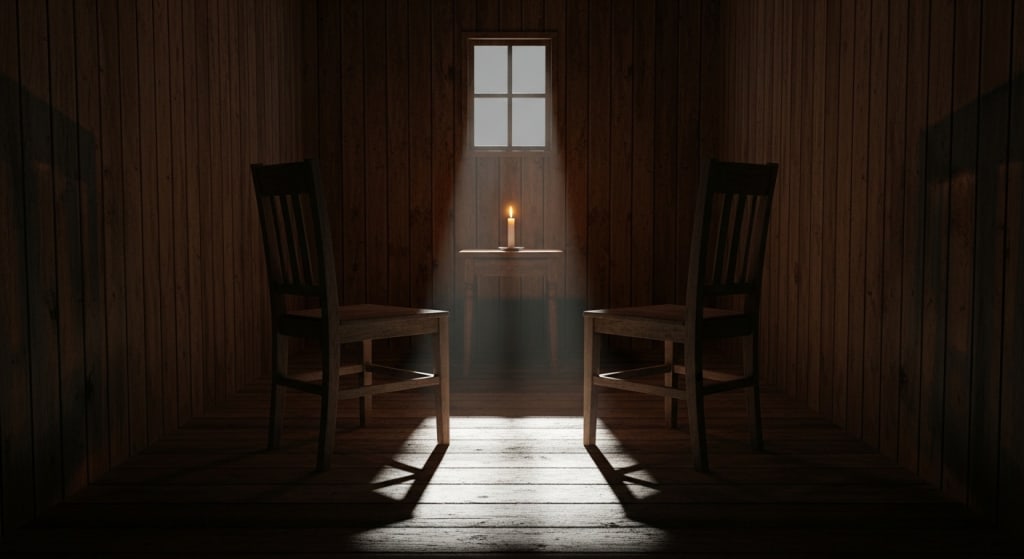
The room with the two chairs, the candle between them, the moonlight on the floor—that room exists everywhere. It exists in the space between two people who are willing to be real with each other. It exists in the moment when you decide to tell the truth. It exists in the heart of everyone who has ever carried a secret and longed to set it down. The invitation is always there. The chairs are always empty. The candle is always burning. The question is whether you will sit down, look across, and begin to speak.
The weight you are carrying was never meant to be yours alone. The secrets you are hiding are not protecting you; they are imprisoning you. The person you might become if you stopped performing—that person is waiting, just beneath the surface, ready to be known. Confession is the door. Courage is the key. And on the other side is not judgment or rejection, but something you may have forgotten was possible: the experience of being fully seen and still held dear. The experience of being human, together, in the light.
The bravest thing you never do is waiting to be done. The truest thing you never said is waiting to be spoken. The freedom you never found is waiting on the other side of a single sentence, spoken to a single person, in a single moment of courage. The chairs are empty. The candle is lit. The only question left is whether you will sit down.
About the Creator
HAADI
Dark Side Of Our Society
Stop the AI from taking over Earth!
Not long after, Gazzer and I arrived back at Void. It seemed… different not mentioning how much HAVE CHANGED! The buildings, many were removed, the houses looked the same, the population… INCREASED MAGNIFICIENTLY! Oh boy, how much trouble would it be… as in, I WOULD HAVE TO HELP GAZZER THROUGH BUSTLING STREETS JUST TO GET TO SCHOOL! It’s trouble alright! But then, I saw it… AI robots on MY PLANET! I had to stop them. I took my VoidA2000 which turned into a car and drove to the area where the AIs were at.
By *+*+*~Teja~*+*+*a day ago in Chapters



Comments
There are no comments for this story
Be the first to respond and start the conversation.