
Syria is the future of Ukraine?
Many elements of similarity were noted between the Syrian and Ukrainian issues, including that the strategies of the Russian invasion of Ukraine, both military and political, are almost identical to the strategies practiced by the Russian forces on Syrian soil since the Russian intervention in 2015 until now.
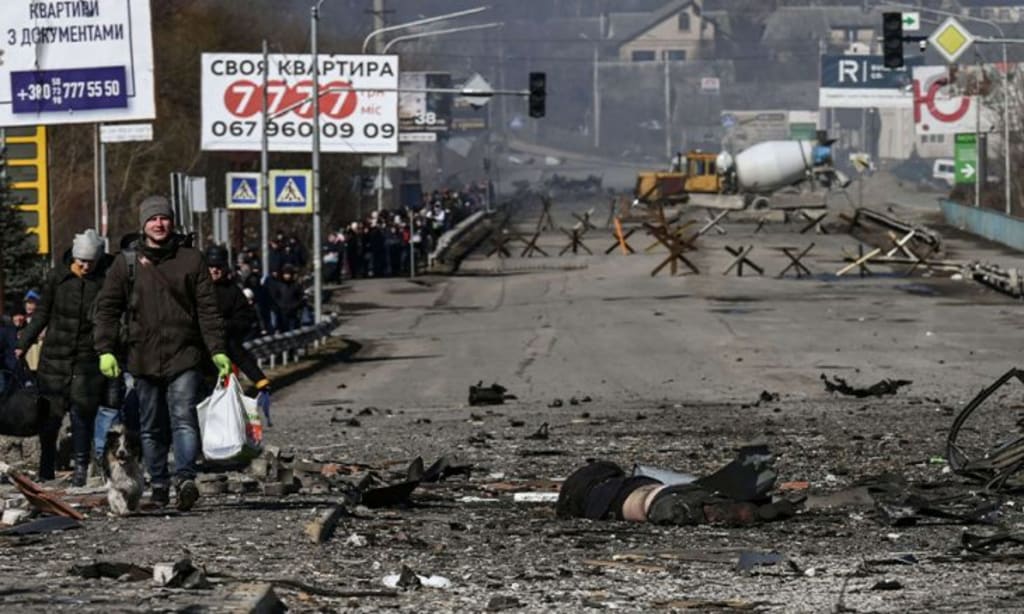
Many elements of similarity were noted between the Syrian and Ukrainian issues, including that the strategies of the Russian invasion of Ukraine, both military and political, are almost identical to the strategies practiced by the Russian forces on Syrian soil since the Russian intervention in 2015 until now.
The Syrians recovered pictures of the Russian siege and bombardment, and most of them sympathized with the Ukrainians.
The reactions of the Syrian regime, which the Russian intervention contributed to preventing it from falling, went beyond what is politically reasonable, starting with the announcement of Faisal Miqdad, from Moscow, in support of the Russian “special operation,” passing through the recognition of President Bashar al-Assad of the “Republics of Lugansk and Donetsk,” and then the establishment of institutions Security by conducting demonstrations in support of Putin and sanctions for those who do not participate, and some “Popular Defense” parties declaring their readiness to fight alongside Russia in Ukraine, leading to Riyad Haddad, the regime’s ambassador in Moscow, declaring that “Ukraine will turn into a big Idlib.”
Remarkably, among the news from the fronts of the Ukrainian war, was the disclosure of the participation of senior Russian generals who were in Syria, including General Andrei Sokovitsky, Deputy Commander of the 41st Army of the Joint Forces, who was killed this month, and General Vitaly Gerasimov, whose death was also announced by Kyiv.
As in Syria, whose cities and towns in Aleppo and Idlib were subjected to Russian raids targeting schools, hospitals and markets, Russia is currently using the strategy of besieging cities, targeting infrastructure and service and health facilities (the last of which was the Mariupol Maternity Hospital) with aerial and artillery bombardment and preventing the entry of humanitarian aid to push the resistance forces in These areas are to leave, as well as to intimidate civilians and make their lives impossible, and then activate “safe corridors” to evacuate civilians, sometimes targeting them, to spread chaos, terror and despair.
Syria was, in practice, a shooting range, training on besieging cities, terrorizing civilians and testing its military systems. According to Russian Defense Minister Sergei Shoigu, the Russian army “tested all Russian weapons in Syria,” and that “all regiment commanders, division commanders, armies, all regional commanders and all chiefs of staff. And services, they participated in the battles of Syria.” According to the Russian “Zvezda” channel, the Russian army tested 359 modern weapons in Syria under combat conditions, and that some of them “gained international fame thanks to their quality”!
In this sense, the Russian army copied the attacks it carried out in Idlib, Hasaka, Raqqa, Quneitra, Lattakia, Damascus countryside, Homs and Hama with the attacks taking place today in Izyum, Petrovsky, Hruchovaka, Sumy, Akhtyrka, Kharkiv and Mariupol, without changing anything that the Kremlin authorities were justifying their intervention in Syria with the support of the “regime.” legitimate” and that its intervention in Ukraine is an attempt to occupy a country and bring down a democratic regime and an elected government.
The Russian war operations in Syria since its intervention on September 30, 2015 until now, according to the “Syrian Network for Human Rights,” have killed 6,910 civilians, including 2,030 children, and recorded 1,231 attacks on vital centers, while the United Nations Human Rights Office documented, As of last Wednesday, 516 civilians had been killed, including 71 children, but the office announced that it expected the real numbers to be "much higher."
To the difference between the reasons for the intervention, and the presence of many important political and military differences (including that the Russian ground forces participate in the Ukrainian operations), it is likely that Putin’s decision to invade Ukraine would not have happened had the international system not colluded with his intervention in Syria, and had his army not tested its weapons in Syrian bodies.
About the Creator
Keep reading
More stories from Abd elrhmen and writers in Confessions and other communities.
Chechnya on two fronts: the son of Mufti Kadyrov, an ally of Putin... and "Sheikh Mansour" with Zelensky
The sounds of takbeer appeared again with the scenes of the battles waged by a Chechen combat group in Ukraine, but this time it is not Kadyrov’s Chechen forces loyal to Moscow, but rather a battalion called “Sheikh Mansour” allied with Zelensky and fighting alongside Ukraine against the Russian army, to complete the paradox on the Chechen side of This Ukrainian war, between Chechens fighting each other on two opposing fronts, to transformations after the harsh Chechen defeat in the Russian wars, which made a team of Chechens fight alongside Russia, and allyed its president after years of a bloody war waged by Chechnya against Russia, which destroyed dozens of villages And the Caucasian cities, and this is a remarkable transformation that means, in one aspect, that the experiences gained by the Chechen fighters after years of their war with Russia, turned in favor of Russia.
By Abd elrhmen4 years ago in Confessions
Blessed 33
So I woke up on the morning of February 5, 2026 and guess what and you know what I realized? It’s my 33rd birthday. Do you know what that means? Yes, technically I’m getting old, but what I couldn’t have guessed was this would be one of the best days of my life.
By Joe Patterson5 days ago in Confessions
The Gaddafi Model Revisited: Is Iran the Next Target in a Global Power Strategy?
The Gaddafi Model Revisited: Is Iran the Next Target in a Global Power Strategy? In recent geopolitical debates, a controversial phrase has resurfaced: the “Gaddafi Model.” Originally linked to Libya’s decision in the early 2000s to dismantle its weapons of mass destruction programs, the model is now increasingly referenced in discussions about Iran. The implication is clear—intense pressure, isolation, and forced dismantling of strategic capabilities may once again be used as tools of regime control. As tensions rise in the Middle East, the question is no longer theoretical: could Iran be facing a similar fate, and what role do regional powers like Pakistan play in this unfolding strategy?
By Wings of Time about 7 hours ago in Confessions



Comments
There are no comments for this story
Be the first to respond and start the conversation.