
The Art of Starting Over
Why new beginnings are both terrifying and beautiful
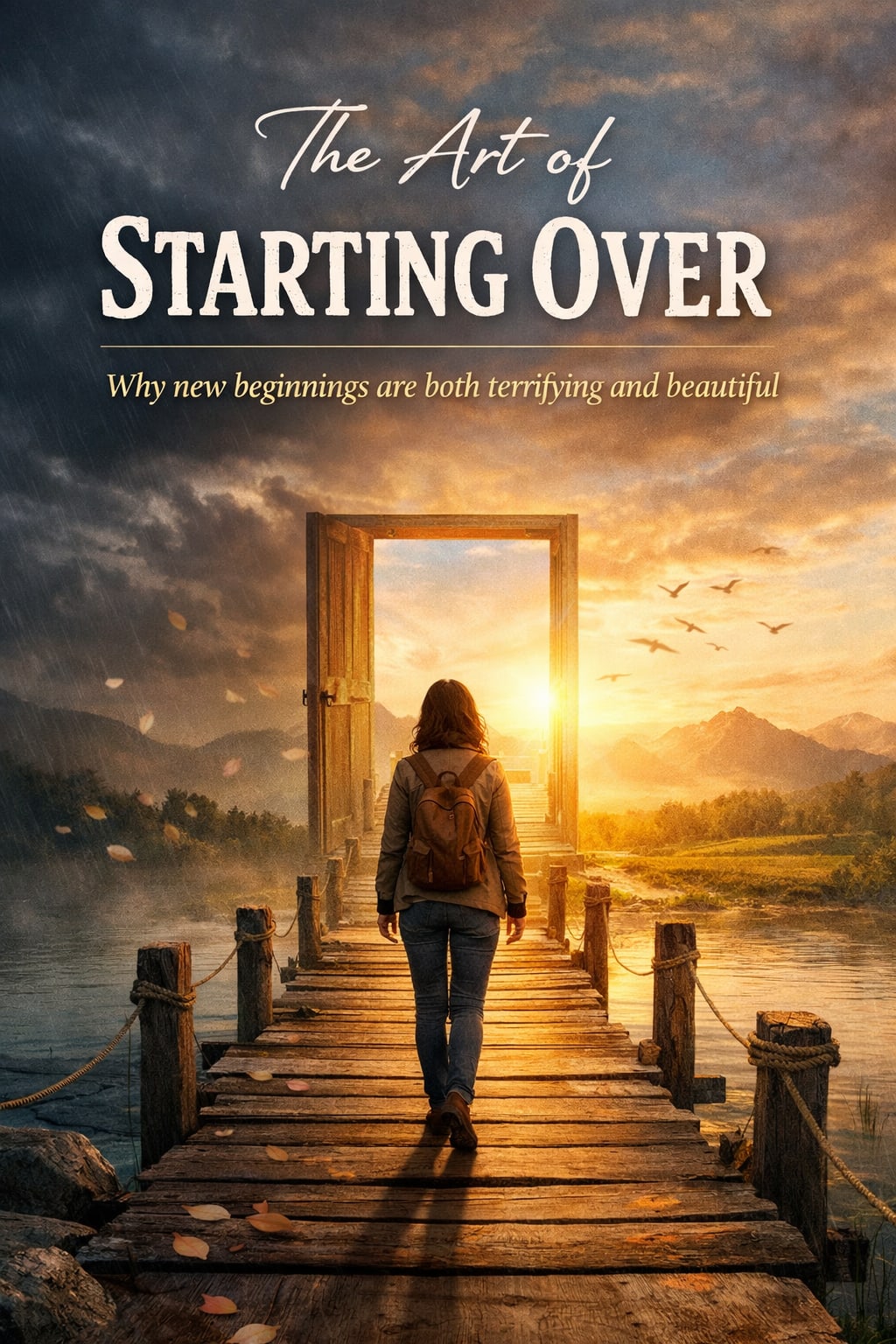
Starting over is rarely a choice we make lightly. More often, it is handed to us—wrapped in endings we did not plan, losses we did not invite, or realizations we can no longer ignore. A job ends. A relationship collapses. A dream dissolves. Or sometimes, nothing dramatic happens at all—we simply wake up one morning with the quiet, unsettling awareness that the life we are living no longer fits the person we have become.
And so we stand at the edge of a beginning we did not expect, holding pieces of what once was, wondering how to build again.
Starting over is terrifying because it asks us to release the familiar, even when the familiar is no longer good for us. Yet it is beautiful for the very same reason: it offers the rare chance to rebuild our lives with intention, wisdom, and courage we did not possess before.
This is the art of starting over—the delicate balance between grief and hope, fear and possibility, endings and beginnings.
Endings: The Unavoidable Doorway
Every new beginning is born from an ending. Yet we are rarely taught how to end things well.
We cling.
We negotiate with reality.
We replay memories like old films, searching for alternate endings that do not exist.
Endings hurt because they dismantle the structures we built our identities around. A career is not just income—it is purpose. A relationship is not just companionship—it is belonging. When they end, we do not simply lose circumstances; we lose versions of ourselves.
But endings serve a necessary function. They clear emotional and psychological space. They interrupt patterns that would otherwise continue indefinitely. They force reflection.
Without endings, we would never evolve.
Starting over begins not with action, but with acceptance—the quiet, often painful acknowledgment that a chapter has closed, whether we feel ready or not
The Fear of the Blank Page
If endings are painful, beginnings are intimidating.
There is a unique fear that comes with standing before a blank page of life. No script. No guarantees. No certainty that the next chapter will be better than the last.
We fear:
Making the same mistakes again
Wasting time
Looking foolish
Failing publicly
Regretting the leap
The blank page represents responsibility. When we start over, we lose the ability to blame circumstances alone—we must now participate in creating what comes next.
Yet the blank page is also freedom.
It does not hold our past failures unless we rewrite them into the story. It does not demand we repeat old roles. It invites reinvention.
The terror and beauty exist together because possibility is always double-edged: we might fail—but we might also finally succeed.
Grieving the Life That Was
One of the most overlooked parts of starting over is grief.
Even when the ending was necessary—even when it was healthy—we still mourn what could have been.
We grieve:
The future we imagined
The plans we made
The time invested
The emotional labor given
The identity we carried
People often rush this stage, eager to “move on” quickly. But suppressed grief has a way of resurfacing later—through bitterness, fear of risk, or emotional numbness.
Starting over gracefully requires honoring what was.
Not glorifying it.
Not clinging to it.
But acknowledging its role in shaping us.
Grief is not a step backward; it is emotional closure. It allows us to carry lessons instead of wounds into our next beginning.
Rediscovering Yourself
When something significant ends, it often strips away layers of identity.
Without the job, who am I?
Without the relationship, who am I?
Without the dream, who am I?
Starting over offers a rare opportunity: rediscovery.
You are no longer bound to the expectations of your former life. You can reassess:
What truly matters to you
What drains you
What energizes you
What values you want to live by
What kind of life feels authentic now
This stage can feel disorienting because identity reconstruction takes time. But it is also deeply empowering.
You are not rebuilding the same life—you are designing a more honest one.
The Courage to Begin Before You Feel Ready
Many people believe they must feel confident before starting over.
In reality, confidence comes after action, not before it.
You begin while afraid.
You begin while uncertain.
You begin while doubting yourself.
Courage is not the absence of fear; it is movement despite fear.
Small steps matter:
Updating a resume
Taking a class
Moving to a new city
Meeting new people
Starting therapy
Launching a side project
Each step sends a signal to your mind: I am capable of forward motion.
Momentum builds quietly. What once felt impossible becomes routine.
Starting over is less about giant leaps and more about consistent, brave steps into unfamiliar territory.
Letting Go of the Old Narrative
One of the greatest obstacles to new beginnings is the story we tell ourselves about our past.
“I failed.”
“I wasted years.”
“I’m too late.”
“I’m not good enough.”
These narratives chain us to old identities.
But starting over invites narrative revision.
What if the job loss was redirection?
What if the breakup was protection?
What if the delay was preparation?
Reframing does not deny pain—it extracts meaning from it.
Your past is not only a record of loss; it is evidence of resilience, survival, and growth.
When you change the story, you change the emotional weight you carry into your next chapter.
The Beauty of Reinvention
There is a quiet magic in realizing you are allowed to reinvent yourself—more than once, if necessary.
You can:
Change careers at 40
Fall in love again after heartbreak
Move countries
Learn new skills
Pursue abandoned passions
Become softer or stronger, slower or bolder
Society often pressures us to maintain linear life paths. But real lives are cyclical—filled with resets, pivots, and transformations.
Reinvention is not inauthentic; it is adaptive.
You are not betraying your past self—you are evolving beyond them.
Building Differently This Time
Starting over does not mean starting from zero.
You carry invisible assets:
Experience
Emotional intelligence
Boundaries
Skills
Self-awareness
Lessons learned the hard way
This time, you notice red flags earlier.
You choose environments more carefully.
You protect your energy.
You define success differently.
New beginnings are rarely repeats—they are refinements.
You build slower, but wiser.
Softer, but stronger.
More intentional, less impulsive.
Finding Hope in Small Wins
In the early stages of starting over, progress feels slow.
You measure life in small victories:
A good interview
A peaceful day alone
A new friendship
A moment of genuine laughter
Feeling excited about the future again
These moments may seem insignificant, but they are emotional milestones. They signal healing.
Hope rarely returns all at once—it trickles back quietly, often unnoticed, until one day you realize you are looking forward to tomorrow again.
That is when you know the new beginning is taking root.
Accepting That Starting Over Is a Lifelong Skill
Perhaps the most liberating realization is this:
Starting over is not a one-time event. It is a lifelong skill.
Life will ask you to begin again many times:
After failures
After successes
After losses
After growth spurts that outpace your environment
Those who master the art of starting over become more resilient, adaptable, and fearless in the face of change.
They stop viewing endings as destruction and start seeing them as transitions.
The Quiet Strength of New Beginnings
There is something profoundly powerful about a person who rebuilds their life.
Not loudly.
Not for applause.
But quietly, brick by brick.
They wake up.
They try again.
They learn.
They adjust.
They keep going.
This quiet perseverance is the true art—not perfection, not speed, but persistence.
Conclusion: Standing at the Edge of Possibility
Starting over will always carry fear. There will always be uncertainty in walking away from what you know toward what you cannot yet see.
But there is also beauty in that space.
Because the same blank page that frightens you also frees you.
It holds:
New love you have not met
Success you have not achieved
Peace you have not felt
Strength you have not discovered
Every ending you survive proves your capacity to begin again.
So if you find yourself at the edge of a new beginning—heart heavy, hands trembling—know this:
You are not lost.
You are not late.
You are not starting from nothing.
You are starting from experience.
And that makes all the difference.
About the Creator
Keep reading
More stories from Aiman Shahid and writers in Confessions and other communities.
When Home Stops Feeling Like Home
Home is supposed to be the safest word in the language. It is the place we imagine when the world feels too loud, too fast, too unforgiving. It lives in childhood memories — in familiar walls, shared meals, worn-out couches, and the quiet comfort of knowing where everything belongs.
By Aiman Shahid4 days ago in Confessions
Blessed 33
So I woke up on the morning of February 5, 2026 and guess what and you know what I realized? It’s my 33rd birthday. Do you know what that means? Yes, technically I’m getting old, but what I couldn’t have guessed was this would be one of the best days of my life.
By Joe Patterson6 days ago in Confessions
Religious Affiliations
The air was so warm I could feel my pores consuming the warmth and sweat began to pour out like mist. “It’s so hot” said my little nephew as I was playing with him. I decided to roll down the window for us. As I took a look around to see how the other people around me were taking in the heat. A lady with bright brown eyes approaches the car as we are sitting in the steamy parking lot.
By Cerina Galvana day ago in Confessions
Bartender
On the heels of grief, pain bears down hard. On the heels of death, pain awakens the quiet place between the end of our own life and now. Feeling anything is like seeing a film and in black and white, slow motion, all sound turned off. Just watching. Gritting teeth, awkward smiles and bloody red eyes move around, scanning the others who are feeling something I don't want to feel, but I do. Escapism is all I have ever known. ~
By ROCK aka Andrea Polla (Simmons)3 days ago in Poets



Comments (1)
Love this. WELL DONE