
The Life I Almost Lived
How one decision quietly rewrote my entire future.
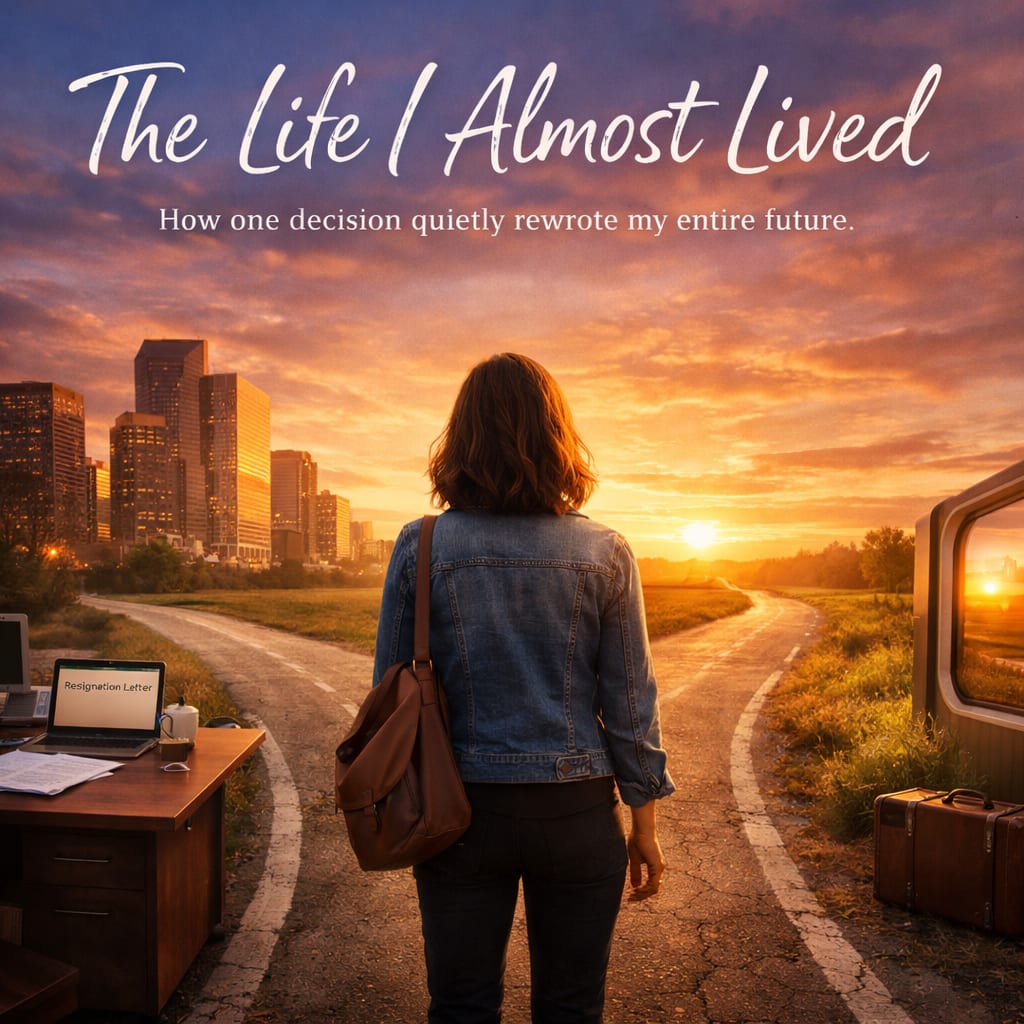
There is a version of my life that exists only in imagination.
In that life, I wake up at 6:30 a.m. to an alarm I never question. I dress in clothes that look impressive but feel unfamiliar. I commute along the same highway, nod at the same colleagues, sit in the same meetings. I earn enough. I am respected enough. I am stable enough.
And yet, in that life, something inside me is always quietly whispering, Is this it?
The strange thing about the life I almost lived is that it wasn’t terrible. It was safe. It was logical. It made sense on paper. It would have impressed relatives at family dinners. It would have looked good in photos. It would have given me a title that sounded important when introduced at weddings.
But it wasn’t mine.
The Power of a Single Decision
We often imagine life-changing decisions as dramatic moments — doors slamming, tears falling, bold declarations. In reality, my turning point looked almost ordinary.
It was a Tuesday.
No lightning struck. No one begged me to stay. There was no cinematic soundtrack swelling in the background. There was just a quiet realization: if I continued on this path, five years would pass, then ten, and I would wake up wondering when my own desires had quietly expired.
The decision itself was small — a “no” instead of a “yes.” A resignation letter instead of another contract renewal. A pause instead of another automatic step forward.
But small decisions are rarely small. They are hinges. And hinges move entire doors.
The Seduction of the “Right” Life
The life I almost lived checked all the boxes.
Steady income. Predictable growth. Social approval. A clear ladder to climb.
It felt responsible. Mature. Sensible.
And that’s what made it so dangerous.
Because the most difficult life to walk away from is not a bad one — it’s a good enough one.
There was no crisis forcing me to change. No dramatic heartbreak. No catastrophic failure. Just a slow dullness creeping into my spirit. A subtle exhaustion that sleep couldn’t fix. A persistent feeling that I was performing rather than living.
When life is unbearable, leaving feels urgent.
When life is tolerable, leaving feels selfish.
And I wrestled with that guilt for months.
The Fear of Disappointing Everyone
The hardest part wasn’t the uncertainty. It was the imagined faces of disappointment.
“What do you mean you’re leaving?”
“But you worked so hard for this.”
“This is such a great opportunity.”
“Do you know how many people would love to be in your position?”
They weren’t wrong.
That’s what made it harder.
There is something terrifying about walking away from what others consider success. It forces you to confront an uncomfortable truth: if you choose differently, you may lose applause.
And applause is addictive.
But applause cannot replace alignment.
The Quiet Cost of Staying
I often think about what would have happened if I had stayed.
Maybe I would have climbed higher. Maybe I would have adapted. Maybe I would have learned to silence that inner whisper.
Humans are remarkably good at adjusting to discomfort.
I might have convinced myself that passion is overrated. That security is everything. That fulfillment is a luxury for the reckless.
I might have grown more polished, more efficient, more admired.
But I would have grown smaller.
Not visibly. Not dramatically. But internally.
There is a subtle shrinking that happens when you consistently ignore your own truth. A slow erosion of curiosity. A quiet dimming of excitement. A flattening of wonder.
And that, to me, felt like a greater risk than uncertainty.
The Myth of the Perfect Plan
One reason we cling to almost-lives is because they come with maps.
Clear steps. Predictable milestones. Structured growth.
The alternative — the path I eventually chose — had none of that.
It was blurry. Undefined. Uncertain.
I didn’t have a five-year plan. I didn’t have guaranteed income. I didn’t have a neat explanation for everyone who asked what I was doing with my life.
All I had was a sense of misalignment and a refusal to ignore it any longer.
We are taught that we should leap only when we have safety nets.
But sometimes the net appears after you jump.
Rewriting My Definition of Success
For years, I defined success externally.
A title. A salary. A LinkedIn update that generated congratulations. A life that looked impressive in short descriptions.
But when I paused long enough to ask myself what I truly wanted, the answers were quieter.
Freedom over status. Meaning over prestige. Flexibility over hierarchy. Growth over security.
I wanted to wake up curious.
I wanted to feel stretched, not suffocated.
I wanted my work to feel like an extension of me, not a costume I wore from nine to five.
And so I chose differently.
Not because it was easy. But because staying would have been harder in the long run.
The Identity Shift
Leaving the life I almost lived required more than changing jobs or paths. It required changing identity.
I had to let go of who I thought I was supposed to be.
The achiever. The dependable one. The one who makes sensible decisions.
In stepping away, I became the uncertain one. The risky one. The confusing one.
Identity shifts are uncomfortable because they temporarily strip you of clarity. You no longer fit neatly into expectations — not even your own.
But in that discomfort, something beautiful happens: you begin building a self that is chosen rather than inherited.
What the Almost-Life Taught Me
I don’t regret the path I nearly stayed on.
It taught me discipline. It taught me structure. It taught me resilience.
But most importantly, it taught me the difference between admiration and fulfillment.
You can be admired and still feel empty.
You can be praised and still feel misplaced.
You can succeed and still feel lost.
The life I almost lived was not wrong. It was simply misaligned.
And misalignment, if left unchecked, becomes misery.
The Courage to Choose Again
We talk a lot about big dreams. Grand passions. Bold reinventions.
But sometimes courage is simply choosing again.
Choosing differently from your past self.
Choosing in alignment with who you are now, not who you were at twenty.
Choosing growth over familiarity.
It’s easy to romanticize the road not taken. To imagine that perhaps the other life would have been smoother, safer, easier.
And maybe it would have been.
But ease is not the same as aliveness.
Living Without “What If”
Today, my life is less predictable than the one I almost lived.
There are days of doubt. Moments of fear. Financial uncertainty. Occasional loneliness.
But there is also ownership.
There is curiosity. There is expansion. There is a sense that I am participating in my life rather than observing it from a safe distance.
And that makes the difference.
The greatest relief is not material. It is psychological.
I do not lie awake wondering who I might have been.
I do not replay the decision with regret.
Because even if this path is harder, it is mine.
The Truth About Almost-Lives
We all carry them.
The city we almost moved to.
The person we almost married.
The career we almost pursued.
The dream we almost chased.
They linger in imagination, polished by nostalgia and stripped of their potential downsides.
But here is what I’ve learned: almost-lives are often projections of fear disguised as security.
They represent the version of us that prioritized comfort over courage.
And while there is nothing inherently wrong with comfort, there is something tragic about silencing your inner voice for the sake of it.
A Quiet Rewrite
No one threw me a celebration for choosing differently.
There was no announcement. No dramatic applause. No headline declaring transformation.
Just a quiet rewrite.
A Tuesday decision that altered the trajectory of years to come.
When people look at my life now, they see a series of choices. They see outcomes. They see visible changes.
What they don’t see is the life that almost was.
The mornings I would have lived.
The meetings I would have attended.
The person I might have slowly become.
And I am grateful for that invisible absence.
If You’re Standing at the Crossroads
If you are reading this while standing at your own invisible crossroads, unsure whether to continue or to pivot, know this:
You do not need catastrophe to justify change.
You do not need everyone’s approval to choose differently.
You do not need certainty to take the first step.
Sometimes the most powerful decisions are the quiet ones — the ones made without drama, but with deep honesty.
Ask yourself not what looks impressive.
Ask yourself not what others expect.
Ask yourself: Which choice allows me to feel most alive?
Because one day, you will look back at this moment and realize it was not small at all.
It was the hinge.
And it moved everything.
The life I almost lived still exists somewhere — in imagination, in possibility, in an alternate timeline of cautious decisions.
But I no longer romanticize it.
Because the life I am living now, imperfect and unpredictable, is not almost.
It is real.
And it is mine.
About the Creator
Keep reading
More stories from Aiman Shahid and writers in Confessions and other communities.
The Science of Everyday Miracles
When we hear the word miracle, we often imagine supernatural events—burning bushes, parted seas, or impossible survivals. Yet science invites us to see miracles differently. It asks us to look closer at the ordinary: a drop of rain sliding down a window, the warmth of sunlight on skin, the steady rhythm of a heartbeat.
By Aiman Shahida day ago in Confessions
Blessed 33
So I woke up on the morning of February 5, 2026 and guess what and you know what I realized? It’s my 33rd birthday. Do you know what that means? Yes, technically I’m getting old, but what I couldn’t have guessed was this would be one of the best days of my life.
By Joe Patterson12 days ago in Confessions
The Dangerous Roman Rituals Kept Hidden For 2,000 Years
It happened in the early morning of September 3, 89 AD, in a closed room of the medical wing of a Roman villa in Capua, when a 12-year-old girl, calling herself Lucilla, was screaming as two physicians and four matrons nailed her limbs against a marble table.
By Edward Smith4 days ago in Confessions


Comments
There are no comments for this story
Be the first to respond and start the conversation.