
The Science of Everyday Miracles
How Ordinary Moments Reveal Extraordinary Physics
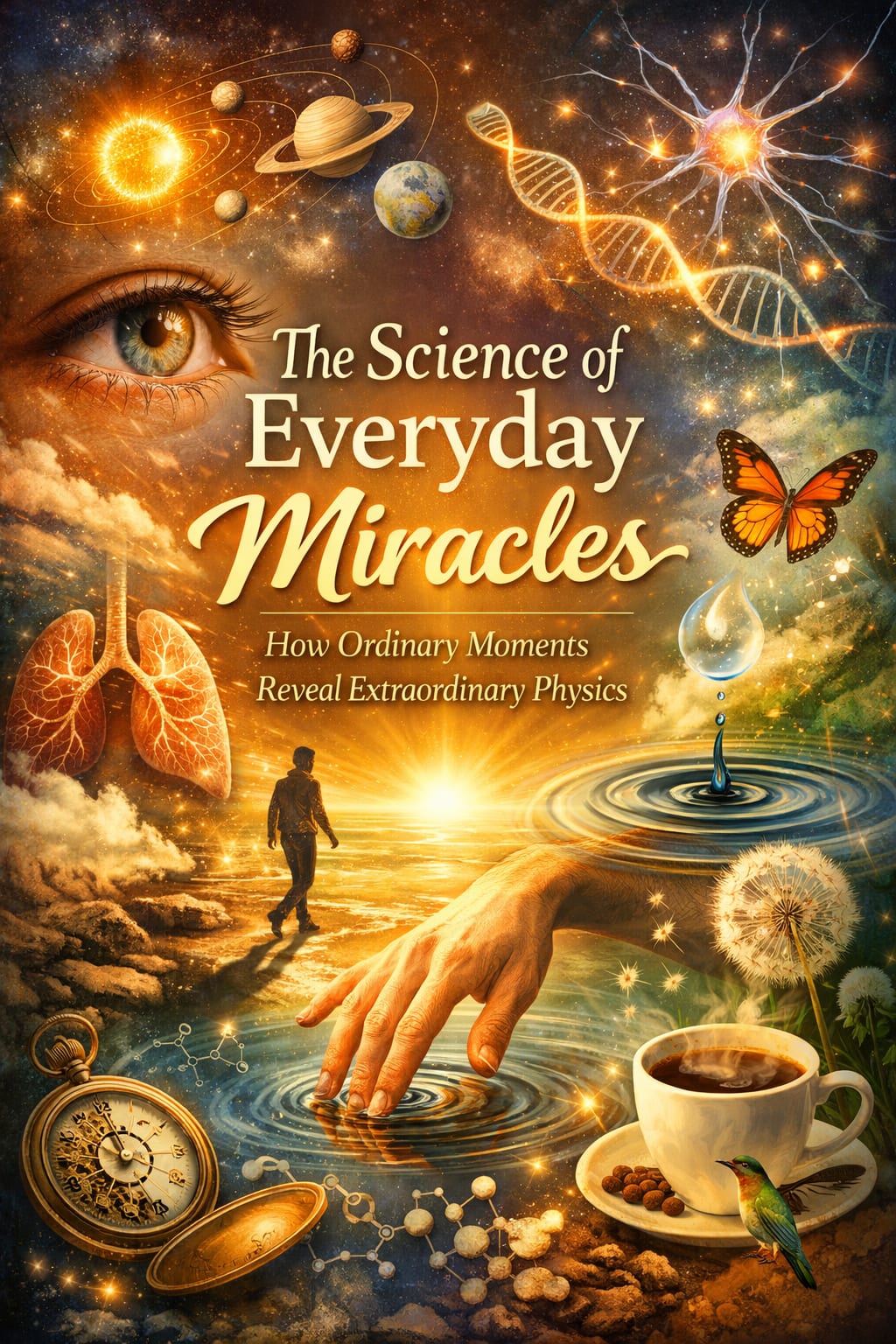
When we hear the word miracle, we often imagine supernatural events—burning bushes, parted seas, or impossible survivals. Yet science invites us to see miracles differently. It asks us to look closer at the ordinary: a drop of rain sliding down a window, the warmth of sunlight on skin, the steady rhythm of a heartbeat.
What if miracles aren’t rare interruptions of nature—but nature itself, operating with breathtaking precision?
The science of everyday miracles is the study of how familiar experiences—breathing, seeing, touching, moving—are powered by complex physical and biological processes so intricate that, once understood, they inspire awe equal to any legend.
The Miracle of Breathing: Air Into Life
Every breath you take feels automatic, effortless, and small. But biologically, it is monumental.
With each inhale, oxygen travels through your nose or mouth, down the trachea, and into branching bronchi that resemble an upside-down tree. At the ends sit millions of alveoli—tiny air sacs with walls so thin that gases pass directly into the bloodstream.
Here’s the astonishing part:
You have roughly 500 million alveoli.
Their combined surface area equals half a tennis court.
Oxygen molecules diffuse into blood cells, binding to hemoglobin.
Your heart then distributes this oxygen to trillions of cells.
All this happens silently, in seconds, without conscious effort.
Breathing is not just survival—it’s a synchronized ballet of anatomy, chemistry, and physics. Diffusion gradients, pressure differences, and molecular bonding all collaborate to keep you alive.
The Physics of Walking: Controlled Falling
Walking feels simple. But biomechanically, it is a continuous act of catching yourself from falling.
Each step involves:
Muscles generating force
Bones acting as levers
Joints absorbing shock
The brain calculating balance in real time
Your center of mass shifts forward, gravity pulls you down, and your leg swings out to stop the fall. Repeat this process—and you move.
From a physics standpoint, walking is an energy-efficient pendulum system. Tendons store elastic energy like springs, reducing metabolic cost.
So the next time you stroll across a room, remember: you’re performing a gravity-negotiating miracle thousands of times per day.
Vision: Turning Light Into Reality
Sight may be the most poetic everyday miracle.
Light reflects off objects and enters your eyes through the cornea. It passes through the pupil, which adjusts size to regulate brightness, then through the lens, which bends light to focus images.
The image projected onto your retina is:
Upside down
Reversed
Flattened
Yet you perceive a stable 3D world. Why?
Because your brain reconstructs reality.
Photoreceptor cells—rods and cones—convert light into electrical signals. These signals travel via the optic nerve to the visual cortex, where the brain:
Detects edges
Interprets color
Calculates depth
Predicts motion
In essence, you don’t see with your eyes—you see with your brain. Vision is a neurological simulation built from photons.
The Chemistry of Taste: Flavor From Molecules
Eating is another sensory miracle.
When food touches your tongue, it dissolves in saliva. Molecules bind to taste receptors that detect five primary tastes:
Sweet
Salty
Sour
Bitter
Umami
But flavor is more than taste—it’s smell, texture, and temperature combined.
As you chew, volatile compounds travel to olfactory receptors in your nose. This is why food tastes bland when you have a cold.
Chemically speaking, every meal is a molecular dialogue between food compounds and neural receptors—interpreted instantly as pleasure, disgust, or nostalgia.
The Miracle of Touch: Feeling the Invisible
Touch allows you to perceive pressure, temperature, vibration, and pain—all through specialized receptors embedded in your skin.
Consider holding a cup of hot tea.
Your nervous system instantly calculates:
Heat intensity
Surface texture
Weight
Grip pressure needed
Signals travel along peripheral nerves to the spinal cord and brain at speeds up to 120 meters per second.
Even more astonishing: your brain maps your body in a sensory layout called the homunculus, dedicating more processing power to sensitive areas like fingertips and lips.
Touch is not passive—it is an active exploration system, constantly updating your brain about the physical world.
The Silent Electricity of Thought
Every thought you have—every memory, idea, or emotion—is powered by electrical impulses.
Neurons communicate through electrochemical signals:
An electrical charge travels down a neuron’s axon.
Neurotransmitters release into synapses.
Neighboring neurons receive the signal.
Your brain contains about 86 billion neurons, forming trillions of connections.
When you recall a childhood memory or imagine the future, you are activating neural circuits shaped by experience.
Thought itself is an emergent property of electricity and chemistry—an invisible miracle happening continuously.
The Gravity That Holds You
Gravity feels mundane because it is constant. Yet it is one of the universe’s most mysterious forces.
At this very moment:
Gravity anchors you to Earth.
It keeps the atmosphere from drifting into space.
It governs ocean tides.
It holds planets in orbit around the sun.
Without gravity, walking, breathing, and even blood circulation would fail.
Einstein revealed that gravity is not just a force but the curvature of spacetime itself—mass bending the fabric of the universe.
So standing still is not simple—you are balanced within a cosmic field shaped by planetary mass.
Sunlight: Fusion From 93 Million Miles Away
Sunlight feels warm and gentle. But its origin is violently powerful.
Inside the sun’s core:
Hydrogen atoms fuse into helium.
Temperatures reach 15 million °C.
Energy releases as photons.
These photons take thousands of years to reach the sun’s surface—then only about 8 minutes to reach Earth.
Sunlight drives:
Photosynthesis in plants
Weather systems
Ocean currents
Vitamin D synthesis in your skin
Every beam of sunlight is nuclear energy delivered safely across space—a daily cosmic gift.
Water: The Liquid That Defies Physics
Water seems ordinary, yet it behaves unlike almost any other substance.
Its “miracles” include:
Expanding when frozen (ice floats)
High heat capacity (stabilizes climate)
Surface tension (allows insects to walk on water)
Universal solvent properties
Because ice floats, lakes freeze from the top down—allowing aquatic life to survive winters.
Because water stores heat, Earth’s climate remains habitable.
Life exists largely because water breaks so many chemical rules.
Time: The Invisible Dimension of Daily Life
You experience time as steady—but physics says otherwise.
Time can:
Slow near massive objects
Stretch at high speeds
Differ between observers
Even psychologically, time is elastic:
New experiences feel longer
Routine compresses memory
Childhood summers feel endless
Your sense of time is shaped by brain processing speed, dopamine levels, and memory density.
So when life “flies by,” it’s not just metaphor—it’s neuroscience.
Technology: Everyday Scientific Magic
Modern life is filled with engineered miracles:
Smartphones contain billions of transistors.
GPS works through atomic clock synchronization.
Wi-Fi transmits data via electromagnetic waves.
Batteries store chemical energy as electricity.
When you send a message, signals travel as encoded radio waves at light speed, routed through satellites and servers, arriving in milliseconds.
What once seemed telepathic is now technological reality.
Why We Stop Noticing Miracles
If everyday life is so extraordinary, why don’t we feel amazed constantly?
Psychology offers an answer: habituation.
The brain filters familiar stimuli to conserve energy. What is repeated becomes background.
You stop hearing a ticking clock.
You forget the sensation of clothing on skin.
You overlook the complexity of breathing.
Familiarity hides wonder.
Science reverses this numbness—it makes the invisible visible again.
The Emotional Power of Scientific Awe
Research shows that experiencing awe—even scientifically inspired awe—has measurable effects:
Reduces stress
Increases generosity
Expands perception of time
Enhances life satisfaction
Looking at stars, studying cells, or understanding quantum physics can evoke the same emotional response as art or spirituality.
Science does not remove magic—it reframes it.
Conclusion: Living Among Miracles
Every second of your existence is supported by layers of scientific wonder:
Oxygen diffusing into blood
Neurons firing thoughts
Gravity anchoring your body
Sunlight fueling ecosystems
Water sustaining cells
None of these feel miraculous because they are constant. Yet constancy does not diminish wonder—it deepens it.
To see everyday miracles, you don’t need supernatural belief. You need attention.
The steam rising from coffee…
The warmth of sunlight on your face…
The rhythm of your pulse…
Each is a doorway into physics, chemistry, and biology working in harmony.
Science, at its heart, is not just analysis—it is appreciation. It teaches us that the ordinary is extraordinary, that the familiar is profound, and that miracles are not rare events.
They are happening—quietly, precisely, beautifully—every single moment of your life.
About the Creator
Keep reading
More stories from Aiman Shahid and writers in Confessions and other communities.
The Day I Stopped Waiting for Permission
There wasn’t a dramatic turning point—no thunderstorm, no slammed doors, no cinematic declaration of independence. The day I stopped waiting for permission began quietly, almost invisibly, like the first crack in a wall you’ve leaned on your whole life.
By Aiman Shahida day ago in Confessions
The Piggy Project
I’ve had so many names in this life I lose track of which ones were ever really mine and which ones I wore because someone needed me to. Some were handed to me before I had words to refuse them, before I knew what they meant, before I knew I could say no. Most weren’t meant to hurt. That doesn’t mean they didn’t leave marks. Marks that told me who I belong to, who I am by way of who claims me, recognizes me in the good and bad, who walks beside me.
By Fatal Serendipity17 days ago in Confessions



Comments
There are no comments for this story
Be the first to respond and start the conversation.