
The Unopened Letter: What We Never Tell Our Parents and Why the Silence Lasts Forever
The Words We Owe the People Who Raised Us—And the Fear That Keeps Them Locked Inside
There is a letter you will never write. It lives inside you, fully formed, every word chosen, every sentence complete. In this letter, you tell your parents everything. Not the edited version, not the polite version, not the version that protects their feelings and your safety. The truth. All of it. The gratitude you have never known how to express. The wounds you have carried since childhood. The ways they shaped you, for better and worse. The person you have become, in all its complexity, and how much of that becoming traces back to them. The love you feel, so deep it terrifies you. The anger you have swallowed, so old it feels like part of your bones. The forgiveness you want to offer, if only they would ask. The understanding you long for, if only they could see.
This letter is perfect. It says everything. And it will never be sent.
The unopened letter is one of the great sorrows of human life. Not because we don't love our parents—most of us do, in complicated ways. Not because we don't want to be known by them—we long for it, desperately. But because the risk of speaking truth to the people who raised us feels like standing on the edge of a cliff. What if they cannot hear it? What if they reject us? What if the love we have built our lives on turns out to be conditional, fragile, unable to hold the weight of who we really are? The fear is so great that we choose silence instead. We choose the safety of the unspoken over the terror of the revealed.
And so the words stay inside. The gratitude never voiced. The wounds never named. The questions never asked. The love never fully expressed. Years pass. Decades. The parents age, become frail, begin to fade. The window for truth closes, inch by inch. And then one day it is too late. They are gone. And you are left with the unopened letter, still perfect, still unsent, now unsendable. You carry it forever, this weight of what was never said, this conversation that will never happen, this love and anger and longing that will never find its home.
I think about a friend whose father died suddenly, unexpectedly, when she was in her thirties. They had a complicated relationship—love underneath, but also distance, also things unsaid. She had always planned to tell him, someday, when the time was right. That she understood now why he had been the way he was. That she forgave him for the things he got wrong. That she loved him, really loved him, even when it was hard. That she was grateful for everything he had given her, including the things he didn't know he gave. She planned to say all of it. Someday. When the time was right.
The time was never right. He died on a Tuesday, ordinary Tuesday, heart attack in the garden. And she was left with a lifetime of unsaid words, a letter that would never be written because it should have been spoken, a conversation that would now happen only in her imagination, forever, for the rest of her life. She told me that she talks to him still, in quiet moments, in the car, before sleep. She tells him everything. And she imagines him listening, understanding, finally able to hear. But it is not the same. It will never be the same.
This story is not unique. It is the story of millions of adult children, carrying unsaid words for parents who are gone, wishing they had spoken sooner, wishing they had been brave enough to risk the truth. The regret is not that they said something wrong. The regret is that they said nothing at all. The regret is the silence, the years of silence, the silence that now lasts forever.
Why is it so hard to speak? Partly because our parents are the first gods we know. They are immense, all-powerful, the source of love and safety and survival. To risk their disapproval feels like risking annihilation, even when we are grown, even when we no longer depend on them. The child inside us still believes that their love is the difference between life and death. That child will do anything to protect that love, including hide who we really are.
Partly because our parents are also human, with their own wounds, their own fears, their own unspoken letters to their own parents. They may not have the capacity to hear what we need to say. They may become defensive, dismissive, hurt. They may prove, in that moment, that they cannot give us what we need. And that knowledge, painful as it is, is also useful. It tells us the truth about who they are and what they can offer. But we are terrified of learning that truth. We prefer the illusion of potential connection to the reality of its absence.
Partly because the things we need to say are often mixed—love and anger, gratitude and resentment, longing and disappointment. We are taught that feelings should be pure, that love should be uncomplicated, that good children do not have mixed feelings about their parents. So we suppress the difficult parts, try to feel only the acceptable ones, and end up feeling nothing fully. The unopened letter contains everything, including the contradictions. That is why it is true. That is also why it is terrifying.
The courage to speak is not about confrontation. It is not about blame. It is about claiming your own truth and offering it to the people who gave you life, in the hope that they might receive it. It is about saying, "This is who I am. This is what I felt. This is what I needed. This is what I still need. This is what I want you to know before it is too late." It is about risking rejection for the chance at real connection. It is about choosing truth over silence, even when truth is hard.
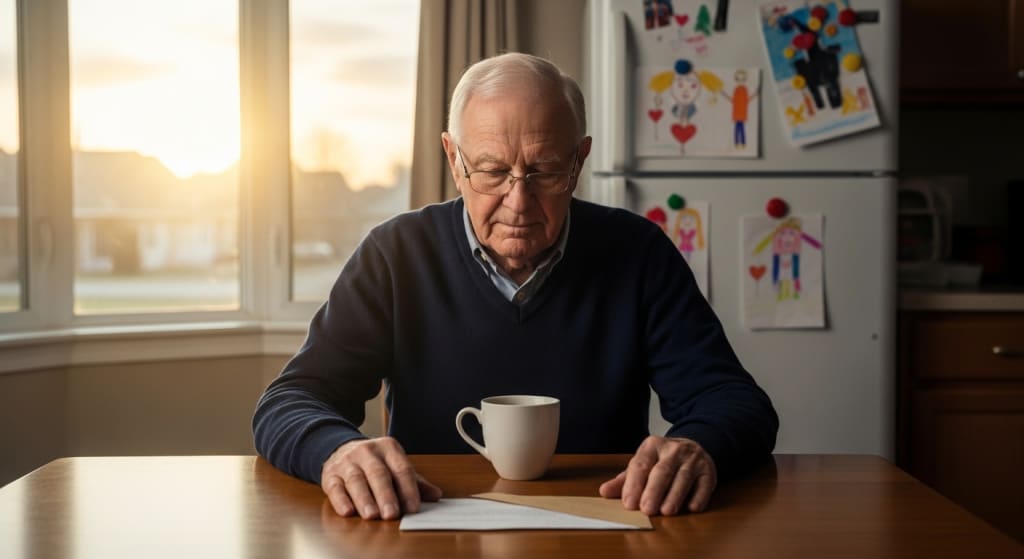
The elderly man at the kitchen table, the unopened letter before him—he could be a parent waiting to hear from a child. He could be a child who never spoke to his own parents and now sits with the weight of that silence. He could be anyone, carrying the unsaid, wondering if it is too late. The sun is rising outside. The coffee is cold. The letter is still sealed. The question is whether he will open it, or whether it will remain forever as it is: a possibility, a hope, a regret waiting to happen.
The words we owe the people who raised us are not optional. They are part of becoming whole. Not because our parents deserve to hear them—maybe they do, maybe they don't. But because we deserve to speak them. Because the unsaid becomes a weight we carry forever, a stone in the heart that never dissolves. Because the only way to be free of the unopened letter is to send it, to risk the response, to let the truth land where it may.
Some parents will receive it. Some will not. Some will hear and understand and meet us in the place we have been waiting to be met. Some will deflect, deny, defend. Some will prove, once and for all, that they cannot give us what we need. Both outcomes are better than silence. Both outcomes free us—one by connecting, the other by releasing. The only bad outcome is the unopened letter, the unsaid words, the conversation that never happens.
The sun is rising. The coffee is cold. The letter is still sealed. The question is not whether it is perfect—it is, in your mind, but perfection is not the goal. The question is whether you will have the courage to send it, in whatever form you can, before the window closes. The question is whether you will risk being known by the people who made you, in the hope that being known might finally set you free.
The unopened letter is waiting. The words are inside. The person who needs to hear them is still here, for now. The time is never perfect. The courage is never complete. But the opportunity is now, this moment, this ordinary morning, this chance to speak before it is too late. The letter will not send itself. The words will not speak themselves. The silence will not break itself. Only you can do this. Only you can open the envelope. Only you can say what needs saying, to the people who need to hear it, while there is still time.
About the Creator
HAADI
Dark Side Of Our Society
Keep reading
More stories from HAADI and writers in Confessions and other communities.
The Ghost in the Garden
The moon tonight, it's a cold, white disk, slicing through the bare branches outside my window. Same kind of moon we used to have, wasn't it? Full and unforgiving, spilling silver across the lawn like a spilled vial of mercury. I stare at it, my fingers tracing the condensation on the glass. This house, it’s quiet now, the kind of quiet that lets you hear your own heartbeat thrumming against your ribs, a drumbeat of old, buried things.
By HAADI2 months ago in Confessions
Lately, I'm empty
Lately, I feel an emptiness inside of me that doesn’t make any sense. I was fine a week ago and now I’m numb to the pain that I’ve been carrying around. Numb to the idea of me existing. I wish I could go to a place where I can hear happy positive thoughts and surround myself with joy. The medication I’m on doesn’t seem to work anymore. I still feel pain from existing, why am I here anyways? Merely to exist. I don’t feel like I’m making any differences being here.
By Cerina Galvan20 days ago in Confessions
Embrace the Spirit: A Journey to Connection and Empowerment
Sensing Spirit? Have you ever sensed the presence of souls or spirits surrounding you, their silent pleas echoing through the ether, beckoning for your assistance? In moments of such overwhelming energy, do you find yourself unsure of how to respond, yearning to connect with, yet also wishing to shield yourself from, the spirit world? Have you pondered the ways to cultivate this connection or even sought to sever ties with unwanted energies? If this resonates with you, allow me to offer you some enlightening guidance.
By Debbie's Reflection2 days ago in Confessions


Comments
There are no comments for this story
Be the first to respond and start the conversation.