
When Being Busy Becomes a Way to Avoid Yourself
How constant motion keeps us from facing what really hurts
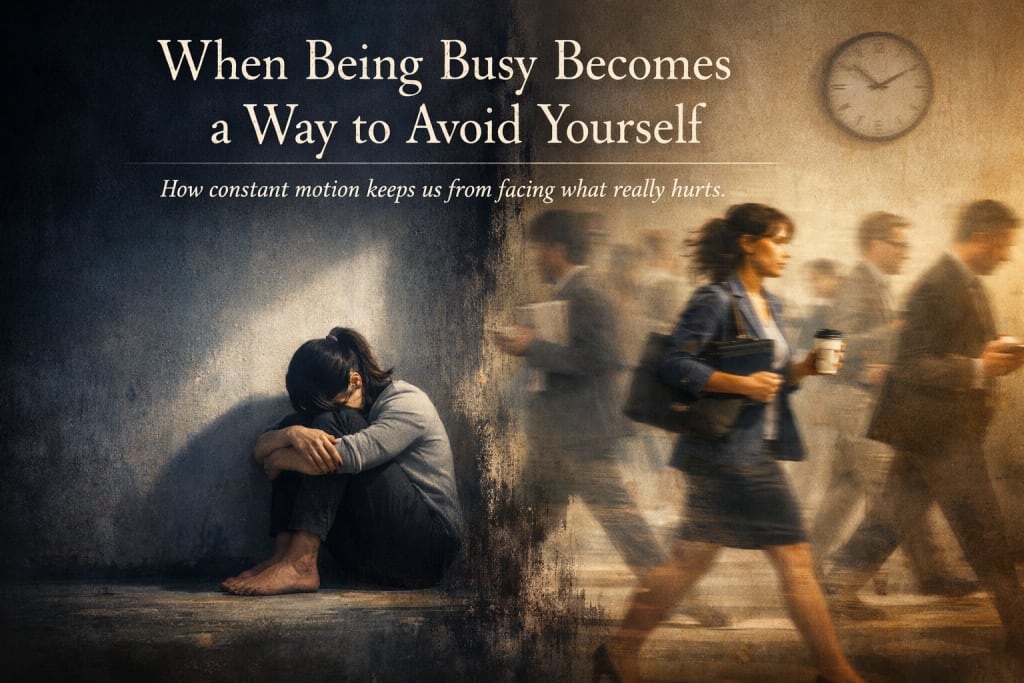
Busyness is often praised as a virtue. We wear it like a badge of honor. When someone asks how we’re doing, we answer, “Busy,” as if it explains everything—and excuses us from saying more. In a world that rewards productivity and movement, being busy feels safe. It feels responsible. It feels like proof that we matter.
But what if busyness isn’t always about ambition or responsibility?
What if, sometimes, it’s about avoidance?
Not avoidance of tasks or obligations—but avoidance of ourselves.
The comfort of constant motion
There’s a strange comfort in always having something to do. A full calendar means fewer empty moments. Fewer empty moments mean fewer chances for uncomfortable thoughts to surface. When our days are packed with meetings, errands, messages, deadlines, and obligations, there’s little room left for reflection.
Stillness can be unsettling. Silence can feel loud.
So we keep moving.
We scroll while waiting. We multitask during conversations. We fill weekends with plans. We turn rest into “productive rest.” Even our downtime must have a purpose—self-improvement, skill-building, optimization. Anything but just being.
Because when everything stops, we’re left alone with our thoughts. And that’s where things get messy.
What we’re really avoiding
Most people don’t stay busy to avoid nothing. They stay busy to avoid something.
Sometimes it’s grief we haven’t processed.
Sometimes it’s anger we don’t know how to express.
Sometimes it’s disappointment, regret, loneliness, or fear.
There are emotions that don’t disappear just because we ignore them. They wait patiently beneath the surface, resurfacing when the noise fades. Busyness becomes a shield—a way to keep those emotions at a manageable distance.
It’s easier to answer emails than to ask yourself why you feel empty.
It’s easier to take on another project than to admit you’re unhappy.
It’s easier to say “I’m just busy” than to say “I don’t know who I am right now.”
The productivity trap
Modern culture doesn’t just allow this behavior—it encourages it. Productivity is often tied to worth. The more you do, the more valuable you seem. Rest is earned, not given. Slowing down is framed as laziness. Burnout is worn like a trophy.
In this environment, avoiding yourself through busyness doesn’t look like avoidance at all. It looks like success.
People praise your work ethic. They admire your discipline. They envy your drive. No one asks whether you’re okay beneath it all, because you appear to be thriving.
And sometimes, even you believe it.
Until the cracks start to show.
When busyness stops working
Avoidance has a shelf life. Eventually, the things you’re running from catch up with you.
It might show up as chronic exhaustion that rest doesn’t fix.
It might appear as irritability, numbness, or a sense of disconnection.
It might come as anxiety during quiet moments or restlessness when there’s nothing to do.
You sit down to relax, and suddenly your mind races. You feel uneasy without knowing why. Silence feels heavy instead of peaceful. So you reach for your phone. You make another plan. You find another task.
Not because you need to—but because you’re uncomfortable being still.
That discomfort is often the clearest sign that something inside you needs attention.
The fear of slowing down
Slowing down forces honesty. And honesty can be frightening.
When you stop moving, you may realize you’re not as fulfilled as you thought. You may notice that a relationship is draining you, or that a goal you’ve been chasing no longer aligns with who you are. You may confront versions of yourself you’ve outgrown—or parts of yourself you’ve neglected.
Busyness keeps these realizations at bay. It delays difficult conversations—with others and with yourself.
But avoidance doesn’t heal wounds. It only postpones the moment you have to face them.
Stillness as a mirror
Stillness doesn’t create problems. It reveals them.
When you allow space in your life—real space, not just empty time filled with distractions—you begin to notice patterns. You start to see what triggers you, what excites you, what drains you. You hear the thoughts you’ve been drowning out with noise.
This can be uncomfortable at first. But discomfort isn’t danger. It’s information.
The feelings that surface in stillness are often signals, pointing toward unmet needs or unresolved emotions. Ignoring them doesn’t make them disappear. Listening to them, however, gives you a chance to respond with intention instead of reaction.
Redefining rest and presence
Learning to stop using busyness as an escape doesn’t mean abandoning ambition or responsibility. It means redefining your relationship with them.
Rest isn’t something you earn after exhaustion—it’s something you need to function well. Presence isn’t wasted time—it’s how you build awareness and clarity. Doing less doesn’t mean becoming less.
It means making room for yourself.
That might look like sitting with your thoughts without immediately reaching for distraction. It might mean journaling honestly, even when what comes out isn’t pretty. It might mean turning down plans, leaving space in your schedule, or allowing boredom to exist without fixing it.
These small acts of stillness are not empty. They’re full of insight.
Facing yourself with compassion
When you finally stop running, what you find inside might surprise you. You may discover pain—but also resilience. Confusion—but also wisdom. Fear—but also a deep desire for change.
The key is approaching yourself with compassion, not judgment.
You didn’t become busy to harm yourself. You did it to cope. You did it because, at some point, it felt safer than feeling. Recognizing this doesn’t require guilt—it requires gentleness.
Growth doesn’t come from forcing yourself to slow down harshly. It comes from choosing presence again and again, even when it’s uncomfortable.
Choosing a different pace
Busyness will always be available. The world will always give you reasons to stay distracted. Choosing to face yourself is a quiet, ongoing decision—one that often goes unnoticed by others.
But it changes everything.
When you stop using busyness as a shield, you begin to live more intentionally. You make choices based on alignment rather than avoidance. You learn to sit with discomfort without letting it control you. You become more honest—with yourself and with others.
And in that honesty, you find something busyness could never give you:
a sense of wholeness.
Final thoughts
Being busy isn’t the problem. Using busyness to avoid yourself is.
The next time you feel the urge to fill every moment, pause and ask why. Not with accusation, but with curiosity. What are you trying not to feel? What are you afraid might surface if you slow down?
The answers may not come immediately. But asking the question is a powerful first step.
Because sometimes, the most productive thing you can do
is stop running—and finally listen.
About the Creator
Keep reading
More stories from Aiman Shahid and writers in Confessions and other communities.
The Piggy Project
I’ve had so many names in this life I lose track of which ones were ever really mine and which ones I wore because someone needed me to. Some were handed to me before I had words to refuse them, before I knew what they meant, before I knew I could say no. Most weren’t meant to hurt. That doesn’t mean they didn’t leave marks. Marks that told me who I belong to, who I am by way of who claims me, recognizes me in the good and bad, who walks beside me.
By Fatal Serendipity3 days ago in Confessions
Arrange a small business loan easily and responsibly up to 5000
What are the terms of our loans? Every great business starts with a dream — but not every dream has the financial support it needs at the right moment. At 5in5, we believe that every entrepreneur deserves a fair chance to grow, to build, and to succeed. That belief is the heart of our story.
By Organic Products 6 days ago in Confessions
The Devil's Triangle
The sails ruffled in the breeze as we cruised along. The Sea Breeze was a mid-size catamaran that sailed out of Royal Naval Dockyard in Bermuda. We had booked this trip weeks in advance and were now looking at our Captain, Spike and two boat hands. Paddy and Wilson seemed like nice guys, joking around with the passengers and telling us some stories about Bermuda that only locals would know. Their island accents sounded almost British but they were pleasant to listen to.
By Barbara Gode Wiles2 days ago in Fiction


Comments
There are no comments for this story
Be the first to respond and start the conversation.