
If Everyone Is in Debt… Then Who Owns the Money?
The 317 Trillion Dollar Question No One Dares to Ask

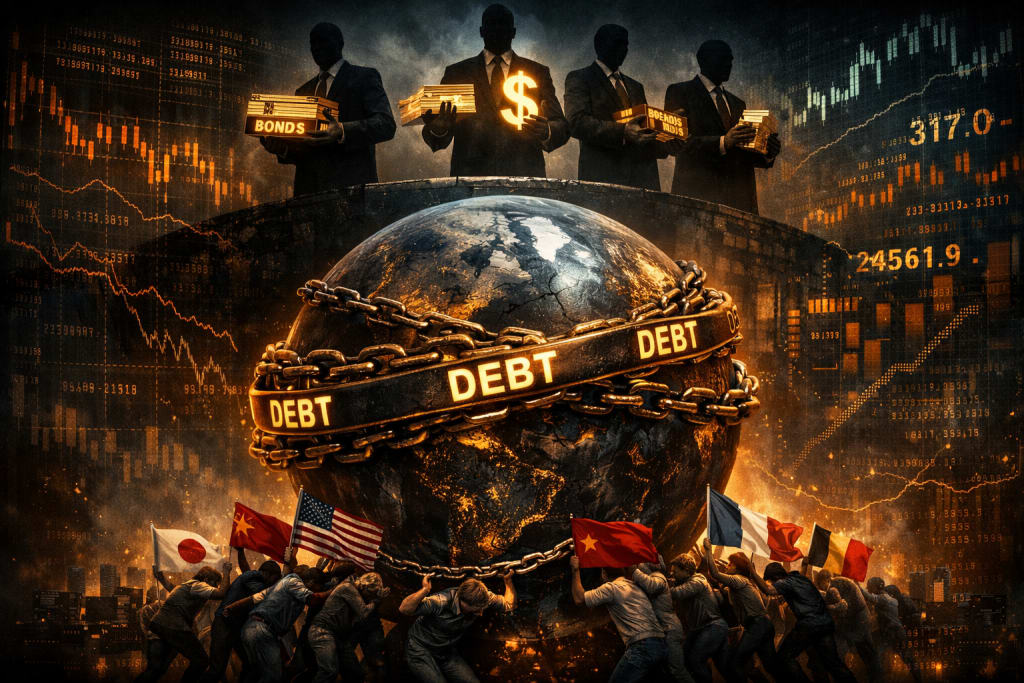
If Everyone Is in Debt… Then Who Owns the Money?
The world is buried under numbers so large that they no longer feel real.
America owes 36 trillion dollars.
China follows with 15 trillion dollars.
Japan carries 10 trillion dollars of debt.
Germany, the United Kingdom, and France — each with trillions more.
When you add everything together, the world is carrying a total debt of 317 trillion dollars.

Three hundred and seventeen trillion.
That number is not just big — it is frightening.
This global debt is nearly 330 percent of the world’s total annual production.
In simple words, even if the entire planet worked non-stop for a year, producing everything it possibly could, it still would not be enough to cover what the world owes.
In fact, economists say that if the whole world stopped spending money entirely — no food, no fuel, no construction, no travel — for three full years, only then could this debt be paid.
And yet, there is one question almost no one asks.
If everyone is in debt… who is the lender?
Debt is not imaginary.
For every borrower, there is a lender.
For every dollar owed, someone owns a dollar as an asset.
If the world owes 317 trillion dollars, then someone, somewhere, owns 317 trillion dollars in claims.
So who is it?
The answer reveals one of the greatest wealth concentration systems in human history.
This did not happen through war.
It did not happen through theft.
It happened through a financial system where the majority borrows and a tiny minority lends — endlessly.
Most people believe debt works like a personal loan.
A bank lends money it already has.
You pay it back with interest.
Simple.
But modern global finance does not work that way.
When governments borrow money today, the money often does not exist beforehand.
Governments issue bonds.
Central banks and major commercial banks buy those bonds.
But instead of using existing money, the system creates new money digitally.
Numbers are typed into computers.
Balances increase.
Money is created from nothing.
But here is the trap.
Only the principal is created.
The interest is not.
If a government borrows one trillion dollars at five percent interest, it must repay the one trillion — plus fifty billion dollars every year.
But the system only created one trillion.
So where does the extra fifty billion come from?
From new debt.
From higher taxes.
From inflation that silently reduces people’s purchasing power.
This means total debt must always grow.
It has to.
To keep the system alive, new loans are required just to pay interest on old loans.
This is not a mistake.
This is the design.
Now the real question becomes clearer:
Who ultimately owns this debt?
The answer comes in four main groups.
First: Central banks.
Second: Institutional investors like pension funds and asset managers.
Third: Foreign governments.
Fourth: Extremely wealthy individuals.
Central banks alone hold tens of trillions of dollars in government bonds — including the Federal Reserve, the European Central Bank, and the Bank of Japan.
But here is something most people never hear.
The U.S. Federal Reserve is not a government-owned bank.
It is a privately structured system created in 1913.
Its regional banks are owned by major commercial banks.
Banks like JP Morgan Chase, Bank of America, Citibank, and Wells Fargo.
These banks earn guaranteed returns while collecting interest on government debt — debt that taxpayers must repay.
So when governments borrow…
and when citizens pay taxes…
money flows upward.
Quietly.
Legally.
Relentlessly.
This is how wealth concentrates without violence.
This is how power moves upward without headlines.
And this is why the system cannot last forever.
Because a system that depends on endless debt growth
inside a limited world
will eventually break.
The only real question is not if it collapses…
But when.
About the Creator
Wings of Time
I'm Wings of Time—a storyteller from Swat, Pakistan. I write immersive, researched tales of war, aviation, and history that bring the past roaring back to life
Keep reading
More stories from Wings of Time and writers in Criminal and other communities.
A Complaint on Trump
A Complaint on Trump: How Reckless Leadership Damaged Global Affairs Global leadership demands maturity, responsibility, and foresight—qualities that many citizens around the world expected from a superpower like the United States. But during Donald Trump’s administration, these expectations were repeatedly shattered. His approach to international affairs created confusion, instability, and rising global tensions. As a concerned citizen, I feel it is necessary to voice my complaint—not out of hatred, but out of responsibility to speak for global peace and justice.
By Wings of Time 2 months ago in Criminal
The Elevator Killers: The Chilling Case of the Parents Who Butchered Their Children
In the prestigious Ekbatan neighborhood of North Tehran, life usually follows a predictable, quiet rhythm. In this massive residential complex, Akbar and Iran Khorramdin lived a life that seemed defined by peace and devotion. To their neighbors, they were the quintessential elderly couple—polite, soft-spoken, and always ready with a gentle greeting in the elevator. No one could have imagined that behind their wrinkled faces and the polished metal of that elevator, a dark, repetitive ritual was unfolding. For years, the building's security cameras captured a chilling image: the couple frequently leaving the elevator carrying heavy, black trash bags, moving with a terrifying calmness, without a hint of panic. They weren't taking out the trash; they were disposing of their own children.
By Mayar Younes4 days ago in Criminal
The Last Confession
M Mehran The police file labeled Case 417-B had gathered dust for seven years. No arrests. No suspects. Just one body and a city full of silence. Until tonight. Detective Aaron Cole stared at the man sitting across the interrogation table. Thin. Pale. Calm in a way that made the room feel colder. His name was Elliot Moore, a night-shift janitor at St. Vincent Hospital. Elliot had walked into the police station at 2:13 a.m. and said only one sentence: “I killed Daniel Harper.” Daniel Harper’s murder was the most disturbing unsolved crime the city had ever known. Aaron pressed the recorder button. “Start from the beginning,” he said. Elliot smiled faintly. “That’s where it gets complicated.” A Crime That Shook the City Seven years ago, Daniel Harper—a respected journalist known for exposing corruption—was found dead in his apartment. No forced entry. No weapon. No fingerprints except his own. The autopsy revealed poisoning, but the toxin was rare, expensive, and untraceable. The media called it The Perfect Crime. Aaron had been a rookie detective back then. The case haunted him. It had ruined careers. It had ended marriages. And now, suddenly, a confession appeared out of nowhere. Too perfect. The Janitor No One Noticed Elliot described his life in careful detail. Invisible. Ignored. He cleaned hospital floors while saving lives walked past him every day. “No one looks at janitors,” he said. “That’s why I was perfect.” Aaron frowned. “Perfect for what?” “For watching.” Elliot explained that Daniel Harper had been visiting the hospital frequently before his death—always late at night, always nervous. Elliot overheard phone calls. Arguments. Names that didn’t belong in public conversations. Politicians. Judges. CEOs. Daniel wasn’t just exposing corruption. He was about to publish something that would destroy powerful people. “And they noticed,” Elliot whispered. The Twist No One Expected Aaron leaned forward. “So you killed him?” Elliot shook his head slowly. “No. They did.” The room went silent. “I just made sure they couldn’t get away with it.” Elliot explained that he had followed Daniel one night, out of curiosity. He saw him meet someone in a parking garage—someone Elliot recognized from the news. A senator. Elliot watched as Daniel was handed a drink. Watched as his hands began to shake. Watched as the senator walked away calmly, leaving Daniel to die on the cold concrete floor. “I didn’t stop it,” Elliot said, his voice cracking for the first time. “I was scared.” A Crime Within a Crime Instead of calling the police, Elliot made a decision that would change everything. He dragged Daniel’s body back to his apartment. Cleaned the scene. Removed evidence. Made the murder look like a mystery. “Why?” Aaron demanded. “Because I knew the truth would never survive,” Elliot replied. “Power protects itself.” Elliot spent years collecting proof—audio recordings, documents, hidden files Daniel had given him in his final moments. “They thought they committed the perfect crime,” Elliot said. “I gave them one.” Seven Years of Silence Elliot waited. He watched elections come and go. Promotions. Awards. Smiles on television. Meanwhile, Daniel Harper’s name faded into a footnote. Until tonight. “I’m dying,” Elliot said quietly. “Cancer. Stage four.” Aaron’s chest tightened. “So I came here,” Elliot continued. “Because I don’t need justice for myself. I need truth for him.” He slid a flash drive across the table. “Everything is there.” The Real Criminals Forensic analysis confirmed the files were authentic. Recordings of bribes. Emails ordering Daniel’s murder. Bank transfers tied to offshore accounts. Within forty-eight hours, arrests shook the nation. A senator. A judge. A corporate tycoon. The headlines exploded. THE PERFECT CRIME WAS NEVER PERFECT JANITOR EXPOSES MURDER COVER-UP Elliot Moore pleaded guilty—not to murder, but to obstruction of justice. He accepted his sentence without protest. “I did what I had to,” he told Aaron during their last meeting. “History needed time to be ready.” The Final Confession Elliot died six months later in prison medical care. On his grave, someone left a simple note: Truth doesn’t need power. It needs patience. Aaron visited that grave every year. Because some criminals wear suits. Some wear uniforms. And some carry mops, waiting quietly for the world to notice. Why This Story Matters The city still talks about Daniel Harper. But Aaron knows the real story belongs to the man no one ever saw. The janitor who turned a perfect crime into a perfect confession. Keywords (SEO-friendly): criminal story, true crime style fiction, crime short story, murder mystery, psychological crime, unsolved murder, criminal justice, suspense story, Vocal Media crime
By Muhammad Mehran3 days ago in Criminal



Comments
There are no comments for this story
Be the first to respond and start the conversation.